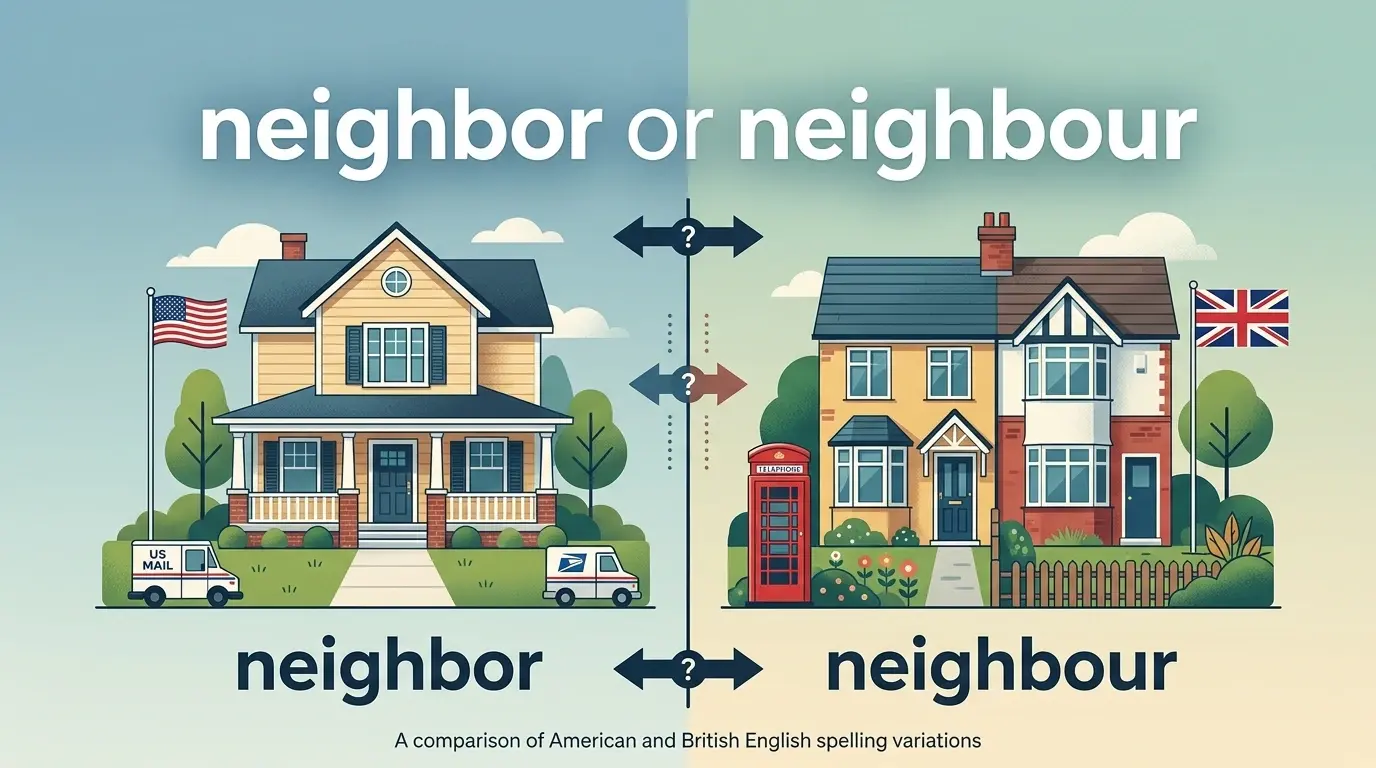
Neighbor is the correct American English spelling, while neighbour is the British English spelling. Both spellings are correct, depending on the variety of English you use.
You are writing an email about the person who lives next door. You type neighbor, then stop and wonder if you need the extra u in neighbour.
This confusion is common because American and British English use different spelling conventions. The meaning does not change, and neither spelling is a mistake in its own variety of English.
If you write for a US audience, use neighbor. If you are following British English, use neighbour. The same regional pattern appears in related words, such as neighboring/neighbouring and neighborhood/neighbourhood.
This guide explains the difference with simple rules, examples, common mistakes, and an easy memory trick.
Quick Answer
Neighbor is the standard American English spelling. Neighbour is the standard British English spelling. Both mean a person who lives near you or next to you. The spelling difference is mainly the extra u in the British form.
| Spelling | English variety | Example |
| neighbor | American English | My neighbor has a new car. |
| neighbour | British English | My neighbour has a new car. |
Cambridge identifies neighbor as the US spelling of neighbour, while Oxford lists neighbor as the US form.
Quick Rule
Use “neighbor” in American English and “neighbour” in British English; both spellings are correct.
What Does Neighbor or Neighbour Mean?
Neighbor and neighbour mean a person who lives close to you. They can also describe a nearby country, place, person, or thing. The two spellings have the same meaning and pronunciation.
For example:
- My neighbor lives next door.
- Our neighbour has a beautiful garden.
- Canada is a northern neighbor of the United States.
- France is a European neighbour of several countries.
The word can also be used as a verb. As a verb, it means to be next to or near something.
For example:
- The farm neighbors a small village.
- The farm neighbours a small village.
Cambridge lists both noun and verb uses, with neighbor marked as the US form and neighbour as the UK form.
Read More: Students’ or Student’s? The Correct Possessive Form ExplainedNeighbor vs Neighbour: What Is the Difference?
The main difference between neighbor and neighbour is spelling. Neighbor is used in American English, while neighbour is used in British English.
The meaning, pronunciation, and basic grammatical use remain the same.
Neighbor
Neighbor is the American English spelling.
Examples:
- My neighbor helped me move.
- I invited my neighbors to dinner.
- Our neighboring town is only ten miles away.
- The United States has several neighboring countries.
Neighbour
Neighbour is the British English spelling.
Examples:
- My neighbour helped me move.
- I invited my neighbours to dinner.
- Our neighbouring town is only ten miles away.
- The country has several neighbouring states.
The extra u does not create a different meaning. It simply reflects the spelling convention used in British English.
American English and British English Spelling
American English normally uses neighbor, while British English uses neighbour. This is a regional spelling difference, similar to color/colour and favor/favour.
| American English | British English |
| neighbor | neighbour |
| neighbors | neighbours |
| neighboring | neighbouring |
| neighborliness | neighbourliness |
| neighborhood | neighbourhood |
The same spelling pattern continues in several related words.
For example, American English uses neighborhood, while British English uses neighbourhood. Oxford lists neighbor as the American form and neighbour as the British form.
Examples by Region
American English:
My neighbor brought us some cookies.
British English:
My neighbour brought us some biscuits.
The spelling changes, but the word itself has the same basic meaning.
Why Does Neighbor Have Different Spellings?
The different spellings come from differences between American and British English spelling conventions. British English keeps the u in words such as neighbour, while American English uses the shorter neighbor form.
This pattern is not unique to this word.
Compare:
- color → colour
- favor → favour
- honor → honour
- neighbor → neighbour
American spelling often uses shorter forms in these words.
British spelling generally keeps the u.
This does not mean one version is more correct than the other. The right choice depends on the English variety you are using.
Neighbor or Neighbour in Everyday English
You can use neighbor or neighbour in many everyday situations. The spelling you choose should match your audience and style.
Talking About Someone Nearby
American English:
My neighbor has a friendly dog.
British English:
My neighbour has a friendly dog.
Talking About a Next-Door Neighbor
American English:
Our next-door neighbor is very friendly.
British English:
Our next-door neighbour is very friendly.
Talking About Countries
The word can also describe a country that is close to another country.
American English:
Canada is America’s northern neighbor.
British English:
France is one of Britain’s closest European neighbours.
Oxford gives both the personal and geographical meanings of the word.
Talking About Nearby Places
The word can also describe something located next to another place.
American English:
The neighboring town has a larger hospital.
British English:
The neighbouring town has a larger hospital.
Neighbor, Neighbour, Neighborhood, and Neighbourhood
One common mistake is changing the main word correctly but forgetting its related forms.
If you are writing American English, use:
- neighbor
- neighbors
- neighboring
- neighborhood
If you are writing British English, use:
- neighbour
- neighbours
- neighbouring
- neighbourhood
American English Examples
My neighbor moved last year.
All my neighbors attended the meeting.
We visited a neighboring town.
The neighborhood is very quiet.
British English Examples
My neighbour moved last year.
All my neighbours attended the meeting.
We visited a neighbouring town.
The neighbourhood is very quiet.
Keeping the same spelling style throughout your writing makes your work more consistent.
Common Mistakes With Neighbor vs Neighbour
Mistake 1: Mixing US and UK Spellings
A writer may use neighbor in one sentence and neighbour later.
For example:
My neighbor is friendly. The neighbourhood is quiet.
This is not necessarily confusing, but it mixes spelling systems.
If you are writing for a US audience, consistency is usually better:
My neighbor is friendly. The neighborhood is quiet.
For British English:
My neighbour is friendly. The neighbourhood is quiet.
Mistake 2: Thinking One Spelling Is Wrong
Both forms are standard.
Neighbor is not a misspelling of neighbour.
Likewise, neighbour is not a misspelling when used in British English.
The key is to know which English variety you are following.
Mistake 3: Using “Neighbour” for an American Audience
If your article, resume, email, or website follows American English, neighbor is the expected spelling.
For example:
My neighbor called me yesterday.
This is the natural US spelling.
Mistake 4: Forgetting Related Words
Some writers remember neighbor but accidentally write neighbourhood in American English.
Keep the pattern consistent:
US: neighbor → neighborhood
UK: neighbour → neighbourhood
Which Spelling Should You Use?
If you are writing for readers in the United States, use neighbor. If you are writing in British English, use neighbour. For international writing, choose one style and use it consistently throughout the document.
For American English
Use:
- neighbor
- neighbors
- neighboring
- neighborhood
This is the best fit for US websites, school assignments, business writing, and general American English.
For British English
Use:
- neighbour
- neighbours
- neighbouring
- neighbourhood
This style is common in the UK and other contexts that follow British spelling conventions.
For a Global Audience
Either spelling can work.
The most important point is consistency.
If your website uses American English, stay with American spelling. If your publication follows British English, keep the British form.
Do not switch spelling styles randomly from one page or paragraph to another.
Neighbor or Neighbour: 20 Example Sentences
Here are examples showing how the two forms work.
American English
- My neighbor has a new puppy.
- Our neighbors invited us to dinner.
- I borrowed a ladder from my neighbor.
- The neighboring town has a larger school.
- She is one of my closest neighbors.
- My next-door neighbor grows vegetables.
- The neighborhood is quiet at night.
- A neighbor called the police after hearing the alarm.
- We visited a neighboring city last weekend.
- Our neighbors helped us during the storm.
British English
- My neighbour has a new puppy.
- Our neighbours invited us to dinner.
- I borrowed a ladder from my neighbour.
- The neighbouring town has a larger school.
- She is one of my closest neighbours.
- My next-door neighbour grows vegetables.
- The neighbourhood is quiet at night.
- A neighbour called the police after hearing the alarm.
- We visited a neighbouring city last weekend.
- Our neighbours helped us during the storm.
Notice that the meaning stays the same. Only the spelling convention changes.
Is Neighbor and Neighbour More Correct?
Neither spelling is universally more correct. Neighbor is the standard American spelling, while neighbour is the standard British spelling.
Your choice should depend on the variety of English you are using.
For US readers:
neighbor
For UK readers:
neighbour
Cambridge and Oxford both identify this as a US-versus-UK spelling distinction.
Is “Neighbor” Correct in American English?
Yes. Neighbor is the standard American English spelling.
Examples include:
- My neighbor is a teacher.
- Our neighbors moved away.
- The neighboring city is larger.
- I like this neighborhood.
Cambridge’s dictionary specifically labels neighbor as the US spelling of neighbour.
Is “Neighbour” Correct in British English?
Yes. Neighbour is the standard British English spelling.
Examples include:
- My neighbour is a teacher.
- Our neighbours moved away.
- The neighbouring city is larger.
- I like this neighbourhood.
Cambridge identifies neighbour as the UK spelling, and Oxford lists neighbor as its US English equivalent.
Easy Memory Trick
Remember the extra u as a clue for British spelling.
American: neighbor
British: neighbour
You can also connect it with other familiar spelling pairs:
- color → colour
- favor → favour
- honor → honour
- neighbor → neighbour
So, when writing American English, leave out the u.
When writing British English, keep the u.
FAQs
Is it neighbor or neighbour?
Both are correct. Neighbor is the American English spelling, while neighbour is the British English spelling.
Is neighbor American or British?
Neighbor is the standard American English spelling. British English normally uses neighbour.
Is neighbour British or American?
Neighbour is the standard British English spelling. American English normally uses neighbor.
Is “neighbor” spelled with a U?
In American English, no. The standard spelling is neighbor. British English uses neighbour with a u.
What is the American spelling of neighbour?
The American spelling is neighbor.
What is the British spelling of neighbor?
The British spelling is neighbour.
Is neighborhood American spelling?
Yes. Neighborhood is the American spelling. British English generally uses neighbourhood.
Is neighboring American spelling?
Yes. Neighboring is the American spelling. British English uses neighbouring.
Conclusion:
Neighbor and neighbour are both correct spellings. The difference depends on the type of English you use.
Neighbor is standard in American English, while neighbour is standard in British English.
The meaning does not change between the two forms. The same pattern appears in related words, such as neighboring/neighbouring and neighborhood/neighbourhood.
If you are writing for a US audience, choose neighbor. For British English, choose neighbour. The most important rule is to stay consistent with your chosen spelling style.

I’m Sophia Mitchell, an English grammar and writing enthusiast. I create simple, easy-to-understand content to help learners improve their English. My goal is to make grammar clear, practical, and enjoyable for everyone.











1 thought on “Neighbor or Neighbour? Correct Spelling, Meaning & Examples”