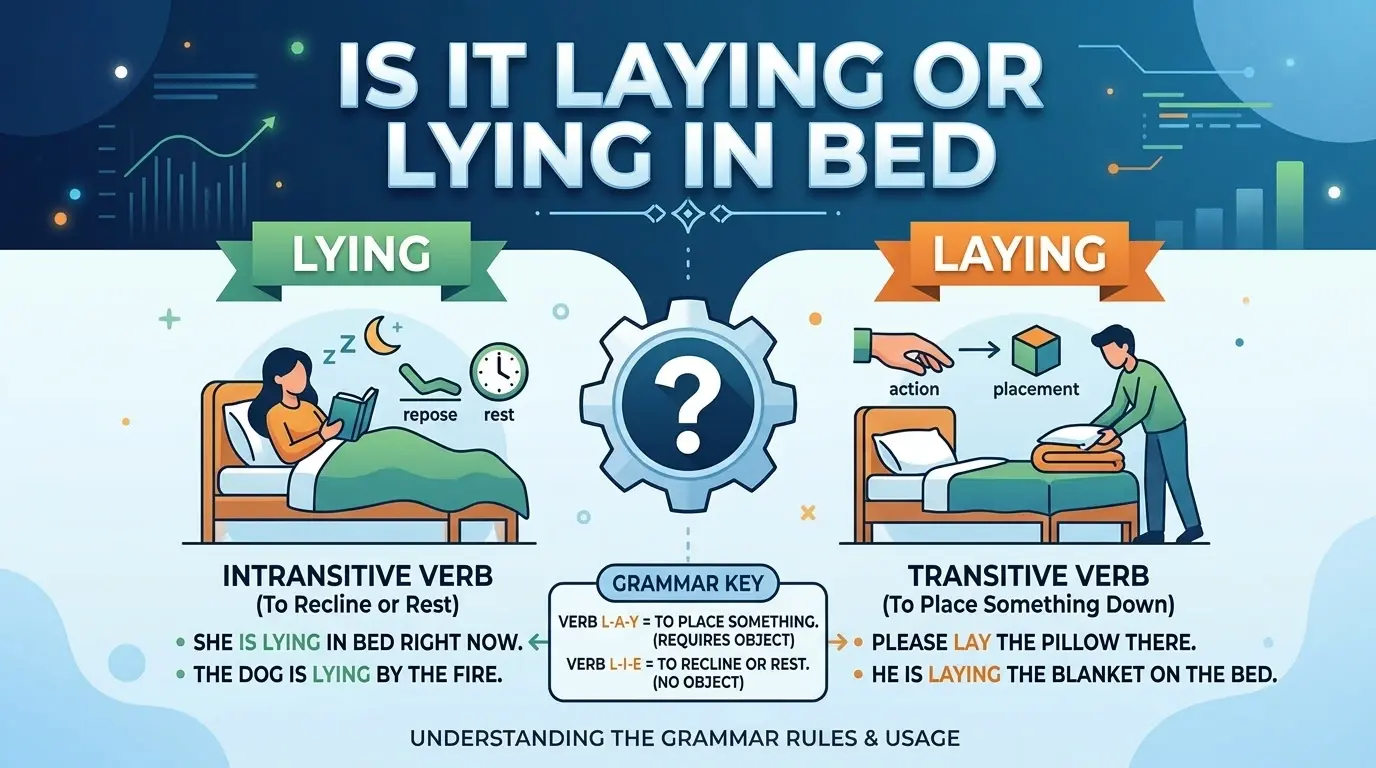
When talking about resting in bed, “lying in bed” is correct, while “laying in bed” is usually incorrect. The confusion comes from the verbs lie and lay, which have different meanings and forms.
You might write, “I’m laying in bed,” and wonder if it sounds right. This mistake is common because lay and lie look and sound similar. However, they follow different grammar rules.
Use lying when you mean resting or being in a horizontal position. For example, “She is lying in bed.” Use laying when you are placing something somewhere, such as “She is laying the book on the bed.”
If you often wonder whether to say laying or lying in bed, this guide explains the difference with simple rules and clear examples.
Is It Laying or Lying in Bed? Quick Answer
“Lying in bed” is correct when you mean resting or being in a horizontal position. The verb lie does not take a direct object in this meaning. Laying means placing something somewhere, so it needs an object, such as “laying the book on the bed.”
Quick Rule
Use “lying” for resting yourself and “laying” when you are placing something somewhere.
Why Is “Lying in Bed” Correct?
“Lying in bed” is correct because the verb “lie” means to rest or remain in a horizontal position. “Lying” is its present participle. “Laying” comes from “lay,” which normally means putting something somewhere.
For example:
I am lying in bed.
This means you are resting or remaining in bed.
You are not placing an object anywhere.
That is why lying is the correct form.
Compare it with:
I am laying the blanket on the bed.
Here, laying is correct because you are putting the blanket somewhere.
The blanket is the object of the verb.
This distinction is the key to understanding lying vs. laying.
Read More: Color or Colour? The Correct Spelling in American and British EnglishWhat Does “Lie” Mean?
Lie means to rest or remain in a flat or horizontal position. It does not normally take a direct object when used with this meaning. Its -ing form is lying.
For example:
- I lie in bed every morning.
- She is lying on the sofa.
- He was lying on the floor.
- They are lying in bed.
- I need to lie down.
Notice that the person is the one in the resting position.
You do not place another object.
Examples
She is lying in bed.
He is lying on the couch.
The dog is lying on the floor.
In all three examples, lie means to be in a resting position.
What Does “Lay” Mean?
Lay usually means to put or place something somewhere. Because it normally takes a direct object, it is different from lie in this meaning. Its present participle is laying.
For example:
She is laying the book on the bed.
The object is the book.
You are placing the book on the bed.
Another example:
He is laying the clothes on the chair.
The object is the clothes.
This is why laying is not normally correct in the sentence:
I am laying in bed.
If you mean that you are resting in bed, you need lying.
Laying in Bed or Lying
“Lying in bed” means being in bed while resting or remaining there. “Laying in bed” would require an object because “lay” means putting something somewhere. The correct choice depends on whether you are resting or placing something.
| Phrase | Correct? | Meaning |
| lying in bed | Yes | Resting or remaining in bed |
| laying in bed | Usually no | Incorrect if you mean resting |
| laying a book on the bed | Yes | Putting a book on the bed |
| lying on the bed | Yes | Resting on the bed |
Compare these sentences
Correct:
I am lying in bed.
You are resting.
Correct:
I am laying my phone on the bed.
You are placing your phone.
The difference becomes clear when you ask:
What is being placed?
If nothing is being placed, lying is usually the form you need.
Lie, Lay, Laid, and Lying Explained
The confusion becomes harder because lie and lay have different forms in different tenses. Learning the basic forms together makes the pattern easier to remember.
Lie
Lie means to rest or be in a horizontal position.
I lie in bed when I am tired.
Lying
Lying is the -ing form of lie.
I am lying in bed.
Lay
Lay means to put or place something somewhere.
I lay the book on the bed.
But lay is also the past tense of lie.
Yesterday, I lay in bed all morning.
This is one reason the verbs are confusing.
Laid
Laid is the past tense and past participle of lay.
She laid the book on the table.
It can also appear with the verb have:
She has laid the book on the table.
Simple Table
| Verb | Meaning | Example |
| lie | Rest/be in a position | I lie in bed. |
| lying | Resting/be in a position | I am lying in bed. |
| lay | Put/place | I lay the book down. |
| laid | Past of lay | I laid the book down. |
The tricky part is that lay can also be the past tense of lie.
For example:
I lay in bed yesterday.
This means:
I was in bed yesterday.
It does not mean that you placed something in bed.
Is “Laying in Bed” Ever Correct?
“Laying in bed” can be grammatically correct when “laying” has an object that someone is placing in the bed. But it is incorrect when you simply mean that a person is resting in bed.
For example:
She is laying the baby in bed.
Here, the baby is the object.
She is placing the baby in bed.
But:
She is lying in bed.
Here, she is resting in bed.
There is no direct object after lying.
Compare
Laying:
He is laying the blanket on the bed.
Lying:
He is lying in bed.
The first sentence describes an action involving an object.
The second describes someone’s position.
Lying in Bed vs Lying Down
“Lying in bed” describes being in bed while resting, while “lying down” focuses on moving into or being in a horizontal position. Both use “lying” because they come from the verb “lie.”
Examples:
I am lying in bed.
This tells us where you are.
I am lying down.
This tells us about your position.
You can combine them:
I am lying down in bed.
That sentence is also correct.
More examples
She is lying in bed and reading.
He is lying down because he feels tired.
They are lying in bed watching television.
The verb remains lying because the meaning is resting or being in a horizontal position.
Why Do People Say “Laying in Bed”?
“Laying in bed” is common in everyday speech because “lay” and “lie” are easily confused. The confusion becomes stronger because “lay” is the past tense of “lie.” Standard grammar still uses “lying” for the present continuous form.
For example:
I am lying in bed.
The grammar follows:
lie → lying
Not:
lie → laying
The form laying comes from:
lay → laying
So:
lay + ing = laying
while:
lie + ing = lying
This difference is easy to miss because the verbs have overlapping forms.
Common Mistakes
1. “I am laying in bed.”
❌ Usually incorrect if you mean resting.
✅ I am lying in bed.
2. “She was laying on the couch.”
❌ Incorrect if she was simply resting.
✅ She was lying on the couch.
3. “I am laying down.”
❌ Usually incorrect when you mean moving your body into a resting position.
✅ I am lying down.
However, laying down can be correct when something is being placed down.
I am laying the baby down.
Here, the baby is the object.
4. “He is lying the book on the bed.”
❌ Incorrect.
✅ He is laying the book on the bed.
You are placing the book somewhere.
5. “Yesterday I was laying in bed.”
❌ Incorrect if you mean resting in bed.
✅ Yesterday I was lying in bed.
The word was does not change the -ing form.
15 Real Examples of “Lying in Bed”
Here are natural examples using lying correctly:
- I am lying in bed right now.
- She was lying in bed when I called.
- He spends Sunday mornings lying in bed.
- They were lying in bed and talking.
- I like lying in bed on cold mornings.
- She stayed lying in bed for another hour.
- He was lying in bed reading a book.
- The child is lying in bed quietly.
- I found him lying in bed.
- She is still lying in bed.
- We were lying in bed when the alarm rang.
- He prefers lying in bed after a long day.
- She spent the afternoon lying in bed.
- I was lying in bed when I heard the noise.
- The patient was lying in bed and resting.
10 Examples of “Laying” With an Object
These examples show when laying is correct:
- She is laying the baby in bed.
- He is laying the book on the table.
- I am laying the clothes on the bed.
- She was laying the blanket over the child.
- He is laying the papers on the desk.
- They are laying tiles on the floor.
- She is laying the plates on the table.
- He was laying the cards on the table.
- I am laying the keys beside the phone.
- They were laying the foundation for the project.
In each sentence, laying has an object.
That is the easiest clue.
A Simple Test: Find the Object
When you are unsure between lying and laying, look for an object.
If someone is simply resting:
I am lying in bed.
If someone is placing something:
I am laying the book on the bed.
Ask:
What am I placing?
If there is an object, laying may be correct.
If there is no object and you mean resting, lying is usually correct.
This test works in many everyday sentences.
Memory Trick
Use this simple rule:
Lie = recline. Lay = place.
Think:
I lie down.
I lay something down.
The word something is the clue.
You can also remember:
Lying = yourself
Laying = something else
For example:
I am lying in bed.
You are resting yourself.
I am laying the blanket on the bed.
You are placing something.
This is not a perfect rule for every grammatical use, but it is very useful for everyday sentences.
FAQs
Is it “laying in bed” or “lying in bed”?
Lying in bed is correct when you mean resting or remaining in bed. Laying is used when something is being placed somewhere.
Is “I am laying in bed” grammatically correct?
Not if you mean that you are resting in bed. The standard form is “I am lying in bed.”
Is “lying in bed” correct English?
Yes. Lying in bed is standard English when someone is resting or remaining in a horizontal position.
What is the difference between laying and lying?
Laying means putting or placing something somewhere. Lying means resting or remaining in a horizontal position.
Is it “lying down” or “laying down”?
Lying down is correct when you mean resting or moving your body into a horizontal position. Laying down is correct when you are placing an object down.
Is “laying the baby in bed” correct?
Yes. In this sentence, the baby is the object being placed in bed. Therefore, laying is correct.
Is it “I was laying in bed” or “I was lying in bed”?
Use “I was lying in bed” when you mean that you were resting in bed.
What is the past tense of “lie”?
The past tense of lie, meaning to rest, is lay.
Yesterday, I lay in bed all morning.
This is different from lay, which means to place something.
What is the past tense of “lay”?
The past tense of lay, meaning to put or place something, is laid.
She laid the book on the bed.
How do I remember lay vs. lie?
Remember lie = rest and lay = place. If you are resting, use lie. If you are placing something, use lay.
Conclusion:
If you mean that you are resting or staying in bed, lying in bed is the correct phrase. Laying is used when someone is putting or placing something somewhere.
The easiest way to remember the difference is simple: lie means rest, while lay means place.
So write:
I am lying in bed.
But write:
I am laying the book on the bed.
Once you identify whether an object is being placed, choosing between lying and laying becomes much easier.

I am an English language writer passionate about grammar and clear communication. I create simple, easy-to-understand content that helps readers improve their English skills. My goal is to make learning English both practical and enjoyable.










