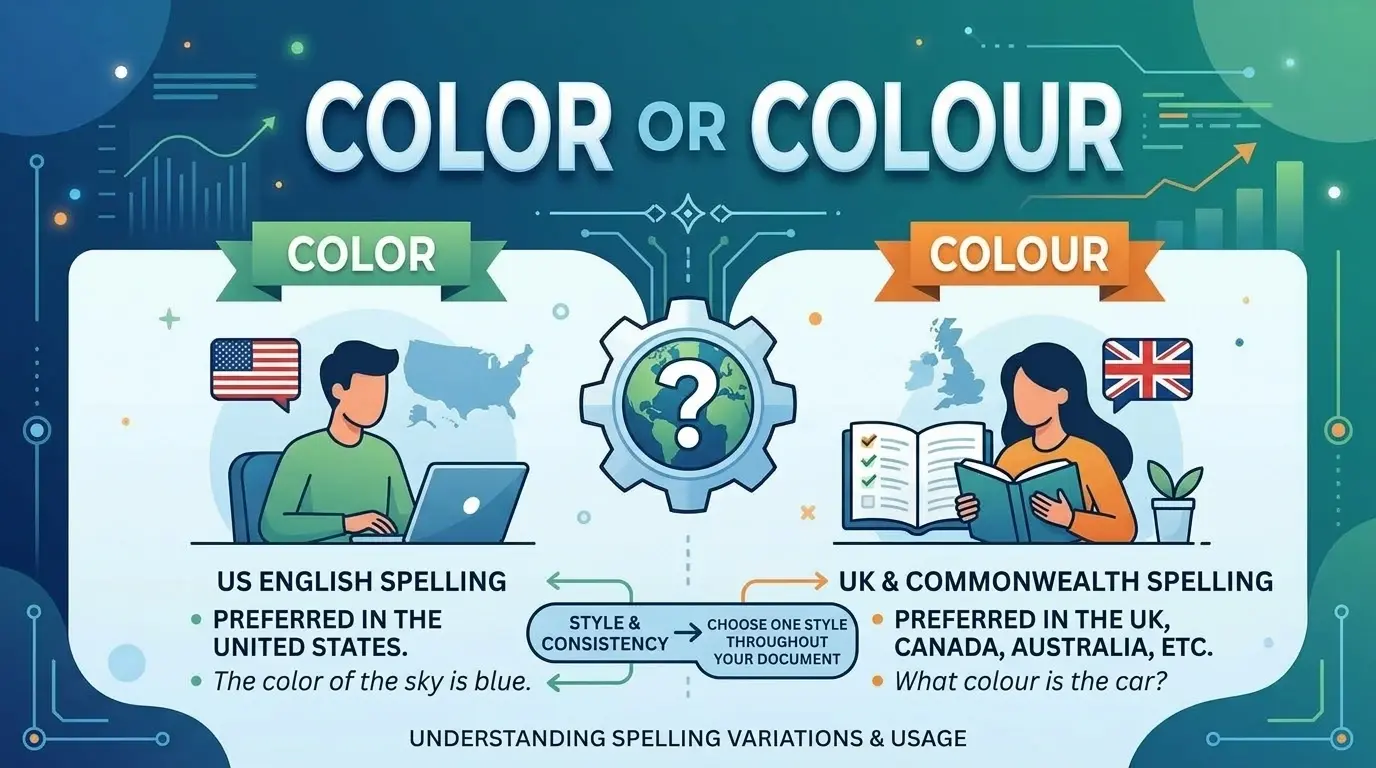
Color is the standard American English spelling, while colour is the standard British English spelling. Both forms are correct in the right variety of English.
You might notice the difference while reading a website, editing a document, or filling out an English assignment. One version has four letters, while the other has an extra u.
The meaning does not change.
Both color and colour refer to qualities such as red, blue, green, or yellow. The main difference is regional spelling. American English uses color, while British English uses colour.
If you write for a US audience, color is normally the better choice. If you follow British English, use colour.
Quick Answer
Color is the standard spelling in American English. Colour is the standard spelling in British English. Both words have the same meaning and pronunciation. The difference is a regional spelling convention. For US writing, use color. For British English, use colour.
Quick Rule
American English uses color, while British English uses colour with an extra u.
What Is the Difference Between Color and Colour?
Color and colour have the same meaning, but they follow different English spelling conventions. Color is used in American English, while colour is used in British English. The extra u in colour is the main spelling difference.
For example:
American English:
My favorite color is blue.
British English:
My favourite colour is blue.
The difference is not related to meaning.
It is also not a difference in grammar.
It is simply a difference in spelling between major varieties of English.
Cambridge identifies color as the US spelling of colour. It identifies colour as the UK spelling of color.
Read More: Saw or Seen? The Correct Form Explained
Is Colour or Color Correct?
Both color and colour are correct spellings. The correct choice depends on the variety of English you are using. American English normally uses color, while British English normally uses colour. Neither spelling is an error when used in its appropriate variety.
This means you should consider your audience.
If you are writing for readers in the United States, use:
color
If you are writing for readers in the United Kingdom, use:
colour
For example:
| English variety | Correct spelling | Example |
| American English | color | What is your favorite color? |
| British English | colour | What is your favourite colour? |
Grammarly also gives color as the American spelling and colour as the British spelling.
Are Color and Colour Pronounced the Same?
Yes, color and colour are pronounced almost the same. Only the spelling changes. The extra u in colour does not add a new sound.
Here is a quick comparison:
| English variety | Spelling | Common pronunciation |
|---|---|---|
| American English | color | KUH-ler |
| British English | colour | KUH-luh |
British speakers often make the ending a little softer. The difference is small.
This means the confusion happens only in writing, not in speech.
When to Use Color
Color is the standard form in American English. Use it when your writing follows US spelling conventions, including schoolwork, business writing, websites, and other content intended for an American audience.
Here are some examples:
- My favorite color is green.
- The walls are a light color.
- Which color do you prefer?
- The artist used bright colors.
- I bought a color printer.
- The picture looks better in color.
- She changed the color of her dress.
- The chart uses different colors.
- What color are your eyes?
- The room needs more color.
For a US-focused website, color should normally be your default spelling.
When to Use Colour
Colour is the standard form in British English. Use it when following British spelling conventions, including writing intended for readers in the United Kingdom.
Examples include:
- My favourite colour is green.
- The walls are a light colour.
- Which colour do you prefer?
- The artist used bright colours.
- I bought a colour printer.
- The picture looks better in colour.
- She changed the colour of her dress.
- The chart uses different colours.
- What colour are your eyes?
- The room needs more colour.
The meaning remains the same.
Only the spelling convention changes.
Color vs Colour Examples
The easiest way to understand the difference is to compare the same sentences in both varieties. The spelling changes, but the meaning stays the same.
American English
What is your favorite color?
British English
What is your favourite colour?
The difference appears in both words because favorite also has a regional spelling difference.
Here are more examples:
| American English | British English |
| favorite color | favourite colour |
| bright colors | bright colours |
| color scheme | colour scheme |
| color printer | colour printer |
| color photograph | colour photograph |
| color palette | colour palette |
| colored pencils | coloured pencils |
| coloring book | colouring book |
| colorful design | colourful design |
| colorless liquid | colourless liquid |
Grammarly uses the example “favorite color” for American English and “favourite colour” for British English.
Colour and Color in Formal Writing
Both forms are acceptable in formal writing when they match the chosen English variety. The important point is consistency. If you are writing in American English, use color throughout your document. If you are using British English, use colour consistently.
For example, a US document should use:
The color of the logo matches our brand.
A British document would use:
The colour of the logo matches our brand.
Do not switch between the two forms without a reason.
For a US website, using color throughout the site creates a consistent American English style.
Color vs Colour in the United States
For readers in the United States, color is the standard spelling. American dictionaries and language resources identify color as the US form.
Examples:
- favorite color
- color wheel
- color scheme
- color blindness
- color photo
- color printing
- color palette
So if your target audience is American, choose color.
You do not need to add the u simply because another English-speaking country uses it.
Colour or Color in the United Kingdom
In British English, colour is the standard spelling. Cambridge identifies colour as the UK form and color as the US form.
Examples:
- favourite colour
- colour wheel
- colour scheme
- colour blindness
- colour photo
- colour printing
- colour palette
If you are following British English, keep the u.
Color or Colour in Other Countries
The US uses color. Most other English-speaking countries use colour. This includes Canada, Australia, New Zealand, and India.
| Country | Usual spelling |
|---|---|
| United States | color |
| United Kingdom | colour |
| Canada | colour |
| Australia | colour |
| New Zealand | colour |
| India | colour |
| Pakistan | colour |
What about Pakistan? Pakistani English generally follows British spelling in schools, exams, and most publications. So colour is the usual choice. If your institute or employer has its own style guide, follow that.
What about Europe? British English is often taught in European schools, so colour is common. However, many international companies use American English. Follow your audience or style guide.
Tip: Set your spell checker to English (UK) or English (US) so it matches your choice.
Related Words: Colorful vs Colourful
The same spelling difference appears in related words. American English uses colorful, while British English uses colourful. The extra u remains in the British form.
American English
The garden is colorful.
British English
The garden is colourful.
The same pattern appears with several related words:
| American English | British English |
| colorful | colourful |
| colorless | colourless |
| multicolor | multicolour |
| colored | coloured |
| coloring | colouring |
These differences follow the same broad spelling pattern.
Coloring or Colouring?
Coloring is the American English spelling, while colouring is the British English spelling. Both forms refer to the act or result of adding color to something.
For example:
American English:
The children are coloring pictures.
British English:
The children are colouring pictures.
Cambridge specifically identifies coloring as the US spelling of colouring.
The same regional pattern applies to the verb:
American:
She colored the picture.
British:
She coloured the picture.
Colored Meaning: Spelling and Careful Use
Colored means having color, or having been given color. In British English, the spelling is coloured.
Common examples:
- Colored pencils
- Colored lights
- A colored map
The word can also mean “influenced.” For example, His opinion was colored by his past experience.
Be careful with context. Using colored to describe people is considered outdated and offensive in many situations today. For objects and ideas, it is perfectly fine.
Color and Colour in Idioms
Idioms follow the same spelling rule. Use color in American English and colour in British English.
| American English | British English | Meaning |
|---|---|---|
| show your true colors | show your true colours | show your real personality |
| pass with flying colors | pass with flying colours | succeed easily |
| colorful language | colourful language | vivid or strong words |
The meaning stays the same. Only the spelling changes.
Why Does American English Use Color?
The shorter color spelling became established in American English as part of broader American spelling preferences. Grammarly notes the influence of American lexicographer Noah Webster, whose dictionaries helped establish shorter spellings in American English.
This does not mean color is a newer or more correct form.
It is simply the standard American spelling.
British English retained the u in words such as:
- colour
- favour
- honour
- behaviour
American English commonly uses:
- color
- favor
- honor
- behavior
Grammarly describes these as examples of spelling differences between American and British English.
Where Did the U in Colour Come From?
The u in colour comes from French influence on English spelling. The word’s Latin root is color, but English adopted the French-style form, and Britain kept it.
American English later simplified it, as explained above.
Common Mistakes With Colour and Color
The biggest mistake is treating one spelling as universally correct. Color and colour are both standard forms, but they belong to different English spelling conventions.
Mistake 1: Using British spelling in US writing
If you are writing for a US audience, this may look inconsistent:
What is your favourite colour?
For American English, write:
What is your favorite color?
Mistake 2: Using American spelling in British writing
For British English, write:
What is your favourite colour?
rather than:
What is your favorite color?
Mistake 3: Mixing both forms
Avoid switching between color and colour in the same document.
Choose the spelling system that matches your audience.
Mistake 4: Assuming one form is wrong
Neither spelling is simply “wrong.”
The difference is regional.
Mistake 5: Misspelling Color or Colour
The only correct forms are color and colour. Anything else is a spelling error.
Common wrong spellings:
- coulour → colour (or color)
- clour or clor → color (or colour)
- coulor → color
Easy tip: both words start with col-. The only choice is the ending: -or (American) or -our (British).
How to Remember Color or Colour
Use this simple memory trick:
US = color
UK = colour
Think of the extra u as part of the British spelling.
You can also remember this group:
American: color, favor, honor
British: colour, favour, honour
This pattern can help you recognize several related spelling differences.
However, not every word follows the same pattern.
So use the memory trick as a guide, not as a universal spelling rule.
Color or Colour for Kids
Color and colour are the same word. Americans write color. British people write colour.
Here is a simple way to explain it:
- color has 5 letters
- colour has 6 letters
Practice sentences:
- American: I color the sun yellow.
- British: I colour the sun yellow.
Ask your teacher whether your class follows American or British English, then use that spelling every time.
Is Colour vs Color More Common?
The answer depends on the English variety and the audience. Color is standard in American English, while colour is standard in British English. Frequency alone does not make one spelling correct for every audience.
For a US-focused website, color is the natural choice.
For a UK-focused publication, colour is the natural choice.
The same principle applies to related forms.
FAQs
Is color or colour correct?
Both are correct. Color is the standard American English spelling, while colour is the standard British English spelling.
Is color American or British?
Color is the standard American English spelling. British English normally uses colour.
Is colour American or British?
Colour is the standard British English spelling. American English normally uses color.
Why does British English spell color with a u?
British English traditionally uses colour, while American English standardized the shorter color form. Noah Webster’s dictionaries helped establish many shorter American spellings.
Should I use color or colour in the US?
Use color when writing in American English. This is the standard US spelling.
Should I use color or colour in the UK?
Use colour when following British English spelling conventions.
Is colorful or colourful correct?
Both are correct depending on the English variety. American English uses colorful, while British English uses colourful.
Is coloring or colouring correct?
Both are correct. Coloring is the US spelling, while colouring is the UK spelling.
Do color and colour have the same meaning?
Yes. They have the same basic meaning. The difference is mainly their spelling in American and British English.
Which spelling should a US website use?
A US-focused website should generally use color and other American English spellings consistently. Grammarly notes that English dialect settings include different spelling conventions.
Are color and colour pronounced the same?
Yes. They sound almost the same. Only the spelling is different.
Is it color or colour in Pakistan?
Pakistani English generally follows British spelling, so colour is the usual choice. Follow your institute’s style guide if it says otherwise.
What does colored mean?
Colored means having color. It can also mean “influenced,” as in colored by experience. Avoid using it to describe people.
Conclusion:
Color and colour are both correct spellings. The choice depends on the English variety you are using.
Color is standard in American English, while colour is standard in British English.
If you write for a US audience, choose color. If you follow British English, choose colour. The same difference appears in related words such as colorful/colourful, colored/coloured, and coloring/colouring.
The easiest rule is simple: US English uses color; UK English uses colour.

As an American English writer, I specialize in creating clear and engaging content that makes grammar and language learning accessible to everyone. I enjoy breaking down complex English concepts into simple, practical lessons that readers can apply with confidence. My mission is to help learners strengthen their communication skills through easy and reliable content.











2 thoughts on “Color or Colour? The Correct Spelling in American and British English”