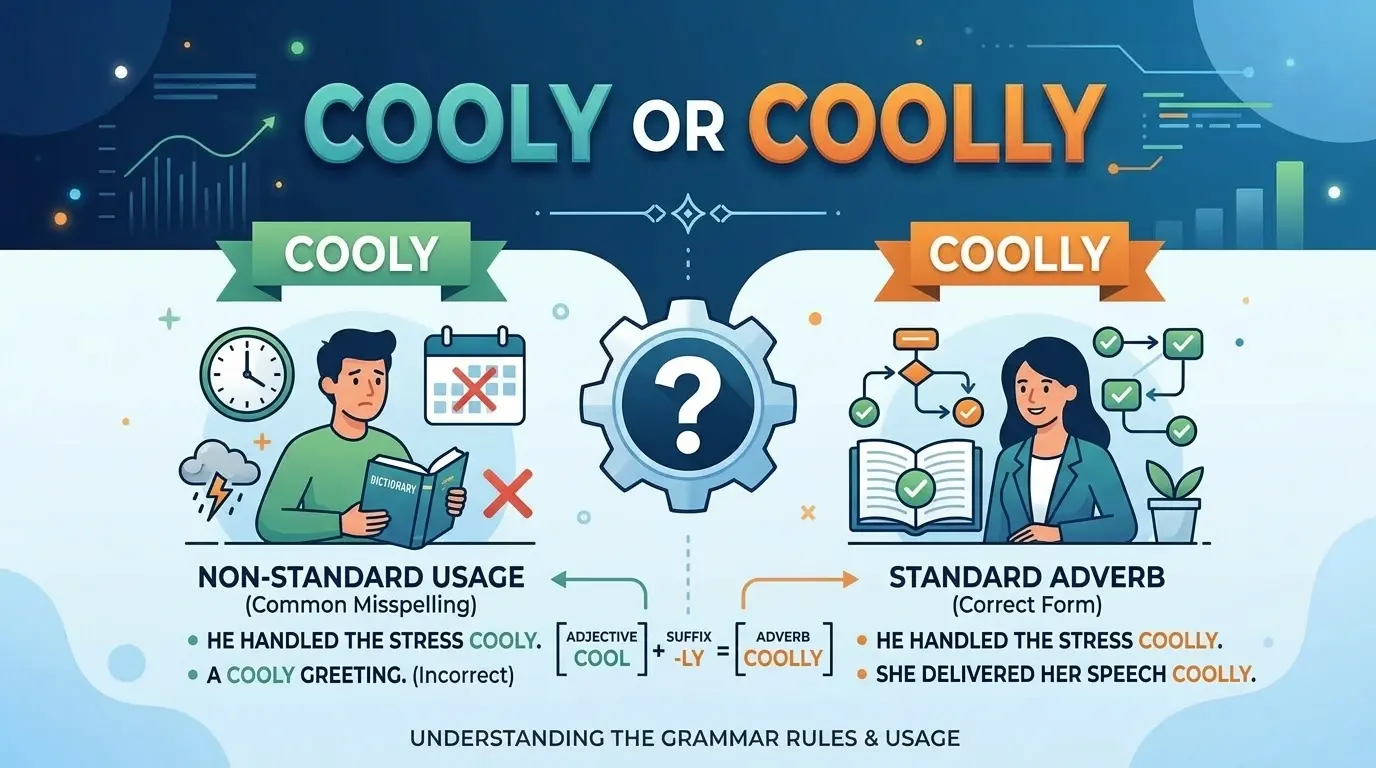
Coolly is the standard spelling when you need the adverb meaning “in a calm or unemotional way.” Cooly is not the standard spelling for this common adverb.
You might type a quick message and write, “She answered cooly.” It looks reasonable because the adjective cool simply becomes an adverb with -ly in many English words.
However, this word follows a spelling pattern that can be easy to miss. When cool takes the adverb ending -ly, the final l is retained, giving us coolly.
For example, “He coolly rejected the offer” means he rejected it in a calm or controlled way. The correct spelling is therefore coolly, with two ls before the y.
Quick Answer
Coolly is the correct standard spelling when you mean “in a calm, controlled, or unemotional way.” Cooly is generally considered a misspelling in this use. The word comes from cool + -ly, producing coolly with two ls.
Quick Rule
Cool + ly becomes coolly, so remember the two Ls when spelling this adverb.
What Does “Coolly” Mean?
Coolly is an adverb that describes an action done in a calm, controlled, unemotional, or sometimes unfriendly manner. It comes from the adjective cool and is formed by adding -ly.
For example:
She coolly explained her decision.
This means she explained her decision calmly and without showing much emotion.
The exact feeling can depend on context.
Coolly can suggest:
- Calmly
- Without excitement
- Without showing emotion
- In a controlled manner
- Sometimes in an unfriendly or distant manner
Consider these examples:
He coolly rejected the proposal.
He rejected it without showing much emotion.
She coolly handled the difficult situation.
She remained calm and controlled.
The word does not always have a negative meaning.
Someone can behave coolly because they remain calm under pressure.
Read More : Color or Colour? The Correct Spelling in American and British EnglishWhy Is “Coolly” Spelled With Two Ls?
Coolly is spelled with two ls because the base adjective cool already ends in l. Adding -ly gives cool + ly = coolly, rather than removing an l.
The spelling may look unusual because many familiar adverbs are formed by simply adding -ly.
For example:
- quick → quickly
- slow → slowly
- careful → carefully
- quiet → quietly
With cool, the final spelling becomes:
cool + ly = coolly
The two ls belong to different parts of the word.
- cool → ends in ll
- ly → provides the final y
So:
cool + ly = coolly
Not:
cool + ly = cooly
This is why coolly is the standard spelling.
Is “Cooly” a Word?
Cooly is not the standard spelling of the common adverb coolly. If you want to describe someone doing something calmly or without emotion, use coolly with two ls.
The form cooly may occasionally appear as a typo or in unusual historical or specialized contexts.
That does not make it the appropriate spelling for ordinary modern English writing.
For normal writing, choose:
She coolly answered the question.
Avoid:
She cooly answered the question.
This distinction is especially important in school assignments, professional writing, articles, and formal communication.
Coolly vs. Cooly
| Form | Standard for this meaning? | Meaning |
| coolly | Yes | In a calm or unemotional way |
| cooly | No | Common misspelling of coolly |
The correct form is coolly.
The easiest way to remember it is to keep the spelling of the base word cool.
cool + ly = coolly
The word already has two ls before the ending is added.
How to Use “Coolly” in a Sentence
Coolly usually comes before or after the main verb and describes how someone performs an action. It works naturally with verbs such as answer, reply, handle, reject, say, and respond.
Here are examples:
- She coolly answered the difficult question.
- He coolly rejected the suggestion.
- The manager coolly handled the complaint.
- She coolly explained what had happened.
- He coolly responded to the criticism.
- The player coolly scored the final goal.
- She coolly walked away from the argument.
- He coolly accepted the decision.
- The lawyer coolly presented the facts.
- She coolly dismissed the accusation.
- He coolly replied to the email.
- The teacher coolly addressed the problem.
- She coolly refused the offer.
- He coolly explained his reasons.
- The team coolly dealt with the pressure.
- She coolly looked at him and smiled.
- He coolly denied the claim.
- The speaker coolly answered each question.
- She coolly dealt with the unexpected problem.
- He coolly accepted the criticism.
These examples show how coolly describes the manner of an action.
What Is the Adjective Form?
The adjective is cool.
The adverb is coolly.
Compare:
She remained cool.
Here, cool describes she.
She coolly answered the question.
Here, coolly describes how she answered.
This is a useful way to understand the difference between the two forms.
Adjective
cool
He is cool under pressure.
Adverb
coolly
He coolly handled the pressure.
The -ly ending changes the word into an adverb.
Why Do People Write “Cooly”?
Cooly is easy to write because it looks like a simple combination of cool + y. However, the standard adverb keeps the spelling of cool and adds -ly.
The correct formation is:
cool + ly → coolly
Not:
cool + y → cooly
This mistake is similar to other spelling errors where writers drop a letter from the base word before adding a suffix.
When you are unsure, look at the base word first.
The base word is:
cool
It already contains two l’s.
Keep them when forming the adverb:
coolly
Coolly Grammar Rule
Coolly is an adverb because it describes how an action happens. It is formed from the adjective cool by adding the adverb-forming suffix -ly.
Consider:
She gave a cool response.
Here, cool is an adjective describing response.
Now compare:
She coolly responded.
Here, coolly describes the verb responded.
The meaning is related, but the grammatical role is different.
Cool
Adjective:
He remained cool during the interview.
Coolly
Adverb:
He coolly answered every question.
This distinction can help you decide which form belongs in your sentence.
Does “Coolly” Always Mean Calmly?
Coolly often means calmly or without strong emotion, but its exact meaning depends on context. It can sometimes suggest that someone is distant, unfriendly, or deliberately unemotional.
For example:
She coolly accepted the apology.
This may simply mean she stayed calm.
But:
He coolly dismissed her concerns.
This can suggest a more distant or uncaring attitude.
The surrounding words help determine the intended tone.
Therefore, coolly does not always mean “nicely calm.”
It can describe controlled behavior that feels emotionally distant.
Common Mistakes With “Coolly”
1. Writing “cooly”
Incorrect:
She cooly replied.
Correct:
She coolly replied.
The standard spelling contains two ls.
2. Removing an L
Incorrect:
He cooly handled the situation.
Correct:
He coolly handled the situation.
Remember that cool already ends with two ls.
3. Confusing “cool” and “coolly”
Incorrect:
She cool answered the question.
Correct:
She coolly answered the question.
When you need an adverb to describe how she answered, coolly is appropriate.
4. Assuming every -ly word follows the same visual pattern
English spelling has many patterns and exceptions.
Instead of guessing, check the base word and the standard spelling.
For this word:
cool → coolly
Coolly in Different Contexts
Coolly can describe behavior in everyday, professional, academic, and literary writing. The meaning remains connected to calmness or emotional control.
At Work
The manager coolly responded to the complaint.
This suggests a controlled response.
During an Argument
She coolly explained her side.
This suggests she did not become emotional.
In Sports
The striker coolly scored the penalty.
Here, coolly suggests calmness under pressure.
In a Story
He coolly looked toward the door.
This can create a controlled or emotionally distant tone.
In Professional Writing
The report coolly examined the available evidence.
Here, the word can suggest an objective or unemotional approach.
Memory Trick
Remember the base word:
COOL
Now add:
LY
Put them together:
COOL + LY = COOLLY
The word cool already has two Ls.
So don’t drop one when adding -ly.
Easy memory line:
Stay cool, keep both Ls, and write coolly.
That simple trick can help you avoid writing cooly.
FAQs
Is “cooly” or “coolly” correct?
Coolly is the standard spelling when you mean “in a calm, controlled, or unemotional way.” Cooly is generally a misspelling in this use.
What does “coolly” mean?
Coolly means in a calm, controlled, or unemotional manner. Depending on context, it can also suggest emotional distance.
How do you spell “coolly”?
The correct spelling is coolly, with two ls.
Why does “coolly” have two Ls?
The word comes from cool + ly. The base word cool already has two ls, and they remain when -ly is added.
Is “cooly” a real word?
Cooly is not the standard spelling for the common adverb meaning “in a calm way.” Use coolly in normal modern English writing.
Is “coolly” an adjective or adverb?
Coolly is an adverb. It describes how an action is performed.
What is the adjective form of “coolly”?
The adjective is cool. For example, “She stayed cool during the interview.”
What is an example of “coolly”?
He coolly rejected the offer.
This means he rejected the offer in a calm or controlled manner.
Is “coolly” spelled with one L or two?
Coolly is spelled with two ls.
What is the difference between “cool” and “coolly”?
Cool is usually an adjective, while coolly is an adverb. Compare “a cool response” with “she responded coolly.”
Conclusion:
Coolly is the correct standard spelling when you mean “in a calm, controlled, or unemotional way.” Cooly is generally a spelling mistake in this context.
The easiest way to remember the correct form is to start with the base word cool. It already contains two ls. Add -ly, and you get coolly.
So remember:
cool + ly = coolly
When writing a school assignment, email, article, or professional document, choose coolly.

I’m Sophia Mitchell, an English grammar and writing enthusiast. I create simple, easy-to-understand content to help learners improve their English. My goal is to make grammar clear, practical, and enjoyable for everyone.











1 thought on “Cooly or Coolly? The Correct Spelling Explained”