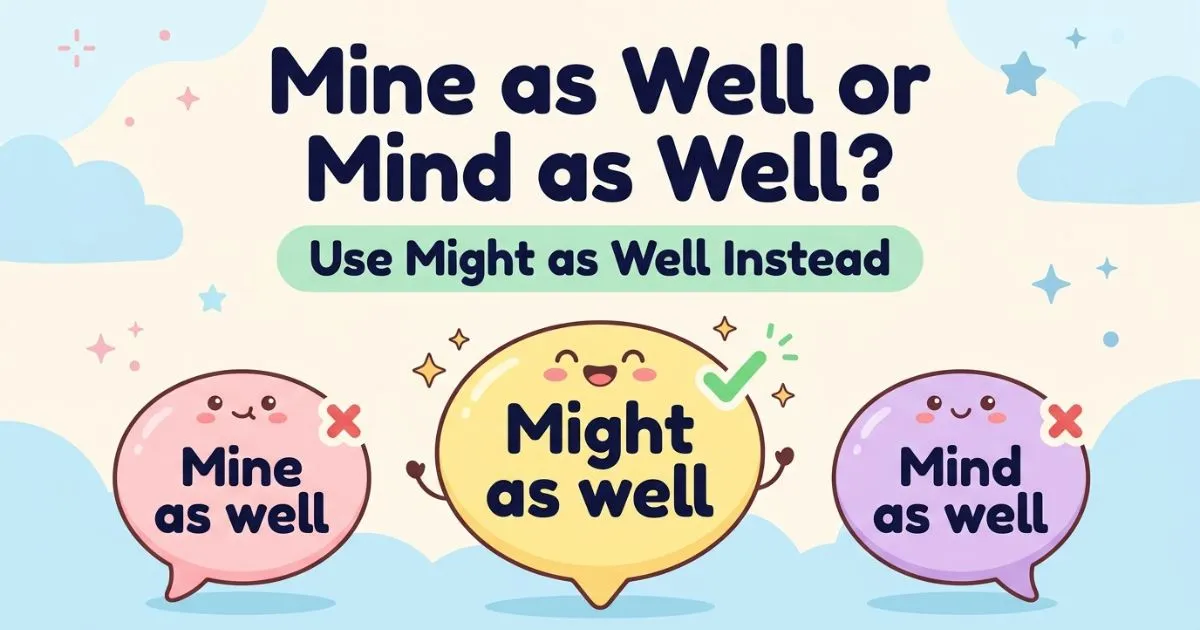
You’re typing a quick text, “we mine as well go,” and something looks off. Is it mine as well or mind as well? Neither.
When you mean “there’s no good reason not to,” the phrase is might as well.
This is an expression people mostly hear instead of read, so the spelling often slips.
Here you’ll learn what it means, why the wrong versions creep in, the one situation where “mine as well” is actually fine, and three quick checks to use before you hit send.
Every example is short and real-life, so you can copy the pattern straight into your own writing.
The Quick Answer
When you’re suggesting an action or accepting a situation, the correct phrase is might as well.
- ✅ We might as well leave now.
- ❌ We mine as well leave now.
- ❌ We mind as well leave now.
“Mine as well” isn’t wrong everywhere. It’s just a different phrase, and it’s about ownership. “Mind as well” isn’t standard English at all.
Quick rule: action → might. Ownership → mine. In this idiom, mind never fits.
What Does “Might as Well” Mean?
Might as well means doing something is a sensible choice because there’s no better option. The unspoken message is: “Why not?”
- We’ve finished early, so we might as well leave.
- You’re already online, so you might as well pay the bill.
- It’s raining. We might as well stay home.
It’s Practical, Not Always Excited
Often the phrase carries a shrug. The speaker isn’t thrilled, just logical. It tends to appear when energy is low and the next step is obvious. Here’s what it usually does:
- Reluctant agreement: “I might as well help him.”
- Default choice: “We might as well walk.”
- Mild suggestion: “You might as well rest.”
- Saving effort: “I might as well finish now.”
The “Since I’m Already Here” Test
If you can put “since…” or “because…” in front of your sentence, you probably want might as well. “Since we’re already at the store, we might as well buy milk.” If no such reason fits, you may not need the idiom at all.
Read More: Lose vs. Loose: 3 Quick Tests to Pick the Right Word
Why Do People Write “Mine as Well” or “Mind as Well”?
Spoken English moves fast. Say “might as well” quickly and the ending of might blurs, so it can sound like mine or mind. Your brain stores the sound, and your fingers type what your ear remembered.
Two things make it worse. Mine and mind are both everyday words, so they look believable on screen. And many learners pick up English by listening more than reading, so they rarely see the correct spelling.
You’re in good company. English is full of phrases that get written the way they sound:
| Heard | Often written | Correct |
| might as well | mine as well / mind as well | might as well |
| supposed to | suppose to | supposed to |
| could have | could of | could have |
| for all intents and purposes | for all intensive purposes | for all intents and purposes |
| wreak havoc | wreck havoc | wreak havoc |
The pattern shows that these errors come from the ear, not from poor English.
Is “Mine as Well” Ever Correct?
Here the sources disagree. Some call it flatly wrong, while others say it’s fine for ownership. The truth sits in the middle, and it depends on what you mean.
As a suggestion: always wrong.
- ❌ I mine as well go home.
- ✅ I might as well go home.
As ownership: grammatical, but uncommon. Here, mine is a possessive pronoun that stands for “my thing,” and as well means “too.”
- Everyone brought a laptop. I brought mine as well.
- Her phone is dead, and mine as well.
Even then, many writers choose a clearer version: “I brought mine too” or “Mine is dead too.” The short form can leave readers wondering what mine refers to, especially in writing.
The fastest check: look at the word after the phrase. If a bare verb follows (“mine as well go,” “mine as well try”), it’s a mistake. Swap in might.
Is “Mind as Well” Correct?
Not in standard writing. Mind is a real word with real jobs: to care about something, to object to something, or to pay attention.
- Do you mind opening the window?
- Please mind the step.
- I don’t mind waiting.
None of these means “it makes sense to.” In the idiom, mind can’t stand in for might.
You will hear “mind as well” in casual speech and some regional dialects. Fiction writers sometimes use it in dialogue to give a character a voice. In your own essays, emails, and posts, write might as well.
- ❌ We mind as well finish the work.
- ✅ We might as well finish the work.
Might as Well vs Mine as Well vs. Mind as Well
| Phrase | Status | Meaning | Example |
| Might as well | Standard | A sensible action when nothing better is available | We might as well walk. |
| Mine as well | Only for ownership | “Mine too” | I brought mine as well. |
| Mind as well | Nonstandard | None in this idiom | Write “might as well” instead. |
How to Use “Might as Well” Correctly
The Simple Formula
Subject + might as well + base verb
- I might as well call her.
- You might as well wait here.
- She might as well take the earlier train.
Two small rules keep you safe. Don’t add to after the phrase, and don’t add -s to the verb. Might never changes form, whoever the subject is.
Examples by Situation
At school:
- You might as well ask the teacher for help.
- I might as well finish this assignment tonight.
At work:
- Everyone’s already on the call, so we might as well begin.
- The report is nearly done, so I might as well send it today.
In daily life:
- The bus is late. We might as well walk.
- We missed the train, so we might as well get lunch.
- Since we’re early, we might as well grab a coffee.
Dropping the Subject in Casual Chat
In texts and relaxed speech, people often skip the subject: “Nothing else planned. Might as well go!” That’s natural in casual messages. In formal writing, keep the subject so the sentence stays clear.
Looking Back: “Might as Well Have”
To talk about the past, add have and a past participle. The meaning is that another choice would have been just as sensible.
- The meeting was cancelled again. We might as well have stayed home.
- Given the storm, we might as well have waited.
Might as Well vs May as Well
“May as well” and “might as well” are both standard. Dictionaries such as Cambridge list both for suggestions, and might as well is the more common one.
- We might as well start the meeting.
- We may as well start the meeting.
If you’re unsure which to pick, use might as well. It also gives you a handy test: swap in may as well. “We may as well go” works, while “We mine as well go” and “We mind as well go” don’t.
Common Mistakes (and Fixes)
- Swapping in mine: ❌ I mine as well try. ✅ I might as well try.
- Swapping in mind: ❌ We mind as well leave. ✅ We might as well leave.
- Writing “aswell”: ❌ You might aswell wait. ✅ You might as well wait. (As well is always two words.)
- Adding to: ❌ We might as well to leave. ✅ We might as well leave.
- Adding -s: ❌ She might as well goes home. ✅ She might as well go home.
- Mixing it up with “might also”: “We might as well take a taxi” means taking a taxi is the sensible choice. “We might also take a taxi” simply adds another possible option.
- Repeating it: “We might as well keep going; we might as well finish; we might as well.” Use it once, then give your reason.
Can You Use “Might as Well” in Formal Writing?
It’s fairly informal. It’s fine in everyday writing, friendly emails, and many workplace messages. In academic papers or very formal documents, say your reasoning directly:
| Instead of | Try |
| We might as well proceed. | It would be reasonable to proceed. |
| You might as well apply. | It would be appropriate to apply. |
| We might as well stop. | Given these results, we should stop. |
A good habit, even in casual writing, is to add the reason: “We might as well leave; the store is closed.” The idiom then does less work, and your logic does more.
Three Quick Checks Before You Hit Send
- The verb test. Is a bare verb right after the phrase (go, try, wait)? Then you want might as well.
- The ownership test. Can you replace mine with “my + noun”? “I brought mine as well” becomes “I brought my laptop as well.” If yes, mine is fine. If not, it’s a typo.
- The search test. Before sending a long email or essay, search your draft for “mine as well” and “mind as well.” Check each result by eye. Blind find-and-replace can break the sentences where mine is correct.
Quick Practice
Fill in the blanks.
- It’s already 9 p.m., so we ___ order dinner.
- Your charger is on the table, and ___ is in my bag.
- The shop closes in ten minutes. We ___ go now.
- Spot the error: “You mind as well ask her.”
Answers: 1) might as well. 2) mine (ownership). 3) might as well. 4) “You might as well ask her.”
FAQs
1. Is it “mine as well” or “mind as well”?
Neither works when you’re suggesting an action. The standard phrase is “might as well,” as in “We might as well leave.” “Mine as well” only fits sentences about ownership, and “mind as well” isn’t standard English, so use “might” in essays, emails, and everyday writing.
2. Is “mine as well” ever correct?
Yes, but only about ownership, where mine means “my thing” and as well means “too”: “I brought mine as well.” It never works as a suggestion. Because it can confuse readers, “mine too” is often clearer, and it’s never a substitute for “might as well.”
3. What does “might as well” mean?
It means doing something makes sense because there’s no better option or good reason not to. It often carries a shrug rather than excitement. “It’s raining, so we might as well stay home” suggests that staying in is the practical choice, not necessarily the thrilling one.
4. Why do people confuse “might” with “mine” and “mind”?
Mostly because of how the phrase sounds. In fast speech, the ending of “might” blurs, and “mine” and “mind” are familiar words that look believable in print. People type what they remember hearing, and learners who mostly listen rarely see the written form.
5. Is “might as well” formal?
It works in everyday writing, emails, and many workplace messages, but it’s fairly informal. In academic or legal writing, state your reasoning directly, such as “It would be reasonable to proceed” or “Given these results, we should continue.” Using it sparingly also keeps your writing sharp.
6. Should I write “aswell” or “as well”?
Write “as well” as two words. “Aswell” is a spelling mistake, and the full phrase is always three separate words: “might as well,” never “might aswell.” Proofread this one by eye, since the typo is easy to miss.
7. Is “may as well” also correct?
Yes. “May as well” and “might as well” are both standard and mean nearly the same thing: doing something is sensible when nothing better is available. “Might as well” is the more common choice, so it’s the safer default if you’re unsure which to use.
Conclusion:
So, mine as well or mind as well?
For a suggestion or a practical decision, neither one. Write might as well: “We might as well leave now.”
Keep mine for things that belong to you, and keep mind for caring, objecting, and paying attention.
Your next step takes two minutes. Open your latest email or assignment, search for “mine as well” and “mind as well,” and fix any that slipped in.
After a few weeks of the verb test, you won’t need to check at all.

I’m Sophia Mitchell, an English grammar and writing enthusiast. I create simple, easy-to-understand content to help learners improve their English. My goal is to make grammar clear, practical, and enjoyable for everyone.