You are writing an email, a school essay, or a simple caption, and you freeze halfway through the sentence.
Is it “me and my family” or “my family and I”? One sounds natural when you talk. The other sounds more polished. Somewhere in your head, an old teacher is whispering that one of them is wrong.
The truth is that both phrases can be correct. What decides it is the job the phrase does in your sentence.
In this guide, you will learn a five-second test, see clear examples, spot the mistakes even confident writers make, and finally know which form to use without second-guessing.
The Quick Answer: Me and My Family or My Family and I?
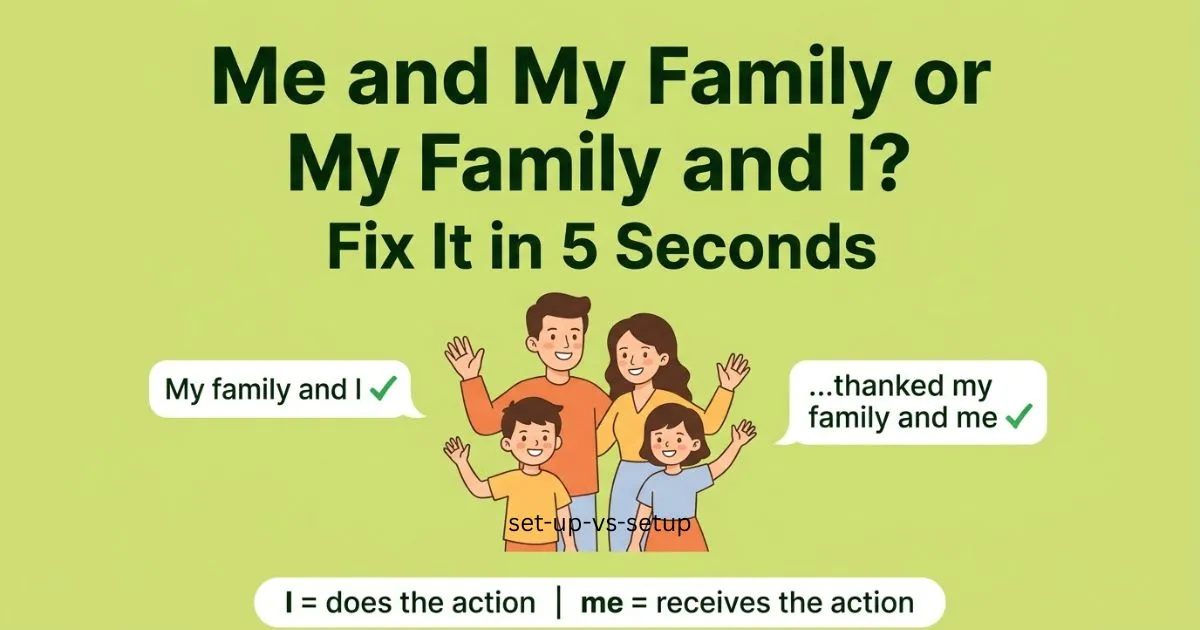
Here is the short version. When you and your family are doing the action, use my family and I. When the action happens to you, use my family and me or me and my family.
| Phrase | Its job | Example |
| My family and I | Subject (does the action) | My family and I visited Lahore. |
| My family and me | Object (receives the action) | The guide welcomed my family and me. |
| Me and my family | Object (receives the action) | They invited me and my family. |
That is the whole rule. The rest of this article shows you how to apply it quickly and why people get it wrong.
Why This Question Confuses So Many People
Spoken English is relaxed. You hear “me and my brother went out” in movies, songs, and on the street, so it starts to sound normal.
Then school adds a second problem. Many people remember a half-rule: “never say me, always say I.” It feels safe, but it creates new mistakes, such as “she invited my family and I,” which is incorrect.
So you end up caught between two habits. One comes from casual speech. The other comes from an over-corrected rule. The cure is not memorising one phrase. It is understanding one small idea.
Read More: Is “Good Morning” One Word? Spelling, Caps & Email Rules
Subject and Object: The One Idea You Need
Pronouns change form depending on their job in the sentence. There are only two jobs to know.
Subject Pronouns Do the Action
Subject pronouns are I, you, he, she, we, and they.
- I cook dinner on Sundays.
- We enjoy travelling.
Object Pronouns Receive the Action
Object pronouns are me, you, him, her, us, and them.
- The coach praised me.
- Everyone welcomed us.
Think of a sentence as a small scene. The subject starts the action. The object is where the action lands.
In “My family and I watched a movie,” you started the action. In “The theatre gave free tickets to my family and me,” the tickets landed on you. Adding “my family” does not change your job in the sentence. It only adds more people to it.
The Remove-the-Other-Person Test
This is the fastest way to choose correctly. You do not need to remember any grammar terms.
Three Simple Steps
- Take “my family” (and the word “and”) out of the sentence.
- Read what is left with only “I” or “me.”
- Put back whichever one sounded right.
Worked Examples
Sentence 1: (Me / I) and my family went to the market.
Remove the family: “Me went to the market” sounds wrong. “I went to the market” sounds right.
Answer: My family and I went to the market.
Sentence 2: She called (my family and I / my family and me).
Remove the family: “She called I” sounds wrong. “She called me” sounds right.
Answer: She called my family and me.
| Full sentence | Test sentence | Answer |
| ___ bought a house. | I bought a house. | My family and I |
| The company contacted ___. | The company contacted me. | my family and me |
| ___ attended the wedding. | I attended the wedding. | My family and I |
| The teacher praised ___. | The teacher praised me. | my family and me |
A Second Check: The “We” Shortcut
You can also replace the whole phrase with “we” or “us.”
- “My family and I are leaving” becomes “We are leaving.” That works, so “I” is correct.
- “They thanked my family and me” becomes “They thanked us.” That works, so “me” is correct.
This works because “we” is the subject partner of “I,” and “us” is the object partner of “me.” If you ever doubt the first test, run this one as a double-check.
When to Use “My Family and I”
Use my family and I when the phrase comes before the verb and does the action. Ask one question: Who is doing it? If the answer is you and your family, “I” is correct.
- My family and I moved to a new city last year.
- My family and I enjoy movie nights.
- My family and I started a small garden.
- My family and I adopted a puppy.
- My family and I are planning a trip.
You will use this form most often in school essays, emails, job interviews, speeches, and any writing where a polished tone matters.
When “Me and My Family” or “My Family and Me” Is Correct
Many learners believe “me” is always wrong. It is not. After a verb or a preposition, you need the object form.
Prepositions that usually call for “me” include to, for, with, between, from, and about.
- The restaurant owner welcomed me and my family.
- The photographer took a picture of my family and me.
- The gift was for my family and me.
- She sat between my family and me.
- They travelled with my family and me.
Both “me and my family” and “my family and me” are fine in these sentences, because the case (me) is right either way. Many writers prefer “my family and me,” since it follows the habit of mentioning others before yourself.
Is “Me and My Family” Ever Acceptable as a Subject?
Let’s be honest about this one. In formal grammar, “Me and my family are going fishing” is not correct, because “me” is an object pronoun in a subject position.
In real life, though, you will hear it constantly. It shows up in casual talk, song lyrics, films, and social media captions. Everyone understands it, and few people will correct you in a friendly chat.
The problem starts when it moves into writing that matters. In an essay, a cover letter, a business email, or a college application, use “my family and I” when you are the subject.
A simple rule of thumb: if you would proofread it carefully, use the formal form.
Mistakes Even Confident Writers Make
1. Using “I” Because It Sounds Smarter
This is the most common error. People assume “I” sounds more educated, so they use it everywhere.
- Wrong: The award was given to my family and I.
- Right: The award was given to my family and me.
Run the test: “The award was given to I” is clearly wrong. The same logic fixes the classic “between you and I.” The correct phrase is between you and me, because “between” is a preposition and needs an object.
2. Using “Me” as the Subject
- Wrong: My family and me started a business.
- Right: My family and I started a business.
Test it: “Me started a business” does not work, but “I started a business” does.
3. Reaching for “Myself”
Some people dodge the whole problem by writing “The manager thanked my family and myself.” That is usually a nervous swap. Unless you are doing something to yourself, “myself” does not belong here. Write “my family and me.”
4. Forgetting the Verb Is Plural
“My family and I” counts as two parts joined together, so it takes a plural verb.
- Wrong: My family and I is happy.
- Right: My family and I are happy.
“I and My Family”: Is It Correct?
You may wonder about “I and my family went on vacation.” The pronoun “I” is the right case there, because it is the subject. The real issue is style.
English speakers traditionally mention themselves last. We say “my parents and I,” “my friends and I,” “my team and I.” Putting others first sounds more considerate, and it has become the standard pattern. “I and my family” is not a pronoun error, but it sounds unnatural, so most editors will change it to “my family and I.”
Order is a matter of style. Case (I or me) is a matter of grammar. Keep those two ideas separate and the whole topic gets easier.
Formal English vs Everyday Conversation
| Situation | Best choice |
| Essays and school assignments | My family and I (subject) / my family and me (object) |
| Professional emails and applications | Same as above, applied correctly |
| Chatting with friends | Casual forms are common and understood |
| Social media captions | Depends on your tone; both appear |
The same grammar rules apply to American and British English. The informal habit of saying “me and my family” appears in both.
If you are unsure and the writing is important, choose the form that matches the grammar, not the form that merely sounds fancy.
“My Family and I Are Doing Well” and “My Family and I Are Grateful”
Two phrases people search for all the time are these, and both are correct.
- My family and I are doing well, thank you for asking.
- My family and I are grateful for your support.
In both, “my family and I” is the subject. Replace it with “we” and the sentence still works: “We are doing well.” “We are grateful.”
Notice the verb, too. It is “are,” not “is,” because the subject has two parts.
When someone else is the one acting, the object form appears:
- Thank you for supporting my family and me.
- We appreciate everything you have done for my family and me.
Here is a handy rule for thank-you notes. If you are the one feeling the gratitude, you are the subject (“my family and I are grateful”). If you are the one receiving the kindness, you are the object (“thank you for helping my family and me”).
Me and My Family Meaning
“Me and my family” simply refers to the speaker together with their relatives. There is nothing hidden in the meaning. The only question is grammar: which pronoun fits the sentence.
You will also see “Me and My Family” used as a topic or heading, especially for school essays and young learners’ lessons. A title has no verb, so there is no case to check. Still, “My Family and I” often looks more formal and polished as a heading, so it is a safe choice when you want a neat title.
Sentence Examples You Can Reuse
Home
- My family and I cook dinner together every Sunday.
- Grandma invited my family and me for lunch.
School
- My family and I recently moved to a new city.
- The principal welcomed my family and me on the first day.
Work
- My family and I appreciate your flexibility.
- The company invited me and my family to the annual dinner.
While travelling
- My family and I explored the old city on foot.
- The airline upgraded the seats for my family and me.
In messages and captions
- My family and I had a wonderful weekend.
- Thank you to everyone who welcomed my family and me.
Me and My Family Essay: How to Start
Essays on this topic usually begin with a simple introduction. Since you often describe things your family does together, “my family and I” will appear a lot. Use it as the subject, and use “my family and me” when someone else acts.
Here is a quick plan:
- Introduce your family in one or two sentences.
- Describe one daily habit or tradition.
- Share a memory or a lesson.
- Close with what your family means to you.
Sample opening paragraph:
There are five people in my family, and we live in a small house with a big courtyard. Every evening, my family and I sit together for dinner, and each person shares one thing from the day. My parents taught my brothers and me that listening is a form of respect. That simple habit has made our home a place where everyone feels heard.
Notice how the paragraph uses “my family and I” as the subject and “my brothers and me” as the object. That is the same rule, applied twice.
Me and My Family Quotes (Original Lines)
If you want a short line for a caption or card, here are a few original ones. They are not from any famous person, so feel free to use them.
- My family and I may not have much, but we always have each other.
- Home is wherever my family and I are laughing together.
- My family and I turn ordinary evenings into stories.
- Thank you to everyone who stood beside my family and me.
- Some of my best days began with my family and me around one table.
Each line follows the same rule, so you can copy the pattern for your own sentences.
Quick Practice
Choose the correct option.
- ___ are planning a camping trip. (Me and my family / My family and I)
- The teacher praised ___ after the competition. (my family and I / my family and me)
- ___ enjoy cooking together. (Me and my family / My family and I)
- The photographer took pictures of ___. (my family and me / my family and I)
Answers: 1) My family and I. 2) my family and me. 3) My family and I. 4) my family and me.
If you got one wrong, run the remove-the-other-person test on it again. It will show you why.
Quick Cheat Sheet
- The phrase does the action: my family and I.
- The phrase receives the action, or follows a preposition: my family and me (or “me and my family”).
- Not sure? Remove “my family” and see whether “I” or “me” sounds right.
- Use a plural verb: “My family and I are…”
FAQ
1. Is “me and my family” grammatically correct?
Yes, when it works as an object, such as “The photographer took a picture of me and my family.” It is not correct as a subject in formal English, although you will hear it in casual speech.
2. Is “my family and I” always correct?
No. It is correct only when the phrase is the subject, such as “My family and I went to the movies.” After a verb or preposition, use “me” instead.
3. Is it “she invited my family and I” or “my family and me”?
It is “she invited my family and me.” Remove the family and you get “she invited me,” which is correct. “She invited I” is not.
4. Is “I and my family” correct?
The pronoun case is fine for a subject, but the order sounds unnatural. English usually puts the speaker last, so “my family and I” is the standard choice.
5. Why do I hear “me and my family” everywhere?
Casual speech is relaxed about grammar, and people hear the phrase so often that it sounds normal. Written and formal English still prefer “my family and I” for subjects.
6. What is the easiest way to choose?
Remove “my family” from the sentence. If “I” sounds right, use “my family and I.” If “me” sounds right, use “my family and me.” You can also test it with “we” and “us.”
7. Is “my family and I are doing well” correct?
Yes. “My family and I” is the subject, and it takes the plural verb “are.” You can check it by replacing the phrase with “we”: “We are doing well.”
Conclusion:
The question of me and my family or my family and I comes down to one thing: is the phrase doing the action or receiving it?
Use “my family and I” when you act. Use “my family and me” or “me and my family” when the action reaches you.
Your next step is simple. The next time you write a sentence like this, delete “my family” for a moment and read it with just “I” or “me.”
That five-second habit will settle the question every time, in essays, emails, and everyday messages.

As an American English writer, I specialize in creating clear and engaging content that makes grammar and language learning accessible to everyone. I enjoy breaking down complex English concepts into simple, practical lessons that readers can apply with confidence. My mission is to help learners strengthen their communication skills through easy and reliable content.



1 thought on “Me and My Family or My Family and I? Fix It in 5 Seconds”