Use in person after a verb. Use in-person before a noun. That is the whole answer.
Picture this. You text a coworker: “Let’s set up an in-person meeting. Can you come in-person on Friday?” Nothing looks wrong. But the second hyphen is a mistake.
The mix-up is easy to make. Both forms mean the same thing: being there, face to face. The only change is the job each one does in the sentence.
Below you will find the rule, a quick table, memory tricks, and 20 examples. You will also see the one gray area that trips up many writers today.
Quick Answer
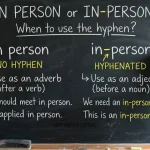
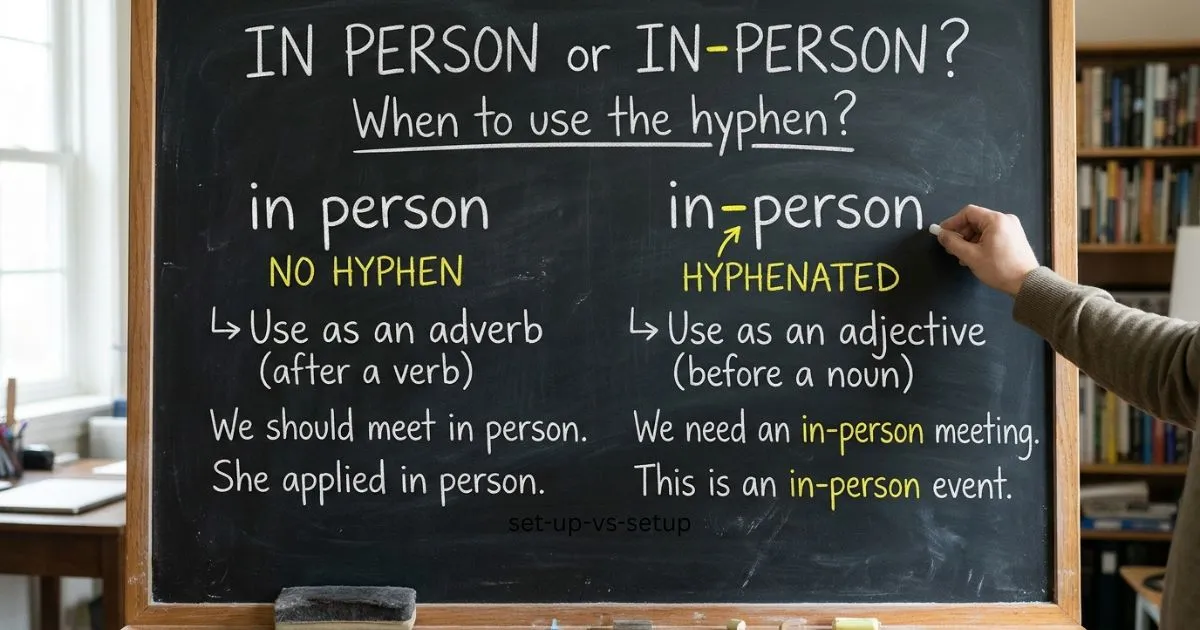
Write in-person with a hyphen when it comes before a noun, as in “an in-person class.” Write in person with no hyphen when it follows a verb, as in “we met in person.” The hyphen turns two words into one adjective. Without a noun to describe, you do not need it.
⚡ Quick Rule in 1 Line
“Before a noun, add the hyphen; after a verb, leave the space — that’s the whole rule.”
What Is the Difference Between In Person and In-Person?
In person is an adverb phrase. It tells how something happens: face to face, with people in the same place. In-person is an adjective. It describes a noun, such as a meeting, class, or visit. Same meaning, different job in the sentence.
Let’s look at each one.
In person (no hyphen) means “in one’s bodily presence.” It answers the question “how?” You do something in person. You meet in person. You sign in person.
In-person (hyphen) describes a thing. It answers the question “what kind?” What kind of interview? An in-person interview. What kind of class? An in-person class.
Here is the same idea written both ways:
- We interviewed her in person.
- It was an in-person interview.
The meaning does not change. The grammar does. Merriam-Webster explains it the same way: use “in person” as an adverb and “in-person” as an adjective.
This is not a US versus UK spelling issue. The hyphen rule is about grammar, so American and British writers follow the same logic.
The Grammar Rule: Why the Hyphen Appears
A hyphen joins two or more words into one adjective that sits before a noun. “In person” is two words. “In-person” is one idea. Put the hyphen in only when that idea comes right before the noun it describes.
Grammar books call this a compound adjective. It is a group of words that work together to describe a noun.
Here are other examples that follow the same pattern:
- a well-known author (but: the author is well known)
- a full-time job (but: she works full time)
- a long-term plan (but: we plan for the long term)
Notice the pattern. Before the noun, the words get a hyphen. After the verb, they stand alone.
“In person” works the same way:
- an in-person visit (before the noun “visit”)
- visit in person (after the verb “visit”)
Why does the hyphen help? It stops the reader from stumbling. Without it, “in person meeting” can look like three separate words. The hyphen tells the reader that “in-person” belongs together and describes “meeting.”
Oxford Learner’s Dictionaries lists in-person as an adjective used only before a noun. That is a useful clue. If there is no noun right after it, you probably want the plain adverb: in person.
Read More: Me and My Family or My Family and I? Fix It in 5 Seconds
Quick Comparison Table
This table shows the two forms side by side. The only real difference is the job each one does. Adverb jobs go without the hyphen. Adjective jobs get the hyphen. Use the table as a fast check before you hit send.
| Feature | In person | In-person |
|---|---|---|
| Part of speech | Adverb (phrase) | Adjective |
| Hyphen? | No | Yes |
| Where it sits | After a verb | Before a noun |
| Question it answers | How? | What kind? |
| Quick test | Next word is a verb, period, or comma | Next word is a noun |
| Example | She applied in person. | She sent an in-person application. |
| Similar word | personally, face to face | face-to-face, on-site |
| Opposite | online, remotely | virtual, online |
Memory Tricks
Use the noun test. Look at the word right after the phrase. If it is a noun, such as class or meeting, add the hyphen. If it is a verb, a period, or a word like “for,” skip it. This one check solves most cases.
Here are four tricks you can use.
1. The noun test. Find the word that comes next. Is it a thing you can touch or name? Meeting, class, event, visit, interview. If yes, write in-person.
2. The hand-holding picture. The hyphen is like two hands holding each other so they can hold a noun together. No noun to hold? No hyphen needed.
3. The “how” and “what kind” questions. Ask yourself: “Am I saying how, or what kind?”
- How did you meet? In person.
- What kind of meeting? An in-person meeting.
4. The end-of-sentence test. If the phrase can end the sentence, it is the adverb. “I will tell her in person.” That works, so no hyphen.
Pick the trick that feels natural. After a week of using it, you will not need it.
20 Example Sentences
These examples are split by form so you can see the pattern. Read them out loud. The hyphen shows up only when a noun follows.
In person (no hyphen)
- We met in person after two years of emails.
- You must sign the form in person.
- She looks taller in person than on TV.
- Please thank the team in person if you can.
- I would rather explain this in person.
- Voters can register in person at the county office.
- He accepted the award in person.
- The manager wants to talk to you in person.
- Many people still shop for shoes in person.
In-person (hyphen)
- We booked an in-person interview for Tuesday.
- The school brought back in-person classes in September.
- An in-person visit helps build trust.
- She prefers in-person meetings to video calls.
- The in-person event sold out in two days.
- Our in-person support desk opens at nine.
- The company offers in-person and online training.
- He missed the in-person part of the exam.
- An in-person tour costs nothing.
Both forms in one sentence
- Please apply in person at the in-person job fair.
- She spoke in person at the in-person town hall.
Sentences 19 and 20 are handy study tools. The first “in person” follows a verb. The second “in-person” sits before a noun.
Common Mistakes
The most common mistake is adding a hyphen after a verb. The second most common is leaving the hyphen out before a noun. Both slip into emails, resumes, and job posts all the time. Here are the errors to watch for.
Hyphen after a verb
- ❌ Let’s meet in-person.
- ✅ Let’s meet in person.
No hyphen before a noun
- ❌ We offer an in person interview.
- ✅ We offer an in-person interview.
Hyphenating the noun too
- ❌ We held an in-person-meeting.
- ✅ We held an in-person meeting.
The hyphen belongs inside the adjective only. The noun stands alone.
Writing it as one word
- ❌ The inperson event starts at noon.
- ✅ The in-person event starts at noon.
Forgetting the second capital in a title
- ❌ Join Our In-person Workshop
- ✅ Join Our In-Person Workshop
In title case, capitalize both parts of the hyphenated word.
Using “in-person” after “is” or “was”
- ⚠ The class is in-person.
- ✅ The class is held in person.
This one is a gray area. We explain it in the next section.
When to Use Each Form
Use in-person when a noun follows right after it. Use in person when it comes after a verb or ends the sentence. If you are unsure, rewrite the sentence so the phrase sits next to a noun or a verb. Then the choice is easy.
In emails and invitations
Emails are where most mix-ups happen. Keep it simple.
- “We would love to see you in person.” (after a verb)
- “Please join us for an in-person lunch.” (before a noun)
On a resume or in a job post
Hiring teams use both forms often. Here is a clean way to write them.
- “Interviews will take place in person.”
- “This role needs strong in-person communication skills.”
- “Candidates must attend an in-person interview.”
In school and training
Schools and course pages repeat these phrases a lot.
- “Students can take the exam in person.”
- “In-person classes meet on Mondays.”
In business writing
Clear writing builds trust with clients.
- “We prefer to deliver bad news in person.”
- “The in-person demo takes thirty minutes.”
The gray area: “The event is in-person”
You will see sentences like “The conference is in-person this year” on many websites. They are common in event listings and ads.
The traditional rule says no hyphen here. No noun follows, so the adverb form is the better fit. Oxford Learner’s Dictionaries marks in-person as an adjective used only before a noun.
The safest move is to avoid the problem. Try one of these fixes:
- Move the adjective: “This is an in-person conference.”
- Use the adverb: “The conference is held in person this year.”
- Use another word: “The conference is face to face this year.”
Any of the three keeps your grammar clean and your reader happy. This is especially smart for school essays, exams, and formal writing.
In Person vs Similar Words
In person has a few close cousins. They mean almost the same thing, but each fits a little differently. Knowing them helps you vary your writing and avoid repeating the same phrase.
Personally. This is the closest synonym for the adverb. “She thanked him personally” means she did it herself. Be careful, though. “Personally” can also mean “in my opinion,” and “in person” never does.
Face to face. This works as an adverb without hyphens: “We spoke face to face.” As an adjective before a noun, it gets hyphens: “a face-to-face talk.” It follows the same rule as in person.
On-site. This often describes work or services at a location: “on-site training.” It focuses on place, not on people meeting.
Virtual, online, remote. These are the usual opposites. “An in-person class” is the opposite of “a virtual class.” “Meet in person” is the opposite of “meet online.”
A short note on word choice: public agencies often prefer “online” or “in person” over “virtual” or “physical,” because those words are plain and clear. That is a good habit for any writer.
Key Takeaways
- In person is an adverb phrase. It has no hyphen.
- In-person is an adjective. It has a hyphen.
- Use the hyphen when a noun comes right after the phrase.
- Skip the hyphen after a verb: “We met in person.”
- Never hyphenate the noun: “in-person meeting,” not “in-person-meeting.”
- Capitalize both parts in titles: “In-Person Workshop.”
- “The class is in-person” is common online, but the traditional rule prefers “held in person.”
- This is a grammar rule, not a US/UK difference.
FAQs
1. Is it “in person” or “in-person”?
Both are correct, but they do different jobs. Use “in-person” before a noun, as in “an in-person event.” Use “in person” after a verb, as in “we met in person.”
2. Does “in person” need a hyphen?
Only when it comes right before a noun. Then it acts as an adjective, and the hyphen joins the two words. After a verb, no hyphen is needed.
3. Is “in person” an adverb or an adjective?
“In person” is an adverb phrase. It tells how something is done. The hyphenated form, “in-person,” is an adjective that describes a noun.
4. Can I write “The meeting is in-person”?
You will see it often online, but the traditional rule says no. No noun follows the phrase. Write “The meeting is held in person,” or say “This is an in-person meeting.”
5. Is “in person” or “in-person” correct on a resume?
Both can be correct. It depends on the sentence. Write “Interviews happen in person” (no hyphen) or “in-person interview” (hyphen). Check the next word each time.
6. What is the opposite of “in-person”?
Common opposites are virtual, online, and remote. For the adverb form, use phrases like “online” or “by video call.” Example: “in-person class” versus “online class.”
7. Is the rule different in UK English?
No. This is a grammar rule about hyphens before nouns, not a spelling difference. American and British writers both hyphenate compound adjectives before a noun.
8. How do I write it in a title?
Capitalize both parts when the hyphen appears: “In-Person Workshop.” For the adverb, follow normal title rules: “Meet You in Person.”
9. Is “inperson” ever correct?
No. “Inperson” is not a standard word. Write “in person” as two words or “in-person” with a hyphen.
10. What is a good synonym for “in person”?
Try “personally,” “face to face,” or “in the flesh.” For the adjective, try “face-to-face” or “on-site.” Pick the one that fits your sentence and tone.
Conclusion:
The rule is short. Use in-person when a noun follows: an in-person class, an in-person visit. Use in person when it follows a verb or ends a thought: meet in person, sign in person.
If a sentence feels tricky, rewrite it so the phrase sits next to a noun or a verb. The right form becomes clear right away.
Check the next word every time. That small habit will keep your emails, resumes, and essays clean.

I’m Sophia Mitchell, an English grammar and writing enthusiast. I create simple, easy-to-understand content to help learners improve their English. My goal is to make grammar clear, practical, and enjoyable for everyone.