You typed “sentance” in an email, and a red line popped up. The red line was right: the correct spelling is “sentence,” with an E, not an A.
This mix-up is very common. The word sounds like “sen-tuhns,” so the middle vowel is easy to guess. Many writers pick A because other words end in -ance, like “distance” and “balance.”
Here is the good news. Sentence is spelled the same in the US and the UK. There is no hidden exception to learn.
This guide shows why people mistype it, how to remember it, and how to use it in grammar and in law.
Quick Answer
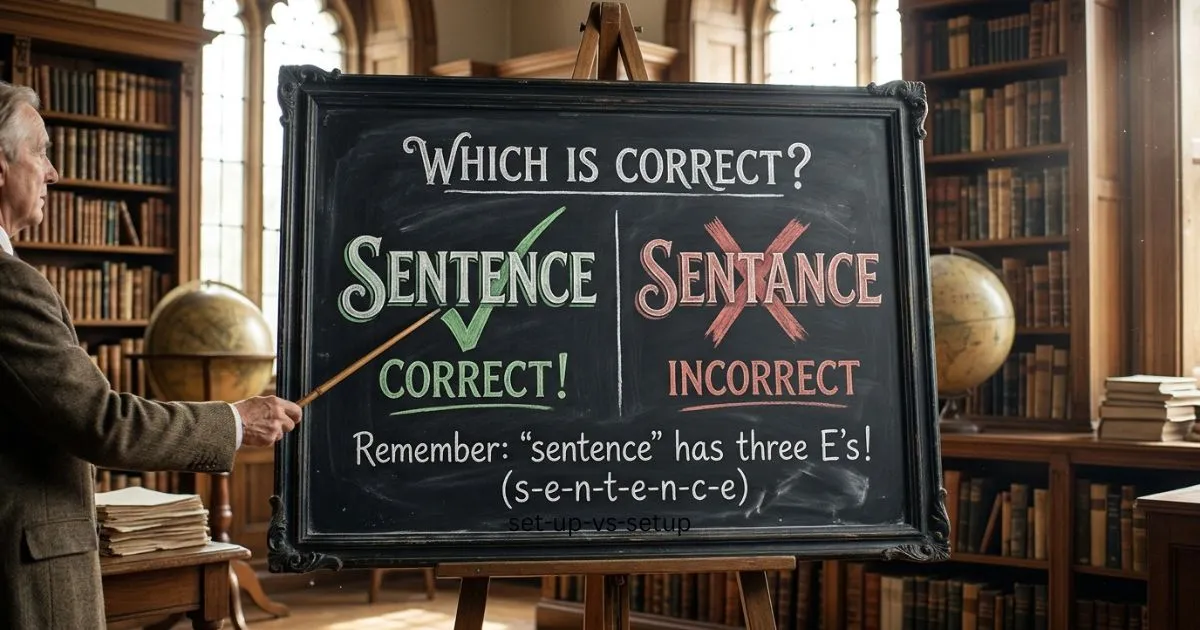
The correct spelling is sentence. It ends in -ence, not -ance. “Sentance” is a misspelling and is not a real English word. The spelling is the same in American and British English. A sentence is a group of words that expresses a complete thought, or a punishment given by a court.
⚡ Quick Rule in 1 Line
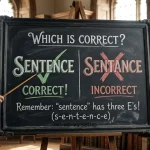
Spell sentence with three Es and zero As: it ends with -ence, just like silence.
Sentence or Sentance: Which Spelling Is Correct?
Sentence is the only correct spelling. “Sentance” is a misspelling, and dictionaries do not list it as a word. The correct form has three Es and ends in -ence. If you see “sentance” in a draft, fix it every time.
Here is the word broken into parts: sen + ten + ce. It has eight letters: S-E-N-T-E-N-C-E.
Merriam-Webster lists the word as “sentence,” and so do other major dictionaries. You will not find a second spelling with an A.
Think of it this way. Sentence is a real word with a long history. Sentance is only a slip of the finger or the ear.
Why People Spell Sentence as Sentance
People write “sentance” because of sound. The ending of sentence is weak and short, so -ence and -ance sound almost the same. The brain guesses an A, and fast typing makes the slip even more likely.
The last syllable is not stressed. When you say the word, the vowel before the N almost disappears.
English also has many common words that end in -ance. Think of distance, balance, importance, and instance. Your memory may pull sentence toward that group.
ESL learners often spell by sound, because English spelling does not always match speech. That makes -ence and -ance a very common trouble spot.
The good news is that this is a small, fixable problem. One memory trick is usually enough.
Read More: Color or Colour? The Correct Spelling in American and British English
Where the Word Sentence Comes From
Sentence comes from the Latin word sententia, which meant a feeling, an opinion, or a judgment. It reached English through Old French and Anglo-French. The -ence ending is a leftover from that path.
Merriam-Webster traces sententia back to the Latin verb sentire, which means to feel or to think. The first known use of “sentence” in English is in the 14th century.
So the first meaning was an opinion. Then it came to mean a judge’s ruling. Later it also came to mean a complete thought put into words.
This word family helps with spelling. Sentiment, sentient, and consent all come from the same Latin verb. Notice the E in each of them.
When you know the roots, the E in the middle of sentence feels less random.
Sentance vs Sentence: Comparison Table
This table shows the full difference at a glance. Only one column is correct, and it is the same in every English-speaking region. Use it as a quick check before you publish.
| Feature | Sentence | Sentance |
|---|---|---|
| Is it correct? | Yes | No |
| Word ending | -ence | -ance (wrong) |
| Listed in dictionaries? | Yes | No |
| American English | Correct | Incorrect |
| British English | Correct | Incorrect |
| Plural | Sentences | Sentances (wrong) |
| Verb forms | Sentenced, sentencing | Sentanced, sentancing (wrong) |
| Use in school or work | Safe | Marked as an error |
Is Sentence Spelled Differently in US and UK English?
No. Sentence is spelled the same in American and British English. There is no US and UK split for this word. “Sentance” is wrong in both, so you never need to switch spellings for a different audience.
Some words do change by region. Color becomes colour, and center becomes centre. Sentence is not one of them.
It joins other words, like “cancellation,” that stay the same across regions. That is why this article treats “sentance” as a plain misspelling, not a regional choice.
If you write for a US audience, use “sentence.” If you write for a UK audience, use “sentence.” The rule is the same.
The -ence vs -ance Spelling Rule
English has no perfect rule for -ence versus -ance. Both endings sound the same. The safest method is to learn each word, then use word families as a clue. One helpful tip is to check a related word that ends in -ent or -ant.
Here is the tip. If a related word has -ent, the noun often ends in -ence. If a related word has -ant, the noun often ends in -ance.
This works most of the time, but not always. Treat it as a clue, not a law.
| Noun | Related word | Ending |
|---|---|---|
| Silence | Silent | -ence |
| Difference | Different | -ence |
| Sentence | Sentient, sentiment | -ence |
| Importance | Important | -ance |
| Distance | Distant | -ance |
| Performance | Perform | -ance |
For sentence, the related words sentient and sentiment both carry an E. That points to -ence.
If you are ever unsure, look the word up. A quick check takes five seconds.
Memory Tricks to Spell Sentence Right
Use one of these tricks to lock in the spelling. Spot the word “ten” in the middle, count the three Es, or link sentence to its word family. Pick the trick that feels easiest, and repeat it a few times.
Trick 1: Find the hidden “ten”
Look at the middle of the word: sen-ten-ce. If you can count to ten, you can spell the middle. Ten has an E, so no A can sneak in.
Trick 2: Count three Es
Write the word once: S-E-N-T-E-N-C-E. Circle the Es. There are three, and there are zero As.
Trick 3: Use the word family
Sentence is related to sentient and sentiment. Both have “ent” in them. Same family, same E.
Trick 4: Rhyme it with silence
Both words end in -ence. Say it out loud: “silence in the sentence.” The matching ending sticks in memory.
What Does Sentence Mean?
A sentence has two main meanings. In grammar, it is a group of words that expresses a complete thought. In law, it is the punishment a judge orders. It can also be a verb, as in “to sentence someone.”
Sentence in grammar
A grammar sentence starts with a capital letter and ends with a period, question mark, or exclamation mark. It usually has a subject and a verb.
Merriam-Webster describes it as a unit that expresses a statement, a question, a command, a wish, or an exclamation. Here are the four common types:
- Statement: The bus is late.
- Question: Is the bus late?
- Command: Wait for the bus.
- Exclamation: The bus is here!
A group of words without a full thought is a fragment, not a sentence. Here is one: “Because it was late.”
Sentence in law
In a court, a sentence is the punishment a judge decides on after a guilty verdict. It can also mean the ruling itself.
For example, “He received a three-year sentence.” Types include a life sentence and a suspended sentence.
Sentence as a verb
As a verb, to sentence means to give a punishment in court. The forms are sentence, sentenced, and sentencing.
The spelling stays with -ence in every form. Never switch to -ance.
18 Example Sentences
These examples show every use of the word. Read them out loud. Seeing the correct spelling again and again helps your memory.
Grammar examples
- Every sentence should start with a capital letter.
- Her first sentence was short and clear.
- Read your sentence out loud before you send the email.
- This sentence has a subject and a verb.
- A very long sentence can confuse the reader.
- The teacher asked us to write ten sentences.
Legal examples
- The judge read the sentence in court.
- He received a five-year sentence.
- The sentence was reduced after the appeal.
- A life sentence means prison for the rest of a person’s life.
Verb examples
- The judge sentenced him to one year of probation.
- She was sentenced on Monday.
- The court will sentence both men next week.
- Sentencing is set for Friday.
Wrong and right pairs
- Wrong: “I wrote one sentance.” Right: I wrote one sentence.
- Wrong: “Fix each sentance.” Right: Fix each sentence.
- Wrong: “Her sentancing is today.” Right: Her sentencing is today.
- Wrong: “Three sentances were missing.” Right: Three sentences were missing.
Common Mistakes With Sentence
The biggest mistake is writing “sentance,” but it is not the only one. Learners also drop letters, swap vowels, or break the plural and verb forms. Here are the errors to watch for, and the fix for each.
1. Misspelling the base word
Besides “sentance,” people also write sentense, sentece, setence, sntence, and sentince. All of these are wrong. The only correct form is sentence.
2. Carrying the error into other forms
If you write “sentance,” the mistake spreads. You get sentances, sentanced, and sentancing. Fix the base word and all forms follow.
| Wrong | Right |
|---|---|
| sentances | sentences |
| sentanced | sentenced |
| sentancing | sentencing |
3. Mixing up sentence and sentience
Sentience means the ability to feel or perceive. Sentence is a group of words or a court punishment. They look close, but the meanings are far apart.
4. Trusting spell check alone
Spell check catches “sentance” in most documents. It can miss the error in images, file names, and social media bios. Give those a quick manual check.
5. Calling a fragment a sentence
A fragment lacks a complete thought. “After the meeting ended” is a fragment. “After the meeting ended, we left” is a sentence.
When to Use Each Form
There is only one correct spelling, but the word has several forms. Use sentence for the noun and the base verb. Use sentences for more than one. Use sentenced for past actions, and sentencing for the process in court.
| Form | Part of speech | Use it when | Example |
|---|---|---|---|
| Sentence | Noun | You mean one group of words, or one punishment | Write one sentence. |
| Sentence | Verb | A judge gives a punishment | The judge will sentence him. |
| Sentences | Noun (plural) | You mean more than one | Read these sentences. |
| Sentenced | Verb (past) | The punishment was already given | She was sentenced today. |
| Sentencing | Verb or noun | The court is in the process of deciding | Sentencing is on Friday. |
A quick checklist before you hit publish:
- Does every form have -ence?
- Are there three Es in the base word?
- Is there an A anywhere? If yes, fix it.
Key Takeaways
- Sentence is the only correct spelling. “Sentance” is a typo.
- The spelling is the same in US and UK English.
- The word has three Es and zero As.
- Spot the hidden “ten” in sen-ten-ce to remember the middle.
- The word comes from Latin sententia, meaning opinion or judgment.
- It has two main meanings: a complete thought in grammar and a punishment in law.
- The plural is sentences. The verb forms are sentenced and sentencing.
- Keep -ence in every form of the word.
FAQs
1. Is it sentence or sentance?
The correct spelling is sentence. It ends in -ence. “Sentance” is a common misspelling and should be fixed in any piece of writing.
2. Is sentance a real word?
No. Sentance is not a real English word. It is a typo or a spelling guess based on sound. Dictionaries list only “sentence.”
3. How do you spell sentence?
Sentence is spelled S-E-N-T-E-N-C-E. It has eight letters and three Es. A helpful trick is to spot the word “ten” in the middle: sen-ten-ce.
4. Is sentence spelled differently in British English?
No. Sentence is spelled the same in British and American English. “Sentance” is wrong in both.
5. What is a sentence in grammar?
In grammar, a sentence is a group of words that expresses a complete thought. It starts with a capital letter and ends with a period, question mark, or exclamation mark.
6. How many Es are in sentence?
There are three Es in sentence: s-E-n-t-E-n-c-E. There are no As in the word.
7. What is the plural of sentence?
The plural is sentences. Add an S to the end. Never write “sentances.”
8. What is the past tense of sentence?
The past tense of the verb is sentenced. For example, “The judge sentenced him to one year.” Never write “sentanced.”
9. Why does sentence end in -ence and not -ance?
The word comes from the Latin sententia through Old French. It kept the -ence ending on the way into English. Related words like sentient and sentiment also have an E.
10. Can a sentence be one word?
Yes. A one-word command like “Stop!” is a complete sentence. The subject “you” is understood, even though it is not written.
Conclusion:
The answer is simple: sentence is correct, and sentance is a mistake. This is true in American and British English, so you never need to switch.
Remember the hidden “ten” in sen-ten-ce, and count three Es with no A. If you are still unsure, link it to silence, sentient, or sentiment.
Fix the base word, and the plural and verb forms fix themselves. Now you can write your next sentence with confidence.

I am an English language writer passionate about grammar and clear communication. I create simple, easy-to-understand content that helps readers improve their English skills. My goal is to make learning English both practical and enjoyable.