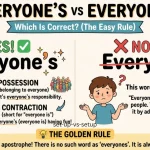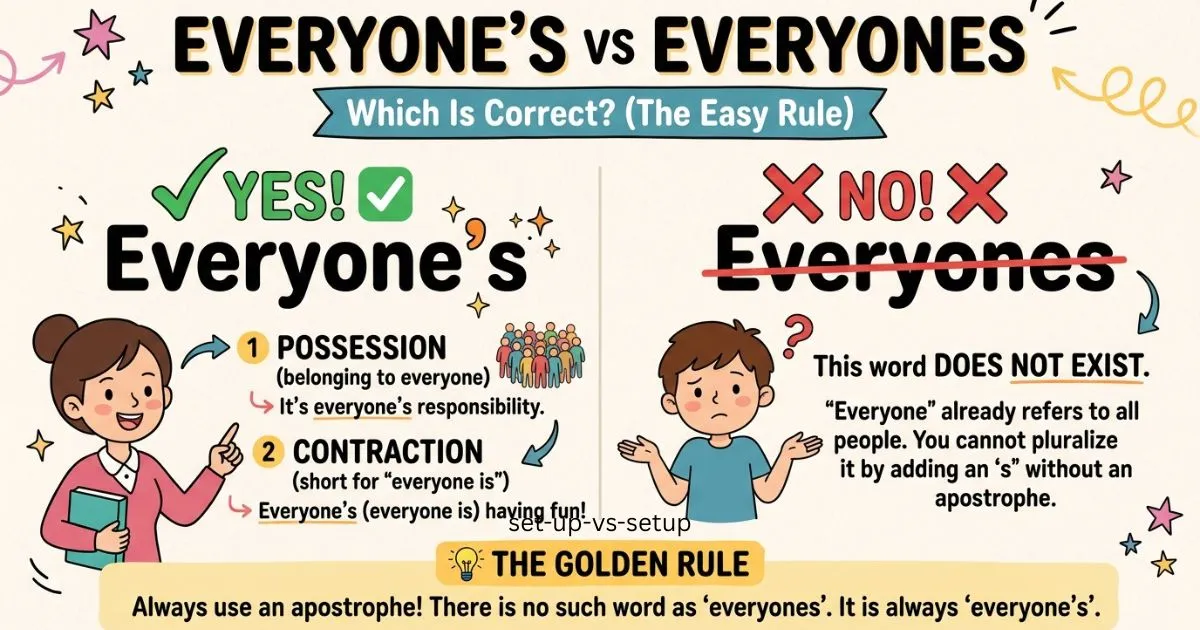
You type “Everyones invited to the party!” and hit send. The correct form is everyone’s, with an apostrophe before the s.
Everyones is not a word. Everyone is singular, so it never takes a plain plural s. Everyone’s does two jobs: it shows ownership (“everyone’s coat”) and it shortens “everyone is” or “everyone has.”
Writers also trip over everyones’, with the apostrophe after the s. That form is wrong too. This guide shows the rule, simple examples, and a memory trick that works every time.
Below, you will also see how to tell the possessive from the contraction in one second. Spelling checkers often miss this error, so it helps to know the rule yourself.
Quick Answer
Use everyone’s. It is the possessive form (everyone’s idea) and the contraction of “everyone is” or “everyone has” (everyone’s here). Everyones is not a real word, and everyones’ wrongly treats everyone as plural. The apostrophe goes before the s in both US and UK English.
⚡ Quick Rule in 1 Line
“Everyone is singular, so it gets apostrophe-s: everyone’s. Plain everyones and everyones’ are wrong in standard writing.”
Everyone’s vs Everyones: The Short Difference
Everyone’s is the correct form. It shows ownership (everyone’s bag) or shortens “everyone is” and “everyone has.” Everyones is not a word in standard English. Everyones’ is also wrong, because it treats everyone as a plural noun, and everyone is singular.
The confusion is easy to understand. Most nouns become plural with an s: dog, dogs. So writers add an s to everyone, too.
But everyone is a pronoun, not a regular noun. Pronouns follow their own rules.
Then comes a second problem. Does the apostrophe go before the s or after it? For everyone, it always goes before.
- ✅ everyone’s: correct (possessive or contraction)
- ❌ everyones: not a word
- ❌ everyones’: apostrophe in the wrong spot, and it treats everyone as plural
Why Everyone Is Singular (The Grammar Rule)
Everyone is an indefinite pronoun, and grammar treats it as singular. It refers to many people, but it takes a singular verb: everyone is, everyone has. Because it is singular, it has no plural form, so a plain s is never added.
Think about what the word means. Everyone means every person. You would say “every person is here,” not “every person are here.”
Everyone works the same way.
- Right: Everyone loves pizza.
- Wrong: Everyone love pizza.
- Wrong: Everyone are happy.
Grammar Girl explains that everyone sounds like a lot of people, but in grammar it acts as one singular word. That is why it takes a singular verb.
No plural form means no plural possessive either. That rules out everyones’ for good.
Read More: Its vs. It’s: A 5-Second Test to Choose Correctly
The Two Jobs of Everyone’s
Everyone’s does two jobs. As a possessive, it shows that something belongs to everyone, as in “everyone’s turn.” As a contraction, it shortens “everyone is” or “everyone has,” as in “everyone’s here.” The spelling is the same for both jobs.
Job 1: Possessive (ownership). It shows that something belongs to each person in the group.
- Everyone’s opinion matters.
- I need everyone’s help.
Job 2: Contraction (shortened words). It joins everyone with “is” or “has.”
- Everyone’s here. (everyone is)
- Everyone’s finished the quiz. (everyone has)
The quick test. Say “everyone is” or “everyone has” in its place. If the sentence still works, it is a contraction. If it fails and a noun follows, it is a possessive.
Try it on “Everyone’s turn is next.” Swap in “everyone is turn.” That fails, so it is a possessive.
Unlike its and it’s, the possessive and the contraction share one spelling here. That makes this one easier.
In formal writing, many editors prefer the full words. Write “everyone is ready” in an essay and “everyone’s ready” in a text.
Why Everyones’ Is Wrong Too
Everyones’ is wrong because an apostrophe after the s marks a plural noun, like “the students’ books.” Everyone is not a plural noun. So the apostrophe must come before the s, and the correct form is everyone’s.
Here is the plural rule. If a plural noun ends in s, add only an apostrophe. Think of “the dogs’ bowls” or “the teachers’ lounge.”
Dogs and teachers are plural. Everyone is not. So the plural-possessive rule does not apply.
- everyone’s: one pronoun, apostrophe before the s
- the students’: one plural noun, apostrophe after the s
Need a truly plural idea? Change the word. Write “all the students’ ideas” or “people’s ideas.”
Comparison Table
This table shows all three forms side by side. Only one form is correct in standard English. Keep it handy as a quick check before you publish or send a message.
| Form | Correct? | Why | Wrong → Right |
|---|---|---|---|
| everyone’s | ✅ Yes | Possessive, or short for “everyone is/has” | Everyone’s ticket is ready. |
| everyones | ❌ No | Not a word; everyone has no plural | Everyones invited. → Everyone’s invited. |
| everyones’ | ❌ No | Treats everyone as plural | Everyones’ ideas matter. → Everyone’s ideas matter. |
A Memory Trick That Works Every Time
Say it as two words: “every person’s.” You would never write “every persons” or “every persons’.” Since everyone means every person, it follows the same pattern: one apostrophe, placed before the s.
Here are three quick tricks. Use whichever one sticks.
- The two-word swap. Replace everyone with “every person.” If “every person’s” looks right, write everyone’s.
- The is/has swap. Replace everyone’s with “everyone is” or “everyone has.” If it works, you need the apostrophe.
- The one-group rule. Everyone is one group word. One group word, one apostrophe-s.
No version of this trick ever ends in a plain s.
20 Real Example Sentences
Examples make the rule stick. Below are 20 sentences with everyone’s, grouped by how it works. Read them aloud once. Then check the wrong-to-right fixes at the end, because those match the mistakes people make most often in emails and texts.
Possessive (ownership)
- Everyone’s seat is near the window.
- I need everyone’s attention for a quick update.
- The new rule is in everyone’s best interest.
- Everyone’s favorite song played at the party.
- We respect everyone’s opinion in this class.
- Please check everyone’s name on the list.
- The teacher praised everyone’s hard work.
- Cleaning up is everyone’s job.
Contraction: everyone is
- Everyone’s waiting outside.
- I think everyone’s ready to start.
- Everyone’s invited to the picnic.
- Don’t worry; everyone’s learning.
- Everyone’s going to love this recipe.
Contraction: everyone has
- Everyone’s finished the quiz.
- Everyone’s had a long day.
- I hope everyone’s eaten lunch.
- Everyone’s got a copy of the schedule.
Wrong → Right
- ❌ Everyones invited. → ✅ Everyone’s invited.
- ❌ Everyones’ ideas matter. → ✅ Everyone’s ideas matter.
- ❌ I value everyones opinion. → ✅ I value everyone’s opinion.
Everyone’s Mind or Everyone’s Minds?
Use a singular noun after everyone’s when each person has just one of something, like a mind or a favorite color. Use a plural noun when each person has several, like hobbies. Many editors still prefer “on everyone’s mind.”
The logic is simple. “Every person’s mind” sounds natural, so “everyone’s mind” does too.
- Safety is on everyone’s mind.
- Everyone’s hobbies are different.
Everybody’s follows the same rule. Everybody is also singular. Write “everybody’s idea,” never “everybodys idea.” Everybody’s is a little less formal than everyone’s.
Everyone else’s puts the apostrophe after “else.” The ’s goes on the last word of the phrase. Write “I like her plan better than everyone else’s,” not “everyone’s else.”
Common Mistakes (and Quick Fixes)
Most mistakes come from three habits: adding a plain s, putting the apostrophe after the s, and pairing everyone with a plural verb. Each one has a quick fix. Spelling checkers often miss them, so a final read-through helps.
- Mistake 1: Everyones (no apostrophe). Common in texts and social posts. Fix: add the apostrophe before the s.
- Mistake 2: Everyones’ (apostrophe after the s). This treats everyone as plural. Fix: move the apostrophe before the s.
- Mistake 3: “Everyone are.” Everyone takes a singular verb. Fix: use “is” or “has.”
- Mistake 4: Trusting autocorrect. Some tools skip this error. Fix: use the two-word swap before you hit send.
- Mistake 5: Writing “everyone’s else.” Fix: write “everyone else’s.”
When to Use Each Form
Use everyone when you mean all people as the subject: “Everyone knows.” Use everyone’s to show ownership or to shorten “everyone is” or “everyone has.” Never use everyones or everyones’ in standard writing, school work, or business emails.
- everyone: the subject or object of a sentence. “Everyone passed.” “I thanked everyone.”
- everyone’s (possessive): when something belongs to everyone. “Everyone’s notes are on the table.”
- everyone’s (contraction): in casual writing. “Everyone’s here.” In formal writing, spell it out.
- everyones / everyones’: not for standard writing.
US vs UK English: Any Difference?
There is no US versus UK spelling difference here. Both use everyone’s, with the apostrophe before the s. The only small difference is style. British usage more often accepts “their” after everyone, while some American editors prefer to rewrite the sentence.
Grammar Girl notes that British usage commonly pairs everyone with a singular verb and a plural pronoun. American grammarians are less settled on that point.
This is not a spelling-pair word like color and colour. Do not look for a regional spelling split.
The apostrophe rule is the same in the United States, the United Kingdom, Canada, and Australia.
Key Takeaways
- Everyone’s is the only correct form.
- Everyones is not a word, and everyones’ is wrong.
- Everyone is singular and has no plural form.
- Everyone’s can be a possessive or short for “everyone is/has.”
- Use the “every person’s” swap to check yourself.
- Say “everyone else’s,” with the apostrophe after “else.”
- There is no US vs UK spelling difference for this word.
FAQs
1. Is it everyones or everyone’s?
Everyone’s is correct. Everyones is not a word in standard English. Add an apostrophe before the s to show ownership or to shorten “everyone is” or “everyone has.” Example: “Everyone’s invited.”
2. Is everyones’ ever correct?
No, not in standard English. An apostrophe after the s belongs to plural nouns, and everyone is singular. Use everyone’s instead. If you need a plural idea, write “all the students’” or “people’s.”
3. What is the plural of everyone?
Everyone has no plural form. It already points to a whole group. To talk about several groups, use phrases like “all the groups” or “people.”
4. Is everyone singular or plural?
Everyone is grammatically singular. It takes a singular verb: “everyone is,” “everyone has.” It sounds like many people, but grammar treats it as one word.
5. Is everyone’s a contraction or a possessive?
It can be either. As a possessive, it shows ownership: “everyone’s turn.” As a contraction, it stands for “everyone is” or “everyone has”: “everyone’s here.”
6. Is it “everyone’s mind” or “everyone’s minds”?
Both appear in writing, but many editors prefer “on everyone’s mind.” Use the singular when each person has one of the thing. Use the plural when each person has several, like hobbies.
7. Is everybody’s correct too?
Yes. Everybody is also singular, so the possessive is everybody’s. Everybodys and everybodys’ are wrong for the same reasons as everyones and everyones’.
8. Does UK English spell it differently?
No. UK and US English both write everyone’s with the apostrophe before the s. The only difference is style, such as how often “their” follows everyone.
9. Can I use “their” after everyone?
Yes, in most writing. Merriam-Webster lists singular “they” and “their” with singular indefinite pronouns like everyone. For strict formal writing, you can rewrite: “All the students brought their books.”
10. How do I know if everyone’s means “is” or “has”?
Look at the next word. A noun means it is possessive: “everyone’s turn.” An adjective or -ing verb means “is”: “everyone’s ready.” A past-tense verb like finished or eaten usually means “has”: “everyone’s finished.”
Conclusion:
The answer is simple. Write everyone’s, with the apostrophe before the s. It works as a possessive and as a short form of “everyone is” or “everyone has.”
Everyones is not a word. Everyones’ treats everyone as plural, and it is not. When in doubt, say “every person’s” in your head. If that fits, everyone’s is right.
The rule is the same in US and UK English.

I’m Sophia Mitchell, an English grammar and writing enthusiast. I create simple, easy-to-understand content to help learners improve their English. My goal is to make grammar clear, practical, and enjoyable for everyone.