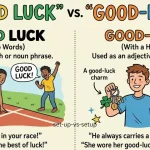
You text “goodluck!” to a friend, and autocorrect splits it into “good luck.” Autocorrect is right. Write it as two words. Add a hyphen only before a noun, as in “good-luck charm.”
Here is the short version. “Good luck!” is the wish. “A good-luck charm” is the hyphenated form. “Goodluck” as one word is not standard English, except as a personal name.
Many learners mix these up because English joins some word pairs and splits others. Everyday and every day are another example.
This guide shows which form to pick, why it works, and how to spot the error fast. You will also get a memory trick, 18 example sentences, and a short FAQ.
Quick Answer
Write “good luck” as two words in almost every case. Use the hyphenated “good-luck” only as a compound adjective before a noun, as in “good-luck charm.” The one-word “goodluck” is not standard English. It appears only as a given name, such as Goodluck, and needs a capital G.
⚡ Quick Rule in 1 Line
Two words for the wish, a hyphen before a noun, and one word only for a name.
Goodluck vs Good Luck vs Good-Luck: What’s the Difference?
“Good luck” is the standard phrase, written as two words. “Good-luck” is the same phrase with a hyphen, used only before a noun. “Goodluck” is not a standard English word. You will see it mostly as a first name.
The table below shows all three forms side by side.
| Form | Standard? | Use it when | Example |
|---|---|---|---|
| good luck | Yes | You wish someone well, or name the idea of luck | Good luck on your exam! |
| good-luck | Yes, before a noun | The phrase works as one adjective | She wore a good-luck bracelet. |
| Goodluck | Only as a name | You write a person’s first name | Goodluck sent the invitation. |
| goodluck (lowercase) | No | Never in normal writing, except hashtags and usernames | #goodluck |
Why “good luck” stays two words
“Good” is an adjective. “Luck” is a noun. Together they form a plain adjective-and-noun pair, like “good news” or “good morning.”
Some pairs have fused into one word, like “sunshine.” “Good luck” has not. Dictionaries such as Merriam-Webster and Dictionary.com list it as two words.
If you wonder how English decides between a space and one word, see our guide to everyday vs every day. It follows the same space-or-one-word logic.
Is Good-Luck With a Hyphen Ever Correct?
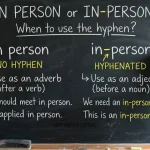
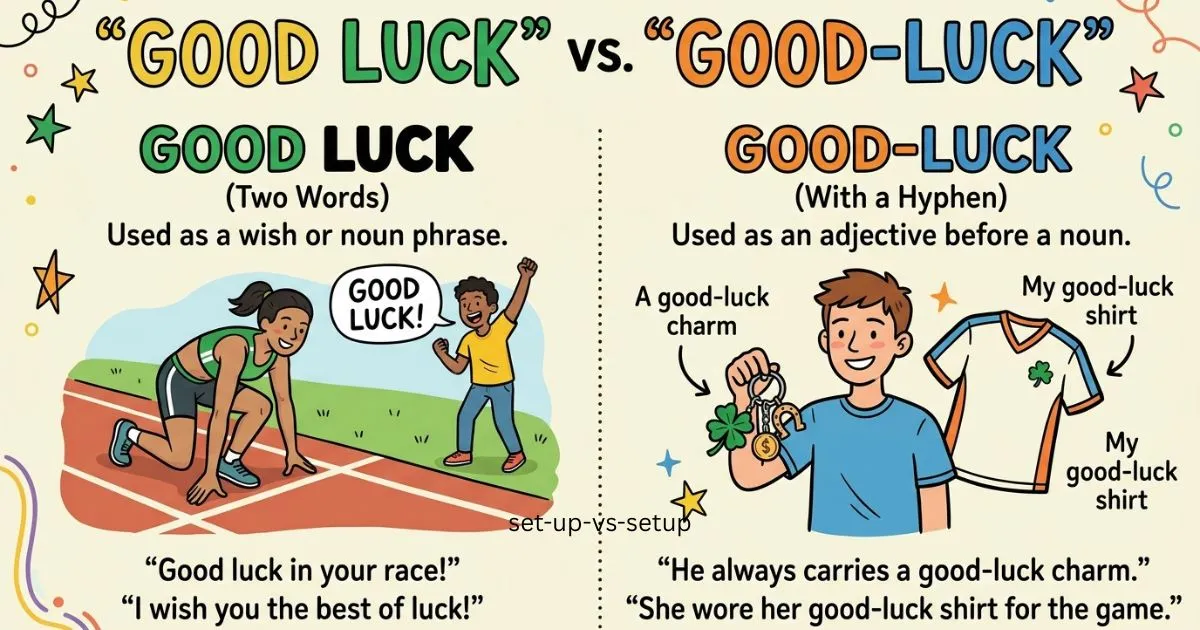
Yes. Use “good-luck” with a hyphen when the two words work together as one adjective before a noun, as in “good-luck charm.” After the noun, or when “good luck” stands alone, drop the hyphen.
This is the compound adjective rule. The hyphen tells the reader that “good” and “luck” belong together. Without it, a reader could pause and wonder what “good” is describing.
The noun test
Look at what comes right after the phrase.
- A noun follows: use a hyphen. “My good-luck charm is a coin.”
- No noun follows: use a space. “That coin brings good luck.”
The same words change form because their job changes. Before the noun, they act as an adjective. After it, “luck” is the noun itself.
Is the hyphen required?
Not always. Writers often leave it out. Recent Merriam-Webster example sentences show both “good luck charm” and “good-luck symbol,” so usage is mixed.
For formal writing, the hyphen is the safer choice. Whichever you pick, stay consistent across your page, and check your own style guide if you have one.
Read More: Accept vs Except: How to Choose the Right Word Fast
Grammar Rule: How “Good Luck” Works in a Sentence
“Good luck” is an uncountable noun, so it has no plural and no “a” before it. People also use it as a short wish by itself: “Good luck!” In casual speech, it can sound sarcastic.
Three common patterns
- Good luck + with + noun: Good luck with your presentation.
- Good luck + on, in, or at + noun: Good luck on your test. Good luck at the game.
- Good luck + -ing: Good luck finding a seat.
“Good luck with” and “good luck on” are both correct and common. “With” fits almost any task. “On” often fits a test, a day, or an event.
The sarcastic use
Dictionaries note a second, informal meaning. It means you think the task is hard or impossible.
- “I’m asking for a raise.” “Oh, good luck with that.”
Tone and context tell the reader which meaning you intend.
Is “Goodluck” Ever Correct? The Name Exception
“Goodluck” is correct only as a proper name, such as the first name Goodluck. In that case, write it as one word with a capital G. Do not use it as a wish in normal writing.
The name is well known in Nigeria. A 2011 column on Nigerian English says the one-word spelling spread as a common error, partly because of a famous person’s first name. The column’s point is simple: as a phrase, English has only “good luck.”
How to handle a name
- Spell a person’s name the way they spell it.
- Do not “fix” it to “Good Luck” in a guest list, email, or form.
- Keep the capital G, because it is a proper noun.
Hashtags and usernames
“#goodluck” and “goodluck_2026” are fine online. Hashtags and usernames cannot hold spaces. That is a platform limit, not a spelling rule.
Memory Trick: Space, Hyphen, or One Word?
Use the noun test. If a noun comes right after the phrase, add a hyphen. If no noun follows, use a space. Save the one-word spelling for a person’s name. Three quick checks beat guessing every time.
- Is it a wish or the idea of luck? Use a space: good luck.
- Does a noun come right after it? Add a hyphen: good-luck charm.
- Is it someone’s name? Use one word with a capital: Goodluck.
Here is a short way to remember it: hyphen before, space after. The hyphen appears before a noun. A space appears when the phrase stands alone or comes after the noun.
18 Example Sentences
These examples show each form in real use. Read them aloud and notice the pattern. A space appears when the phrase stands alone. A hyphen appears before a noun. One word with a capital letter marks the name.
Wishing someone luck (space)
- Good luck on your driving test tomorrow!
- I wish you good luck with the new job.
- Good luck finding a parking spot downtown.
- We all sent her good luck before the interview.
- Good luck, and call me when it’s over.
- We wish all applicants good luck.
Before a noun (hyphen)
- She wears a good-luck bracelet to every exam.
- He kept a good-luck coin in his pocket.
- The good-luck charm fell out of my bag.
- My grandmother sent a good-luck card.
After a noun or on its own (no hyphen)
- That charm brings good luck.
- The coin is for good luck.
- It was a stroke of good luck that the bus was late.
Sarcastic use
- You want a refund without a receipt? Good luck with that.
- Good luck getting him to admit he is wrong.
Names and online use
- Please write the guest’s name as Goodluck, one word, with a capital G.
- Goodluck is a first name used in Nigeria.
- #goodluck works in a social media post.
Common Mistakes
Most errors come from speed or autocorrect. The big ones are writing “goodluck” as one word, adding “a” before “good luck,” and using a hyphen where no noun follows. This table shows each mistake and its fix.
| Mistake | Correct form | Why |
|---|---|---|
| Goodluck on your exam! | Good luck on your exam! | “Good luck” is two words |
| I wish you a good luck. | I wish you good luck. | “Luck” is uncountable here |
| She sent me good lucks. | She sent me good luck. | No plural form |
| I wish you good-luck. | I wish you good luck. | No noun follows, so no hyphen |
| Good lucky on your test! | Good luck on your test! | “Lucky” is an adjective, not the noun |
| It brought badluck. | It brought bad luck. | “Bad luck” follows the same two-word pattern |
When to Use Each Form
Choose by job, not by habit. This keeps your writing clear and professional.
- Emails, cards, and texts: good luck (two words).
- Product pages and formal writing: good-luck charm, with a hyphen, for a clean look.
- Names on forms and invitations: Goodluck, exactly as the person spells it.
- Hashtags and usernames: #goodluck is fine because spaces are not allowed.
- Titles and headlines: capitalize by your title-case rule, such as “Good Luck Charms for Exams.”
Is There a US vs UK Difference?
No. In the dictionaries we checked, “good luck” has one standard spelling, and we found no separate British version. This is not a US vs UK pair like color and colour. The real choice is a space, a hyphen, or one word.
That is why this article sits in the common mistakes cluster instead of the US vs UK spelling cluster. If you want a true spelling split, read color vs colour or cancelled vs canceled.
Key Takeaways
- “Good luck” is two words in standard English.
- “Good-luck” takes a hyphen only before a noun, as in “good-luck charm.”
- The hyphen is optional in everyday writing but safer in formal writing.
- “Goodluck” is correct only as a proper name, with a capital G.
- “Good luck” is uncountable. Never write “a good luck” or “good lucks.”
- Hashtags and usernames can use one word because they cannot hold spaces.
- There is no separate US or UK spelling.
- Memory trick: hyphen before, space after.
FAQs
1. Is goodluck one word or two words?
It is two words. “Good luck” is the standard form in dictionaries such as Merriam-Webster and Dictionary.com. The one-word “goodluck” is not standard English. It appears mainly as a first name, where one word and a capital G are correct.
2. Is it good-luck or good luck?
Use “good luck” for the wish and for the noun. Use “good-luck” only before a noun, where it works as one adjective, as in “good-luck charm.” After the noun, drop the hyphen.
3. Do you hyphenate good luck charm?
You can. The hyphen is the safer choice in formal writing because it shows the two words act as one adjective. The open form, “good luck charm,” is also common. Pick one style and stay consistent.
4. Is goodluck ever correct?
Yes, as a proper name. Write it as one word with a capital G. Hashtags and usernames may also use “goodluck,” because they cannot hold spaces. That is a platform limit, not a spelling rule.
5. Is there a US vs UK spelling difference for good luck?
No. We found no separate British spelling. Both American and British writers use the two-word form. The only real choice is between a space, a hyphen, and one word.
6. Can I say “a good luck”?
No. “Good luck” is uncountable, so it takes no “a” and has no plural. Say “I wish you good luck” or “Good luck!” You can say “a stroke of good luck” instead.
7. Is it good luck with or good luck on?
Both are correct. “Good luck with your presentation” and “Good luck on your test” are common. “With” fits almost any task. “On” often fits a test, a day, or a specific event.
8. How do you capitalize good luck?
Capitalize “Good” when it starts a sentence or a card message, as in “Good luck!” In the middle of a sentence, keep it lowercase. Capitalize both words only in a title that uses title case.
9. What can I say instead of good luck?
Try “best of luck,” “wishing you the best,” or “fingers crossed.” Each one carries a warm, supportive tone. “Best of luck” works well in cards and formal messages.
10. Is “good luck” a noun or an exclamation?
It is both. As a noun: “She had good luck at the fair.” As a wish: “Good luck!” Dictionaries also list it as an idiom, which fits its fixed, ready-made wording.
Conclusion:
Write “good luck” as two words. That is the standard form for wishes and for the noun.
Add a hyphen only when it sits before a noun, as in “good-luck charm,” and even then many writers skip it.
Keep “Goodluck” for a person’s name, with a capital G. There is no US vs UK split here. Use the noun test, and you will get it right each time.

I’m Sophia Mitchell, an English grammar and writing enthusiast. I create simple, easy-to-understand content to help learners improve their English. My goal is to make grammar clear, practical, and enjoyable for everyone.