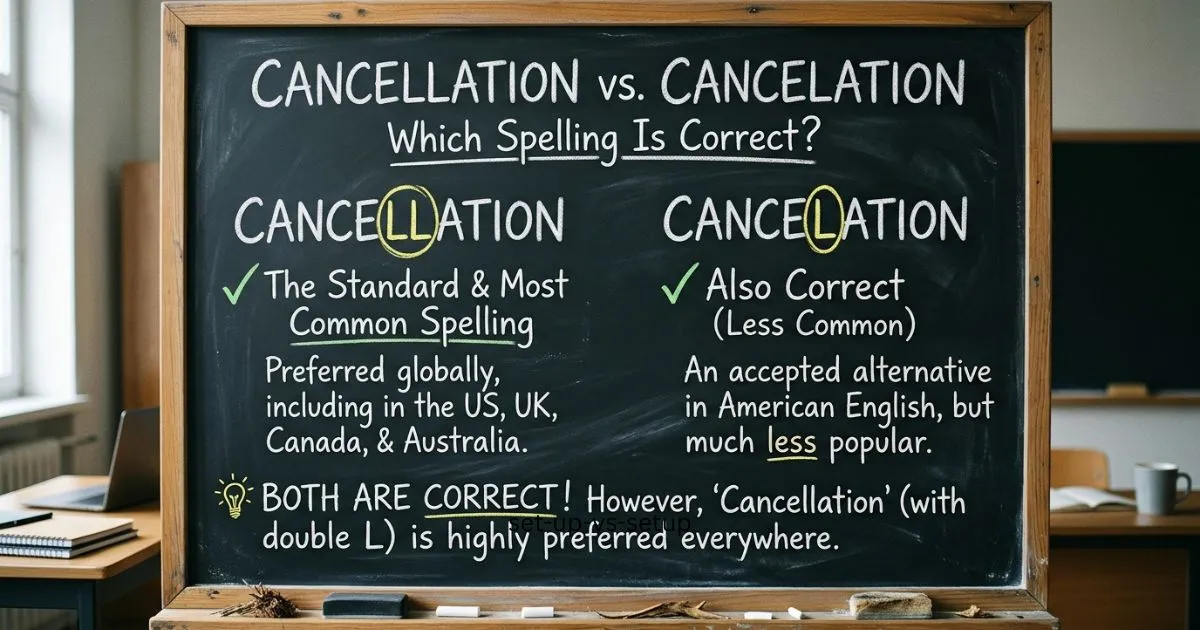
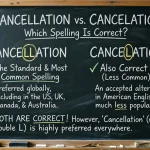
Cancellation, with two Ls, is the standard spelling in both US and UK English. Cancelation, with one L, exists, but it is rare and best avoided.
Picture this. You type “canceled” in an email, and it looks perfect. Then you write the noun, “cancelation,” and stop. Something feels off.
Your instinct is right. Americans do drop an L in “canceled.” But the noun does not follow that rule. Dictionaries and writing tools point to “cancellation” on both sides of the Atlantic.
This guide shows the rule, the exception, and a simple memory trick. You will also get 20 example sentences you can copy.
Quick Answer
Cancellation (two Ls) is the standard spelling in American and British English. Cancelation (one L) is a rare variant that most editors avoid. The verb is different: Americans write canceled, and British writers write cancelled. Only the noun keeps two Ls everywhere.
⚡ Quick Rule in 1 Line
Americans drop one L in canceled, but cancellation keeps its two Ls on both sides of the Atlantic.
What Is the Difference Between Cancellation and Cancelation?
Cancellation and cancelation mean the same thing: the act of calling off something planned. The only difference is spelling. Cancellation, with two Ls, is the standard form in the US and UK. Cancelation, with one L, is a rare variant that most writers avoid.
Both words are nouns. Each names the act of calling off something that was planned, such as a flight, a class, or a subscription.
So is cancelation wrong? Not exactly. Merriam-Webster says cancellation is the usual spelling everywhere, though cancelation is sometimes used. Grammarly calls it technically not incorrect, but extremely rare.
That gap matters. A form can appear in a dictionary and still look odd to readers. Many people who see “cancelation” will think it is a typo.
You may also find websites that say Americans should write “cancelation.” That advice does not match the dictionary and writing-tool sources linked at the end of this article. Always check a trusted dictionary before you copy a rule.
Read More: Cancellation or Cancelation: Which Spelling Is Correct?
Why Cancellation Breaks the US vs UK Spelling Pattern
Most cancel words split by region. Americans write canceled and canceling. Britons write cancelled and cancelling. The noun cancellation is the exception. Both countries use two Ls, so it does not follow the usual one-L American pattern.
Start with the usual pattern. American English often skips the doubled consonant when the word’s stress is not on the last syllable. That is why Americans write “traveled” and “canceled.” British English doubles the letter, so you get “travelled” and “cancelled.”
Many linguists link the American habit to Noah Webster, who shaped early US dictionaries.
Now the exception. The noun “cancellation” does not follow this split. Writers in both countries kept the double L. Merriam-Webster and Grammarly both treat it as the usual spelling everywhere.
No tidy rule explains why. Dictionaries record how people really write, and people kept two Ls in the noun.
Here is the short version:
- Verb forms: The US uses one L. The UK uses two.
- Noun form: The US and the UK both use two Ls.
This makes the noun easier than the verb. You do not have to guess your audience. You only have to remember that “cancellation” keeps both letters.
The same US vs UK habit shows up in other words too, such as color and colour, or gray and grey. Cancellation is one of the few that does not split.
Cancel Word Family: US vs UK Table
Here is the full word family side by side. Notice that the noun cancellation stays the same in both regions. Use this table when you edit a document and need a fast check.
| Word form | American English | British English | Note |
|---|---|---|---|
| Base verb | cancel | cancel | Same everywhere |
| Past tense | canceled | cancelled | Region splits |
| -ing form | canceling | cancelling | Region splits |
| Person who cancels | canceler | canceller | Rare word; same split |
| Able to be canceled | cancelable | cancellable | Merriam-Webster lists both forms |
| Noun (standard) | cancellation | cancellation | Two Ls in both regions |
| Noun (rare variant) | cancelation | cancelation | Listed as a variant; avoid it |
Memory Trick
Here is the trick: the thing that happened keeps both Ls everywhere. Only the action word changes in the US. If you are naming the event, write cancellation with two Ls and move on.
Try these three hooks:
- Noun = two Ls. If you are naming the event, write cancellation.
- Call off. To call off a plan, think of the word call. Call has two Ls, and so does cancellation.
- Only verbs get the shortcut. The American one-L habit stops at canceled and canceling.
One more tip: pick the verb spelling for your audience first. Then write the noun with two Ls every time. You will not need to look it up again.
20 Example Sentences
These 20 examples show how cancellation works in real writing. Most use two Ls, because that is the standard form. A few show the verb split and the rare one-L variant, so you can spot the differences.
American usage (two Ls)
- The airline announced the cancellation of several flights because of the storm.
- Please read our cancellation policy before you book your room.
- There is no cancellation fee if you cancel 24 hours ahead.
- She emailed the gym to request a membership cancellation.
- The cancellation of the school trip upset the whole class.
- A cancellation notice arrived in my inbox on Monday.
British usage (two Ls)
- The rail company apologized for the cancellation of the 8:15 train.
- Hotel cancellations must be made 48 hours before arrival.
- The theatre announced the cancellation of tonight’s show.
- The council confirmed the cancellation of the summer fair.
- Her cancellation of the subscription took effect on Friday.
Verb and noun together
- US: We canceled the meeting, and the cancellation surprised no one.
- US: The concert was canceled, and fans received refunds after the cancellation.
- UK: They cancelled the match, and the cancellation was announced at noon.
- UK: The flight was cancelled, and the airline offered help after the cancellation.
The rare one-L variant (know it, but avoid it)
- Your cancelation request was received. (Acceptable but uncommon. Write cancellation.)
- Send the cancelation form to the main office. (Same advice.)
Everyday business use
- Cancellation of the order takes up to two business days.
- I asked for a refund because of the cancellation.
- Cancellations are free until noon on Friday.
Common Mistakes
The biggest mistake is copying the American verb rule into the noun. Writers see canceled, then assume cancelation must follow. It looks logical, but most editors and style tools expect cancellation with two Ls.
Copying the verb rule into the noun.
- Wrong: Please confirm your cancelation.
- Right: Please confirm your cancellation.
Mixing verb styles in one document.
- Wrong: We canceled the flight and cancelled the hotel.
- Right (US): We canceled the flight and canceled the hotel.
- Right (UK): We cancelled the flight and cancelled the hotel.
Using the noun as a verb.
- Wrong: I want to cancellation my order.
- Right: I want to cancel my order.
Typos inside the word.
- Wrong: cancellaton, cancelllation
- Right: cancellation
Trusting advice that says the US uses cancelation.
Some pages say American English requires one L in the noun. Merriam-Webster, Grammarly, and ProWritingAid say otherwise. Check a trusted dictionary first.
When to Use Each Form
Use cancellation in almost every case. It works for US readers, UK readers, and global audiences. Use cancelation only when quoting a source, matching a client’s style guide, or keeping an official name that already uses it.
Writing for a US audience: Use cancellation for the noun. Use canceled and canceling for the verb.
Writing for a UK audience: Use cancellation for the noun. Use cancelled and cancelling for the verb.
Writing for a global audience: Use cancellation. Then choose one verb style and keep it.
Writing for ESL exams, résumés, and business emails: Use cancellation. It is safe in every setting.
When cancelation is acceptable: Use it only when you quote a source, follow a fixed style guide, or keep an official name that already uses it. Outside those cases, skip it.
A final rule: stay consistent. If one page uses canceled, do not switch to cancelled halfway down.
Key Takeaways
- Cancellation (two Ls) is the standard noun spelling in both US and UK English.
- Cancelation (one L) is a rare variant. Most writers should avoid it.
- The verb splits by region: canceled and canceling in the US, cancelled and cancelling in the UK.
- Do not copy the American verb rule into the noun.
- Remember the hook: call off, call has two Ls, and so does cancellation.
- Pick one verb style for your audience and stay consistent.
FAQs
1. Is it cancellation or cancelation?
Cancellation is the standard spelling. It uses two Ls in both American and British English. Merriam-Webster notes that cancelation, with one L, is sometimes used, but it is far less common. When in doubt, choose cancellation.
2. Is cancelation a real word?
Yes, but it is a rare variant. Grammarly calls it technically not incorrect, yet extremely rare. Because readers expect the two-L form, cancelation can look like a typo. Use it only when quoting or following a fixed style.
3. Is cancellation spelled with one L or two in American English?
Two Ls. American English cuts an L in canceled and canceling, but not in the noun. Merriam-Webster says cancellation is the usual spelling everywhere. So an American writer should still type cancellation.
4. Why do Americans write canceled but cancellation?
The verb follows a US spelling habit, often linked to Noah Webster, that skips the doubled consonant. The noun did not follow. No neat rule explains it. Dictionaries simply record that writers in both countries kept two Ls in the noun.
5. How do you spell cancellation in British English?
Cancellation, with two Ls. British English also doubles the L in cancelled and cancelling. So in the UK, every form of the word has two Ls. The one-L shortcut is mainly an American habit.
6. Is it cancelable or cancellable?
Merriam-Webster lists both. Cancelable follows the American one-L pattern. Cancellable follows the British two-L pattern. Pick the one that matches your audience, and stay consistent through the whole document.
7. Which spelling should ESL learners use for exams and work emails?
Use cancellation. It is accepted in the US and UK, so it is safe for any exam, résumé, or business email. You only need to choose a region for the verb: canceled or cancelled.
8. Does spellcheck accept cancelation?
Some spellcheckers may let it pass, since it is a listed variant. Even so, cancellation is the safer choice. Do not rely on a red line, or the lack of one, to decide.
9. Is cancellation a noun or a verb?
It is a noun. It names the act of canceling something, such as a flight or a plan. The verb is cancel. Writing “I cancellation my order” is a mistake. Say “I cancel my order” or “I want a cancellation.”
10. What is an easy way to remember the spelling?
Remember that the noun keeps both Ls everywhere. Only the verb forms change in the US. You can also think of “call off.” Call has two Ls, and so does cancellation.
Conclusion:
Cancellation, with two Ls, is the right choice for American and British writers.
It is the exception to the usual US vs UK split, so do not copy the one-L habit from canceled. Cancelation exists, but it is rare and can look like a typo.
Choose your region for the verb, canceled or cancelled. Then keep cancellation steady for the noun. That one habit will keep your emails, policies, and essays clean.

I am an English language writer passionate about grammar and clear communication. I create simple, easy-to-understand content that helps readers improve their English skills. My goal is to make learning English both practical and enjoyable.



2 thoughts on “Cancellation vs Cancelation: Which Spelling Is Correct?”