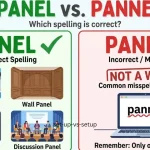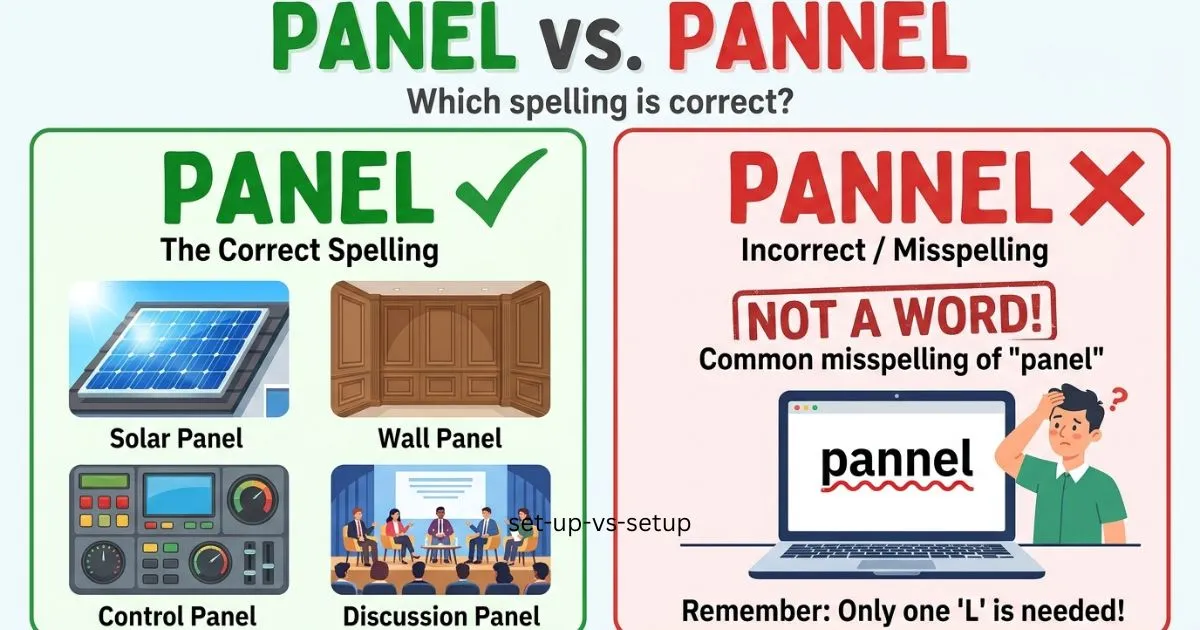
You typed “pannel” on a slide, and a red line popped up. Spell check was right: the correct spelling is panel, with one N.
Pannel is a typo in both US and UK English. No region treats it as the modern spelling.
It is an easy slip. Words like channel, tunnel, and funnel all carry a double N. Panel does not.
If you write for school, work, or a blog, one wrong letter can make a good page look careless. This guide gives you the rule, a quick memory trick, and real examples.
It also clears up the one true US vs UK difference in this word family: paneled vs panelled.
Quick Answer
Panel is the correct spelling. Pannel is a misspelling in both American and British English. Panel has one N and one L: P-A-N-E-L. The only US/UK split is in related words. Americans write paneled and paneling, while British writers usually write panelled and panelling.
⚡ Quick Rule in 1 Line
Panel has one N and one L — if you see two Ns, it is a typo.
Panel vs Pannel: What Is the Difference?
Pannel is not a standard modern word. It is a typo, or a very old spelling of panel from Middle English.
Merriam-Webster traces panel back to Middle English. In that early period, the word showed up as panel, panele, and pannel. Writers used it for cloth, saddle cloth, glass, and lists of jurors.
So pannel is not a made-up word. It is an old form that did not survive. Merriam-Webster and Oxford both list the word as panel today.
This makes the topic unusual. Most US and UK pairs split cleanly, like color and colour. This one does not. The base word has no US spelling and UK spelling. It has one spelling: panel.
| Spelling | Correct today? | US English | UK English | Note |
|---|---|---|---|---|
| panel | Yes | Yes | Yes | The standard spelling everywhere |
| pannel | No | No | No | A typo, or an old Middle English form |
Is “Pannel” a Word?
No, pannel is not a word in modern English. Major dictionaries list the word as panel. You may see pannel in very old texts or old legal writing. Today it counts as a spelling mistake in school, work, and online writing.
The typo is common. Even programmers make it. In 2020, a Linux kernel patch fixed “pannel” to “panel” in code comments and error messages.
If you quote an old book or document, keep its original spelling. Add [sic] if you want readers to know it is not your typo.
In all your own writing, use panel.
Read More: Cancellation vs Cancelation: Which Spelling Is Correct?
Why People Write “Pannel” (Common Mistakes)
People add a second N because many English words ending in -nel use a double N, such as channel, tunnel, and funnel. Writers also hear a short A sound before the N. Both habits push the hand toward pannel.
Here are the mistakes we see most often:
- Doubling the N: pannel, pannels, pannelist. All are wrong.
- Changing the vowel: panal is also a misspelling.
- Mixing regions in one document: paneled in paragraph one, panelled in paragraph five.
- Using the wrong word: writing panel when you mean pane, the glass in a window.
- Trusting autocorrect blindly: a red line helps only if you read the suggestion.
The fix is simple. Check the N count. Panel has one.
Memory Trick: Panel = Pane + L
Remember this: panel is pane plus L. Pane, the glass in a window, has one N. So panel has one N too. Add the L at the end, and you have panel.
This is only a memory aid. It is not a claim about word history. But it works, and it takes two seconds.
Here is a second trick. Split the word into two beats: PAN + EL. Only one N sits in the middle.
The -nel ending does not follow one clean rule, so learn each word on its own:
| Double N (-nnel) | Single N (-nel) |
|---|---|
| channel | panel |
| tunnel | kernel |
| funnel | colonel |
| flannel | |
| kennel | |
| fennel |
When you reach for a double N, stop and ask: “Is this a channel or a panel?” That small pause saves the typo.
What Does Panel Mean?
Panel has several common meanings: a flat section of a wall, door, or machine; a board with controls; a group of experts or judges; and a list of jurors. Each meaning uses the same spelling: panel.
Here is how the word works in daily life:
- A flat section: a door panel, a ceiling panel, a glass panel.
- A control board: the control panel on a microwave or the electrical panel in a home.
- A group of people: a panel of experts, a panel of judges, a quiz show panel.
- A jury: the group of citizens called for jury duty.
- A comic frame: one boxed picture in a comic strip.
- A solar panel: a flat unit that turns sunlight into power.
- A verb: to cover a wall or room with panels.
The verb is where the US and UK spellings split. That is the next section.
Paneled vs Panelled: The Real US vs UK Difference
The noun panel never changes. But the verb forms do. Americans write paneled and paneling with one L. British writers usually write panelled and panelling with two Ls. Merriam-Webster lists both spellings for the verb.
This follows a familiar pattern. American English usually keeps a single L when you add an ending. British English doubles it. You see the same split in traveled and travelled, or labeled and labelled.
| Word | American English | British English |
|---|---|---|
| Base noun or verb | panel | panel |
| Past tense verb | paneled | panelled |
| -ing form or wall covering | paneling | panelling |
| A person on a panel | panelist | panellist (panelist also appears) |
| Wrong everywhere | pannel, pannelled, panneling | pannel, pannelled, panneling |
Notice the last row. The double L in British English does not make pannel correct. The extra N is wrong in every region.
Usage surveys show Americans strongly prefer paneling and panelist. In the UK, you will see both panelist and panellist in print.
Since your readers are in the United States, use the one-L forms: paneled, paneling, and panelist.
Panel vs Pane
A pane is one sheet of glass in a window or door. A panel is a larger flat section, a control board, or a group of people. Pane and panel look alike, so writers sometimes swap them by mistake.
Use this quick test. If you can see through it, you may mean pane. If it is a section, a board, or a group, you mean panel.
- She cleaned the window pane.
- The glass panel in the door cracked.
- One pane of glass sits inside the door panel.
The plurals follow the same split: panes and panels. Neither one takes a double N.
20 Example Sentences
The examples below show panel in real use. They cover groups of people, flat sections, regional spellings, and common errors.
Panel as a group of people
- The panel will answer questions after the talk.
- Our panel of experts includes a doctor and a nurse.
- A three-judge panel reviewed the case.
- She was invited to speak on a panel about writing.
Panel as a flat or physical object
- The electrical panel is in the garage.
- Press the red button on the control panel.
- One ceiling panel needs to be replaced.
- The company installed solar panels on the roof.
- The comic has a funny panel on page three.
- A glass panel in the door cracked.
American English forms
- We paneled the den in pine last summer.
- The paneling in the basement looks dated.
- She was the only panelist who disagreed.
British English forms
- The study was panelled in dark oak.
- The old library has beautiful wood panelling.
- Each panellist had three minutes to speak.
- They panelled the hallway before painting it.
Wrong vs right
- ❌ The pannel will start at noon. ✅ The panel will start at noon.
- ❌ Check the control pannel. ✅ Check the control panel.
- ❌ We bought new solar pannels. ✅ We bought new solar panels.
When to Use Each Form
Use panel every time for the noun and the base verb. Then pick one regional style for forms with endings. For a US audience, use paneled, paneling, and panelist. For a UK audience, use panelled, panelling, and panellist. Never use pannel.
Here is a simple guide:
- Writing for US readers, school, or business: paneled, paneling, panelist.
- Writing for a UK, Irish, or Australian audience: panelled, panelling, and often panellist.
- Taking an English test: follow the style used in the test instructions.
- Quoting someone: keep their spelling exactly as written.
- Unsure of your audience: pick one style and use it the whole way through.
Consistency matters more than which side you pick. A page that mixes paneled and panelled looks unedited.
How to Stop Typing “Pannel”
The fastest fix is a small system. Set your spell checker to English (US). Add an autocorrect rule that swaps pannel for panel. Then search your draft for “nn” before you publish.
Try these steps:
- Set your language: choose English (US) in Word, Google Docs, or your browser.
- Create an autocorrect entry: type pannel, replace with panel.
- Use the trick: pane plus L equals panel.
- Search before publishing: use Find to check for “pannel” and “panal.”
- Read it out loud: say PAN + EL and count one N.
These habits take a minute to set up. They protect every future draft.
Key Takeaways
- Panel is correct. Pannel is a typo in both US and UK English.
- Panel has one N and one L.
- Memory trick: panel is pane plus L.
- Pannel is an old Middle English spelling, not a modern word.
- The US/UK split appears only in verb and related forms.
- US style: paneled, paneling, panelist.
- UK style: panelled, panelling, and often panellist.
- A pane is glass. A panel is a section, a board, or a group.
- Set up autocorrect to catch the typo for good.
FAQs
1. Is it panel or pannel?
The correct spelling is panel. It has one N and one L. Pannel is a typo in modern English. Major dictionaries such as Merriam-Webster and Oxford list only panel. This is true in both American and British English.
2. Is pannel correct in British English?
No. British English also spells the word panel. The UK difference is in the verb forms, where panelled and panelling use two Ls. The N never doubles in either region.
3. How do you spell panel?
Spell it P-A-N-E-L. Say it in two beats: PAN-EL. To remember it, think of pane plus L. Pane has only one N, so panel has only one N as well.
4. Is it paneled or panelled in American English?
Use paneled and paneling in the US. These forms have one L. British English prefers panelled and panelling. Merriam-Webster lists both spellings for the verb, but US writers mostly choose the one-L forms.
5. What is the difference between panel and pane?
A pane is a single sheet of glass in a window or door. A panel is a flat section, a control board, or a group of people. The words look alike, but they have different meanings.
6. How many Ns are in panel?
One. Panel has one N and one L. If you type two Ns, you have written the typo pannel. Use the pane-plus-L trick to double-check.
7. Why do people spell panel with two Ns?
Many words ending in -nel use a double N, like channel, tunnel, and funnel. Writers copy that pattern without thinking. Panel is one of the words that does not follow it.
8. Is it panelist or panellist?
In the US, use panelist. In the UK, you will see both spellings. Both words mean a person who sits on a panel. Pick one style for your audience and stay consistent.
9. What did pannel mean in old English texts?
In Middle English, pannel was one spelling of panel. The word could mean a piece of cloth, a saddle cloth, a pane of glass, or a list of jurors. Today, only the spelling panel is standard.
10. How can I stop misspelling panel?
Use the pane-plus-L trick. Set your spell checker to English (US). Add an autocorrect rule that changes pannel to panel. Before you publish, search long documents for “pannel” and fix every match.
Conclusion:
Panel is the only correct spelling. Pannel is a typo in American and British English, and it survives only as an old Middle English form.
Remember the trick: panel is pane plus L.
The only real US vs UK split is in related words. Americans write paneled, paneling, and panelist.
British writers often use panelled, panelling, and panellist. Pick one style, stay consistent, and keep the N single.

I’m Sophia Mitchell, an English grammar and writing enthusiast. I create simple, easy-to-understand content to help learners improve their English. My goal is to make grammar clear, practical, and enjoyable for everyone.