A plain-English guide for students, English learners and anyone who writes emails and texts.
You’ve typed “good morning” a thousand times, and your phone never complained. Then one day you’re writing an important email, and a small doubt appears: is that one word or two?
Here’s the short version. “Good morning” is always two words, always. The part people get wrong is everything around it: why “goodnight” can be one word, when to use capital letters, whether you need a comma, and what to write in an email or a flirty text.
This guide gives you one simple rule that explains it all, examples you can copy, and straight answers to the questions people search most, from “good afternoon” to “morning” versus “good morning” in a message.
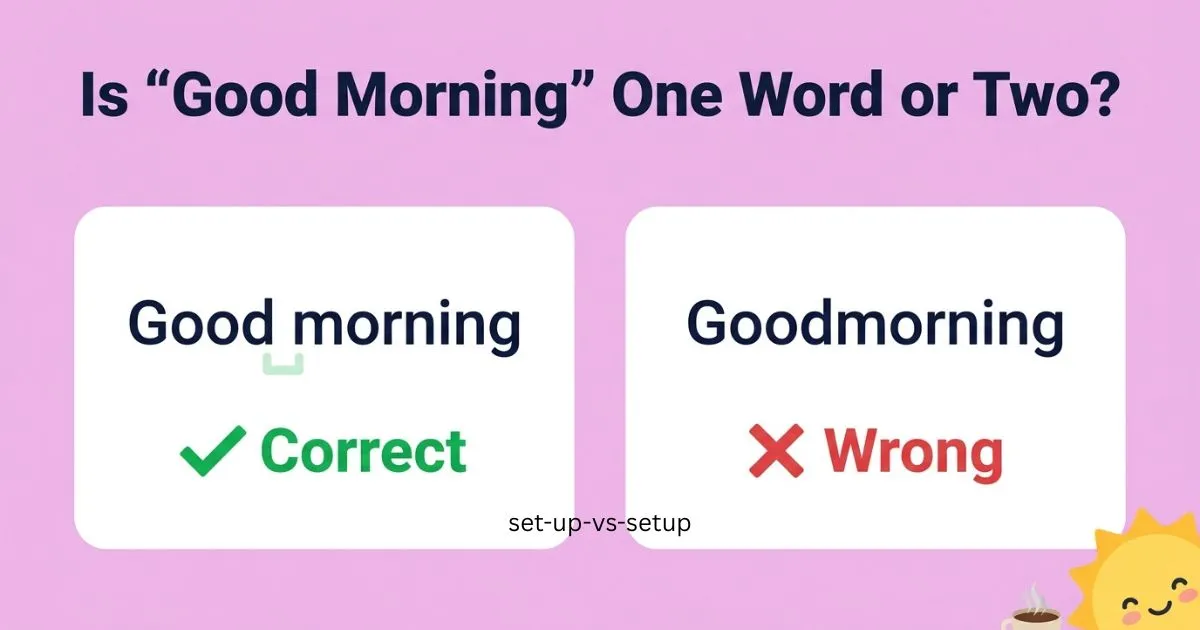
Is “Good Morning” One Word or Two?
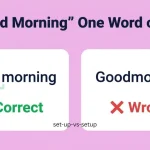
“Good morning” is two words. You put a space between them in formal emails, casual texts, greeting cards and speeches alike. “Goodmorning” is not listed as a spelling by the major dictionaries, so it counts as a typo, no matter how often you see it online.
Here is a quick reference you can save:
| Version | Correct? | Note |
| Good morning | Yes | Standard spelling for the greeting |
| good morning | Yes | Fine in the middle of a sentence or a casual text |
| Goodmorning | No | A typo, not a recognised word |
| Good-morning | No | No hyphen is needed |
| GM | Informal | Shorthand for texts and social media only |
If you remember one thing, remember this: a greeting made of “good” plus a time of day gets a space.
Why “Good Morning” Is Two Words
The reason is plain grammar. “Good” is an adjective. “Morning” is a noun. When an adjective describes a noun, the two stay separate, just like “strong coffee” or “cold weather.” Nobody writes “strongcoffee.”
Here’s a two-second test. Expand the greeting into a full sentence: “I wish you a good morning.” That sentence only makes sense with two words. Write “I wish you a goodmorning” and it looks wrong immediately.
The phrase can wear different hats
Dictionaries such as Merriam-Webster classify “good morning” as an interjection, a standalone expression in the same family as “hello.” But the same two words can also behave like an ordinary noun phrase:
- As a greeting: “Good morning, Alex.”
- As a noun phrase: “I had a good morning.”
- As an object: “She wished me a good morning.”
In all three, “good” still describes “morning.” The words do separate jobs, so they never fuse into one.
Is “Good Afternoon” One Word or Two?
Same answer: two words. “Good afternoon,” “good evening” and “good day” all follow the adjective-plus-noun pattern, so none of them merge. “Goodafternoon” is just as wrong as “goodmorning.”
One detail causes confusion here. “Afternoon” is itself a single word. It began as “after noon,” and over time the two parts joined into one noun. So the joined part is “afternoon,” not the whole greeting.
| Greeting | Spelling | Typical use |
| Good morning | Two words | From waking up until around midday |
| Good afternoon | Two words | After midday |
| Good evening | Two words | Later in the day |
| Good day | Two words | A formal greeting |
| Goodbye | One word | A farewell |
Is Goodnight One Word?
Sometimes. This is the one place where English gives you a real choice, and the right choice depends on how you use the word.
“Goodnight” (one word) works as a farewell, a noun or an adjective:
- “Goodnight, Mom.” (a farewell)
- “Say goodnight to Grandma.” (a noun)
- “She gave him a goodnight kiss.” (an adjective)
“Good night” (two words) is the more traditional spelling for the farewell, and it is the correct form when you describe the night itself:
- “Have a good night.”
- “We had a good night at the concert.”
Sources don’t fully agree on how strict this is. Some dictionaries and style guides treat the two spellings differently, so don’t assume one rule covers every case. A practical approach: in casual texts, “goodnight” is fine. In formal writing, “good night” is the safer pick. Whichever you choose, stay consistent inside the same piece.
Read More: Master’s Degree vs Masters Degree: Rules & Examples
Why Is Good Morning Two Words When Goodnight Is One?
There is no single grammar law behind this. It’s mostly history. English words often travel through three stages: written as separate words, then hyphenated, then joined into one. Some phrases finish the trip. Others stop halfway.
- Goodbye finished the trip. It is often traced back to an older phrase meaning “God be with you,” and today it is always one word.
- Goodnight is mostly there. The one-word form took hold because it started acting like a noun and an adjective, as in “goodnight kiss.”
- Good morning never needed to. It stayed a greeting built from an adjective and a noun, and nothing pushed it to merge.
Language teachers make the same point: the confusion exists only because “goodnight” has a one-word life as a noun. “Good morning,” “good afternoon” and “good day” don’t have that noun form, so they stay open.
Could “goodmorning” become standard one day? Languages change, so nobody can promise it won’t. But right now no major dictionary lists it, and anyone editing your work will mark it as an error.
Why Do People Write “Goodmorning” Anyway?
It isn’t ignorance. It’s a habit. A few common causes:
- Fast typing. When you’re rushing, your fingers skip the space bar.
- The goodnight effect. You’ve seen “goodnight” and “goodbye” as one word, so your brain assumes the pattern repeats.
- Autocorrect habits. Your keyboard learns from what you type, not from the dictionary. If you keep writing “goodmorning,” it may start suggesting it.
- Hashtags and branding. Spaces aren’t allowed in a hashtag, so #goodmorning looks normal online. That is a style choice, not a grammar rule.
If your keyboard has learned the wrong habit, retype the two-word version a few times in a row. Most phones adjust quickly.
Does It Really Matter?
In a quick text to a friend, nobody will panic. But in a job application, a client email or a school assignment, a small slip can make your message look rushed. Readers rarely notice perfect writing. They notice the one thing that’s off.
Getting this right costs you nothing, and it signals that you pay attention to detail. That’s a good return for one extra space.
Is “Good Morning” Capitalized?
It depends on where the phrase sits in your writing. Here are the rules in plain terms:
- At the start of a sentence or message: capitalize only the first word. “Good morning, everyone.”
- In an email greeting: same rule. “Good morning, Ms. Johnson.”
- In the middle of a sentence: no capitals at all. “She always says good morning before her first coffee.”
- In titles, headlines and cards: capitalizing both words is a style choice. “Good Morning, Sunshine” on a birthday card looks fine.
- In professional writing: avoid ALL CAPS. “GOOD MORNING” can feel like shouting.
Some writers capitalize both words in an email greeting, like “Good Morning, Team.” Many modern style guides prefer the sentence case, “Good morning, team,” so that is the safest option when you aren’t sure.
Notice that the name after the comma keeps its capital letter, because names always do. “Good morning, Sarah.”
Do You Need a Comma After “Good Morning”?
Usually, yes, when you are speaking directly to someone.
- “Good morning, Sarah.” (comma before the name)
- “Good morning, everyone.” (comma before the group)
- “Good morning!” (an exclamation mark works with no name)
Skipping the comma isn’t a disaster, and most readers will still understand. But “Good morning, everyone” reads more cleanly than “Good morning everyone.”
Punctuation also changes the mood. A period keeps things calm and neutral. An exclamation mark adds warmth or energy. Leaving punctuation out in a quick text feels relaxed and casual.
And please skip the hyphen. “Good-morning” is not standard.
Is “Good Morning” One Word in an Email?
No. The rule doesn’t change because you’re in your inbox. It is “Good morning” with two words in a formal email, a friendly one, and a one-line reply.
How to open an email with good morning
- Write the greeting in sentence case. “Good morning,” with a capital G and a lowercase m.
- Add the name and a comma. “Good morning, Ms. Carter,” or “Good morning, team,”
- Start the message on a new line. A short gap makes the email easier to scan.
- Match the tone to the reader. More formal for a manager or client, lighter for a colleague you know well.
- Think about when they will read it. If your reader may open the message in the afternoon or in another time zone, a neutral “Hello” or “Hi” avoids an awkward mismatch.
Examples you can copy
Formal:
Good morning, Ms. Carter,
Thank you for sending the project proposal. I have a few questions before our call.
Semi-formal:
Good morning, team,
Please review the updated schedule before our meeting.
Customer support:
Good morning! How can I help you today?
In an email subject line, headline-style capitals such as “Good Morning” are acceptable, because subject lines work like titles. In the body, stick to the sentence case.
Is It “Good Morning” or “Good Afternoon”?
Most people use “good morning” from sunrise until around midday, and “good afternoon” after that. But habits vary by culture and workplace. Some offices keep saying “good morning” until lunchtime.
Context beats the clock. Someone starting an early shift at 2 a.m. may greet colleagues with “good morning,” even though most people would call that hour night. The greeting follows the start of your day, not just the number on the clock.
When you honestly aren’t sure, “hello” always works.
“Morning” vs “Good Morning” From a Girl: Is There a Difference?
Grammatically, both are fine. “Morning” is simply the shortened, casual version of “good morning.” The real difference is warmth, not correctness.
In general, “good morning” feels a little more deliberate and friendly. A bare “morning” feels quick and relaxed. In dating or early-relationship texting, a full “good morning,” especially with your name or a small compliment, often reads as more intentional. A one-word “morning” can read as neutral.
But be careful about reading too much into one word. Some people text in short bursts with everyone. If you want to understand what a greeting means, look at the bigger picture instead:
- Her usual style. Does she write short messages to everyone, or only to you?
- Extras. Did she add an emoji, your name, or a question?
- Consistency. Is this a daily habit or a one-time hello?
- Who starts the conversation? Does the chat continue after the greeting?
If you’re curious, reply warmly and add a small question, like “Morning! Any plans today?” The reply you get will tell you far more than the spelling of her greeting.
Is “Good Morning” One Word in a Flirty Text?
Still two words. Flirting changes what you add around the greeting, not how you spell it. Even the most playful message keeps the space.
Here are some original ideas you can adapt:
- “Good morning, sunshine. Did you sleep well?”
- “Morning, trouble. Coffee later?”
- “Good morning! You were the first thing I thought about today.”
- “Rise and shine, you. The day’s better with a text from you in it.”
A few tips that keep it natural:
- Use their name. It makes a simple greeting feel personal.
- Add a question. It gives the other person an easy way to reply.
- Keep it short. One or two lines is plenty before the day gets busy.
- Match their energy. If they reply with one word, don’t send a paragraph back.
- Respect the silence. If you don’t hear back, don’t keep sending.
Among close friends, “GM” is fine as shorthand. Just don’t use it in anything professional.
Common “Good Morning” Mistakes (and Fixes)
| Mistake | Fix | Why |
| Goodmorning, John! | Good morning, John! | Two words, always |
| Good-morning | Good morning | No hyphen |
| Good Morning everyone (in a normal text) | Good morning, everyone | Sentence case plus a comma |
| GOOD MORNING (in a work email) | Good morning | All caps can feel like shouting |
| My goodmorning was great | I had a good morning | “Good morning” as a greeting is separate; use “morning” as the noun |
Quick practice: fix these sentences
Try correcting these before you read the answers.
- “Goodmorning team, please check the file.”
- “I said Good Morning to my teacher.”
- “She sent me a goodmorning text.”
Answers:
- “Good morning, team, please check the file.”
- “I said good morning to my teacher.”
- “She sent me a good morning text.”
Easy Ways to Remember the Rule
- Expand it. If “I wish you a good morning” works as a sentence, you need two words.
- Compare it. Nobody writes “goodafternoon” or “goodevening,” so “goodmorning” doesn’t fit either.
- Ignore autocorrect. It reflects your typing habits, not the dictionary.
- Think of the space as a pause. Say it slowly: “good… morning.” You can hear two words.
FAQs
Is “good morning” one word or two?
It’s two words. “Good” is an adjective and “morning” is a noun, so they stay separate in every context: emails, texts, cards and speeches. “Goodmorning” isn’t a recognised spelling in major dictionaries, so treat it as a typo and always keep the space.
Is goodnight one word?
It can be. “Goodnight” works as a one-word farewell, noun or adjective, as in “goodnight kiss.” “Good night” in two words is the more traditional spelling and the correct form when describing a night, as in “Have a good night.” For formal writing, choose two words.
Is “good morning” capitalized?
Capitalize only the first word when it starts a sentence or email: “Good morning, team.” In the middle of a sentence, use lowercase: “She said good morning.” Capitalizing both words is acceptable in titles, headlines and greeting cards, but avoid all caps in professional messages.
Is “good morning” one word in an email?
No, it stays two words in every email, formal or casual. Write “Good morning,” followed by the person’s name and a comma, then start your message on a new line. Pick “Hello” instead if the reader might open your email later in the day.
Why are “good morning” two words and “goodnight” one?
There’s no single rule; it’s mostly language history. “Goodnight” became common as a noun and adjective, which pushed it toward one word, much like “goodbye.” “Good morning” remained a greeting made of an adjective and a noun, so it never merged and dictionaries still list two words.
Is it “good morning” or “good afternoon”?
Use “good morning” from sunrise until around midday, then switch to “good afternoon.” Habits vary by culture and workplace, and some people say “good morning” until lunchtime. If someone is just starting their day, even at an unusual hour, “good morning” fits. When unsure, say “hello.”
Is “good afternoon” one word or two?
It’s two words, just like “good morning” and “good evening.” Only “afternoon” is a single word, because it began as “after noon” and joined over time. Writing “goodafternoon” is incorrect, so keep a space between “good” and “afternoon” in emails, texts and formal writing.
Conclusion:
So, is “good morning” one word or two? Two. It’s an adjective plus a noun, just like “good afternoon,” “good evening” and “good day.”
“Goodnight” is the odd one out because it grew a one-word life as a noun and adjective, and “goodbye” merged completely.
For everyday writing, keep these four habits: use two words, capitalize only the first one in a sentence, add a comma before a name, and skip the hyphen. Do that and you’ll never second-guess this greeting again.
Your next step: check your phone keyboard today. If it suggests “goodmorning,” correct it a few times so it learns the right spelling.

I am an English language writer passionate about grammar and clear communication. I create simple, easy-to-understand content that helps readers improve their English skills. My goal is to make learning English both practical and enjoyable.



1 thought on “Is “Good Morning” One Word? Spelling, Caps & Email Rules”