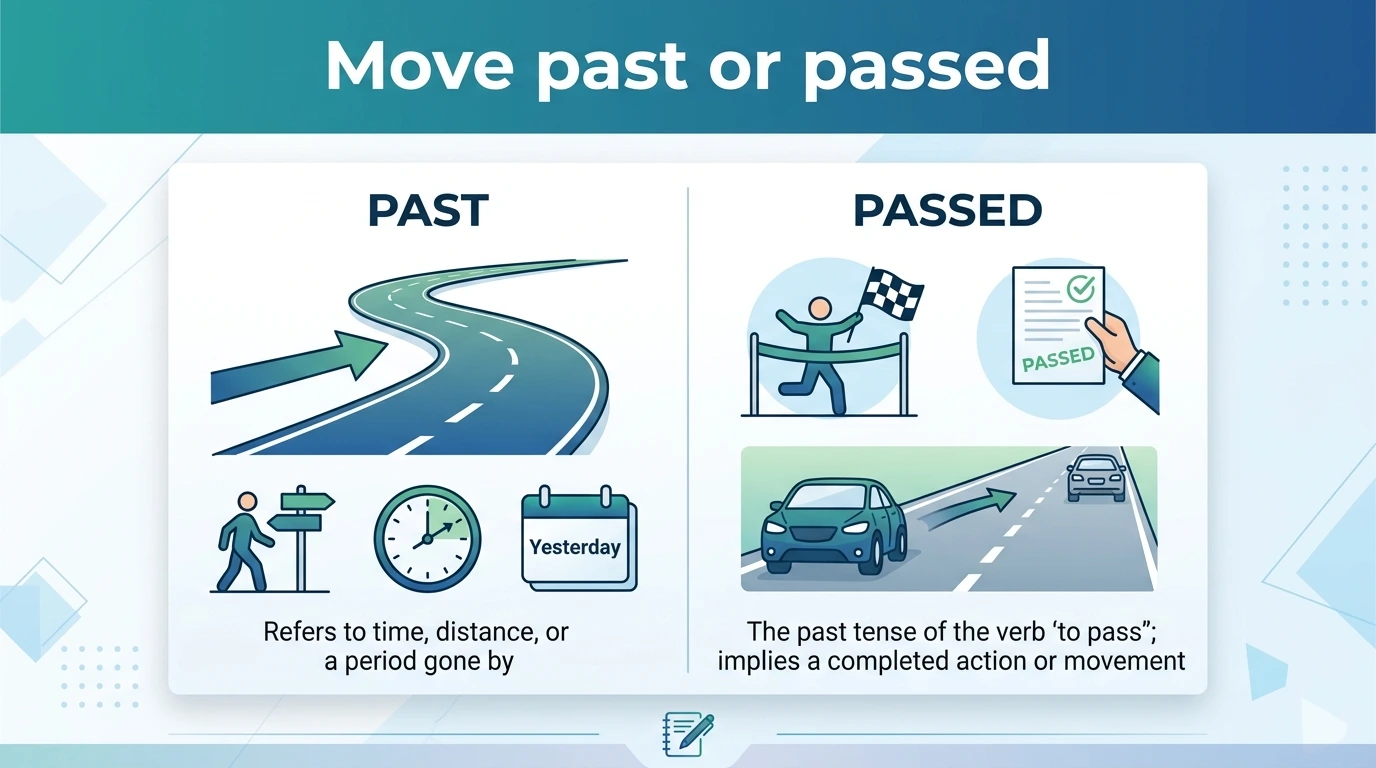
Move past is the correct phrase when you mean going beyond something or getting beyond a difficult situation. Move passed is incorrect in this use.
You may wonder, “Should I move past it or move passed it?” The two words sound similar, but they have different jobs in English.
Past can describe something beyond a point, while passed is the past-tense form of the verb pass. When move is the main verb, you normally need past.
For example, you can move past a mistake, move past an argument, or move past a difficult period.
Quick Answer
Move past is correct when you mean to go beyond something physically, emotionally, or mentally. Passed is the past tense of pass, so it does not normally follow “move” in this expression. For example, “She moved past the problem” is correct.
Quick Rule
Use “past” after “move” when you mean going beyond something or getting beyond a situation.
Why Is “Move Past” Correct?
Move past is correct because move acts as the main verb, while past shows the point or thing beyond which the movement occurs. Passed is a verb form, so it does not fit this structure.
Consider this sentence:
She moved past the old building.
Here, moved is the verb.
Past tells us where she moved.
The meaning is that she went beyond the building.
Now consider the figurative use:
He moved past his mistake.
The person is not physically moving.
Instead, the phrase means he got beyond the mistake emotionally or mentally.
In both cases, past is correct.
Read More: Goodluck or Good Luck? Correct Spelling, Meaning & ExamplesMove Past Meaning in Different Sentences
- What Does “Move Past It” Mean?
- What Does “I Moved Past It” Mean?
- What Does “Move Past This” or “Move Past That” Mean?
- What Does “Let’s Move Past This” Mean?
- What Does “Can We Move Past This?” Mean?
- What Does “Moving Past Something” Mean?
- What Does “Move Past Each Other” Mean?
What Does “Move Past” Mean?
Move past can mean physically going beyond a person or place, but it can also mean recovering from or getting beyond an experience, problem, or difficult situation. The exact meaning depends on the context.
Physical meaning
The car moved past the house.
The car went beyond the house.
Emotional meaning
She finally moved past the argument.
She stopped allowing the argument to affect her.
Mental meaning
He needs to move past his fear.
He needs to get beyond that fear.
General meaning
We need to move past this problem.
This means the people involved need to deal with the problem and continue.
So, move past can describe both physical movement and figurative progress.
Past or Passed: The Main Difference
Past and passed sound alike in many varieties of English, but they have different meanings and grammatical roles. Past can work as a preposition, adjective, adverb, or noun, while passed is a form of the verb pass.
| Word | Main role | Example |
| past | Preposition, adjective, adverb, noun | She walked past the store. |
| passed | Past tense of pass | She passed the store. |
The difference becomes clearer when you compare the verbs.
Move past
The runner moved past the other runners.
The verb is moved.
Passed
The runner passed the other runners.
The verb is passed.
Both sentences can describe similar movement, but their grammar is different.
Why “Move Passed” Is Incorrect
Move passed is incorrect when you mean “move beyond” something because passed is already a verb form. After move, you need past when describing movement beyond a person, place, point, or situation.
Compare:
❌ I need to move passed this problem.
✅ I need to move past this problem.
The first sentence uses passed where the preposition past is needed.
The second sentence uses the correct structure.
You can also compare:
❌ She moved passed the car.
✅ She moved past the car.
The meaning is “she moved beyond the car.”
Move Past It or Move Passed It?
- Move Past This or Move Passed This?
- Move Past That or Move Passed That?
- Move Pass or Move Past? (Why “Move Pass” Is Also Wrong)
Moved Past or Moved Passed? (Tense Guide)
- Moved Past Tense Explained
- I Moved Past or Passed It?
- We Moved Past or Passed?
- Moves Past, Moving Past, and Moving Passed
- To Move Past or Passed (Infinitive Form)
When to Use “Past”
Past is the correct choice when you mean beyond a particular point, person, place, time, or situation. It often works with verbs such as move, walk, go, run, and drive.
Physical movement
We walked past the school.
The bus drove past my house.
She ran past me.
He moved past the door.
In each example, past describes movement beyond something.
Time
Past can also refer to earlier time.
We talked about the past.
The past few weeks were difficult.
She has learned from her past.
Figurative situations
He needs to move past his fear.
They are trying to move past the disagreement.
She finally moved past the mistake.
This is why move past is so common in personal and professional writing.
When to Use “Passed”
Passed is the past tense and past participle of pass. Use it when pass is the verb describing an action that already happened.
For example:
She passed the exam.
Here, passed means she successfully completed the exam.
Another example:
The car passed the truck.
Here, passed means the car went ahead of or beyond the truck.
You can also say:
He passed me on the road.
Here, passed is the verb.
The key difference is that passed does not simply mean “beyond.”
It is a form of pass.
More examples
- She passed the test.
- He passed the ball.
- The train passed the station.
- They passed through security.
- Time passed quickly.
- The driver passed the other car.
Move Past vs Passed
The easiest way to understand the difference is to compare these two structures.
Move past
She moved past the store.
Moved = main verb
Past = shows what she moved beyond
Passed
She passed the store.
Passed = main verb
Both sentences can describe movement, but the grammar is different.
You should not combine them like this:
❌ She moved passed the store.
Use:
✅ She moved past the store.
Or:
✅ She passed the store.
Move Past a Problem
Move past a problem is a common figurative expression meaning to stop being held back by a problem and continue forward. It can describe personal, emotional, professional, or relationship-related situations.
Examples:
We need to move past this problem.
She is trying to move past her mistake.
He finally moved past the disagreement.
The team needs to move past the loss.
The phrase does not mean that the problem never happened.
It means someone is no longer allowing it to prevent progress.
Move Past a Person or Place
Move past can also have a literal meaning. In this use, it describes physical movement beyond a person, object, or location.
Examples:
The woman moved past me.
The car moved past the entrance.
He moved past the security guard.
We moved past the first checkpoint.
The word past identifies the person, object, or location that is being passed.
Move Past a Difficult Time
People often use move past when talking about difficult experiences.
For example:
She is trying to move past a difficult period.
This means she is trying to leave that difficult period behind emotionally.
You might also see:
- move past the pain
- move past the fear
- move past the disappointment
- move past the conflict
- move past the loss
- move past the mistake
- move past the experience
These are all examples of the same basic idea.
20 Examples of “Move Past”
Here are natural examples showing how move past works in different contexts.
- We need to move past this problem.
- She walked past the store.
- He finally moved past his mistake.
- The car moved past the building.
- They are trying to move past the disagreement.
- She needs to move past her fear.
- The team must move past its recent loss.
- He moved past me without saying anything.
- We should move past this argument.
- She is ready to move past the experience.
- The bus moved past the station.
- He wants to move past his disappointment.
- The company needs to move past its old problems.
- She slowly moved past the difficult period.
- The runner moved past the other competitors.
- They decided to move past their differences.
- He is learning to move past his fears.
- The group wants to move past the conflict.
- She hopes to move past what happened.
- We can move past this and continue.
Common Mistakes
The most common mistake is using “passed” after “move.” Since past and passed sound similar, writers sometimes choose the wrong form. The easiest solution is to identify which word is doing the job of the verb.
Mistake 1
❌ I need to move passed this.
✅ I need to move past this.
Here, move is already the verb.
Mistake 2
❌ She moved passed the building.
✅ She moved past the building.
Past shows the location beyond which she moved.
Mistake 3
❌ We have to move passed our mistakes.
✅ We have to move past our mistakes.
This is a figurative use of move past.
Mistake 4
❌ He past the test.
✅ He passed the test.
Here, passed is correct because it is the verb pass.
A Simple Test: Replace “Passed” With “Went Past”
If you are unsure, try replacing the phrase with went past.
For example:
She moved past the house.
You could say:
She went past the house.
That makes sense.
But passed is different because it acts as a verb:
She passed the house.
You cannot simply treat passed as another spelling of past.
Memory Trick
Remember this simple rule:
Past = beyond.
Passed = an action.
So:
Move past the problem.
But:
She passed the test.
You can also remember:
Move + beyond = move past.
If you can replace past with beyond, past is probably the word you need.
Move past the problem.
Move beyond the problem.
Both express the same basic idea.
FAQs
Is it “move past” or “move passed”?
Move past is correct when you mean going beyond something or getting beyond a situation. Passed is the past tense of pass.
What does “move past” mean?
Move past can mean physically going beyond something or figuratively getting beyond a problem, experience, or difficult situation.
Is “move past” grammatically correct?
Yes. Move past is grammatically correct when past functions as a preposition describing movement beyond something.
Can I say “move passed”?
Not when you mean “move beyond.” The standard phrase is move past.
What is the difference between past and passed?
Past can refer to something beyond a point or earlier in time. Passed is a form of the verb pass.
Is “past” a verb?
Usually, past is not used as the main verb in standard English. It commonly works as a preposition, adverb, adjective, or noun.
Is “passed” always a verb?
Passed is a form of the verb pass. It can function as the past tense or past participle of that verb.
Is it “move past your mistakes” or “move passed your mistakes”?
The correct phrase is move past your mistakes. Here, past means getting beyond the mistakes.
Is it “move past the problem” or “move passed the problem”?
The correct phrase is move past the problem.
How can I remember past vs. passed?
Think past = beyond and passed = an action. For example, “move past the issue” but “passed the test.”
Conclusion:
Move past is the correct phrase when you mean going beyond something or getting beyond a problem or experience. Passed is the past tense of pass, so it does not replace past after move in this expression.
Remember the simple distinction: past means beyond, while passed describes an action. So write move past the problem, move past the mistake, or move past the building.
When you mean successfully completing or going by something with the verb pass, use passed instead.

I am an English language writer passionate about grammar and clear communication. I create simple, easy-to-understand content that helps readers improve their English skills. My goal is to make learning English both practical and enjoyable.











1 thought on “Move Past or Passed? The Correct Phrase Explained”