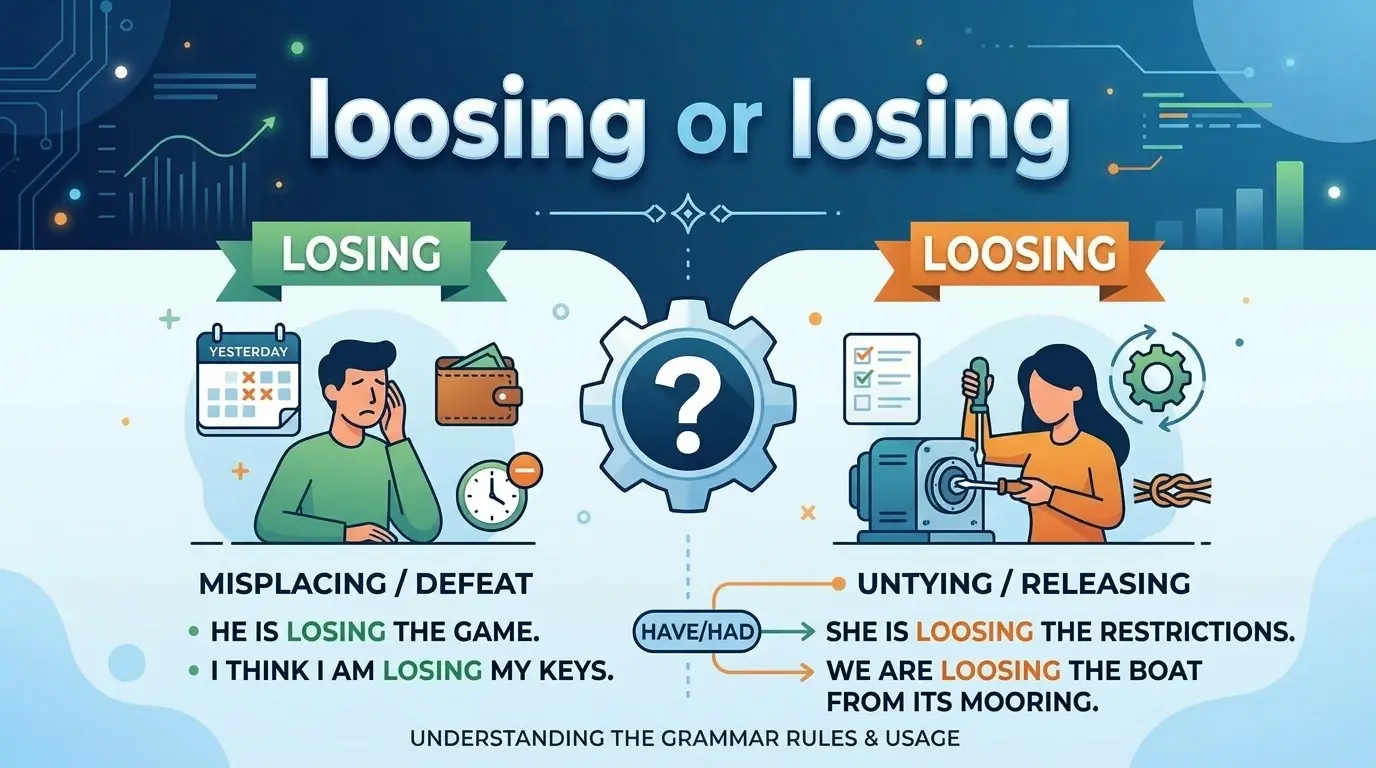
Losing is correct when you mean failing to keep, win, find, or maintain something. Loosing is also a real word, but it means releasing or setting something free.
You are typing a message when you suddenly stop: “Am I loosing my keys again, or is it losing?” The extra o can make these words confusing.
The good news is that the difference comes from their base verbs. Losing comes from lose, while loosing comes from loose. Their meanings are completely different.
You use losing for things like losing a game, losing money, losing patience, or losing your phone. Loosing is much less common and refers to releasing or setting something free.
Understanding the base word makes this spelling choice much easier.
Quick Answer
Losing is correct when you mean no longer having something, failing to win, misplacing something, or experiencing a decrease. Loosing is a real word, but it comes from loose and means releasing or setting something free. For most everyday situations, losing is the word you need.
⚡ Quick Rule in 1 Line
Lose becomes losing for loss; loose becomes loosing when something is released or set free.
What Does “Losing” Mean?
Losing is the present participle of lose. It describes an action or situation involving loss, defeat, misplacement, reduction, or failure to keep something. It is the form you need in most everyday sentences involving “loss.”
The verb lose has several meanings.
You can lose something you own:
I keep losing my keys.
You can lose a competition:
Our team is losing the game.
You can lose an advantage:
The company is losing customers.
You can also lose a feeling or ability:
She is losing confidence.
The same pattern applies to many common expressions.
Examples of losing
- losing money
- losing weight
- losing time
- losing patience
- losing interest
- losing confidence
- losing control
- losing a game
- losing a job
- losing an opportunity
- losing your keys
- losing your phone
In all these examples, the correct form is losing.
Why is there only one “o”?
The base verb is lose, not loose.
When lose takes the -ing ending, the final e is removed:
lose → losing
You do not add another o.
Read More : Move Past or Passed? The Correct Phrase ExplainedWhat Does “Loosing” Mean?
Loosing is a real English word, but it has a different meaning. It comes from the verb loose, which can mean to release, free, or let something go. The word is much less common in everyday English than losing.
For example:
The archer was loosing an arrow.
Here, loosing means releasing the arrow.
Another example is:
The soldiers were loosing the horses.
This means they were releasing the horses.
The word can appear in contexts involving:
- Arrows
- Animals
- Ropes
- Prisoners
- Restraints
- Release
However, modern writers often choose clearer words such as releasing, freeing, or letting go.
Examples of loosing
- The archer was loosing an arrow.
- The hunter was loosing the dogs.
- The sailors were loosing the ropes.
- The guard was loosing the prisoners.
- The rider was loosing the horse.
So, loosing is not simply a misspelling of losing.
It is a different word with a different meaning.
Losing or Loosing: The Main Difference
Losing comes from lose and refers to loss, defeat, misplacement, or reduction. Loosing comes from loose and refers to releasing or setting something free. The spelling depends on the base verb and the meaning you want.
Compare these two sentences:
I am losing my keys.
You cannot find your keys.
The archer is loosing an arrow.
The archer is releasing an arrow.
The extra o changes the base word.
Lose → Losing
Lose means to no longer have something, fail to win, or experience a loss.
Losing is its -ing form.
Loose → Loosing
Loose can mean to release or set something free.
Loosing is its -ing form.
The simplest way to understand the difference is:
lose → losing
loose → loosing
Why Do People Confuse Loosing and Losing?
Losing and loosing look almost identical, and the familiar spelling of loose can make writers add an extra “o.” The mistake often happens when people remember the spelling instead of identifying the base verb.
Look at these words:
lose
loose
The difference is only one letter.
This makes the confusion understandable.
The problem becomes clearer when you look at the -ing forms:
lose → losing
loose → loosing
If you mean loss, use the word related to lose.
If you mean release, use the word related to loose.
A common mistake
❌ I am loosing my wallet.
✅ I am losing my wallet.
The writer means they cannot keep or find the wallet.
Therefore, losing is correct.
Another example:
❌ Our team is loosing the game.
✅ Our team is losing the game.
A team can lose a game.
It does not “loose” a game.
Grammar Rule Loosing vs Losing
Choosing the correct form starts with identifying the verb you actually mean.
Lose + -ing = Losing
The final e in lose is removed before adding -ing.
lose → losing
Examples:
She is losing interest.
He is losing money.
They are losing the match.
Loose + -ing = Loosing
The final e in loose is also removed.
loose → loosing
Examples:
The archer is loosing arrows.
The soldiers were loosing the prisoners.
The important point is not simply the spelling pattern.
The important point is the meaning of the base verb.
Loosing or Losing in Sentences
Here are examples that show how the two forms work.
Examples with Losing
- I am losing my keys again.
- She is losing patience.
- Our team is losing the game.
- He is losing money.
- They are losing interest in the project.
- The company is losing customers.
- I am afraid of losing my job.
- She is losing confidence.
- We are losing valuable time.
- He is losing control of the situation.
- The player is losing the match.
- She is losing her phone.
- They are losing an important opportunity.
- The team is losing momentum.
- He is losing focus.
Examples with Loosing
- The archer was loosing an arrow.
- The hunter was loosing the dogs.
- The guard was loosing the prisoners.
- The sailor was loosing the ropes.
- The rider was loosing the horse.
- The soldier was loosing arrows at the target.
- The keeper was loosing the animals.
- The crew was loosing the ropes from the dock.
- The warrior was loosing his arrows.
- The handler was loosing the dogs into the field.
These examples show why the two words cannot be exchanged.
Is “Losing Weight” or “Loosing Weight” Correct?
Losing weight is the correct phrase. It comes from the verb lose, because the meaning involves having less body weight. Loosing weight would imply releasing or setting weight free, which is not the intended meaning in normal English.
Correct:
She is losing weight.
Incorrect for this meaning:
She is loosing weight.
The same rule works with other common phrases.
Correct expressions
- losing weight
- losing money
- losing time
- losing sleep
- losing interest
- losing patience
- losing confidence
- losing control
- losing focus
Whenever the idea involves something being lost, choose losing.
Is “Losing the Game” or “Loosing the Game” Correct?
Losing the game is correct because a team can lose a game. Loosing the game is incorrect when you mean that the team is failing to win. The correct verb is lose, so its present participle is losing.
Correct:
Our team is losing the game.
Correct:
We are losing the match.
Incorrect:
Our team is loosing the game.
The word loosing has nothing to do with failing to win.
Is “Loosing My Keys” or “Losing My Keys” Correct?
Losing my keys is correct when you mean misplacing them or no longer having them. Loosing my keys would use the verb loose, which means release or set free. That meaning does not fit ordinary situations involving misplaced keys.
Correct:
I keep losing my keys.
Incorrect:
I keep loosing my keys.
This is one of the most common situations where the extra o creates an error.
Remember:
Lose your keys → losing your keys
Common Mistakes
The most common mistake is using “loosing” when the sentence actually needs “losing.” This usually happens with words involving defeat, loss, misplacing something, or a decrease. The correct choice comes from the base verb lose.
Mistake 1: Loosing a game
❌ We are loosing the game.
✅ We are losing the game.
Mistake 2: Loosing money
❌ He is loosing money.
✅ He is losing money.
Mistake 3: Loosing weight
❌ She is loosing weight.
✅ She is losing weight.
Mistake 4: Loosing patience
❌ I am loosing patience.
✅ I am losing patience.
Mistake 5: Loosing your phone
❌ He keeps loosing his phone.
✅ He keeps losing his phone.
These sentences all involve loss, so the base verb is lose.
Losing vs Loosing Comparison Table
| Word | Base Verb | Meaning | Example |
| Losing | Lose | Failing to keep something | I am losing my keys. |
| Losing | Lose | Failing to win | We are losing the game. |
| Losing | Lose | Becoming less | She is losing confidence. |
| Loosing | Loose | Releasing something | The archer is loosing an arrow. |
| Loosing | Loose | Setting something free | They are loosing the horses. |
This table shows the main distinction clearly:
Losing = loss
Loosing = release
Is “Loosing” a Correct Word?
Yes, loosing is a real English word. It is the present participle of the verb loose, so calling every use of it a spelling mistake would be inaccurate. Merriam-Webster’s word finder identifies loosing as the present participle of loose.
However, loosing is much less common than losing in everyday English.
That is why many readers may assume it is always incorrect.
Consider:
The archer is loosing an arrow.
Here, the word can be correct.
But:
The team is loosing the game.
Here, it is wrong because the intended meaning is defeat.
So the answer is not simply:
“Loosing is wrong.”
The accurate rule is:
Use loosing when you mean releasing or setting free.
Use losing when you mean experiencing loss or failing to keep or win something.
Losing or Loosing vs Loosening
Another word sometimes enters this confusion: loosening.
These three forms have different meanings.
Losing
Comes from lose.
I am losing my keys.
Meaning: I cannot find or keep them.
Loosing
Comes from loose.
The archer is loosing an arrow.
Meaning: The archer is releasing it.
Loosening
Also comes from loose, but it means making something less tight.
He is loosening the screw.
Meaning: He is making the screw less tight.
This gives you three useful patterns:
lose → losing
loose → loosing
loose → loosening
Do not treat these forms as interchangeable.
Does American English Use “Loosing” and “Losing” Differently?
The basic distinction is not a US-versus-UK spelling difference. Both losing and loosing come from the same English verbs and retain their separate meanings across standard English varieties.
American English:
She is losing her patience.
British English:
She is losing her patience.
The important distinction is the meaning of lose and loose, not a regional spelling rule.
For an American English audience, losing is the form you will need in ordinary sentences about loss.
Memory Trick
Use this simple trick:
Lose = Loss = Losing
If something is being lost, use:
losing
losing money
losing a game
losing your keys
Loose = Release = Loosing
If something is being released, use:
loosing
loosing an arrow
loosing the horses
loosing the prisoners
Another quick reminder is:
One O in lose → losing.
Two Os in loose → loosing.
The key is to remember the base verb first.
FAQs
Is “loosing” or “losing” correct?
Both words are correct, but they have different meanings. Losing comes from lose and describes loss or defeat. Loosing comes from loose and means releasing or setting something free.
Is “loosing” a real word?
Yes. Loosing is the present participle of loose. It can mean releasing or setting something free. It is much less common in everyday English than losing.
Is it “losing weight” or “loosing weight”?
The correct phrase is losing weight. The verb lose is used because the person is experiencing a reduction in weight.
Is it “losing the game” or “loosing the game”?
The correct phrase is losing the game when you mean failing to win. Loosing does not mean losing a competition.
Is it “losing my keys” or “loosing my keys”?
Use losing my keys when you mean misplacing or no longer being able to find them. Loosing means releasing something.
What is the difference between lose and loose?
Lose means to no longer have something, fail to win, or experience a loss. Loose can mean not tight or can work as a verb meaning to release something.
What is the difference between loosing and loosening?
Loosing means releasing or setting something free. Loosening usually means making something less tight.
For example:
The archer is loosing an arrow.
He is loosening the bolt.
Why do people spell losing as loosing?
The words lose and loose look very similar. Because loose contains two os, writers sometimes incorrectly carry that spelling into losing.
Is “I am loosing my job” correct?
No, not if you mean that you may no longer have your job. The correct sentence is:
I am losing my job.
Is “loosing an arrow” correct?
Yes. Loosing an arrow can mean releasing an arrow from a bow. This is one of the legitimate uses of loosing.
Conclusion:
The difference between losing and loosing comes down to their base verbs. Losing comes from lose and refers to loss, defeat, misplacing something, or becoming less.
Loosing comes from loose and means releasing or setting something free.
For everyday sentences such as losing weight, losing money, losing a game, or losing your keys, always use losing.
Remember the simple rule: lose → losing, while loose → loosing.

I’m Sophia Mitchell, an English grammar and writing enthusiast. I create simple, easy-to-understand content to help learners improve their English. My goal is to make grammar clear, practical, and enjoyable for everyone.









2 thoughts on “Loosing or Losing? The Correct Spelling and Meaning Explained”