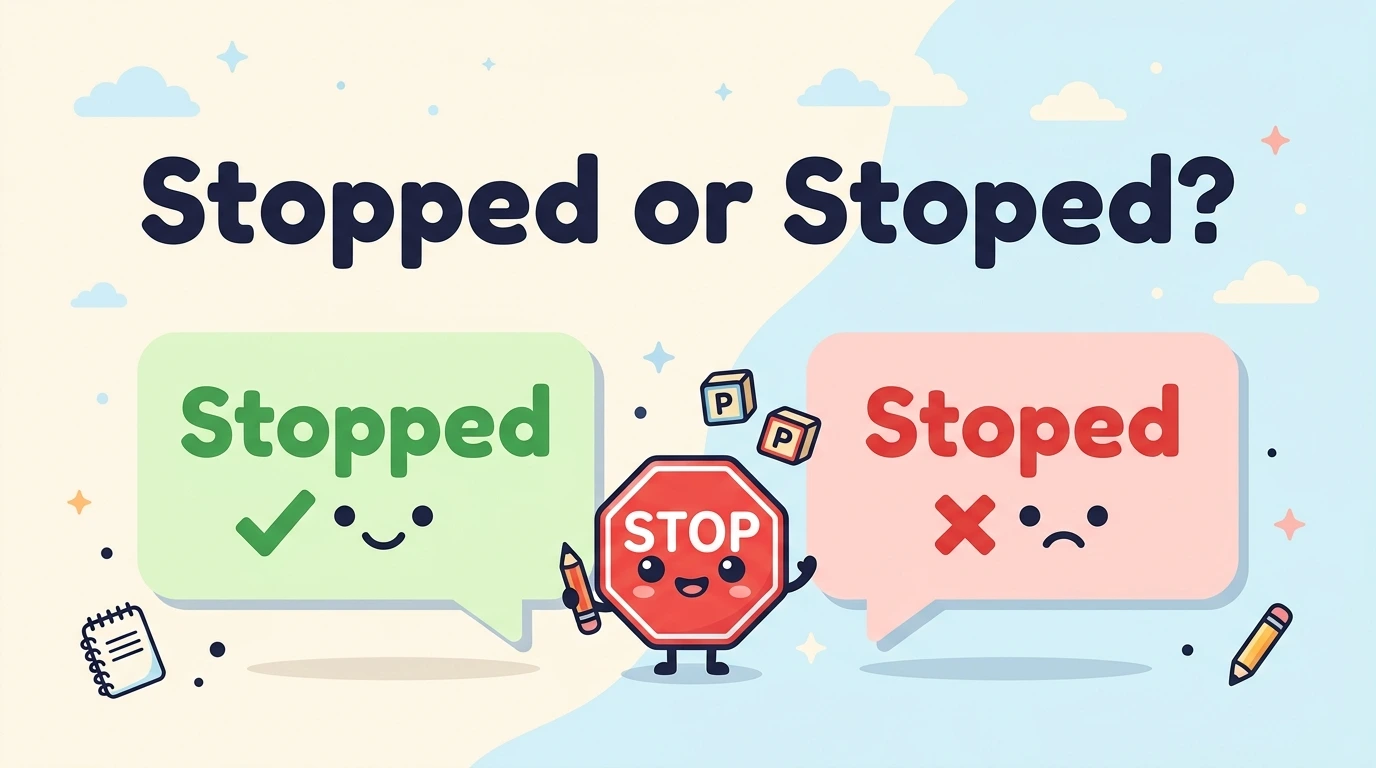
Most English verbs form the past tense by simply adding -ed: walk becomes walked, open becomes opened, play becomes played. So it feels natural to turn stop into “stoped.”
But that is exactly where the mistake comes from.Stopped is the correct spelling.
Stoped is incorrect for the everyday verb stop. The reason is a spelling rule that tells you to double the final consonant.
Once you understand it, you will spell stopped, stopping, and dozens of similar words correctly every time.
Stopped or Stoped: Quick Answer
Use stopped for both the past tense and the past participle of stop.
- Correct: The bus stopped near the school.
- Incorrect: The bus stoped near the school.
Quick rule: stop + p + ed = stopped.
What Does Stopped Mean?
Stopped means that something came to an end or came to a halt. Depending on the sentence, it can describe movement, an activity, or someone preventing something.
Stopped as “came to a halt”
- The car stopped at the red light.
- The train stopped outside the station.
Stopped as “ended an activity”
- She stopped talking when the phone rang.
- The rain had stopped, and the clouds had cleared.
Stopped as “prevented something”
- The teacher stopped the argument.
- The guard stopped the visitor at the gate.
Read More: Gauging Interest vs Gaging Interest: Which Spelling Is Correct?
Is Stopped a Verb or an Adjective?
Stopped is mainly a verb, but it can also work as an adjective or in the passive voice. Both uses keep the double P.
As a verb, it is the past tense and past participle of stop:
- The bus stopped at the corner.
As an adjective, it describes something that is not moving or not working:
- A stopped car was blocking the lane.
- The stopped clock showed 3:15.
In the passive voice, it shows that something was halted by someone or something else:
- The match was stopped because of rain.
- Why was the payment stopped?
- The leak has been stopped.
Spelling stays the same in every case: stopped, never “stoped.”
Why Does Stopped Have Two P’s?
Stopped follows the consonant-vowel-consonant (CVC) rule.
When a short verb ends in one consonant after one vowel, you double the last consonant before adding an ending that begins with a vowel, such as -ed or -ing.
| Letter | In “stop” |
| Consonant | s |
| Vowel | o |
| Consonant | p |
Because stop fits this pattern, the p doubles:
- stop → stopped
- stop → stopping
Why the Doubling Matters
The double consonant protects the short vowel sound. Compare these pairs:
| Word | Vowel sound |
| hoped (from hope) | long “o” |
| hopped (from hop) | short “o” |
Stopped is pronounced with a short “o,” like “stopt.” Writing it with one p would visually suggest a long vowel, as in “hoped.” The second p tells the reader to keep the vowel short.
How to Pronounce Stopped
Stopped ends with a “t” sound, not an “id” or “ed” sound. It is a one-syllable word.
- US: /stɑːpt/
- UK: /stɒpt/
After a voiceless sound like “p,” the -ed ending is pronounced “t.” That is why the word sounds like “stopt,” and why some people forget the extra letters when they spell it.
Say it as “stopt,” but write it as s-t-o-p-p-e-d.
Stopped vs. Stoped: Side-by-Side
| Form | Correct for the verb stop? | Notes |
| stop | Yes | Base form |
| stops | Yes | Present tense with he, she, it |
| stopped | Yes | Past tense and past participle |
| stopping | Yes | -ing form |
| stoped | No | Incorrect past form |
| stoping | No | Incorrect -ing form |
Is Stoped Ever a Real Word?
Almost never, but there is one exception. Stope is a separate, specialized mining verb meaning to excavate ore in steps, so “stoped” and “stoping” can appear in mining texts. That does not make them acceptable spellings of the ordinary verb stop.
When to Double the Final Consonant
Before you double a final consonant, check these conditions:
- The word is short (one syllable) and ends in consonant-vowel-consonant. Examples: stop, drop, plan, grab.
- For longer words, the stress falls on the last syllable. Examples: begin → beginning, prefer → preferred.
Verbs That Follow the Same Pattern
| Base verb | Past tense | -ing form |
| stop | stopped | stopping |
| drop | dropped | dropping |
| plan | planned | planning |
| hop | hopped | hopping |
| clap | clapped | clapping |
| grab | grabbed | grabbing |
| slip | slipped | slipping |
Verbs That Do Not Double
Doubling does not happen in these cases:
- Two vowels before the final consonant: rain → rained, need → needed, clean → cleaned
- Two consonants at the end: help → helped, look → looked
- Stress on the first syllable of a longer word: open → opened, visit → visited, offer → offered
- Words ending in w, x, or y: play → played, fix → fixed, snow → snowed
This is why “lookked” is wrong even though “stopped” is right. The ending of the word decides, not the verb itself.
Stopped or Stopping
Both forms double the p, but they do different jobs.
Use stopped for something that has ended, or with “has,” “have,” and “had”:
- The bus stopped suddenly.
- The machine has stopped working.
- We had stopped for lunch.
Use stopping for an action in progress, or when the word works as a noun:
- The bus is stopping now.
- Stopping suddenly can be dangerous.
Stop vs Stopped: Which Form Do You Need?
Use stop for the present tense and after helper verbs like do, does, and did. Use stopped for the past, and after has, have, or had.
Quick comparison:
| Situation | Correct form | Example |
| Present (I, you, we, they) | stop | They stop at noon. |
| Present (he, she, it) | stops | The train stops here. |
| Simple past | stopped | The train stopped here. |
| After has/have/had | stopped | It has stopped. |
| After do/does/did | stop | Did it stop? |
After Do, Does, and Did
After do, does, or did, always use the base form: stop.
The helper verb already shows the tense, so the main verb stays simple.
- Correct: Did it stop? Incorrect: Did it stopped?
- Correct: Does the bus stop here?
- Correct: Why did you stop?
Remove the helper and the past form returns: “Why did you stop?” becomes “Why stopped you?” in old-fashioned English, but in normal speech we simply say “You stopped.”
After Has, Have, and Had
After has, have, or had, use stopped.
- It has stopped raining.
- We have stopped using that app.
- She had stopped before I arrived.
- The order has been stopped.
Stops, Not Stopps
For he, she, or it, add only -s: stops. The double P happens only before -ed and -ing, not before -s.
- Correct: The bus stops here.
- Incorrect: The bus stopps here.
It’s Stopped or Its Stopped?
It’s stopped is correct. It’s here means “it has” (it has stopped).
- It’s stopped raining. (It has stopped raining.)
“Its” without an apostrophe shows ownership, as in “The car lost its brakes.” It does not fit before “stopped” in a normal sentence.
Examples of Stopped in Sentences
Everyday English
- I stopped drinking soda last year.
- The baby stopped crying after dinner.
- My laptop suddenly stopped working.
Professional writing
- Production stopped due to equipment failure.
- Construction stopped because of bad weather.
Academic writing
- The experiment stopped after contamination occurred.
- Researchers stopped data collection temporarily.
Stopped Doing vs Stopped to Do
Stopped doing means you quit the action. Stopped to do means you paused so you could do something else.
| Pattern | Meaning | Example |
|---|---|---|
| stopped + -ing | quit an activity | I stopped eating sugar. |
| stopped + to + verb | paused for a purpose | I stopped to eat lunch. |
| stopped + object | prevented or halted | They stopped the match. |
- She stopped talking. (She went quiet.)
- She stopped to talk. (She paused so she could chat.)
When you want to say “after you finish,” use after stopping, not “after stopped”:
- Correct: After stopping at the shop, we drove home.
- Incorrect: After stopped at the shop, we drove home.
Synonyms of Stopped
Common synonyms of stopped are halted, ceased, paused, ended, and discontinued. They are close, but not identical.
| Word | Best used when | Example |
| halted | something stops suddenly | Traffic halted at the bridge. |
| ceased | the tone is formal | The noise ceased at midnight. |
| paused | the stop is temporary | He paused to think. |
| ended | something is fully over | The meeting ended early. |
| discontinued | something is officially withdrawn | The company discontinued that model. |
Use stopped when you want the simple, everyday word that fits almost any situation.
Why People Write “Stoped”
- They apply the “just add -ed” rule too quickly. It works for many verbs, so it feels safe.
- They spell by sound. “Stopped” sounds like “stopt,” so the extra p is easy to miss.
- Fast typing. A skipped letter is easy to overlook when you read your own work.
- English learners. Many languages do not double consonants, so the rule is unfamiliar.
The same mistake appears with other verbs: droped (dropped), planed (planned), grabed (grabbed), sliped (slipped), refered (referred), and begining (beginning).
Other Misspellings of Stopped
Stopped has only one standard spelling. These variants are all mistakes in modern English:
- stoped (missing P)
- stopted (extra T)
- stoppted (double P plus extra T)
- stopeed (extra E)
“Stopt” is an old-fashioned variant sometimes seen in older or poetic writing. It is not used in modern writing, so use stopped (verify in your preferred dictionary if you are unsure).
American vs. British English
Stopped is the same in both. Some words with a final consonant do differ by region, such as traveled (US) and travelled (UK), but stop is not one of them. You can use stopped in emails, essays, and professional writing anywhere in the world.
Easy Ways to Remember the Spelling
- One P becomes two: stop has one p, stopped has two.
- The short-vowel test: if the vowel is short (hop, stop, plan), double the consonant. If the vowel is long (hope, rain), do not.
- The mantra: “Stop, double P, add ED.”
- Read it aloud: “stopped” looks and sounds complete, while “stoped” looks off.
Key Takeaways
- Stopped is correct. Stoped is a spelling mistake for the everyday verb.
- Stopped is both the past tense and past participle of stop.
- The -ing form is stopping, also with two p’s.
- Double the final consonant in short consonant-vowel-consonant words.
- Do not double it after long vowels (rained), after two consonants (helped), or in words ending in w, x, or y (played).
- American and British English both use stopped.
FAQs
Is it stopped or stoped?
Stopped is correct. Stoped is not the standard spelling of the past tense of stop.
How do you spell stopped?
S-T-O-P-P-E-D, with two p’s before the -ed ending.
Why does stopped have two p’s?
Stop is a short word that ends in consonant-vowel-consonant, so its final consonant doubles before -ed and -ing.
What is the past tense and past participle of stop?
Both are “stopped.” Example: The car stopped. The machine has stopped.
Is it stopping or stoping?
Stopping, with two p’s.
Is stopped spelled the same in American and British English?
Yes, both use the same spelling.
Is stoped ever correct?
Only as a form of the mining verb “stope.” It is never correct as the past tense of the everyday verb stop.
What is the difference between stopped and stopping?
Stopped describes something that has ended. Stopping describes something in progress, or the act itself.
Is it “did it stop” or “did it stopped”?
Did it stop. After did, use the base form of the verb.
Is stopped a verb?
Yes. It is the past tense and past participle of stop. It can also act as an adjective, as in “a stopped clock.”
How do you pronounce stopped?
It ends with a “t” sound, like “stopt.” It has one syllable.
Conclusion:
Stopped is the only correct spelling for the past tense and past participle of stop, and stopping is the correct -ing form.
Both come from one rule: when a short word ends in a single vowel plus a single consonant, double the final consonant before adding -ed or -ing.
Keep that rule in mind and you will also get words like dropped, planned, and grabbed right.

As an American English writer, I specialize in creating clear and engaging content that makes grammar and language learning accessible to everyone. I enjoy breaking down complex English concepts into simple, practical lessons that readers can apply with confidence. My mission is to help learners strengthen their communication skills through easy and reliable content.