You type “Lets go!” to a friend, or you write “My teacher let’s us leave early.” Both look fine at a glance, yet both are wrong.
That one tiny apostrophe is easy to get wrong, because the two words sound identical.
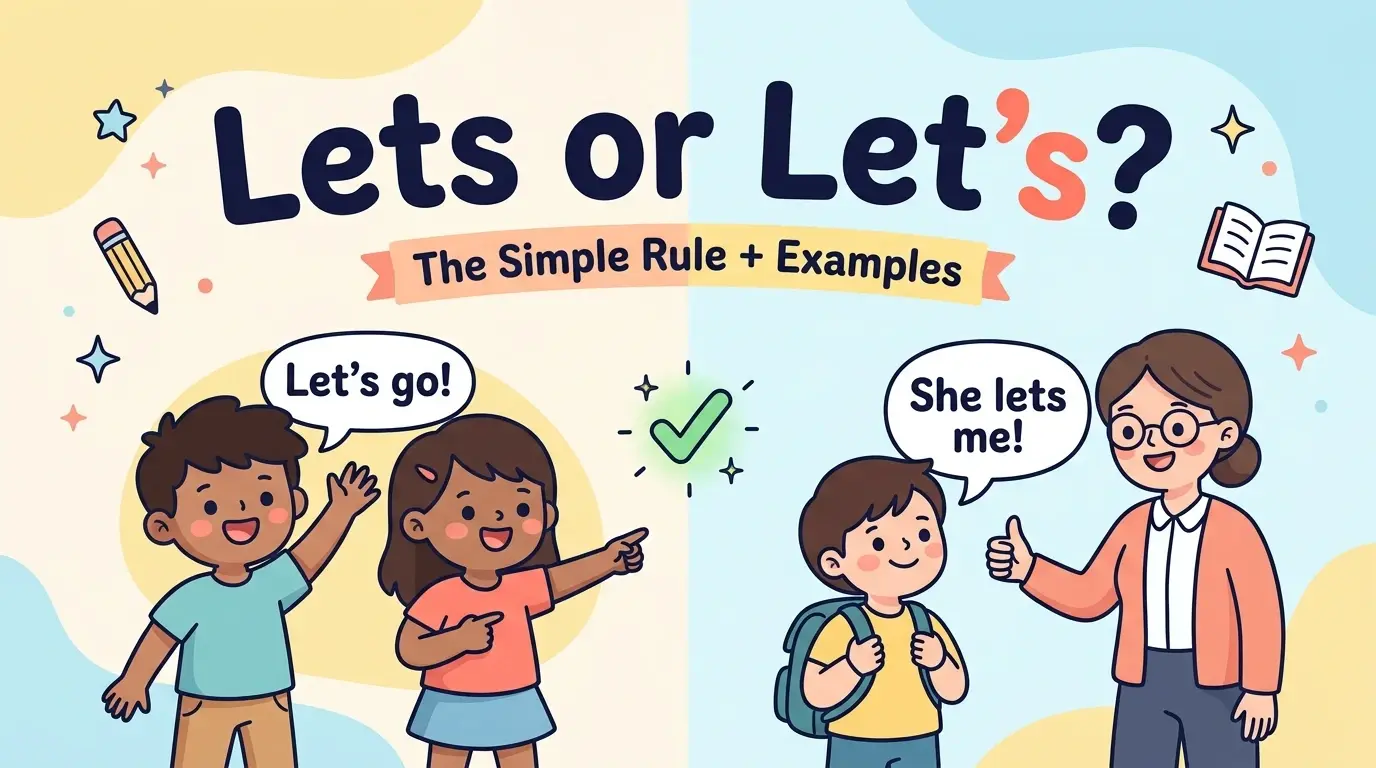
Here is the short answer. Let’s is a contraction of “let us” and is used for suggestions. Lets is the verb “let” in its third-person singular form, meaning “allows” or “permits.”
Once you know the one-second test in this guide, you will rarely need to think about it again.
Lets or Let’s at a Glance
| Let’s | Lets | |
| Apostrophe | Yes | No |
| What it is | Contraction of “let us” | Verb (he/she/it form of “let”) |
| Meaning | Suggestion or invitation | Allows, permits, enables |
| Example | Let’s go home. | She lets me go home. |
| Quick test | Swap in “let us” | Swap in “allows” |
What Does “Let’s” Mean?
Let’s is short for “let us.” The apostrophe replaces the missing “u” and the space. You use it when you are inviting someone to do something with you, proposing a plan, or encouraging a group.
- Let’s start the meeting.
- Let’s try a different approach.
- Let’s go, team!
- I know you’re upset, but let’s take a breath.
Let’s Is Followed by a Base Verb
After let’s, use the plain form of the verb: let’s eat, let’s begin, let’s check. You will not see “let’s eating” or “let’s to go.”
Let’s Not
To suggest avoiding something, add “not” after let’s.
- Let’s not waste time.
- Let’s not argue about this.
Let’s Let
You may also see “let’s let,” which feels odd but is correct. It means “let us let.”
- Let’s let them go in first.
Read More: New Year or New Years? The Correct Spelling and Grammar Explained
Let’s vs Let Us: Which Is More Formal?
Both are grammatical. “Let us” sounds formal, and often ceremonial, as in “Let us begin” at a speech or “Let us pray.” In everyday emails, school work, and conversation, let’s is the natural choice. In very formal academic writing, some writers avoid contractions altogether and rephrase, for example “We should review the data first.”
What Does “Lets” Mean?
Lets is the verb “let” in the present tense when the subject is he, she, it, or a single person or thing. It means “allows” or “permits.” It is not a contraction, so it never takes an apostrophe.
- She lets me borrow her books.
- My boss lets us leave early on Fridays.
- This app lets you edit photos.
- Dave lets his dog sleep indoors.
Which Subjects Take “Lets”?
Only third-person singular subjects add the s:
- I let my friend borrow my phone.
- You let your friend borrow your phone.
- We let our friends borrow our phones.
- She lets her friend borrow her phone.
- The app lets users save files.
Lets Can Also Mean “Rents Out”
In British English, “lets” can mean rents out a property: “My sister lets her flat to a student.” You will see it often in property listings. In American English, “rent” is more common.
When “Lets Go” Is Actually Correct
“Lets go” is correct in one situation: when “go” is part of the phrase “let go,” meaning to release something.
- She always lets go of the rope too soon.
If you mean “let us go” (we should leave), write let’s go.
How to Choose the Right One: The “Let Us” Test
Replace the word in your sentence with “let us.”
- If the sentence still makes sense, use let’s.
- If it becomes nonsense, use lets.
Example 1: “___ go to the park.”
Let us go to the park. ✓ → Let’s go to the park.
Example 2: “She ___ me use her phone.”
She let us me use her phone. ✗ → She lets me use her phone.
Example 3: “My coach ___ us skip practice.”
My coach let us us skip practice. ✗ → My coach lets us skip practice.
A second check: if “allows” fits, you want lets. “She allows me to use her phone” works, so it is lets.
An Easy Way to Remember
The apostrophe in let’s marks missing letters, just like in don’t (do not) or we’re (we are). If nothing has been shortened, there is no reason for an apostrophe. An apostrophe is not a decoration for words that end in s.
Common Mistakes With Lets and Let’s
Mistake 1: Writing “Lets” for a Suggestion
- ✗ Lets try again.
- ✓ Let’s try again.
Mistake 2: Writing “Let’s” for Permission
- ✗ She let’s me stay up late.
- ✓ She lets me stay up late.
Mistake 3: Putting an Apostrophe in a Software Feature Description
- ✗ The app let’s you edit pictures.
- ✓ The app lets you edit pictures.
This one shows up constantly in product descriptions and website copy, where it looks especially careless.
Mistake 4: Writing “Let’s Us”
“Let’s” already contains “us,” so adding another one repeats it.
- ✗ Let’s us begin.
- ✓ Let’s begin.
Mistake 5: Confusing “Let Us Know” With “Let’s Know”
In “Please let us know when you arrive,” the words “let us” are a request for information, not a suggestion. Do not contract it.
- ✗ Please let’s know when you arrive.
- ✓ Please let us know when you arrive.
So the “let us” test works for choosing between lets and let’s, but it does not mean every “let us” should become “let’s.” Check the meaning first.
Lets and Let’s in Everyday Writing
| Situation | Correct sentence |
| Making plans | Let’s meet after work. |
| Suggesting a break | Let’s take five minutes. |
| Starting a task together | Let’s review the report before sending it. |
| Describing a parent | My father lets me drive his car. |
| Describing a teacher | The teacher lets students use calculators. |
| Describing a tool | This system lets employees update their details. |
Key Takeaways
- Let’s = let us (suggestions, invitations).
- Lets = allows or permits (he, she, it, or a singular noun as the subject).
- If swapping in “let us” works, use let’s.
- Never write “let’s us” or “she let’s me.”
- “Lets go” is only correct when it means “releases,” as in “lets go of the rope.”
- Both forms are used the same way in American and British English.
FAQs
Is it “lets” or “let’s”?
Both are correct words with different jobs. Let’s means “let us” and makes a suggestion. Lets means “allows” and describes permission.
Is “lets go” correct?
Not when you mean “let us go.” Write “Let’s go.” The only time “lets go” is correct is when “let go” is a verb phrase meaning release: “He lets go of the handle.”
Is it “she lets me” or “she let’s me”?
She lets me. The word means “allows,” so no apostrophe is needed.
Can I use “let’s” in formal writing?
Yes, in most professional writing it is perfectly fine, especially when you are making a suggestion. “Let us” suits speeches and ceremonial language, and very formal academic writing may avoid contractions entirely.
Is “let’s not” correct?
Yes. It means “let us not”: “Let’s not make the same mistake twice.”
Is “lets” a real word?
Yes. It is the he/she/it form of the verb “let.” In British English it can also mean rents out a property.
Do British and American English spell these differently?
No. Both use lets and let’s in the same way. The only difference is that “lets” meaning “rents out” is mainly British.
What is the fastest way to remember the difference?
Replace the word with “let us.” If it fits, use let’s. If it doesn’t, use lets, and check that “allows” works in its place.
Conclusion:
The difference comes down to meaning. Use let’s when you mean “let us” and you are suggesting something.
Use lets when someone or something allows an action. If you are unsure, run the “let us” test, then check whether “allows” fits.
A single apostrophe will not ruin an email, but getting it right keeps your writing clear and credible, whether you are texting a friend or sending a report to your manager.

I am an English language writer passionate about grammar and clear communication. I create simple, easy-to-understand content that helps readers improve their English skills. My goal is to make learning English both practical and enjoyable.