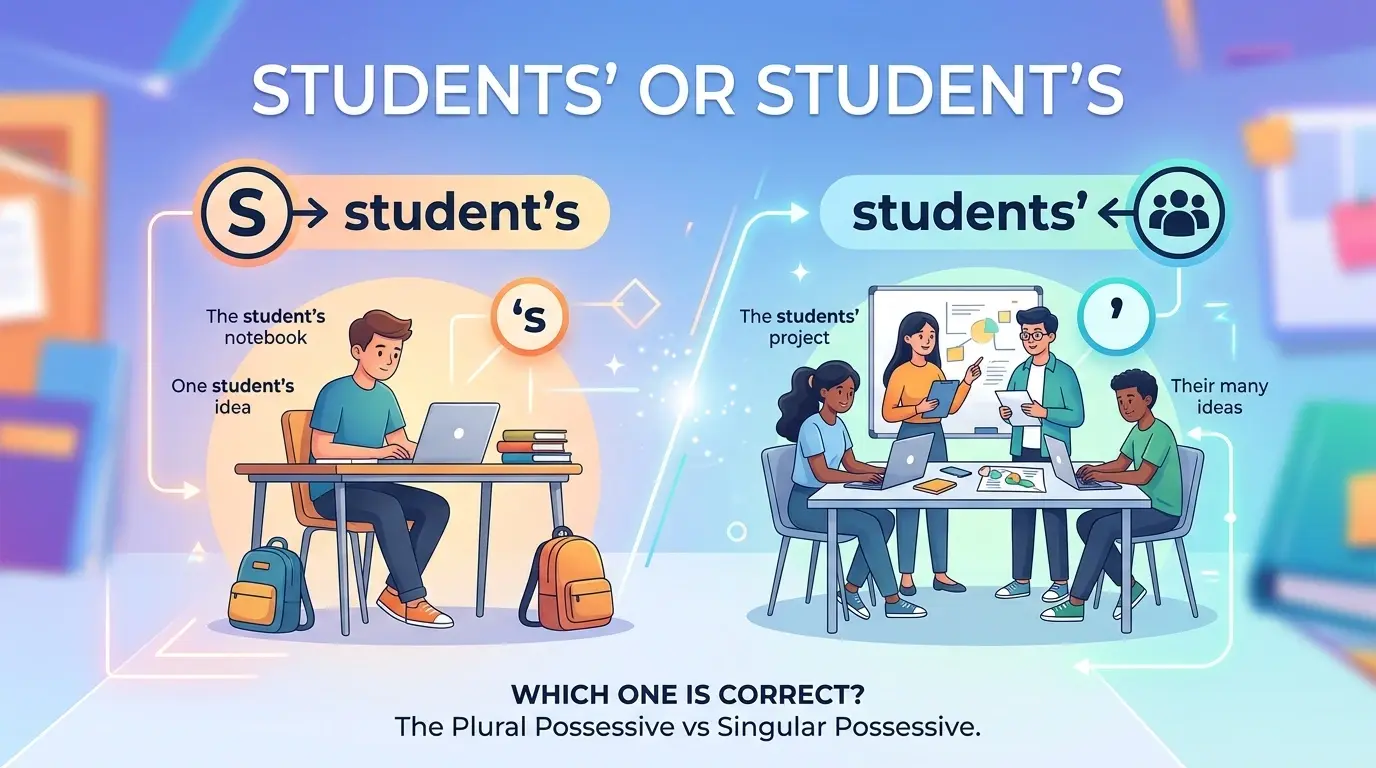
Student’s is correct for one student, while students’ is correct for two or more students. The apostrophe changes position because the meaning changes.
Imagine you are checking a school assignment and write, “The students’ project is excellent.” Then you wonder: should it be student’s instead?
This small apostrophe can change the number of people you are talking about.
The rule is actually simple. Student’s show possession by one student, such as “the student’s notebook.” Students’ shows possession by multiple students, such as “the students’ notebooks.” Both forms are correct, but they cannot always be used interchangeably.
If you often hesitate between students’ or student’s, this guide will help you understand the difference with simple rules and real examples.
You will also learn how to avoid common apostrophe mistakes in everyday English.
Students’ or Student’s? Quick Answer
Student’s is correct when something belongs to one student. Students’ is correct when something belongs to two or more students. The apostrophe comes before the s for one student and after the s for multiple students.
For example:
- The student’s book = the book belongs to one student.
- The students’ books = the books belong to two or more students.
The difference is not about American or British spelling. It is about singular and plural possession.
Quick Rule
Use student’s for one student and students’ for two or more students.
The Difference Between Student’s and Students’
The main difference is the number of students who possess or are connected to something. Student’s is the singular possessive form, while students’ is the plural possessive form. The apostrophe changes position because the two forms represent different numbers.
Compare these sentences:
The student’s notebook is on the desk.
This means one student owns or uses the notebook.
The students’ notebooks are on the desk.
This means two or more students own or use the notebooks.
The word student becomes students when you mean more than one.
Then the apostrophe shows possession.
Basic pattern
One student → student’s
Two or more students → students’
This simple rule solves most questions about these two forms.
What Does “Student’s” Mean?
Student’s is the possessive form of the singular noun student. It means something belongs to, relates to, or is connected with one student. The apostrophe comes before the final s because the noun is singular.
For example:
- the student’s desk
- the student’s phone
- the student’s answer
- the student’s teacher
- the student’s name
- the student’s project
In each example, student’s refers to one student.
Example
The student’s homework was difficult.
Here, the homework belongs to or was assigned to one student.
Another example:
The student’s parents attended the meeting.
The phrase refers to the parents of one student.
Notice the apostrophe:
student’s
The apostrophe comes before the s.
That is the standard pattern for a singular possessive noun.
What Does “Students'” Mean?
Students’ is the possessive form of the plural noun students. It means something belongs to, relates to, or is connected with two or more students. The apostrophe comes after the final s.
Examples include:
- the students’ desks
- the students’ books
- the students’ answers
- the students’ parents
- the students’ projects
- the students’ classroom
For example:
The students’ homework was collected after class.
This means the homework came from multiple students.
Another example:
The students’ names were written on the board.
The names belong to or identify more than one student.
Notice the spelling:
students’
The plural students already end in s.
Therefore, you normally add only the apostrophe.
Student’s vs Students’ Comparison
| Form | Number of students | Meaning | Example |
| student | One | A single student | The student is reading. |
| student’s | One | Belonging to one student | The student’s book is new. |
| students | Two or more | More than one student | The students are reading. |
| students’ | Two or more | Belonging to multiple students | The students’ books are new. |
The important point is that student’s and students’ are both correct.
They simply have different meanings.
Cambridge explains the general rule this way: use ’s with a singular noun and an apostrophe after s with a regular plural noun ending in s.
The Simple Possessive Rule
The easiest way to remember the difference is to ask one question:
How many students are you talking about?
One student?
Use:
student’s
Example:
The student’s laptop is broken.
You are talking about one student.
More than one student?
Use:
students’
Example:
The students’ laptops are broken.
You are talking about multiple students.
This rule follows the general possessive-noun pattern.
For most singular nouns, English adds ‘s to show possession.
For regular plural nouns ending in s, English normally adds only an apostrophe.
How to Know Which Form You Need
Choosing between student’s and students’ becomes easier when you separate the plural rule from the possessive rule.
First, decide whether a student is singular or plural.
Step 1: Identify the number
If you mean one person:
student
If you mean more than one:
students
Step 2: Show possession
For one student:
student’s
For multiple students:
students’
Step 3: Check the noun after it
Look at the thing connected to the student or students.
For example:
The student’s assignment
One student has an assignment.
The students’ assignments
Several students have assignments.
This method works for many common phrases.
20 Real Examples of “Student’s”
Here are natural examples using student’s for one student.
- The student’s book was left in the classroom.
- The teacher checked the student’s answer.
- I found the student’s notebook.
- The student’s name was missing from the list.
- The principal spoke with the student’s parents.
- The teacher praised the student’s effort.
- The student’s project received positive feedback.
- The counselor discussed the student’s goals.
- The student’s desk was near the window.
- We reviewed the student’s test results.
In every sentence, student refers to one student.
20 Real Examples of “Students'”
Here are natural examples using students’ for multiple students.
- The students’ books were on the table.
- The teacher collected the students’ assignments.
- The school displayed the students’ artwork.
- The students’ names appeared on the list.
- The teacher answered the students’ questions.
- The principal listened to the students’ concerns.
- The students’ projects were displayed in the hallway.
- The school announced the students’ results.
- The teacher reviewed the students’ test papers.
- The students’ desks were arranged in rows.
In each sentence, ‘students’ refers to more than one student.
Student’s and Students’ in the Same Sentence
Yes, one sentence can contain both forms. This happens when you talk about one student and a group of students together. Check each apostrophe separately.
Examples:
- The student’s locker is next to the other students’ lockers.
- Each student’s answer was added to the students’ shared document.
- The teacher compared one student’s essay with the other students’ essays.
For each possessive, ask: How many students does this word refer to? One means student’s. More than one means students’.
Student’s Homework or Students’ Homework
This is one of the most common places where the difference matters.
Student’s homework
The student’s homework is on the desk.
This refers to homework belonging to one student.
Students’ homework
The students’ homework is on the desk.
This refers to homework belonging to multiple students.
The word homework does not determine the apostrophe.
The number of students does.
Student’s Name vs Students’ Names
These phrases also show the difference clearly.
One student
The student’s name is Sarah.
There is one student.
Multiple students
The students’ names are Sarah and John.
There are multiple students.
Notice that the apostrophe moves after the s when the noun becomes plural.
Student Name or Student’s Name?
Use student’s name when you mean the name of one specific student. Use student name (no apostrophe) as a label, such as a form field or column heading.
Student name works like a describing word. It tells the type of name, not whose name it is.
| Phrase | Meaning | Example |
|---|---|---|
| student’s name | Name of one specific student | The student’s name was missing from the list. |
| students’ names | Names of several students | The students’ names were written on the board. |
| student name | A label or category | Enter your student name below. |
| student names | A label for a list | Student Names (column heading) |
The same idea works with other nouns. A student book can be a book made for students in general. A student’s book belongs to one particular student.
Heading and form styles can differ between organizations, so verify your own style guide.
Name of the Students or Students’ Name?
Both are grammatically fine, but the students’ names sounds more natural than the names of the students. The “of” version is just wordier.
Use a singular name with students’ only when the group shares one name, such as a team name:
The students’ team name was Blue Owls.
Does “Students” Need an Apostrophe?
No. The plain plural students does not need an apostrophe. Add one only to show possession (students’) or to shorten a word (student’s = student is/has).
| Situation | Correct form | Example |
|---|---|---|
| More than one student, no ownership | students | The students are late. |
| Something belongs to one student | student’s | The student’s bag is red. |
| Something belongs to many students | students’ | The students’ bags are red. |
| Short for “student is/has” | student’s | The student’s ready. |
Quick test: does the word show that something belongs to or is connected with the students? If not, write students with no apostrophe.
Student’s as a Contraction (Student Is / Student Has)
Student’s does not always show possession. It can also be a short form of student is or student has.
- The student’s waiting outside. (student is)
- The student’s finished the test. (student has)
To check, replace student’s with student is or student has. If the sentence still makes sense, it is a contraction. If you can say “of the student,” it is possessive. In formal writing, the full forms are usually clearer.
Students’ or Students’s?
Students’ is correct. Students’s is not. Students is already a regular plural ending in s, so you add only the apostrophe.
The confusion comes from singular nouns that end in s, like boss or James. Some style guides add ’s to those (the boss’s office). That rule does not apply to students, because it is plural.
Incorrect: The students’s books are on the desk.
Correct: The students’ books are on the desk.
Straight (‘) vs Curly (’) Apostrophe
Both ‘ and ’ mean the same thing in student’s and students’. The straight one comes from the keyboard. The curly one is the typographic form many word processors insert automatically.
Pick one style and use it consistently. Just make sure you don’t type an opening quote mark (‘) by mistake.
Student’s Work or Students’ Work
Both forms can be correct.
Student’s work
The student’s work was excellent.
One student produced the work.
Students’ work
The students’ work was displayed at the exhibition.
Multiple students produced the work.
The possessive form depends on the number of students, not the word work.
Common Mistakes
1. Writing “student’s”
Student’s is normally incorrect when you mean the possessive form of the regular plural students.
Incorrect:
The student’s books are here.
Correct:
The students’ books are here.
Because students already end in s, add only the apostrophe.
2. Using “student’s” for multiple students
Incorrect:
The student’s names were listed.
If you mean several students, use:
The students’ names were listed.
Student’s means one student’s.
Students’ means multiple students’.
3. Using “students'” for one student
Incorrect:
The students’ name is David.
If there is only one student, write:
The student’s name is David.
4. Confusing “students” with “students'”
These are not the same.
Students is simply the plural of student.
The students are studying.
Students’ is possessive.
The students’ books are open.
The apostrophe shows that the following noun is connected to or belongs to the students.
5. Adding an apostrophe to make a plural
Do not use an apostrophe just to make a student plural.
Incorrect:
There are many student’s in the class.
Correct:
There are many students in the class.
An apostrophe is not normally used to create the regular plural. It has another grammatical job here: showing possession. Cambridge specifically notes this distinction.
Student or Students: Singular or Plural?
Student is singular (one person). Students is plural (more than one). The plural is regular: add -s, with no apostrophe.
The verb must match the number:
- The student is ready.
- The students are ready.
Number words help too:
- Singular: one student, a student, every student
- Plural: two students, many students, all students
There is no irregular plural for this word. The plural of student is always students.
Students or The Students?
Use students for students in general. Use the students for a specific, known group.
- Students need enough sleep. (students in general)
- The students in my class need enough sleep. (a specific group)
Memory Trick
Use this simple trick:
One = ‘s
One student → student’s
Many = s’
Many students → students’
Think of the apostrophe as showing where the ownership marker goes.
student + ‘s = student’s
students + ‘ = students’
Once you identify whether you mean one or several students, the choice becomes much easier.
Is “Students’ or Student’s” a Spelling Difference?
No.
The difference is mainly grammatical, not a US-versus-UK spelling difference.
American and British English generally use the same basic possessive rule here. A singular noun takes ‘s, while a regular plural noun ending in s takes an apostrophe after the s.
So you can use:
- student’s
- students’
in both American and British English.
The correct choice depends on what you mean.
What About “Students”?
It is useful to understand the three forms separately:
Student
One person.
The student is reading.
Students
More than one person.
The students are reading.
Student’s
Something connected to one student.
The student’s book is open.
Students’
Something connected to multiple students.
The students’ books are open.
Once you understand these four forms, most apostrophe questions become simple.
What About Irregular Plural Possessives?
The rule changes slightly with irregular plural nouns.
For example:
- child → children
- children → children’s
- man → men
- men → men’s
- woman → women
- women → women’s
These plural nouns do not end in s, so they take ‘s in the possessive form.
Compare:
The student’s book
The students’ books
The child’s book
The children’s books
This is why it is important to identify whether a plural noun actually ends in s.
FAQs
1.Is “student’s” or “students'” correct?
Both are correct. Use student’s for one student and students’ for two or more students.
2.What is the plural possessive of student?
The plural possessive form is students’. For example: The students’ classroom was clean.
3.What is the singular possessive of a student?
The singular possessive form is student’s. For example: The student’s classroom was clean.
4.Is “students’s” correct?
No. When students is already a regular plural ending in s, add only an apostrophe: students’.
5.Should I write “student’s name” or “students’ name”?
Use student’s name for one student. Use students’ names for multiple students.
6.Do American and British English use different forms?
No major US-versus-UK difference applies to this basic rule. Both varieties use student’s for singular possession and students’ for regular plural possession.
Conclusion:
The difference between student’s and students’ is simple once you identify the number of students.
Use student’s when one student owns or is connected to something. Use students’ when two or more students own or are connected to something.
For example, the student’s book belongs to one student, while the students’ books belong to multiple students.
The key is to remember that the apostrophe shows possession. It does not make student plural. For a regular plural ending in s, place the apostrophe after the s.

As an American English writer, I specialize in creating clear and engaging content that makes grammar and language learning accessible to everyone. I enjoy breaking down complex English concepts into simple, practical lessons that readers can apply with confidence. My mission is to help learners strengthen their communication skills through easy and reliable content.











3 thoughts on “Students’ or Student’s? The Correct Possessive Form Explained”