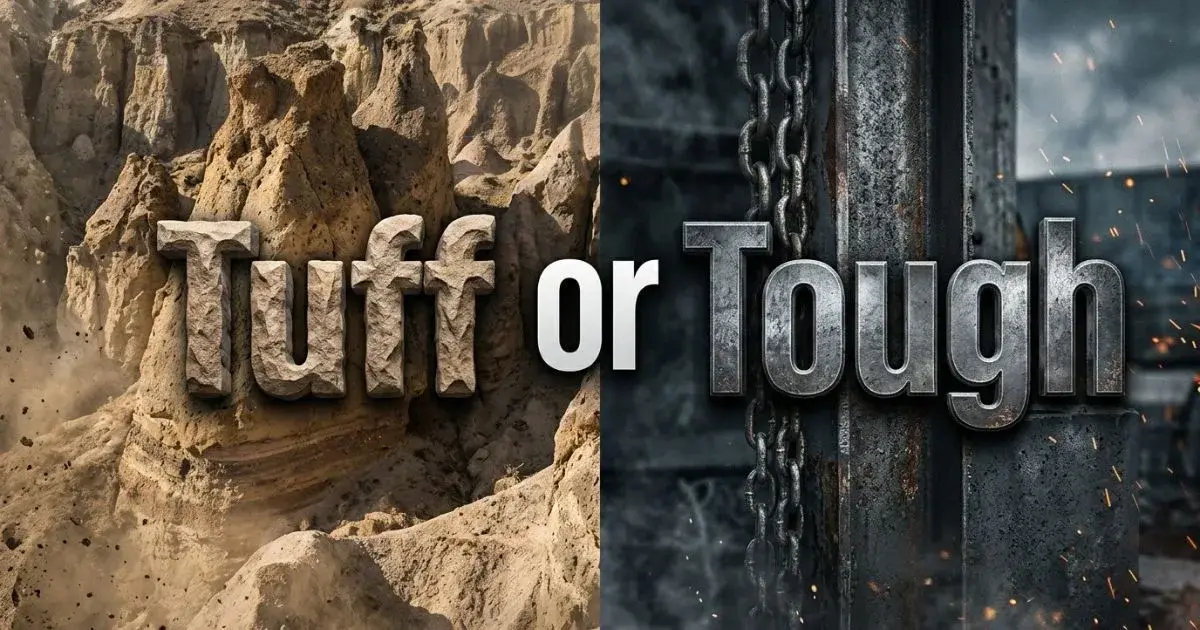
You are typing a quick message about a brutal exam, and your fingers write “tuff.” Autocorrect says nothing. So is it a mistake, or a real spelling?
Both words sound identical, which is exactly why people mix them up. But they are not equal. One is the everyday spelling you need in almost all your writing.
The other is a geology term, a casual slang spelling, and sometimes a brand name.
This guide explains tuff or tough in plain language: what each word means, when each is acceptable, a quick test that settles any sentence, and the mistakes that catch people most often. You will leave with one simple rule you can use every time.
Tuff or Tough: The Quick Answer
Here is the short version.
- Tough is the standard adjective. It means difficult, strong, durable, or strict. Example: “That was a tough decision.”
- Tuff is a geology noun for rock formed from compacted volcanic ash. Example: “The cliff is made of tuff.”
- Tuff also appears as a casual, nonstandard spelling of tough, and in some brand names.
The rule: if you mean difficult, strong, strict, or hard to chew, write tough. If you mean the rock, or you are copying a brand name, write tuff. When you are unsure, tough is the safe choice.
What Does “Tough” Mean?
Tough is a flexible word. Its meaning shifts with whatever it describes, so it helps to see the main senses one by one.
Difficult or Full of Problems
This is the most common use. A tough exam, a tough choice, and a tough week all involve effort or hardship.
- Finding a flat in a big city is tough.
- She has been having a tough time lately.
- We had a tough conversation about money.
Strong Enough to Handle Pressure
A tough person does not give up easily when conditions get hard. The informal phrase “tough as nails” describes someone very strong who copes well with difficult situations.
- He stayed tough through the whole tournament.
- She is a tough negotiator.
Strong, as a Material
Objects can be tough too. Here the word means they resist damage and do not break easily.
- These boots are made of tough leather.
- Builders need tough gloves.
Strict or Firm
Rules, policies, and people can be tough when they refuse to go easy.
- The college has a tough policy on late work.
- Politicians often promise to be tough on crime.
Hard to Chew
Meat is tough when it is hard to cut or bite. Overcooked steak, for example, turns tough and dry.
Not Easily Moved by Emotion
A “tough guy” is someone who does not show much sentiment. He looked like a tough guy at first, but he turned out to be very kind.
“Tough Luck”
In informal English, “that’s tough” can mean “that’s unlucky.” Said ironically, a blunt “Tough!” means “I’m not sorry for you.” Tone matters here, so use it carefully.
Read More: I Could Care Less or I Couldn’t Care Less? Which Is Right
What Does “Tuff” Mean?
Tuff has three separate lives, and only one of them is fully standard.
Tuff as a Rock
In geology, tuff is rock formed when volcanic ash and small fragments compact and cement together. Geologists use this word all the time, and no other spelling will do.
The students studied layers of tuff near an old volcano.
Tuff as Casual Slang
In casual online writing, people use tuff as a playful spelling of tough. Sometimes it is praise, as in “that fit is tuff.” Sometimes it is just stylized tough, as in “that’s tuff, man.”
Treat this as nonstandard. It can work in a message to a friend where the spelling is part of the tone. Outside that setting, readers may take it for a typo. Slang also shifts quickly, and the meaning depends heavily on context.
Tuff as a Brand or Name
Some companies and products spell their name Tuff. If you see “Tuff Tools” in marketing, check whether it is a brand before “correcting” it. When you write about a brand yourself, copy its spelling exactly.
Is Tuff a Real Word, or Just a Typo?
Both, depending on the sentence. Tuff is a real word in geology. As a spelling for the everyday adjective, it is nonstandard.
Think of it like a tool that is perfect for one job and wrong for another. A real word is not automatically the right word for your sentence. Always ask what you mean and who is reading.
Why Do They Sound the Same?
Both words are pronounced /tʌf/. English spells that “uff” sound in several ways: tough, rough, enough, and stuff all end the same way to the ear.
The -ough cluster is especially unpredictable. Though, through, and bough use the same letters but sound different from each other. Nothing in the spelling tells you the sound, so you have to memorize each word.
A handy habit: if you catch yourself misspelling one -ough word, quickly scan the same document for others like it.
A 3-Step Test That Settles Any Sentence
Rules are easy to forget mid-sentence. This quick test works every time.
- Ask what you mean. Is it difficult, strong, durable, or strict? Or is it a rock?
- Swap in a test word. Replace the word with “difficult” or “durable.” If the sentence still works, use tough. If “rock” or “ash” fits instead, use tuff.
- Read the full sentence aloud. Context catches slips that a single word hides.
Try it on these:
- “The deadline is ___.” Difficult fits, so: tough.
- “The cliff is made of ___.” Rock fits, so: tuff.
- “She is a ___ boss.” Strict fits, so: tough.
“Tough Time” vs “Tuff Time”?
People often search for “tuff time” because the phrase comes up in everyday speech. In standard English it is tough time: “She is having a tough time at work.” It means a period full of difficulty.
“Hard time” and “difficult time” mean nearly the same thing, and tough time and hard time are generally interchangeable. One catch: “hard time” can also mean time served in prison, as in “doing hard time.” A tough time never carries that meaning.
Tough also forms many natural pairs worth learning as chunks:
- tough time
- tough decision
- tough question
- tough choice
- tough competition
- tough challenge
Tougher and Toughest, Never Tuffer and Tuffest
The comparative of tough is tougher, and the superlative is toughest. Because tuff is a noun in geology, it does not take these endings in standard English.
- “This exam is tougher than the last one.”
- “That was the toughest week of the year.”
Compound words keep the spelling too: tough-minded, tough-looking.
Wrong vs Right: Quick Fixes
Here are the slips that appear most often, with the fix beside each.
| Wrong | Right |
| The exam was tuff. | The exam was tough. |
| We need tuffer rules. | We need tougher rules. |
| It is the tuffest material we tested. | It is the toughest material we tested. |
| Set a tuff milestone for Q3. | Set a tough milestone for Q3. |
| She is a tuff-minded manager. | She is a tough-minded manager. |
| The sample contained a lot of tough. | The sample contained a lot of tuff. |
The last row is the reverse mistake: using tough when the sentence is about rock.
Which Word Fits Where
The right choice depends on your reader and your purpose.
- School, work, and professional writing: Use tough. Essays, emails, reports, and applications all expect standard spelling.
- Texts and social media: Tuff can be a deliberate style choice among friends. Expect some readers to see it as a typo.
- Geology and earth science: Use tuff for the rock. Replacing it with tough changes the meaning entirely.
- Brand names: Copy the spelling the brand uses.
Common Mistakes and Why They Happen
Trusting the Spell Checker
Because tuff is a real word, a spell checker may not flag it. The tool sees a valid spelling and moves on, even though your sentence needed tough. Always run the test yourself on important documents.
Assuming Tuff Always Means “Cool”
In slang, tuff can express admiration, but “that’s tuff” can also be a casual reply to bad news, much like “that’s tough.” Read the full conversation before deciding what a speaker meant.
Fixing a Geology Term by Mistake
If you proofread a science paper and change every tuff to tough, you will damage the text. Check the topic first.
Mixing Up the Rock and the Quality
“The rock is tough” says the rock is strong or hard to break. “The rock is tuff” names the type of rock. One describes a quality; the other identifies a material.
Tough in Real Life: Examples by Situation
Seeing the word in context helps it stick.
- At school: The professor set a tough problem on the final. Group work was tougher than I expected.
- At work: We faced a tough budget decision this quarter. The manager is tough but fair.
- In sports: The team prepared for a tough match away from home. She is mentally tough under pressure.
- In daily life: It has been a tough year for many families. These shoes are tough enough for daily use.
- In the kitchen: The chicken turned tough because it cooked too long.
Quick Practice: Tuff or Tough?
Fill in each blank, then check the answers below.
- The final exam was really ___.
- The geologist sampled a layer of volcanic ___.
- This is the ___ decision I have ever made.
- These gloves are ___ enough for farm work.
- The coach is ___ but fair.
- The cliff is made of ___.
Answers: 1. tough 2. tuff 3. toughest 4. tough 5. tough 6. tuff
If you missed one, go back to the 3-step test and look at the word you swapped in.
A Quick Proofreading Routine
Before you send or submit anything important:
- Use Find to search for “tuff.”
- Test each result with “difficult” or “rock.”
- Fix the ones that fail, and leave real rock or brand names alone.
- Glance at other -ough words (rough, enough, though) while you are there.
Easy Ways to Remember the Difference
- Tuff rhymes with stuff. Stuff is material, and tuff is a material: rock.
- Tough means difficult. If “difficult,” “strong,” or “strict” fits, use tough.
- The -ough family. Tough, rough, and enough share the same ending and the same sound, so spell them as a group.
- When in doubt, choose tough. Outside geology and brand names, it is almost always the right pick.
FAQs
Is it tuff or tough?
Tough is the standard spelling for anything difficult, strong, durable, or strict. Tuff is a geology term for volcanic rock and also appears as nonstandard slang or in brand names. In normal writing, choose tough. When unsure, choose tough.
Is tuff a real word?
Yes. Tuff is a real noun in geology, meaning rock formed from compacted volcanic ash. It is not the standard adjective for “difficult” or “strong.” Casual writers also use it as slang, but formal readers will usually treat that spelling as a mistake.
Can I use tuff in a text message?
You can, if you want a casual slang tone and your reader will understand it. Keep in mind that some people may read it as a typo. For anything formal, such as school, work, or applications, write tough instead. Better safe when clarity matters.
Are tuff and tough pronounced the same?
Yes. Both are pronounced /tʌf/, which is why the spelling is so easy to mix up. Rough and enough end with the same sound. Since your ear cannot help, rely on meaning: difficulty or strength means tough, volcanic rock means tuff.
Is it “tough time” or “tuff time”?
The standard phrase is “tough time,” meaning a period of difficulty, as in “She is having a tough time at work.” Hard time and difficult time mean nearly the same. “Tuff time” is not standard unless you are deliberately using slang or a brand name.
What is the comparative form of tough?
The comparative is tougher, and the superlative is toughest. For example: “This exam is tougher than the last,” and “That was the toughest week.” Tuffer and tuffest are nonstandard, so avoid them in schoolwork or professional writing. Compounds like tough-minded keep the same spelling.
Conclusion:
The choice between tuff or tough comes down to meaning. Tough is the standard adjective for anything difficult, strong, durable, or strict.
Tuff belongs to geology, to certain brand names, and to casual slang where the spelling is a deliberate style choice.
For school, work, and everyday writing, tough is the right answer almost every time.
Your next step: open the last thing you wrote, search for “tuff,” and run the 3-step test on every match. Then retry the practice quiz in a few days to lock the rule in.

As an American English writer, I specialize in creating clear and engaging content that makes grammar and language learning accessible to everyone. I enjoy breaking down complex English concepts into simple, practical lessons that readers can apply with confidence. My mission is to help learners strengthen their communication skills through easy and reliable content.










