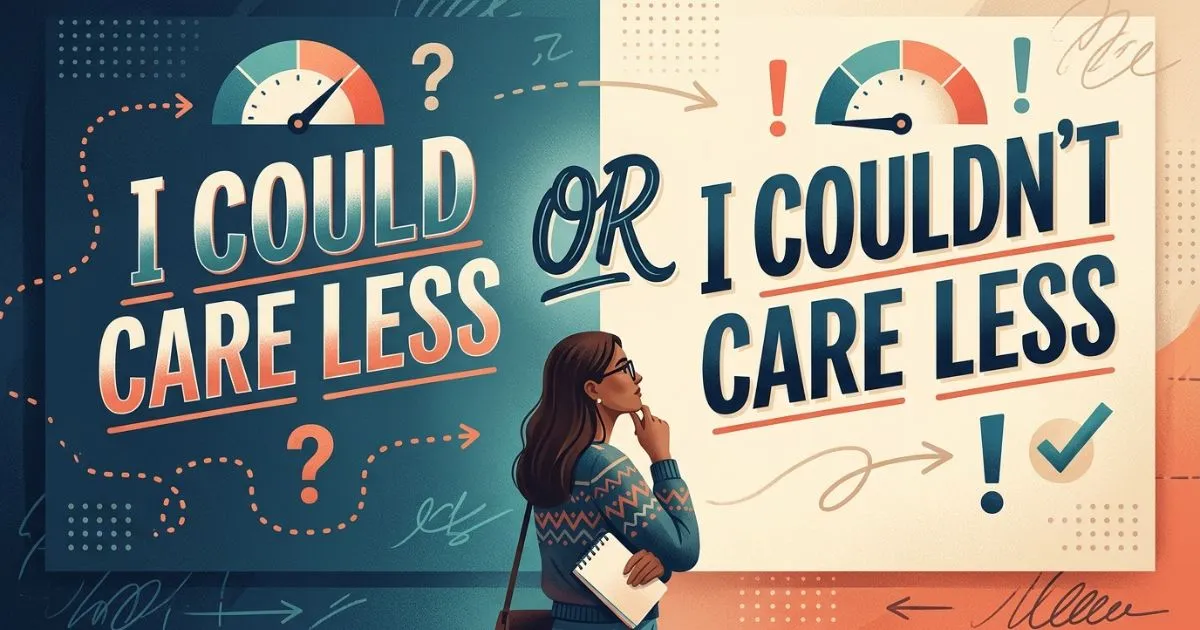
Someone says, “I could care less,” and half the room nods while the other half winces. Everyone understands the message, yet only one version passes the logic test.
If you have ever paused mid-sentence wondering which phrase to type, you are in good company.
This guide settles the question of I could care less or I couldn’t care less in plain language. You will learn what each phrase means, why people use both, what dictionaries and grammarians say, and which one to pick for texts, essays, and work emails.
You will also get a simple memory trick and polite alternatives for moments when “couldn’t care less” sounds too harsh.
The Short Answer: “Couldn’t Care Less” Is the Safer Choice
Use “I couldn’t care less” when you mean you do not care at all. It is the original phrase, and its logic holds up.
“I could care less” is also heard everywhere, especially in American speech, and people usually mean the same thing by it. Merriam-Webster even lists it as a variant. But the literal words say the opposite, so some readers see it as a mistake.
When in doubt, choose the version that cannot be misread.
Read More: Theirself or Themself? The Quick, Clear Answer
What Does “I Couldn’t Care Less” Mean?
It is a blunt way of saying “I don’t care.” You care so little about something that it is impossible to care any less.
Think of it as a scale
Picture a dial from 0 to 10. If your interest sits at 0, you cannot turn it down any further. That is why “couldn’t” fits: your concern has already hit the floor.
This does not mean you care about nothing in life. It only describes your feelings about the one topic in front of you.
Examples
- My cousin kept boasting about her new purse, but I couldn’t care less about designer brands.
- I couldn’t care less if it rains. I love beach days either way.
- He couldn’t care less who wins the competition.
- They couldn’t care less about the cancelled show.
You may also see the full form, “I could not care less.” It means exactly the same thing.
A note on tone
This phrase can sound rude or snarky. Saying it to a friend who is excited about something can feel like a slap, even if you are only joking. Match the phrase to the moment.
What Does “I Could Care Less” Mean?
In everyday speech, people use “I could care less” to say they are not interested. Heard in a conversation, it usually lands as “I don’t care.”
What the words literally say
Taken word for word, the sentence says you care a little and could lower that amount. Britannica’s Ask the Editor column puts it this way: most grammarians consider the expression logical only with “couldn’t,” so the “could” version should technically suggest you are concerned.
LanguageTool makes the same point more bluntly. Break the phrase apart, and “I could care less” is the same as saying “I care.”
Why listeners still understand it
Native speakers say it all the time, and listeners figure out the real meaning from context and tone of voice. Britannica’s advice is practical: whatever your own preference, you should be aware of both forms.
Examples
- Honestly, I could care less what they say.
- She could care less about the latest fashion trend.
- I could care less who gets the credit.
Notice that each sentence only works because the speaker’s attitude is obvious. Remove the voice, and the meaning gets shakier.
Side-by-Side Comparison
| I couldn’t care less | I could care less | |
| Literal meaning | I cannot care any less than I do | I could care less than I do now |
| Intended meaning | I don’t care at all | Usually the same: I don’t care |
| Logic | Consistent | Contradicts itself |
| Dictionary status | The original phrase | Listed by Merriam-Webster as a variant |
| Risk of confusion | Very low | Higher, especially in writing |
| Best for | Clear, careful communication | Casual, spoken American English |
Why Do People Say “Could Care Less”?
Nobody can say for certain, but we do have a few solid clues.
The timeline
According to Merriam-Webster, as cited by LanguageTool, “couldn’t care less” is the original form and became popular in the 1940s. Google Ngram data shows “could care less” becoming common later, starting around the 1960s. So the “could” version arrived second, and it has been around for decades.
Two popular explanations
Some people believe “could care less” began as a slip: a speaker dropped the “n’t” and the shortened version stuck. Others hear it as sarcasm, as if the speaker is saying, “Oh sure, I could care less,” meaning that doing so would be impossible.
Both ideas sound plausible, but neither is proven. It is wiser to say “we don’t know” than to repeat one theory as fact.
Why it survived
Spoken English leans heavily on tone. When someone says “I could care less” with a flat voice and a shrug, nobody thinks they are secretly interested. Habit, rhythm, and context did the rest.
Is “I Could Care Less” Actually Wrong?
Here is where it helps to separate two questions.
Is it a grammar error? Not exactly. The sentence is built correctly, with a subject, a verb, and an adverb. The issue is logic, not grammar.
Is it accepted? Partly. Merriam-Webster lists it as a variant, and plenty of native speakers use it. But critics push back. LanguageTool advises sticking with “couldn’t” and compares the “could” version to using “literally” to mean “figuratively.” In other words, many people use it, and many people also notice it.
So “wrong” is too strong, and “perfectly fine everywhere” is too generous. The honest answer is: it is common, understood, and still criticized.
Which Phrase Should You Use? A Situation Guide
In conversation with friends
Either one will be understood. If you want to avoid a grammar debate over dinner, say “couldn’t.” If you say “could,” expect that someone may jump in and correct you.
In texts and social media
This is where problems start. Writing has no voice, so a text reading “I could care less” can look like you actually care. A reader scanning quickly may take it literally.
Choose “I couldn’t care less” or simply “I don’t care.”
In essays, exams, and school work
Avoid “could care less.” A teacher or examiner who follows the strict logic may mark it down. If you need the idiom, write “couldn’t care less.” If the tone should be neutral, skip the idiom altogether.
In professional writing
Skip both phrases. They sound dismissive in reports, proposals, and emails to colleagues. Say what you actually mean:
- Instead of “I couldn’t care less about the proposed changes,” write “I don’t have strong concerns about the proposed changes.”
Be careful, though. These two sentences are not identical in meaning, so pick wording that matches your real position.
A Simple Memory Trick
Look at the end of the words.
- Couldn’t ends with n’t.
- Don’t ends with n’t.
And “couldn’t care less” means “don’t care.” Both contain a negative, so they match.
Here is a handy shortcut you can repeat to yourself:
- Couldn’t care less = I care zero.
- Could care less = commonly used to mean zero, but literally says “some.”
If you can see the “n’t,” you are using the clear version.
Kinder Ways to Say You Don’t Care
Both phrases can hurt feelings. If you want to stay honest without sounding harsh, try one of these.
Neutral and friendly
- It doesn’t matter much to me.
- I’m not really into that.
- I don’t have a strong preference.
Polite but clear
- That’s not something I’m interested in.
- I’ll let you decide on this one.
Professional
- I’m not concerned about this.
- This isn’t a priority for me right now.
A small tip: pick the alternative that matches your real feeling. “I don’t have a strong preference” says you are flexible, while “I’m not interested” says you want out. They are not interchangeable.
Common Mistakes to Avoid
1. Assuming both phrases mean the same thing literally
They are used for the same purpose, but their literal meanings are opposites. That gap is exactly why one is criticized.
2. Using “could care less” in writing
Without tone of voice, the reader has to guess your attitude. The risk is not worth it.
3. Dropping the “n’t” by accident
When typing fast, it is easy to leave out those three letters. If your sentence looks like “I could care less” and you meant the opposite, you have changed the message.
4. Assuming the phrase is always polite
It is not. Even a joking “I couldn’t care less” can sound cold. Think about who you are talking to before you use it.
5. Treating one theory about its origin as settled fact
Since no one can prove how “could care less” began, avoid saying “it started as a mistake” or “it started as sarcasm” as if it were certain.
Proofreading Checklist
Before you hit send or submit, run through these three quick checks:
- Did I mean “I don’t care”? If yes, make sure the phrase contains “n’t.”
- Who is reading this? A teacher, boss, or client probably deserves a more neutral phrase.
- Could this sound harsh? If so, swap in a gentler alternative from the list above.
Quick Practice
Fill in the blank with the clearest option. Answers are below.
- “I ______ care less about the score; I just want to go home.”
- Writing a formal report? Replace “I couldn’t care less about the schedule” with: “The schedule is not a ______ for me.”
- A friend texts you “I could care less about the trip.” Does she want to go?
Answers: (1) couldn’t, because you mean zero interest. (2) concern or priority, which are neutral replacements. (3) Probably not, but because it is a text, you may want to ask her to be sure.
FAQs
1. Is it “I could care less” or “I couldn’t care less”?
“I couldn’t care less” is the original and logical form, meaning you do not care at all. “I could care less” is widely used with the same intended meaning, and Merriam-Webster lists it as a variant. For writing, choose the “couldn’t” version.
2. What does “I couldn’t care less” mean?
It means you are not concerned at all, much like saying “I don’t care.” The idea is that your interest is already so low that it could not possibly drop any further. It can sound rude, so watch your tone.
3. Does “I could care less” mean you care?
Literally, yes. The words suggest you care some and could care less than you do now. In practice, speakers usually mean the opposite, and listeners work that out from context and tone of voice. In writing, that missing tone can cause confusion.
4. Can I use “I could care less” in an essay?
It is best to avoid it. Some readers treat it as illogical or incorrect, and an essay gives no tone of voice to clarify your meaning. Use “couldn’t care less,” or better, a neutral phrase such as “I am not concerned about this.”
5. Is “I could not care less” correct?
Yes. It is simply the uncontracted form of “I couldn’t care less,” and the meaning is identical: complete indifference. The longer version suits slightly more careful writing, though the phrase itself is still casual and can come across as dismissive.
6. Which phrase came first?
According to Merriam-Webster, as cited by Language Tool, “I couldn’t care less” is the original and grew popular in the 1940s. Google Ngram data shows “I could care less” becoming more common later, in the 1960s.
Conclusion:
So, I could care less or I couldn’t care less? Both are heard in everyday English, and listeners usually understand either.
But “I couldn’t care less” is the original, the logical one, and the one that is hardest to misread.
Your next step is simple: use “couldn’t care less” whenever you write, and switch to a neutral phrase in formal or professional settings.
In casual speech, stay aware of both forms and think about how your words might land.

I am an English language writer passionate about grammar and clear communication. I create simple, easy-to-understand content that helps readers improve their English skills. My goal is to make learning English both practical and enjoyable.






1 thought on “I Could Care Less or I Couldn’t Care Less? Which Is Right”