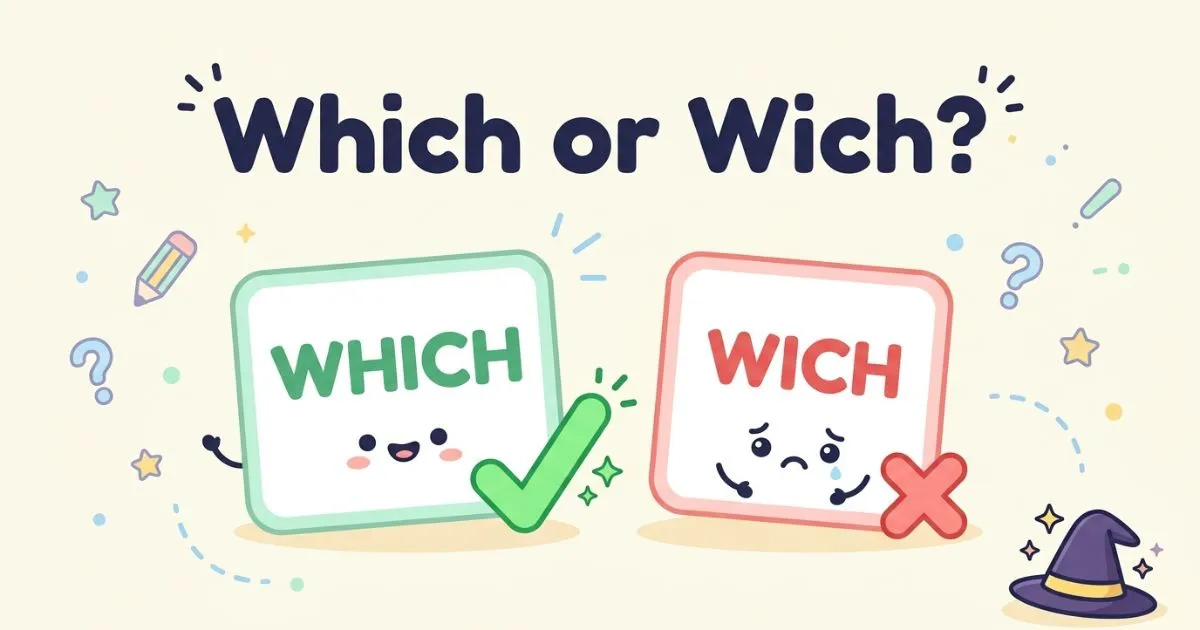
You are typing a quick message, you reach for the word that asks “what one?”, and your fingers hesitate. Is it which or wich?
The answer is simple: which is the correct spelling. Wich is a misspelling in everyday writing, and a spell checker will flag it every time.
The confusion is understandable. In most accents, which, wich, and witch sound exactly the same, and the first “h” in which is silent, so your ear gives you no clue that it is there.
On top of that, wich is not pure nonsense. It survives as an obsolete dictionary word, as the ending of English place names like Norwich, and as a casual shorthand for “sandwich” on menus.
In this guide, you will learn what which means, when wich is and is not acceptable, how to tell which from witch, and a few easy tricks that make the spelling stick.
Which or Wich: The Quick Answer
Write which whenever you want to ask someone to choose, point out a specific thing, or add extra information to a sentence.
- Correct✅: Which dessert do you want, cake or ice cream?
- Incorrect❌: Wich dessert do you want, cake or ice cream?
If you remember only one rule, remember this: which has an “h” right after the “w,” and another one at the end. Every other question word in the same family follows the same pattern: what, when, who, whose, why.
What Does “Which” Mean?
Which is a flexible little word that does several jobs. You use it dozens of times a week, usually without thinking about it. Here are its main roles.
Which as a question word
When you want someone to pick from a limited set of options, you use which. The choices can be stated or simply understood from context.
- Which do you prefer, gold or silver?
- Which bus goes downtown?
- Which student won the competition?
In these sentences, which works as an interrogative pronoun or determiner. In plain terms, it is a question word that narrows things down.
Which as a relative pronoun
Which can also connect extra information to a thing or an animal you have just mentioned. In this role, it usually follows a comma.
- This building, which was built in 1905, is our city hall.
- I bought a laptop, which works very well.
- She missed the bus, which made her late.
In the last example, which refers to the whole situation of missing the bus rather than to a single noun. That is perfectly normal.
Which before a noun
- Which book belongs to you?
- I don’t know which train to take.
- She asked which teacher was absent.
Which in indirect questions
An indirect question is a question tucked inside a statement. It does not need a question mark, but the spelling of which stays the same.
- I know which house is theirs.
- Please tell me which option you selected.
- We haven’t decided which hotel to book.
One small grammar note: which is not a subordinating conjunction like “because” or “although.” It is a pronoun (or determiner) that refers to something, which is why it always points back to a noun, an idea, or a set of choices.
Read More: This or These? The Correct Choice Explained
Is “Wich” Ever Correct?
For the everyday word meaning “what one” or “that,” no. You should never write wich in its place. But since wich does exist in a few corners of English, it helps to know where, so you can spot these cases and not confuse them with a spelling mistake.
An old, obsolete word
Some dictionaries list wich as an obsolete noun. Depending on the source, it can mean a bundle of thread or a village or settlement. In British English, it has also been recorded as a term for a town or site that produced salt. These uses are extremely rare today, and you will almost never need them in modern writing.
Place names ending in “-wich”
The ending -wich appears in many English place names, such as Norwich, Greenwich, Ipswich, Sandwich, and Northwich. It comes from the Old English -wīc, a word that pointed to a settlement or a place known for a particular trade. In these names, wich is a spelling inherited from history, not a typo.
“Wich” as shorthand for sandwich
In American English, you may see wich or ‘wich on menus and shop signs as a playful short form of “sandwich,” as in “Sub ‘Wich.” This is a branding choice, not standard spelling. It would look out of place in an essay, an email, or a school assignment.
Bottom line: if you mean “what one?” or “that,” write which.
Which vs Wich vs Witch
Here is where the three-way mix-up comes from. These words are homophones in many accents, which means they are pronounced the same way but have different spellings and meanings.
| Word | Meaning | Example |
| Which | Asks for a choice or adds information | Which movie should we watch? |
| Witch | A person believed to have magical powers | The witch lived alone in the forest. |
| Wich | Obsolete noun; part of place names; menu slang | Norwich is a city in England. |
Witch is a real, everyday noun, so spell checkers will not catch it if you type it in place of which. Because of that, it is the more dangerous mistake. Compare these two sentences:
- Incorrect❌: Witch dress looks better on me?
- Correct✅: Which dress looks better on me?
And here is a sentence that uses both words correctly:
- Which witch appeared in the story?
The first word asks the question, and the second names the character. When you are stuck, ask yourself: “Am I talking about a person with magical powers?” If not, the word you want is which.
A quick side note: in some accents, such as Scottish English and some regional American English, which is pronounced with a faint “hw” sound at the start, so it does not sound exactly like witch. For most speakers, though, the two words have merged, which is why they trip us up in writing.
Which vs That: A Related Mix-Up
While we are on the subject of which, many writers also wonder when to use that instead. The two words overlap, and the difference comes down to whether the information is essential.
Use “that” for essential information
A clause with that is needed to identify the thing you are talking about. If you remove it, the meaning of the sentence changes. No comma is used.
- The laptop that I bought yesterday is on the desk.
Here, “that I bought yesterday” tells us which laptop you mean.
Use “which” for extra information
A clause with which adds a detail that is nice to know but not essential. It goes inside commas.
- My laptop, which I bought yesterday, is on the desk.
Here, we already know which laptop you mean. The purchase date is bonus information.
A simple test: if you could delete the clause and the sentence would still make complete sense, use which with a comma. If not, use that. This distinction is stricter in American English; in British English, writers sometimes use which more freely.
Which or What
Which and what are both question words, but they are not always interchangeable.
Use which when the choices are limited or already known:
- Which flavor do you want, chocolate or vanilla?
- Which of these two roads is shorter?
Use what when the answer could be anything:
- What is your favorite flavor?
- What time does the train leave?
If you can picture a short list of options in your head, go with which. If the possibilities are open-ended, go with what.
Common Phrases Where People Write “Wich” by Mistake
Some phrases come up so often that the typo sneaks in without notice. In each of these, the correct word is which:
- the extent to which
- the way in which
- in which the
- , which had been
- , which is the
- which of the following
That last one deserves a quick explanation. “Which of the following” is common in multiple-choice questions and simply asks the reader to pick one option from the list that comes next.
Why Do People Misspell “Which”?
Several things work together to cause this slip.
The first “h” is silent. Your ear hears a “w” sound followed by “ich.” Nothing in the pronunciation tells you there is an “h” in the middle of the word’s beginning.
Quick typing. When you type fast, it is easy to drop a letter. The meaning is still clear to the reader, but the mistake stands out.
Writing by sound. English spelling does not always follow pronunciation. Writers who spell by ear often land on wich because it looks like it should work.
Seeing “wich” elsewhere. Place names like Norwich and menu slang like “‘wich” make the shorter spelling look familiar, which can make it feel more acceptable than it is.
The fix is to stop relying on your ear and treat the spelling as a pattern you memorize once.
Easy Ways to Remember the Spelling
Trick 1: Which has two Hs. Count them: W-H-I-C-H. If your version has only one “h” (or none), something is missing.
Trick 2: Think of the “wh-” family. What, when, where, who, why, and which all start with “wh” and are all question words. If which looks like it belongs in that group, it is spelled correctly.
Trick 3: Pair it with a choice. Which helps you choose, and witch belongs in a fairy tale. If your sentence has no spell or broomstick, it is which.
Trick 4: Do a quick proofread. Because which is so common, scan for it before sending anything important. A search for “wich” in your document takes two seconds and catches the mistake instantly.
15 Example Sentences With “Which”
Notice that the spelling stays the same, even though the job of the word changes.
- Which book are you reading?
- Which color do you prefer?
- Which restaurant should we visit tonight?
- Which answer is correct?
- Which road leads to the airport?
- Which train leaves first?
- I know which house belongs to them.
- Please tell me which option you selected.
- She explained which route was the fastest.
- We haven’t decided which hotel to book.
- The car, which was parked outside, belongs to my uncle.
- He missed the meeting, which caused a problem.
- They visited a park, which was near the river.
- In which city were you born?
- The report, which she finished on Friday, is excellent.
Quick Practice: Which, Witch, or Wich?
Fill in the blank with the correct word. Answers are below.
- ______ jacket should I take?
- The ______ stirred her pot.
- We visited Nor______ last summer.
- The film, ______ lasts three hours, was worth it.
- She asked ______ seat was hers.
Answers: 1. Which, 2. witch, 3. Norwich (the place name, with “wich”), 4. which, 5. which.
FAQs
1. Is it “which” or “wich”?
It is which. Wich is a misspelling when you mean the common word used to ask a question or add information. Always include the “h” after the first letter.
2. Is “wich” a real word?
Sort of, but not in the way most people use it. Dictionaries list wich as an obsolete noun, and the ending -wich appears in place names like Norwich and Sandwich. In modern, everyday writing, it is not the correct spelling of which.
3. What is the difference between “which” and “witch”?
Which is a question word and relative pronoun. Witch is a noun that refers to a person believed to have magical powers. They sound alike in most accents but are used in completely different situations.
4. Why do people spell “which” as “wich”?
The first “h” is silent, so spelling by sound leads many people to leave it out. Fast typing and the existence of words like Norwich make the mistake even more common.
5. What part of speech is “which”?
It can be several. Which works as a relative pronoun (“The house, which is old, is for sale”), an interrogative pronoun (“Which is yours?”), and a determiner that comes before a noun (“Which dress looks best?”).
6. Should I use “which” or “that”?
Use that for essential information that identifies the noun, with no comma. Use which for extra, non-essential information, usually set off with a comma.
7. Is “which” spelled differently in British and American English?
No. Both varieties use the same spelling. The only difference is that the that/which rule is applied more strictly in American writing.
8. What is an easy way to remember how to spell “which”?
Remember that which has two Hs: W-H-I-C-H. It also belongs to the “wh-” family of question words, along with what, when, where, who, and why.
Conclusion:
The correct spelling is which, and wich is a mistake in standard writing. It comes from the silent “h,” quick typing, and the fact that which, witch, and wich sound the same in most accents.
Outside of an obsolete dictionary entry, place names like Norwich, and menu slang for sandwiches, wich does not have a place in normal sentences.
Keep three things in mind. First, which has two Hs, one after the “w” and one at the end. Second, which belongs to the same family as what, when, who, and why.
Third, witch is only for the character with a broomstick. With those three habits, you will never have to stop and wonder again.

I’m Sophia Mitchell, an English grammar and writing enthusiast. I create simple, easy-to-understand content to help learners improve their English. My goal is to make grammar clear, practical, and enjoyable for everyone.








2 thoughts on “Which or Wich? The Correct Spelling and a Trick You Won’t Forget”