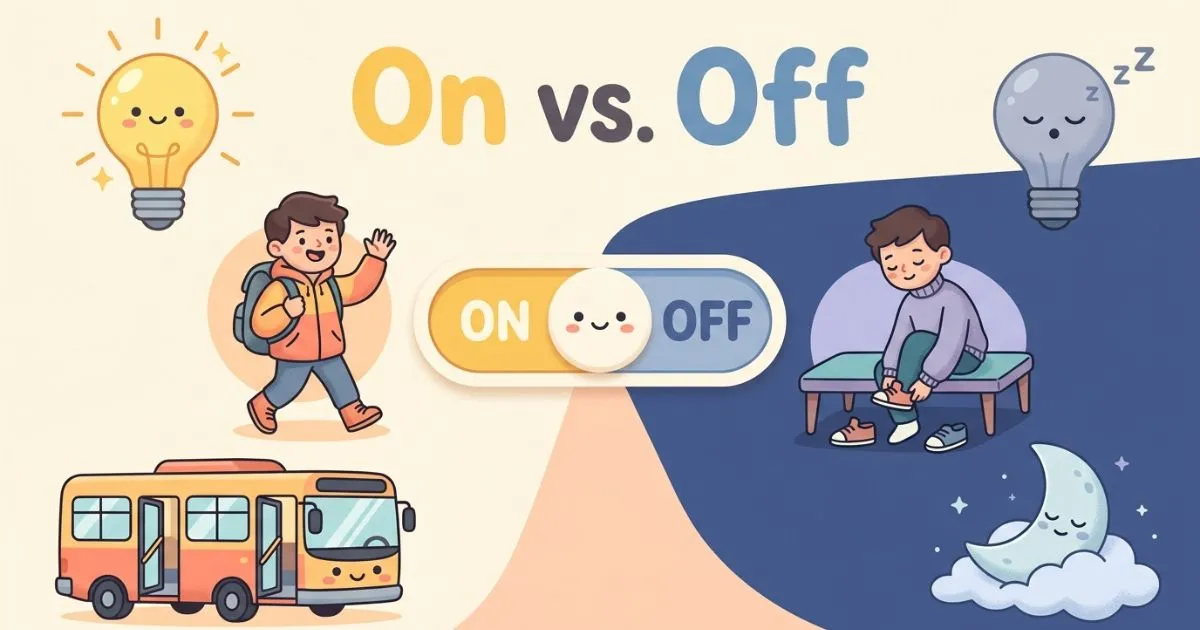
Reaching for a light switch in a dark room, you know exactly what you want: the light on, not off.
But these two small words do far more than control power. You put a jacket on, take your shoes off, get on a bus, and get off at your stop.
Rain can fall on and off all day, a party can be on or off, and you might finally have a day off.
So what separates them? Roughly, on points to operation, contact, or continuation, while off points to stopping, removal, or cancellation.
This guide explains each meaning with clear examples, the rules that matter most, and the mistakes learners make, so you can choose the right word with confidence, whether you are writing, speaking, or studying for an exam.
On vs. Off: The Quick Answer
On usually points to operation, contact, attachment, or continuation. Off usually points to a stopped state, removal, separation, or cancellation.
| Idea | On | Off |
| Power | The TV is on. | The TV is off. |
| Clothing | Put your coat on. | Take your coat off. |
| Surface | The cup is on the table. | The cup fell off the table. |
| Buses and trains | Get on the bus. | Get off the bus. |
| Plans | The party is on. | The party is off. |
| Work | She is on duty. | He has the day off. |
Treat this as a starting point, not a law. Both words have many meanings, and the sentence around them decides which one applies.
What Does “On” Mean?
On works as a preposition (“the book is on the desk”), as an adverb (“turn the light on”), and as part of many phrasal verbs (“carry on,” “move on”). Here are its most useful meanings.
On Means Operating
This is the meaning most learners meet first. A machine, device, or light is on when it is running or giving power.
- The heater is on.
- Leave the fan on while you work.
- Is your microphone on?
On Means Touching or Resting on a Surface
When something sits on top of a surface or is fixed to a vertical one, English uses on.
- Your keys are on the counter.
- There is a clock on the wall.
- The cat is asleep on the sofa.
On Means Attached or Worn
If something is fixed to an object or carried on the body, on describes that connection.
- The lid is on the jar.
- She has a ring on her finger.
- Keep your seatbelt on.
On Marks Days and Dates
Use on before days of the week and specific dates. Notice that times and months use different words.
- The meeting is on Thursday.
- Her birthday is on March 4.
- We arrive at 6:00 (at for clock times) and travel in July (in for months).
On Means Continuing or Happening
On can also show that something continues or is still going ahead.
- The show must go on.
- Keep going. Don’t stop now. Press on.
- Is the match still on, or did the rain cancel it?
Read More: Which or Wich? The Correct Spelling and a Trick You Won’t Forget
What Does “Off” Mean?
Off is also a preposition and an adverb, and it shows up in plenty of phrasal verbs (“call off,” “show off,” “take off”). Its meanings mirror those of on, but with a sense of separation.
Off Means Not Operating
When a device stops running, it is off.
- Please switch the oven off.
- My phone is off, so I missed your call.
- The lights in the hall are off.
Off Means Free From Work or Duty
When you are away from your job or regular responsibilities, you are off.
- I have Friday off.
- The nurse is off duty until morning.
- We’re off for the holidays.
Off Means Cancelled or Postponed
Plans that will not happen are off.
- The wedding is off.
- They called the picnic off because of the storm.
On or Off: Where the Two Words Truly Contrast
In some situations, on and off are clean opposites. In others, the pairing falls apart. Knowing which is which saves you from forcing a rule where none exists.
When They Are True Opposites
- Power: switched on or switched off
- Clothing: put on or take off
- Boarding: get on or get off
- Plans: the game is on or the game is off
- Attachment: the lid is on or the lid is off
When They Are Not Opposites
- On time means punctual. There is no “off time” with the opposite meaning.
- On the table describes position, while off the table can mean “no longer being considered” (“That idea is off the table”).
- Off work means away from your job, but on work is not a natural phrase. You would say you are “at work” or “working.”
If a pairing sounds odd, you are probably looking at a fixed expression, and it is better to learn the full phrase.
Turn On, Turn Off, Switch On, Switch Off
These phrasal verbs are everywhere in daily life, and they follow a pattern worth knowing.
- Turn on / switch on starts a device.
- Turn off / switch off stops it.
You can place the object after the verb or in the middle:
- Turn on the lights. / Turn the lights on.
- Switch off the computer. / Switch the computer off.
The Pronoun Rule
When the object is a pronoun (it, them, her, him), the pronoun must go in the middle.
- Correct: Turn it on.
- Incorrect: Turn on it.
- Correct: Switch them off.
- Incorrect: Switch off them.
This rule applies to most separable phrasal verbs, including put on and take off. It is one of the most useful grammar habits you can build.
Is It On or Off? How to Ask and Answer About Status
Ask “Is it on or off?” when you want to know if something is running right now. Answer with “It’s on” or “It’s off.” Both orders, on or off and off or on, are correct.
The same pattern works for any device, setting, or plural noun:
– Is this on or off?
– Is the heater on or off?
– Are these lights on or off?
– Is that switch on or off?
Only the verb changes (is or are). On and off never change form.
Keep your answer short:
– It’s on.
– They’re off.
– It was off when I got here.
Turned on vs. on: “The oven is on” describes the current state. “The oven was turned on at six” describes an action that happened at a certain time.
Spelling tip: It’s means “it is.” Write “It’s on and off all day,” not “Its on and off.”
On/Off Switch Labels and Symbols
Many switches use a short line (|) for on and a circle (○) for off. If both appear together, the line means on and the circle means off.
Words follow the same idea. Labels are often printed in capitals (ON/OFF) because they are short and easy to spot. In normal sentences, write on and off in lowercase.
The round symbol with a line at the top, found on many power buttons, usually means power or standby, not a simple “off.” If you are unsure, check the device manual.
Put On and Take Off
For clothes, accessories, and things you wear, English uses put on (to start wearing) and take off (to stop wearing).
- Put on your helmet before you ride.
- She took off her gloves.
- He put his glasses on and started reading.
These verbs have other meanings too, which can confuse learners:
- Put off means postpone. “We put off the trip until June.”
- Take off can mean a plane leaving the ground. “The flight takes off at noon.”
- Take off can also mean to leave suddenly. “He took off without saying goodbye.”
Notice how one small change, put on versus put off, completely changes the meaning. That is why it helps to learn these verbs as complete phrases.
Get On and Get Off: Transport Rules
For public transport and larger vehicles, English prefers on and off.
- Get on the train. / Get off the train.
- We got on the plane at gate 12.
- She got off the ferry in Karachi.
The same pattern works for things you sit or stand on: a bicycle, a horse, a motorcycle, a scooter.
Cars and Taxis Are Different
For cars, taxis, and small vehicles, English uses in and out of.
- Get in the car. / Get out of the car.
- She got in a taxi.
A helpful rule of thumb: if you can stand up inside it or walk around, use on and off. If you sit inside a small enclosed space, use in and out.
Off vs On, Off or On: The Rhythm of Stopping and Starting
Both “on and off” and “off and on” mean something that happens occasionally rather than continuously. The order can change without changing the meaning, though “on and off” is the more common version.
- It has rained on and off all day.
- I have been feeling tired off and on this week.
- They worked on the project on and off for years.
The Adjective Form
Before a noun, the phrase often becomes hyphenated.
- an on-and-off relationship
- an on-again, off-again friendship
American English frequently uses “on-again, off-again” for relationships that repeatedly break up and reunite.
Which One Should You Use?
Either is correct. Choose “on and off” if you want the more familiar phrasing. Choose “off and on” if you want to vary your writing. Do not spend time worrying about this choice, because readers will understand both immediately.
On and Off in Relationships
When people say they dated “on and off,” they mean the relationship kept stopping and starting, often with breakups and reunions.
– We dated on and off for two years.
– They have been seeing each other off and on since college.
This is a casual phrase. In formal writing, intermittently or occasionally sounds more professional.
“On-again, off-again” usually puts more focus on the repeated breakups and reunions. “On and off” can also describe a loose, irregular connection.
On-Off Switch, On/Off Button, or On and Off?
Use a hyphen when on and off work together as one adjective before a noun: an on-off switch. After a verb, write them as separate words: the light flickered on and off.
– Before a noun: an on-off switch, an on-off cough
– After a verb: The signal cuts on and off.
– Product labels: an on/off button (slash)
Both the hyphen and the slash appear in everyday writing. Pick one style and use it consistently. If you follow a specific style guide, verify its rule.
Off and On in Everyday Life
Technology
Technology offers the clearest on and off examples.
- Turn on Wi-Fi when you need the internet.
- Turn off Bluetooth to save battery.
- The screen switched off automatically after one minute.
- Notifications are off on my phone.
Work and School
- I’m on shift until 6 p.m.
- She’s off sick today.
- The teacher is on leave this week.
- Exams are off because of the holiday.
Plans and Events
- The concert is on despite the weather.
- The concert is off because the singer is ill.
Idioms Worth Learning
Many common expressions use on and off in ways that go beyond their basic meaning.
- On the record / off the record: official versus unofficial statements
- On hold: paused, waiting
- Off limits: not allowed
- On board: in agreement, or aboard a vehicle
- Off peak: during quieter, cheaper times
- On the fence: undecided
A Note on “Off Of”
You will often hear “off of” in speech: “Get off of the grass.” In formal writing, plain “off” is usually preferred.
- Preferred: She jumped off the wall.
- Informal: She jumped off of the wall.
Another common slip involves “off” with borrowing. English says borrow from, not borrow off, in careful writing. “I borrowed a pen from Ali” sounds correct everywhere, while “borrowed off Ali” is informal and mostly British.
Of vs. Off: Don’t Mix Them Up
Off ends with an f sound and shows removal, distance, or a stopped state. Of ends with a v sound and connects two nouns, showing belonging or amount.
Off rhymes with cough. Of sounds like “uv.”
| Off | Of |
| The ball rolled off the table. | A lot of people. |
Quick check: If the word means “not running” or “away from,” use off. If it links two nouns, use of.
Typos like “on or of,” “on an off,” or “on of off” usually come from fast typing. The fixes are on or off and on and off.
Common Mistakes With On vs Off
Most errors happen when learners translate word for word from another language. Here are the ones to watch.
Using the Wrong Word for Removal
- Incorrect: Please take your shoes on.
- Correct: Please take your shoes off.
Using the Wrong Word for Wearing
- Incorrect: Put your jacket off.
- Correct: Put your jacket on.
Breaking the Pronoun Rule
- Incorrect: Please turn on it.
- Correct: Please turn it on.
Mixing Up Time Prepositions
- Incorrect: The exam is in Monday.
- Correct: The exam is on Monday.
- Incorrect: The class starts on 9 a.m.
- Correct: The class starts at 9 a.m.
Confusing On Time With In Time
- On time means exactly when scheduled: “The train arrived on time.”
- In time means early enough: “We arrived in time to catch the opening scene.”
Using On or Off for Cars
- Incorrect: She got off the taxi.
- Correct: She got out of the taxi.
An Easy Memory Trick
Think of a light switch.
- On means connected or running, the circuit is complete.
- Off means disconnected or stopped, the circuit is broken.
This image works for most basic uses: lights, buttons, clothing, lids, and boarding a bus. For expressions like on time, off work, or on and off, simply memorize the whole phrase.
Another quick tip: if something can be attached or reconnected, on is usually involved. If something is being taken away or stopped, off is usually the answer.
On and Off in Other Languages
Many learners get confused because on and off do not translate word for word. Here are the usual equivalents for power and switches.
| Spanish | encendido / prendido | apagado |
So “on oder off” (German), “off или on” (Russian), “off ili on” (Serbian/Croatian), and “on hay off” (Vietnamese) all mean “on or off.” In Spanish, on means prendido or encendido, and off means apagado.
Words can vary by region, so verify the local term for a specific device.
Careful: Spanish en is not the same as on here. For power, use encendido or prendido.
Quick Practice
Fill in the blanks with on or off. Answers are below.
- Please turn ___ the lights before you leave.
- The book fell ___ the shelf.
- She put ___ her raincoat.
- We got ___ the bus at the market.
- The match is cancelled. It is ___.
- It snowed ___ and ___ all weekend.
- I’m ___ duty tonight, so call me if you need help.
- Take the cap ___ the marker.
Answers: 1. off, 2. off, 3. on, 4. off, 5. off, 6. on and off, 7. on, 8. off.
FAQs
1. What is the main difference between on and off?
On usually means operating, attached, or in contact with something. Off usually means not operating, removed, or separated. The exact meaning depends on the sentence, since both words have several uses.
2. Is it turn on or turn off the light?
Both are correct, but they mean opposite things. Turn on the light to make it work, and turn off the light to stop it.
3. Is it “turn it on” or “turn on it”?
Use “turn it on.” When the object is a pronoun, it goes between the verb and the particle. The same applies to “switch it off,” “put it on,” and “take it off.”
4. Do I say get on the bus or get in the bus?
Say get on the bus. For buses, trains, planes, and ships, English uses on and off. For cars and taxis, use get in and get out of.
5. What does “on and off” mean?
It means something happens occasionally, not continuously. “It rained on and off all day” means the rain started and stopped several times. “Off and on” has the same meaning.
6. Is “on and off” or “off and on” more common?
“On and off” is the more common order, but both are correct and mean the same thing.
7. What is the difference between “put on” and “put off”?
Put on means to wear or place something on yourself or a surface: “Put on your coat.” Put off means to postpone: “We put off the meeting until Monday.”
8. Does on always mean something is working, and does off always mean it is not?
No. On can describe position (“the book is on the desk”), time (“on Friday”), or attachment. Off can describe removal, movement away, time away from work, or a cancelled event. Context decides the meaning.
Conclusion:
On and off look like a simple pair, but they carry many meanings. On often signals operation, contact, attachment, or something continuing. Off often signals a stopped state, removal, distance, or cancellation.
When both words describe a device, they are clean opposites. In other cases, such as on time or off the record, they behave independently and are best learned as complete phrases.
Keep three habits in mind. First, put pronouns in the middle of phrasal verbs: turn it on, take it off. Second, use on and off for large transport and in and out of for cars. Third, when in doubt, read the full sentence and ask what the speaker is describing: power, position, movement, time, or a plan.
With a little practice, these small words will stop being a source of mistakes and become one of the easiest parts of English to use with confidence.

As an American English writer, I specialize in creating clear and engaging content that makes grammar and language learning accessible to everyone. I enjoy breaking down complex English concepts into simple, practical lessons that readers can apply with confidence. My mission is to help learners strengthen their communication skills through easy and reliable content.









1 thought on “On vs. Off: How to Choose the Right Word Every Time”