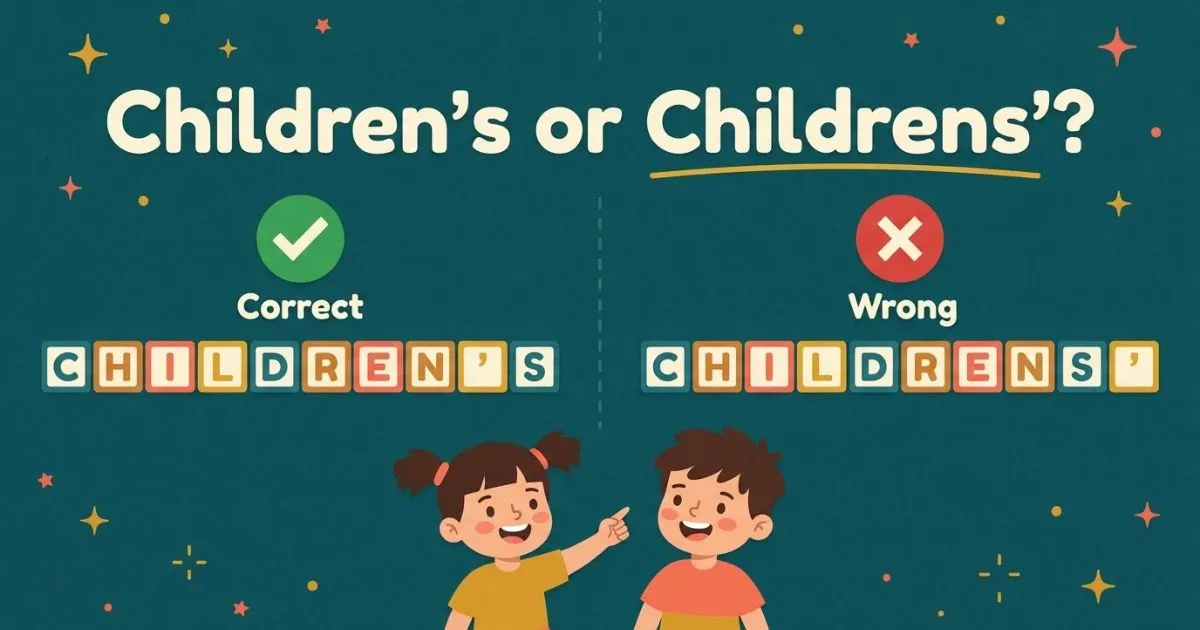
You’re typing a school notice, a shop sign, or a thesis title, and you stop. Is it the children’s room or the childrens’ room?
The apostrophe looks like it could sit on either side of the s, and both versions look fine at a glance.
Here is the answer up front: children’s is correct. But knowing the rule is different from trusting it.
This guide shows you why it works, how to check any possessive in seconds, and where people usually slip.
You’ll get a comparison table, two quick checking methods, real examples, and answers to the questions learners ask most.
Children’s or Childrens’: The Short Answer
Children’s is the correct form. Childrens’ is a mistake.
Children is the plural of child, and children’s is the possessive of children. Putting the apostrophe after the s, as in childrens’, is incorrect in standard English.
Here is the difference in action:
- ✅ The children’s playground is closed today.
- ❌ The childrens’ playground is closed today.
The reason fits in one line: children does not end in s, so you add an apostrophe and an s.
Why Children’s Is Right
Start with the word, not the apostrophe
Most English plurals are made by adding s: ball becomes balls, boy becomes boys. Child doesn’t work that way. It changes to children, which makes it an irregular plural.
That matters because the plural is already complete. There is no s at the end, so the possessive is formed the same way as for a singular noun: add an apostrophe and an s.
child → children → children’s
The apostrophe doesn’t make the word plural. It only shows that something belongs to, or is connected with, the children.
Why your ears can’t help you
Say “children’s” out loud, then say “childrens”. They sound the same. Because speech gives you no clue, you have to rely on the rule rather than on how the word sounds. That is a big reason the mistake is so common in writing.
Why childrens’ feels right
Most of us learned patterns like boys’, girls’ and teachers’. Those plurals end in s, so the apostrophe goes after it. It is natural to copy that habit with children.
The catch is that the habit only works when the plural already ends in s. Children doesn’t, and childrens on its own isn’t a word at all.
Read More: Babies or Baby’s: Which Is Correct? Grammar Rules, Examples & Easy Tips
The Possessive Rules at a Glance
Once you see all four patterns side by side, the confusion disappears. Always look at the noun first, then decide where the apostrophe goes.
| Type of noun | How to make it possessive | Example |
| Singular | Add ‘s | The child’s bag |
| Singular ending in s | Add ‘s | James’s key |
| Regular plural (ends in s) | Add only an apostrophe | The teachers’ room |
| Irregular plural (no s at the end) | Add ‘s | The children’s room |
The last row is the one that applies here. Children belongs with women, men and people: plurals that don’t end in s.
Child, Child’s, Children, Children’s
Four forms, four jobs. Mixing them up is the second most common problem after childrens’.
| Form | What it is | Example |
| Child | Singular noun | The child is asleep. |
| Child’s | Singular possessive | The child’s shoes are by the door. |
| Children | Plural noun | The children are asleep. |
| Children’s | Plural possessive | The children’s shoes are by the door. |
Two questions decide everything:
- How many young people are you talking about, one or more than one?
- Does something belong to them, or is it connected with them?
If the answer to the second question is no, you only need child or children, with no apostrophe.
What “Children’s” Really Means
Children’s does two jobs, and it helps to know both.
Job 1: Ownership
This is the classic use. Something belongs to the children.
- The children’s coats are on the hooks.
- The teacher collected the children’s homework.
Job 2: Purpose or connection
Here nothing is literally “owned.” The thing is made for, or about, children.
- Children’s books
- Children’s hospital
- Children’s rights
- Children’s menu
So when you see a phrase like children’s literature, it simply means literature meant for children. The apostrophe still belongs there, even though no child “owns” it.
A Simple 3-Step Method You Can Use Every Time
Use this whenever you’re unsure about any possessive, not just this one.
- Find the owner. Who or what does the thing belong to, or relate to? Here, it’s the children.
- Write the owner as a plain noun. Is it singular (child) or plural (children)? Does it end in s?
- Add the ending. If the noun doesn’t end in s, add ‘s. If it’s a regular plural that already ends in s, add only an apostrophe.
Let’s try it on the sentence “The toys belonging to the children were everywhere.”
- Owner: the children
- Plain noun: children (plural, no s at the end)
- Ending: add ‘s → children’s
Result: The children’s toys were everywhere.
Two Quick Checks: The Thumb Test and the Of-Test
Rules are useful, but a quick check is what saves you when you’re writing in a hurry.
The thumb test
This tip comes from EdPlace, a UK learning site that teaches apostrophes to young students. Cover the apostrophe with your thumb, then ask: does the word before your thumb own the thing that comes after it?
Try it on “The childrens’ classroom was a mess.”
Cover the apostrophe and you’re left with childrens classroom. The classroom belongs to the children, not to some word called childrens. That tells you the apostrophe has to move: children’s.
The of-test
This one turns the possessive back into plain English. Rewrite the phrase using “of the.”
- the toys of the children → the children’s toys
- the voices of the people → the people’s voices
Whatever word follows “of the” is your owner. If that word doesn’t end in s, add ‘s. If you can’t make the “of the” version work, you may not need a possessive at all.
Examples: Right and Wrong Side by Side
Seeing mistakes next to their fixes makes the pattern stick.
| ❌ Incorrect | ✅ Correct |
| The childrens’ toys are expensive. | The children’s toys are expensive. |
| She works at a childrens hospital. | She works at a children’s hospital. |
| The childrens books are new. | The children’s books are new. |
| We joined the childrens’ festival. | We joined the children’s festival. |
| Five children’s were playing outside. | Five children were playing outside. |
| The child’s parents attended the meeting (many kids). | The children’s parents attended the meeting. |
And here are correct sentences from everyday life:
- At school: The children’s artwork covered the corridor wall.
- At home: Please tidy the children’s room before dinner.
- At work: Our company designs safe children’s products.
- In the community: The library runs a free children’s reading hour.
- In the news: Charities are calling for stronger protection of children’s rights.
Common Mistakes and How to Fix Them
1. Putting the apostrophe after the s
Wrong: childrens’
Fix: children’s
This is the big one. Remember that the apostrophe follows the word as it exists, and children has no s to follow.
2. Dropping the apostrophe entirely
Wrong: The childrens books are on the shelf.
Fix: The children’s books are on the shelf.
If the books belong to, or are meant for, the children, you need the possessive.
3. Using an apostrophe for a plain plural
Wrong: The children’s are playing.
Fix: The children are playing.
EdPlace points out that young learners often add apostrophes “before every s in sight.” The real test is simple: an apostrophe is needed for contraction (don’t, could’ve) or for possession. If it’s neither, leave it out.
4. Choosing child’s when you mean many children
Wrong: The child’s classroom was loud (about a whole class).
Fix: The children’s classroom was loud.
Count the children before you choose the form.
5. Over-correcting other irregular plurals
Some writers learn the children’s rule and then start writing womens’ or mens’. That is the same mistake in a different word. Check whether the plural ends in s before you place the apostrophe.
The Same Rule for Other Irregular Plurals
Once you understand children’s, a whole group of words becomes easy. Irregular plurals that don’t end in s all take ‘s.
- man → men → men’s: The men’s department is upstairs.
- woman → women → women’s: The women’s team won the match.
- person → people → people’s: The people’s choice award went to the local band.
Keep in mind that the possessive of a regular plural, such as teachers or boys, takes only an apostrophe: the teachers’ room, the boys’ coats. The difference isn’t the word. It’s whether the plural form ends in s.
Practical Tips for School, Work and Online
- Search before you submit. In a long document, search for “childrens” and check every result. It takes seconds and catches most slips.
- Double-check titles and headings. In a thesis, report, CV or presentation, a title is the first thing people read, and an apostrophe error there is hard to miss.
- Copy official names exactly. Some organisations spell their own name in their own way. If you’re quoting a name, follow how the organisation writes it. For everything else, use children’s.
- Teaching a child? In England’s Key Stage 2 English requirements, Year 3 and 4 students are expected to place the possessive apostrophe correctly in regular plurals like girls’ and irregular plurals like children’s. The thumb test works well for practice at home.
- Slow down on autopilot phrases. Phrases like “children’s books” and “children’s clothes” are typed so often that people stop thinking about them. Those are the ones to proofread.
FAQs
1. Is it children’s or childrens’?
Children’s is correct. Children is an irregular plural that doesn’t end in s, so you add an apostrophe and an s to show possession. The form childrens’ is a common mistake caused by copying the pattern used for plurals like boys’ and girls’.
2. Is childrens’ ever correct?
No, not in standard English. Childrens is not a word on its own, so there is nothing for the apostrophe to attach to. If you see it on a sign or in an old document, treat it as an error, and write children’s in your own work.
3. What is the possessive form of children?
The possessive form of children is children’s. It shows that something belongs to, or is meant for, more than one child. For example, “the children’s coats” means coats belonging to the children, and “children’s books” means books written for them.
4. Is children’s singular or plural?
Children’s is a plural possessive, because it refers to more than one child. For one child, use child’s, as in “the child’s bag.” The pair works the same way as woman’s and women’s, or man’s and men’s.
5. Why isn’t it childrens’ like boys’ or girls’?
Because children already end in s, so the apostrophe simply goes after it. Children doesn’t end in s, so it follows the pattern of other irregular plurals, such as women’s. The rule depends on how the plural is formed, not on the word being plural.
6. Do I need an apostrophe in “children’s books”?
Yes. In children’s books, the apostrophe shows that the books are meant for children. Even when nothing is literally owned, the possessive form is still correct. Writing childrens books or childrens’ books are both mistakes. Use children’s books.
Conclusion:
The question of children’s or childrens’ has a clear answer: children’s. The word children is already plural and doesn’t end in s, so the possessive takes an apostrophe plus s, just like women’s and men’s. The apostrophe shows ownership or connection, never plurality.
When you’re unsure, run the three steps: find the owner, check whether the plural ends in s, then add the right ending. Back it up with the thumb test or the of-test.
Your next step: open the last thing you wrote, search for “childrens,” and fix every one. After that, the rule becomes automatic.
I’m Sophia Mitchell, an English grammar and writing enthusiast. I create simple, easy-to-understand content to help learners improve their English. My goal is to make grammar clear, practical, and enjoyable for everyone.


1 thought on “Children’s or Childrens’? The Easy Rule That Settles It”