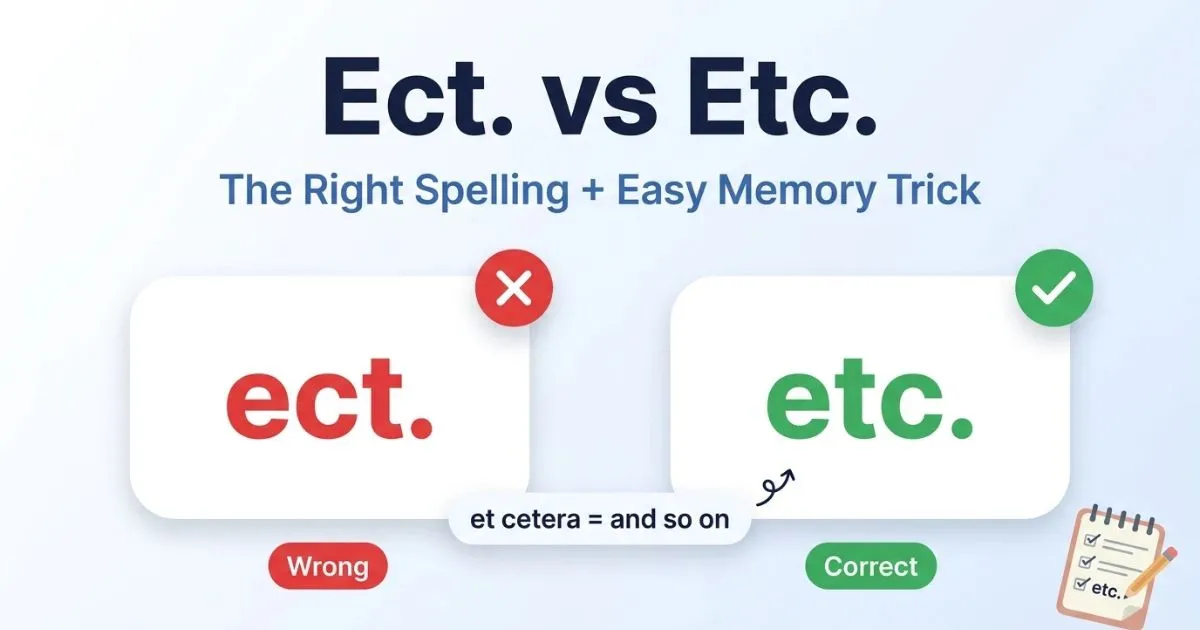
You are halfway through an email, listing what to bring to tomorrow’s meeting. Laptop, notes, charger… and then you freeze. Is the shortcut for “and so on” ect. or etc.?
It is etc. The other version looks right at a glance, but it is a spelling mistake, and readers do notice it.
This guide settles the ect. vs etc. question in seconds, then goes further. You will learn what the abbreviation means, how to punctuate it, which mistakes even confident writers make, and when it is smarter to skip it altogether. A short practice quiz at the end lets you test yourself.
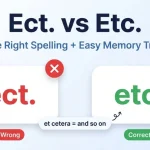
Ect. vs Etc.: The Quick Answer
Etc. is correct. It is the short form of the Latin phrase et cetera, which means “and the rest” or “and other similar things.” Ect. is not a second spelling. It is the same letters in the wrong order.
Here is the whole rule in one line:
Write etc. with the T before the C, and finish it with a period.
| Etc. | Ect. | |
| Status | Correct abbreviation of et cetera | Misspelling |
| Letter order | E-T-C | E-C-T |
| Example | Pack socks, shirts, shoes, etc. | Pack socks, shirts, shoes, ect. |
If that is all you needed, you can stop here. If you want to understand why the mistake happens and how to avoid it for good, keep reading.
What Does Etc. Stand For?
Etc. stands for et cetera, a Latin phrase. In English it works as a signal to your reader. It says, “I have given you a few examples, and you can guess the rest.”
The meaning in plain words
Imagine you write: “The pharmacy sells vitamins, bandages, cough syrup, etc.”
The reader immediately pictures other health products on the shelf. You did not have to name every single one, and the sentence stays short and easy to read. That is the whole job of this little abbreviation.
You can think of it as a replacement for any of these phrases:
- and so on
- and the rest
- and other similar things
Etc., et cetera and etcetera
You may see three forms in the wild:
- Etc. is the abbreviation. It is the most common in emails, notes, and everyday writing.
- Et cetera is the Latin phrase written out in two words.
- Etcetera is a one-word spelling of the written-out form. It is less common than the abbreviation.
All three carry the same idea. Whichever one you pick, the letters keep their order: “et” comes first, and “cetera” follows.
Read More: Would Of or Would Have? Rule, Examples & Quick Fix
Why Do People Write Ect. Instead of Etc.?
The mistake is very common, and it is easy to understand. Three small things trigger it.
1. Fast typing
When you rush, letters at the end of a short abbreviation can easily swap places. Your brain knows what you mean, so your eyes skip right past the error when you read it back.
2. The way people say it
In quick speech, the phrase can blur into something that sounds closer to “ek-set-er-uh.” If your ear hears “ek,” your hand may want to write “ec.” But the written form still begins with “et,” because the Latin phrase begins with “et.”
3. Familiar letter patterns
English is full of words that contain “ct,” such as fact, exact, and contact. Many common words also end in “-ect,” such as correct, select, and project. So “ect” looks like something that could be real, even though it is not the right abbreviation here.
The takeaway: this is a memory slip, not a sign that you are bad at spelling. The fix is to give your brain a system, and you will find one further down.
Can Ect. Ever Be Correct?
For the meaning “and other similar things,” never.
However, the capital letters ECT do exist as a real abbreviation in another field. In medicine, ECT stands for electroconvulsive therapy. If you meet ECT in a health article, it is not a typo. It simply has nothing to do with ending a list.
This is also a good reason not to rely only on a spell checker. Because ECT can be a legitimate abbreviation, some tools may not treat it as an error. A quick manual check is worth the few seconds.
How to Use Etc. Correctly
Knowing the spelling is half the job. The other half is using the abbreviation in the right place. Three habits will keep your sentences clear.
Use it after a group of similar items
Etc. works because the reader can see the category. The examples tell them what kind of things you mean.
Clear:
- I enjoy reading novels, poems, short stories, etc.
- The shop sells shirts, trousers, jackets, etc.
- We studied nouns, verbs, adjectives, etc.
Confusing:
- I bought apples, my cousin, a notebook, etc.
In the last sentence, the items have nothing in common. The reader cannot guess what “etc.” is hiding, so the abbreviation adds confusion instead of saving space.
Give at least two examples first
One example is not enough to show a pattern.
Weak: I enjoy sports, etc.
Better: I enjoy soccer, basketball, tennis, etc.
With only the word “sports,” the reader has no idea which others you mean. With three examples, the pattern is obvious.
Use it when the missing items are obvious or unimportant
Compare these two sentences:
- Please bring pens, pencils, notebooks, erasers, rulers, folders, and other school supplies.
- Please bring pens, pencils, notebooks, erasers, rulers, folders, etc.
The second one is shorter, and nothing important is lost. Everyone knows what school supplies look like.
Ask whether the reader needs the exact list
This is where etc. often causes trouble. If someone must act on your list, such as submitting documents, ordering products, or following safety steps, vague wording can lead to mistakes.
Weak: Submit your forms, receipts, etc.
Better: Submit your ID card, tax form, and bank statement.
When the missing items matter, name them. Clarity is always more valuable than saving a few words.
Punctuation Rules for Etc.
Punctuation around etc. causes almost as many questions as the spelling. Here are the rules in simple terms.
Always keep the period
Etc. is an abbreviation, so the period is part of it.
Correct: We bought bread, milk, eggs, etc.
If etc. ends the sentence, that period also ends the sentence. Do not add a second one.
Wrong: We ordered sandwiches, chips, drinks, etc..
Use a comma before etc. in a list
A comma before etc. is common when it follows a series of items.
Example: I need pencils, pens, paper, etc.
Style guides differ on some punctuation details, so follow the one your school, company, or publication uses. The key is to stay consistent within the same document.
Add a comma after etc. when the sentence continues
If more words follow etc., the abbreviation usually needs a comma after it to close off the list.
Example: We packed notebooks, pencils, etc., before leaving school.
If etc. comes at the very end, no extra comma is needed.
Question marks and exclamation marks
When the sentence is a question, keep the period and add the question mark.
Example: Do we need pens, notebooks, folders, etc.?
The same idea works for an exclamation mark, but use it only when the tone really calls for it. In most ordinary writing, a plain period is enough.
Avoid starting a sentence with etc.
Etc. points back to items you have already named, so it has nothing to point to at the start of a sentence.
Awkward: Etc. were included in the list.
Better: Other items were included in the list.
Common Mistakes and Quick Fixes
Even people who know the right spelling slip up in other ways. Here are the most frequent errors, each with a fix you can use straight away.
1. Writing ect. instead of etc.
Wrong: Please bring your ID, ticket, ect.
Right: Please bring your ID, ticket, etc.
2. Writing “and etc.”
The “et” in et cetera already means “and.” Adding another “and” says the same thing twice.
Wrong: We bought chips, soda, and etc.
Right: We bought chips, soda, etc.
3. Using “such as” and etc. together
Both signal that more examples exist, so you only need one of them.
Repetitive: I enjoy outdoor activities such as hiking, camping, etc.
Better: I enjoy outdoor activities such as hiking and camping.
Also fine: I enjoy outdoor activities: hiking, camping, etc.
4. Repeating it
Less effective: We need paper, pens, folders, etc., etc.
Better: We need paper, pens, folders, etc.
One etc. is enough. If more detail matters, name the extra items instead of stacking abbreviations.
5. Mixing unrelated items
Unclear: I packed apples, shoes, homework, etc.
Better: I packed apples, oranges, bananas, etc.
6. Using it for people
Etc. can sound careless when applied to people, and “other guests” or “other relatives” reads more warmly.
Weak: My cousins, neighbors, etc., came over.
Better: My cousins, neighbors, and other guests came over.
7. Using it to hide vague thinking
Sometimes etc. is a shortcut that lets the writer avoid being specific.
Weak: The company has issues with scheduling, etc.
Better: The company has issues with scheduling, late approvals, and unclear deadlines.
If you cannot name at least two or three items that belong in the list, the sentence probably needs more thought, not an abbreviation.
Real-Life Rewrites: Email, Resume, and Notes
Seeing the rule in everyday situations makes it easier to remember.
- Email: “Please send the files, images, links, etc., before Friday.” This works because the reader knows what kind of material you want.
- Study notes: “Review grammar, spelling, punctuation, etc.” This is a personal reminder, so a loose ending is fine.
- Resume: “Skilled in editing, training, planning, etc.” This sounds vague to a hiring manager. Name the strongest skills instead.
Notice the pattern: the more the reader has to act on your words, the less you should rely on etc.
Read More: Who’s vs. Whose: The Simple Rule (With Examples and a Quiz)
Etc. vs “And So On” vs “Et Cetera”
All of these express the same basic idea, but they feel slightly different on the page.
| Expression | Feel | Example |
| Etc. | Short and familiar | We need pens, paper, etc. |
| Et cetera | Written out, a little more formal | We need pens, paper, et cetera. |
| And so on | Natural and conversational | We need pens, paper, and so on. |
| And other items | Clear and professional | We need pens, paper, and other items. |
Pick the one that sounds natural for your reader. A text to a friend can be casual. A report for your manager may read better with “and other items” or a full list.
Etc. is used in both American and British English, and the spelling does not change between them.
Should You Use Etc. in Formal Writing?
Sometimes, but with care. The rule of thumb is simple: the more serious the document, the more exact it should be.
- Emails, notes, and messages: Etc. is perfectly fine when the list is clear.
- School assignments: Acceptable, but do not let it replace details your teacher expects to see.
- Business reports: Use it sparingly, or swap in “and other items.”
- Contracts, policies, and instructions: List everything that matters. A vague ending can cause real confusion.
A good test: if the reader would be upset to discover what “etc.” was hiding, write the full list.
A Three-Question Check Before You Type Etc.
Make this a quick habit. Before you use the abbreviation, ask yourself:
- Do my examples belong to the same group? If not, rewrite the list.
- Can the reader guess what is missing? If not, add one more example.
- Does the missing part matter? If yes, name it.
If you can answer “yes, yes, no,” etc. is a safe choice. Otherwise, write something clearer.
How to Stop Making the Mistake for Good
Knowing the rule is not always enough. Typing happens fast, and habits are strong. These small tricks help.
Say the full phrase in your head
Before you write the abbreviation, silently say et cetera. You will hear the “et” first. Then write E-T, and add the C. The letters simply follow the phrase in order.
Search before you send
Run a quick search in your document for “, ect” or “ect.” with the comma or period attached. Do not search for “ect” alone, because it appears inside many correct words such as correct, select, and project, and you will waste time scrolling through false alarms.
Set up a text shortcut
Most phones and word processors let you create a text replacement. You can set one so that typing your usual mistake turns into the correct form automatically. It takes a minute to set up and saves you from the error every time.
Ask whether you need it at all
Sometimes the best fix is to remove the abbreviation. Naming one more item or using “and other items” often makes the sentence stronger.
Quick Practice: Test Yourself
Try these five before you read the answers.
- Choose the correct form: “Bring pens, pencils, folders, (etc. / ect.)”
- Fix this sentence: “We bought rice, lentils, and etc.”
- Fix this sentence: “I like fruit such as mangoes, apples, etc.”
- This is an instruction list for new employees: “Bring your documents, forms, etc.” How would you improve it?
- Add the missing punctuation: “We packed towels soap shampoo etc before leaving”
Answers
- Etc.
- “We bought rice, lentils, etc.” (Remove “and.”)
- “I like fruit such as mangoes and apples.” (Remove etc. or “such as.”)
- Name the items, for example: “Bring your ID card, signed contract, and bank details.”
- “We packed towels, soap, shampoo, etc., before leaving.”
If you got four or five right, you have this one covered.
FAQs
1. Is it ect. or etc.?
Etc. is correct. It is the abbreviation of the Latin phrase et cetera, meaning “and other similar things.” Ect. is a common misspelling caused by swapping the last two letters.
2. What does etc. stand for?
Etc. stands for et cetera. In English it means “and the rest,” “and so on,” or “and other similar things,” and it signals that a list continues with items of the same kind.
3. Does etc. need a period?
Yes. Because it is an abbreviation, it is written with a period. If etc. ends a sentence, that single period is enough, so do not add a second one.
4. Can I write “and etc.”?
It is best to avoid it. The word “et” already means “and,” so adding “and” repeats the idea. Write “bread, milk, eggs, etc.” instead of “bread, milk, eggs, and etc.”
5. Can I use etc. in formal writing?
You can, but sparingly. In contracts, policies, and instructions, list every item that matters. Use etc. only when the missing items are obvious and the reader does not need them.
6. Does ECT mean the same as etc.?
No. Capital ECT is a different abbreviation, used in medicine for electroconvulsive therapy. It has nothing to do with ending a list, so for “and so on,” always write etc.
Conclusion
The ect. vs etc. question has a simple answer: etc. is correct, and ect. is a misspelling when you mean “and other similar things.”
Remember the order E-T-C, keep the period, avoid “and etc.,” and name the items whenever the details matter.
Here is your next step. Open the last document or email you wrote and search for “, ect”. If you find one, fix it, and you will remember the rule much better next time.

I’m Sophia Mitchell, an English grammar and writing enthusiast. I create simple, easy-to-understand content to help learners improve their English. My goal is to make grammar clear, practical, and enjoyable for everyone.





1 thought on “Etc vs Ect.: The Right Spelling + Easy Memory Trick”