“He did it hisself.”
You have probably heard a sentence like that in a movie, from a relative, or even from your own mouth. It sounds natural, so why does a teacher circle it in red?
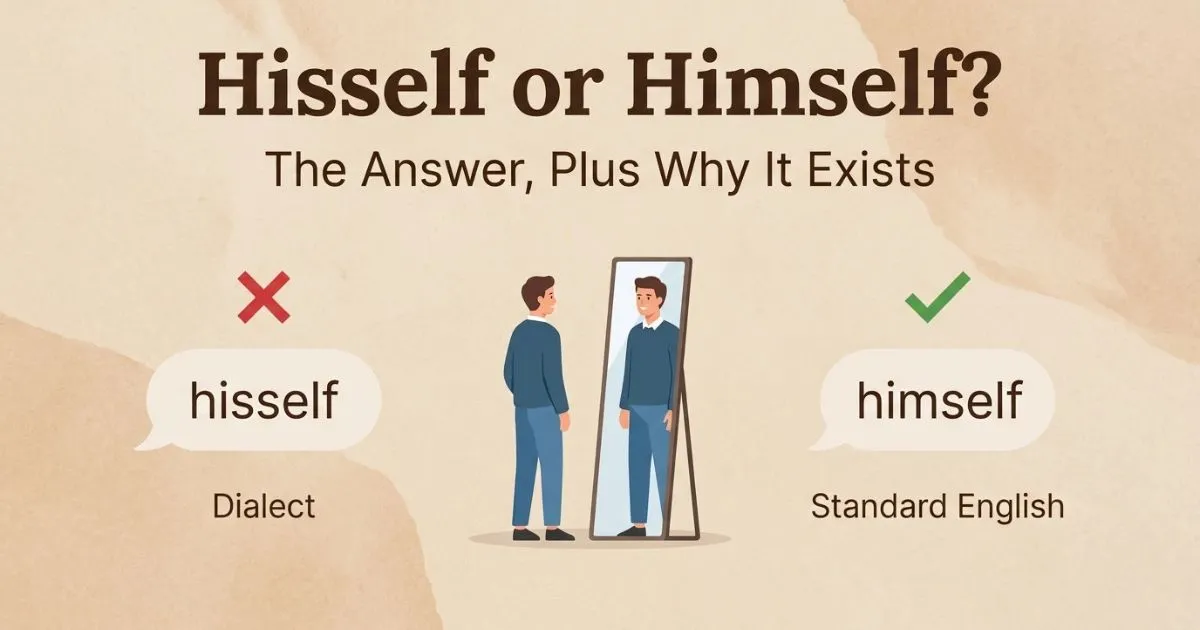
The short answer is that himself is the standard form, while hisself is a dialect variant that does not belong in formal writing.
But “one is wrong” is only half the story. Hisself has a real history, a logical pattern behind it, and a legitimate place in fiction.
In this guide on hisself or himself, you will get the rule, the reasoning, a quick self-test, and clear advice on when each form fits.
The Quick Answer
Use himself.
In essays, emails, reports, and everyday standard writing, himself is the form readers expect. Hisself shows up in some regional speech and in dialogue where an author wants to capture how a character talks.
Outside of those cases, it reads as an error.
One-line rule: Standard writing gets himself. Hisself is only for deliberate dialect.
Himself or Hisself: What Is the Real Difference?
Both words point to the same idea: a male person doing something to, or by, himself. So the difference is not about meaning. It is about status.
- Himself is the standard reflexive pronoun for he.
- Hisself is a dialectal variant. Dictionaries record it, but usage guides treat it as nonstandard.
This is not a US-versus-UK situation like color and colour. Himself is standard on both sides of the Atlantic, so you never need to choose based on where your reader lives.
It is also worth noticing that hisself is not a simple typo. It is built differently from himself, which is why the “spelling mistake” label does not quite fit. Think of it as a different construction that standard English did not adopt.
What Does Himself Mean?
Himself is a singular, masculine pronoun that points back to a male person already mentioned in the sentence. Grammarist notes it can also refer to a male animal. It does three main jobs.
Himself as a Reflexive Pronoun
A reflexive pronoun shows that the person doing the action is also the one receiving it.
- Daniel blamed himself for the mistake.
- My brother taught himself Spanish.
- The boy looked at himself in the mirror.
- He accidentally cut himself while cooking.
The pronoun changes the meaning completely. Compare these two:
- He blamed himself for the accident. (He takes the blame.)
- He blamed him for the accident. (He blames someone else.)
Himself for Emphasis
Himself can also add emphasis to a person you have already named. Grammar books call this an intensive use.
- The manager himself approved the request.
- The author himself signed my copy.
- The coach himself chose the team.
You can delete himself from these sentences and the meaning survives. You are simply stressing that this particular person did it personally.
By Himself
The phrase by himself means alone or without help.
- He lives by himself.
- Robert finished the assignment by himself.
- My grandfather built that table by himself.
Promova gives “on his own” as a close synonym, which is a handy swap if you want to vary your wording.
Not Himself
There is one more everyday use. When someone is not himself, he is acting out of character.
- He was not himself at all on the trip.
This expression is fully standard and shows up in news writing and conversation alike.
Read More: Children’s or Childrens’? The Easy Rule That Settles It
Is Hisself a Real Word?
Yes, and no, depending on what you mean by “real.”
Hisself is recorded in dictionaries as a dialectal variant of himself. Grammarist calls it an official word that most people would still consider grammatically incorrect. Writing Explained goes further and says it is simply not correct in standard English.
These views fit together once you separate two questions:
- Does the word exist? Yes. People say it, and dictionaries record it.
- Is it standard? No. That is why it stays out of formal writing.
So when a website claims hisself “doesn’t exist in English,” that is not accurate. The better statement is that it exists, but it is nonstandard.
Here is how that plays out in practice:
| Situation | Best choice |
| School assignments | himself |
| Business emails | himself |
| Reports and academic papers | himself |
| Everyday standard writing | himself |
| Dialogue for a regional character | hisself, on purpose |
| Discussing language variation | both, clearly labeled |
Why Do People Say Hisself?
Because it makes a certain kind of sense.
The Pattern Looks Logical
Look at the family of reflexive pronouns:
| Pronoun | Reflexive form | Built from |
| I | myself | my + self |
| you | yourself | your + self |
| we | ourselves | our + selves |
| he | himself | him + self |
| they | themselves | them + selves |
Most of the pronouns people learn first are built on the possessive word (my, your, our). So a speaker who follows that pattern would naturally reach for his + self.
Standard English did something different for he and they: it used the object form (him, them) instead. Writing Explained puts it this way: a reflexive pronoun works as the object of a verb, so building it from possessive his is considered an incorrect formation.
The History Is Older Than You Might Think
Grammarist explains that in Old English, reflexives were formed by adding self to the possessive, as in his self. Himself came from a different set of forms, the ones that meant something concerned him.
Over time, speakers settled on one form or the other. Standard English kept himself. In some regions, hisself stayed popular.
So hisself is not a modern internet slip. It is an older pattern that survived in speech while the written standard went another way.
Where You Will Hear It
Hisself is most often linked with Southern and South Midland American English. You might hear a line like:
- “He fixed that truck hisself.”
Using a regional form does not mean someone cannot write standard English. Many people move between their home dialect and formal writing without any trouble. That skill is called code-switching, and it is completely normal.
Why Herself Never Had This Problem
Grammarist adds a neat side note. The shift happened with he because the two forms were different words (his and him). For she, the possessive and object forms are identical: her. There was nothing to confuse, so herself stayed put.
That is why you never hear a “herrself” debate.
How Common Is Hisself in Print?
Very rare. Writing Explained shows a chart comparing the two words in English-language books published since 1800, and the hisself line sits close to zero.
The site is honest that this chart is not scientific. Still, it points in a clear direction: published writing overwhelmingly uses himself.
That is the real reason for the “avoid it” advice. It is not that hisself is incomprehensible. It is that readers of standard writing almost never see it, so it stands out.
When Hisself Is Acceptable
There is one good reason to write hisself: you want a character to sound like a real person from a specific place.
For example:
“I told him to fix it hisself,” Earl said, wiping his hands on a rag.
Here the word does real work. It tells the reader something about Earl’s voice.
A few tips if you use it in fiction:
- Do it on purpose. The choice should be deliberate, not accidental.
- Keep it in dialogue. Your narration should stay in standard English unless the whole story is told in that voice.
- Stay consistent. If a character says hisself, the rest of his speech should fit the same dialect. One lonely dialect word can feel like a typo.
- Do not overdo it. A little goes a long way. Too much dialect spelling can tire the reader.
You may also use hisself when you are writing about language, for example in a grammar article like this one.
Common Mistakes to Avoid
Mistake 1: Using Hisself in Formal Writing
- ❌ He completed the report hisself.
- ✅ He completed the report himself.
If your reader is a teacher, boss, or client, choose himself every time.
Mistake 2: Using Him Where Himself Is Needed
- ❌ John looked at him in the mirror.
- ✅ John looked at himself in the mirror.
If the person receiving the action is the same as the person doing it, you need the reflexive form. Use him only when you mean a different person.
Mistake 3: Leaving Himself Without a Clear Reference
- ❌ The teacher told the student that himself was responsible.
- ✅ The teacher said he himself was responsible.
Himself needs a clear male person earlier in the sentence to point back to. If the reader has to guess, rewrite the sentence.
Mistake 4: Treating Related Dialect Forms as Standard
Hisself has a cousin: theirselves. Like hisself, it is nonstandard. The standard form is themselves.
- ❌ They prepared theirselves for the contest.
- ✅ They prepared themselves for the contest.
A Simple Self-Test
When you are unsure, run through these three steps.
- Is this standard writing? (An email, essay, report, post, or message.) If yes, write himself.
- Is this dialogue for a character whose dialect uses hisself? If yes, you may use hisself deliberately.
- Still not sure? Write himself. It is never wrong in standard English.
And here is a memory trick from Writing Explained, in my own words: his shows ownership (his book), but himself does not show ownership. So an ownership word has no business at the front of it.
Quick Practice
Fill in the blanks, then check the answers below.
- The chef taught ______ to bake bread.
- The principal ______ handed out every certificate.
- My grandfather lives by ______.
- Fix this: “He fixed the bike hisself.”
- True or false: Hisself is acceptable in a job application letter.
Answers:
- himself
- himself (emphasis)
- himself
- He fixed the bike himself.
- False. Use himself in formal writing.
A Note on Pronunciation
The two words sound different at the join. Himself is pronounced with an “m” sound (him-self), while hisself ends the first part with a “z” sound (his-self), as Promova points out.
If you notice yourself saying the “z” version in conversation, you do not need to panic. Just remember to write the standard form when it counts.
FAQs
1. Is it hisself or himself?
Himself is correct in standard English. Hisself is a dialectal variant that appears in some regional speech and in fictional dialogue. For schoolwork, business writing, and everyday standard use, always choose himself. It is accepted in both American and British English.
2. Is hisself a real word?
Yes, dictionaries record it as a dialectal form of himself. However, being recorded does not make it standard. Most usage sources treat it as nonstandard, so it rarely appears in formal writing. Think of it as real but regional.
3. Why do people say hisself?
Many pronouns, like myself and yourself, are built on possessive words. Speakers apply that same pattern to he and get his + self. History also plays a role, since the form survived in some regions, especially the Southern United States.
4. Can I use hisself in my writing?
Only deliberately. It works in dialogue to show how a character speaks, or when you are discussing language itself. In emails, essays, reports, and other standard writing, use himself instead. When in doubt, himself is always the safe option.
5. What is the difference between himself and him?
Him refers to a different person, as in “She called him.” Himself refers back to the subject, as in “He called himself.” Using the wrong one can change the meaning of the sentence, so check who is doing the action.
6. Is theirselves correct?
No. Like hisself, theirselves is a nonstandard form. The standard reflexive pronoun is themselves. Write “They prepared themselves,” not “They prepared theirselves.” The same standard-versus-dialect logic applies to both words.
Conclusion:
So, hisself or himself? Himself is the right choice for standard English, in both American and British writing. Hisself is a real but nonstandard dialect form, best kept for fiction dialogue or language discussion.
Understanding why it exists makes the rule easier to remember. The pattern of pronouns invites his + self, history kept it alive in some regions, and standard English settled on himself.
Your next step: Scan your last email or assignment for hisself and theirselves. If you find either one, swap in himself or themselves, and you are done.

I am an English language writer passionate about grammar and clear communication. I create simple, easy-to-understand content that helps readers improve their English skills. My goal is to make learning English both practical and enjoyable.