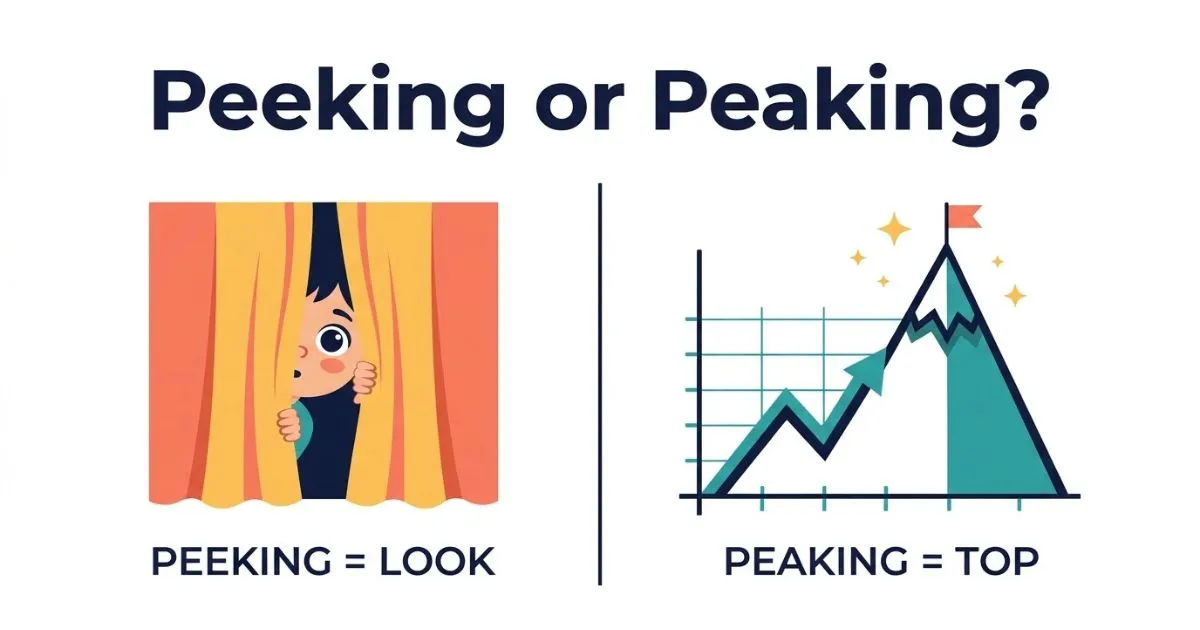
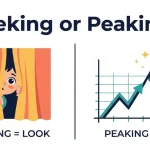
You’re typing fast and write, “She was peaking through the curtains.” Something feels off, but your spellchecker stays silent. One missing letter has turned a curious child into a sales chart.
Peeking or peaking confuses writers at every level. The two words sound identical, and both are real English words. That is exactly why software rarely flags the mistake.
This guide fixes it for good. You’ll get a one-line rule, a three-question test that takes seconds, the sneaky third word (pique) behind even more errors, common mistakes, a short practice quiz with answers, and a proofreading habit that catches the slip before your reader does.
The Short Answer
Both words are correct. They just describe different things.
| Word | What it describes | Example |
| Peeking | Looking briefly or secretly | She was peeking through the door. |
| Peaking | Reaching a highest point | Demand is peaking this week. |
The rule: if someone is looking, write peeking. If something is reaching its top level, write peaking.
That’s most of what you need. The rest of this guide shows you how to apply it without hesitation.
Read More: Site or Cite? The Simple Rule That Ends the Confusion
What Does Peeking Mean?
Peeking is the “-ing” form of the verb peek. To peek is to take a short look, often quietly, and often while trying not to be noticed.
The word usually carries a small sense of secrecy or curiosity. Nobody “peeks” at a long presentation. They peek at a surprise, a message, or a neighbor’s garden.
Think of the classic warning at a birthday party: “No peeking!” It means don’t look before it’s time.
Peeking Through, Into, and Out
Three small patterns cover almost every use of peeking.
Through:
- She was peeking through the curtains.
- He was peeking through the keyhole.
Into:
- The child was peeking into the gift bag.
- He kept peeking into the fridge.
Out:
- The dog was peeking out from behind the sofa.
- A tiny flower was peeking out from under the leaves.
That last pattern surprises people, because nobody is actually looking. A flower can’t look at anything. Here, peeking describes something partly appearing, as if it were glancing out. The sun can do the same: “The sun was peeking through the clouds.”
Peek Can Be a Noun Too
You can also take a peek, meaning take a quick look. Here, peek is a noun. The phrase “take a peak” is a very common mistake, so keep this one in mind. We’ll return to it below.
What Does Peaking Mean?
Peaking is the “-ing” form of peak. It means reaching the highest, strongest, or best point of something.
Nothing about it involves looking. The question is always: is this thing at or near its maximum?
- Temperatures are peaking this afternoon.
- Traffic is peaking during rush hour.
- The athlete is peaking before the championship.
- Electricity use is peaking in the evening.
A Peak Doesn’t Have to Be a Mountain
Many learners think of mountain tops when they see peak. That’s where the word comes from, but modern English uses it far more broadly.
You can talk about the peak of:
- sales
- popularity
- traffic
- demand
- temperature
- athletic form
- a career
When a singer’s popularity is peaking, nothing physically rises. The word simply describes a high point in a process.
Peak as a Verb, Noun, and Adjective
Peak is flexible, which makes peaking easy to recognize once you know the pattern.
- Verb: Demand will peak in July.
- Noun: Demand will reach its peak in July.
- Adjective: Traffic is heaviest during peak hours.
Notice how the first two sentences say the same thing in two ways. We’ll use that in the next section.
The Three-Question Test for Peeking or Peaking
When you’re unsure, don’t rely on the sound. Both words sound the same. Ask what the sentence is actually doing.
Question 1: Is someone (or something) looking or partly appearing?
Yes → peeking.
Question 2: Is something reaching its highest level?
Yes → peaking.
Question 3: Is something stirring up curiosity or interest?
Yes → piquing (more on this word shortly).
The Swap Trick
Here’s a faster method. Replace the word and see if the sentence still works.
- Swap in “looking”: “She was looking through the curtains.” Works, so write peeking.
- Swap in “reaching a high point”: “Sales are reaching a high point.” Works, so write peaking.
If neither swap fits, you may be dealing with a third word entirely.
For peaking, there’s a bonus test. Try changing the verb into the noun phrase reaching a peak. “Demand has reached a peak” makes sense, so the word you need is spelled with an “a.”
Read More: Cancelled or Canceled? Cancellation Spelling Explained
Why Spellcheck Won’t Save You
Here’s the part most guides skip.
Spellcheckers look for words that don’t exist. Peeking exists. Peaking exists. Each is perfectly spelled, so a basic tool sees no problem.
The error is about meaning, not spelling. That’s why you can reread your own writing three times and still miss it. Your brain hears the word correctly and moves on.
Some grammar tools do catch certain cases, but you shouldn’t count on them for every sentence. The reliable fix is a habit, and we’ll build one in the proofreading section below.
The Third Word: Pique
Peek and peak aren’t alone. A third word sounds exactly the same: pique.
| Word | Meaning | Example |
| Peek | Look briefly | She peeked inside. |
| Peak | Reach the highest point | Sales are peaking. |
| Pique | Stir up interest or curiosity | The story piqued my curiosity. |
Pique most often means to arouse interest or curiosity. Dictionaries also list another sense: to provoke irritation or resentment. In everyday writing, the curiosity meaning is the one you’ll meet most.
The Most Common Pique Mistake
You’ll often see this one:
- ❌ The headline peaked my interest.
- ✅ The headline piqued my interest.
The sentence means the headline sparked interest. It did not reach a maximum, so peaked is wrong.
Peeked, Peaked, and Piqued Sound Identical
Here’s something worth knowing: all three past-tense forms are pronounced the same way. Peeked, peaked, and piqued are indistinguishable out loud.
Reading them aloud to proofread will therefore never help. You must check the meaning.
| Base verb | Past tense | -ing form |
| peek | peeked | peeking |
| peak | peaked | peaking |
| pique | piqued | piquing |
The “e” in peeking comes from the base word peek. The “a” in peaking comes from peak. The spelling follows the base verb every time.
Common Mistakes (and Quick Fixes)
Almost every error comes from writing by sound instead of by meaning. Here are the ones to watch for.
1. “Peaking through the window”
- ❌ She was peaking through the window.
- ✅ She was peeking through the window.
She is looking. Choose peeking.
2. “Sales are peeking”
- ❌ Sales are peeking this month.
- ✅ Sales are peaking this month.
Sales don’t look at anything. They hit a high.
3. “Take a peak”
- ❌ Take a peak at this.
- ✅ Take a peek at this.
You’re inviting someone to look.
4. “Sneak peak”
- ❌ Here’s a sneak peak of our new collection.
- ✅ Here’s a sneak peek of our new collection.
A sneak peek is an early look. The word sneak can distract you from the spelling of peek, which is why this one is so common. If you’re offering a preview, you’re offering a look.
5. “Peaked my interest”
- ❌ That peaked my interest.
- ✅ That piqued my interest.
You’re describing sparked curiosity, not a maximum.
Memory Tricks That Actually Stick
You don’t need a grammar lecture. Pick the trick that fits the way you think.
Peek has two e’s, like “see.” Two e’s, two eyes. You peek to see.
Peak is the top. The “a” can remind you of the sharp point of a mountain. Whatever is peaking is climbing toward its highest point.
Pique is for interest. Curiosity gets piqued. Think of the “q” as a question mark waiting to be answered.
Here’s a one-line summary you can screenshot:
| Word | Think |
| Peek | Look |
| Peak | Top |
| Pique | Interest |
Real-Life Scenarios
Seeing the words in context makes the choice almost automatic.
At a birthday party. A child edges toward the wrapped presents. “Stop peeking at the gifts!”
In a shop. December arrives and customers flood in. “Sales are peaking in December.”
In an office. A coworker glances at a screen that isn’t theirs. “He was caught peeking at confidential files.”
At a track meet. A runner hits her best form right before the final. “She’s peaking at exactly the right time.”
In a marketing meeting. A teaser trailer gets everyone talking. “The sneak peek piqued our curiosity.”
Notice that the last example uses all three words in one sentence. It reads naturally once you know which job each word does.
Peeking or Peaking in Professional Writing
At work, a wrong word can quietly change your message.
Compare these two lines:
- “Customer demand is peaking this quarter.”
- “Customer demand is peeking this quarter.”
The first tells your manager that demand is at its highest. The second makes readers wonder what you meant. In reports, emails, and presentations, that confusion costs credibility.
Here are a few correct business-style sentences to model:
- Website traffic is peaking around lunchtime.
- Interest in the product is peaking after the announcement.
- An employee was caught peeking at private documents.
- The campaign piqued the interest of new customers.
Test Yourself: 8-Question Quiz
Fill each blank with peek/peeked/peeking, peak/peaked/peaking, or pique/piqued/piquing. Try it before you scroll to the answers.
- Stop ___ at my screen.
- Electricity demand is ___ in the evening.
- The mystery novel ___ my curiosity.
- Can I take a ___ inside the box?
- Her fitness is ___ just before the final.
- Here’s a sneak ___ of the new app.
- The sun was ___ out from behind the clouds.
- Sales ___ last December.
Answers:
- peeking (someone is looking)
- peaking (demand is at its highest)
- piqued (the novel sparked curiosity)
- peek (a quick look, used as a noun)
- peaking (her form is reaching its best)
- peek (an early look)
- peeking (the sun is partly appearing)
- peaked (sales reached a high)
If you got seven or eight right, you’ve got it. If you missed a couple, reread the three-question test and try again in a day.
A 30-Second Proofreading Routine
Since spellcheck won’t catch this error, build a tiny habit.
- Search your draft for “peek,” “peak,” and “pique” (including every “-ing” and “-ed” form).
- For each hit, ask: is this about looking, a high point, or curiosity?
- Use the swap trick: replace the word with “looking,” “reaching a high point,” or “sparking.”
- Keep a short list of your personal trouble spots. Most people repeat the same two or three mistakes.
This takes less than a minute, and it works for any pair of look-alike words, not just these.
FAQs
Is it peeking or peaking?
Both are correct, but they mean different things. Peeking means looking briefly or secretly. Peaking means reaching the highest point or level. Choose the one that matches your sentence: if someone is looking, use peeking; if something is reaching a maximum, use peaking.
Is “peaking through the window” correct?
No. If someone is looking through a window, the correct phrase is “peeking through the window.” Peaking describes reaching a highest point, which doesn’t fit a person looking through glass. A quick check is to swap in “looking.” If the sentence still works, write peeking.
Is it “sneak peek” or “sneak peak”?
The standard spelling is “sneak peek.” It means an early or brief look at something, such as a trailer or product preview. People often write “sneak peak” because the words sound alike, but a peak is a high point. Since you’re getting a look, you need peek.
Is it “take a peek” or “take a peak”?
It’s “take a peek.” The phrase means to take a quick look at something. Writing “take a peak” is a common mistake caused by the identical pronunciation. If you can replace the phrase with “take a quick look,” then peek is the right spelling.
What is the difference between peaking and piquing?
Peaking means reaching a highest point, as in “Sales are peaking.” Piquing means stirring up interest or curiosity, as in “The headline is piquing my interest.” They sound identical, so check the meaning: a maximum calls for peaking, while sparked curiosity calls for piquing.
How do I remember peeking vs. peaking?
Link each word to a picture. Peek has two e’s, like two eyes, so it’s about seeing. Peak looks like a mountain top, so it’s about the highest point. If you’re stuck, replace the word with “looking” or “reaching a high point” and see which version makes sense.
Conclusion:
Peeking or peaking comes down to one question: what is the sentence doing? If someone is looking, or something is partly appearing, write peeking.
Because these words sound the same and your spellchecker treats them as correct, the fix has to come from meaning, not sound. Use the swap trick, keep the three-word chart handy, and run the 30-second routine on anything you publish.
Your next step: open the last email or post you wrote and search it for “peek,” “peak,” and “pique.” If you find a mix-up, you’ve just seen why this check is worth the minute.

I am an English language writer passionate about grammar and clear communication. I create simple, easy-to-understand content that helps readers improve their English skills. My goal is to make learning English both practical and enjoyable.







1 thought on “Peeking or Peaking? The Simple Rule to Pick the Right One”