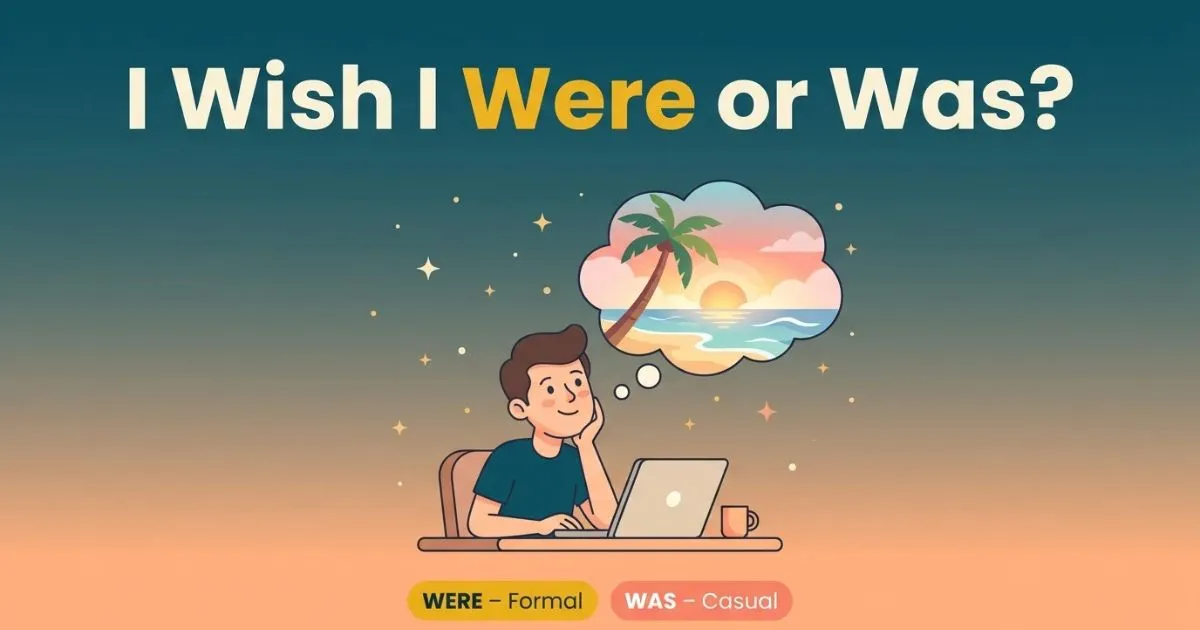
You’re texting a friend about your dream holiday and type, “I wish I was on a beach right now.” Then you stop. Doesn’t “were” sound more correct? Autocorrect might even change it for you, and now you’re doubting yourself.
This tiny choice trips up native speakers and learners alike. The traditional answer, “I wish I were,” seems to break a basic rule: I goes with was. The truth is simple once you see the idea behind it.
In this guide, you’ll get the quick answer, the reason behind it, and an easy way to pick the right form in any situation. You’ll also learn which mistakes to avoid, and you can test yourself at the end.
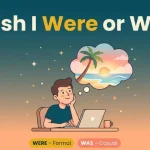
Quick Answer: I Wish I Were or Was?
Choose “I wish I were” whenever you want the safest, most standard option. It’s the form grammar experts prefer, and it suits essays, exams, work emails, and any careful writing.
“I wish I was” is very common in everyday speech. You’ll hear it in casual chats and popular songs. It’s usually called informal or non-standard, not meaningless or confusing.
The meaning is the same in both. Only the level of formality changes.
A simple rule of thumb:
- Formal or unsure: I wish I were
- Casual chat: I wish I was is widely used and understood
- Real past event: always was (“I was late yesterday.”)
Read More: Etc vs Ect.: The Right Spelling + Easy Memory Trick
Why “I Wish I Were” Feels Wrong at First
The normal was/were pattern
In ordinary past-tense sentences, English uses was with I, he, she, and it. It uses were with you, we, and they.
- I was tired.
- She was late.
- You were right.
- They were at home.
That’s why “I were tired” sounds odd. “You was right” sounds odd too. Both break the normal pattern.
Where the confusion starts
Then someone says, “I wish I were taller,” and the pattern seems to collapse. Why does I suddenly get were?
Because after wish, you’re not describing a fact. You’re describing something that isn’t true. English has a special verb form for exactly this situation, and it’s called the subjunctive.
The Subjunctive Mood in Plain English
Grammar books talk about “moods,” but you only need two.
- Indicative mood: ordinary statements about things presented as real.
- Subjunctive mood: wishes, imaginary situations, and things that aren’t true right now.
Compare these two sentences:
- Real: I was happy when the results came out.
- Imagined: I wish I were happier at work.
In the first, something actually happened. In the second, the speaker is picturing a different reality. For imagined situations, the traditional rule says to use were with every subject, including I, he, she, and it.
A tiny memory trick
Word Smarts offers a handy one: if something has happened, use was. If it hasn’t, and may never, use were. Their playful example involves being covered in kittens. Wishing for it calls for were, but describing it after it truly happened calls for was.
Try your own version:
- “I wish I were on holiday.” (It hasn’t happened.)
- “I was on holiday last June.” (It did.)
Does “were” mean past time here?
No, and this surprises many learners. “I wish I were taller” talks about right now. The verb looks past-tense, but it signals distance from reality, not distance in time.
Think of it as a step back from the truth. When a sentence moves away from reality, the verb steps back with it.
Why You Still Hear “I Wish I Was”
If were is the traditional answer, why does was sound so natural?
Because language changes through use. Thesaurus.com points to pop culture: Skee-Lo’s “I Wish” and Pearl Jam’s “Wishlist” both lean on “I wish I was.” It calls this form non-standard but increasingly popular, rather than a disaster.
Pink Floyd’s “Wish You Were Here,” on the other hand, shows the traditional pattern at work. With you, were is always correct.
English teachers’ forums show the same split. Many people accept was in casual speech while still recommending were for anything formal.
Is there a difference in meaning?
You may read that were means “impossible” while was means “possible.” It’s a neat idea, but not a dependable rule. Many writers and teachers see no real difference in meaning between “I wish he were here” and “I wish he was here.”
Treat the choice as style, not a hidden code.
Were or Was: Which Should You Use?
| Situation | Best choice | Example |
|---|---|---|
| School essay or exam | were | I wish I were better prepared for this topic. |
| Work email or report | were | I wish I were able to attend the meeting. |
| Giving advice | were | If I were you, I’d apply today. |
| Text to a friend | was is fine | I wish I was there with you! |
| Casual talk or social posts | was is fine | I wish I was better at cooking. |
| Real past event | was | I was at the office all day. |
When to use “I wish I were”
Many readers expect it, so using it costs you nothing. Thesaurus.com gives the same advice: for a paper your English professor will read, follow the grammarians.
When “I wish I was” is fine
Friendly conversation, text messages, and relaxed social posts are all fine places for it. Nobody will misunderstand you.
If you’re learning English, it’s still smart to know that were is the standard form, even if you sometimes use was casually.
Make “were” your default
If switching styles feels like extra work, build one habit: use were after wish every time. It’s correct in formal and informal settings. It may sound a little careful in a text message, but it won’t be wrong.
It Isn’t Only About “I”
The same rule applies to other singular subjects. These are the traditional forms:
- I wish I were taller.
- She wishes she were a little taller.
- I wish he were here.
- I wish it were warmer today.
- I wish there were more hours in the day.
In casual speech, people often say he was or it was instead.
With you, we, and they, nothing changes, because were is already the normal form:
- I wish you were here.
- I wish we were on holiday.
- I wish they were more helpful.
Never say “I wish you was here.” That one isn’t just informal. It breaks the basic pattern, and even casual speakers avoid it.
“If I were you” works the same way
Advice phrases follow the same logic. “If I were you, I’d ask for help” imagines a situation that isn’t true, because you can’t actually be someone else.
“As if” sentences work this way too: “He talks as if he were the boss.”
Negative wishes
For negatives, you’ll see two versions: “I wish I weren’t so shy” (traditional) and “I wish I wasn’t so shy” (casual). Same rule, same advice.
Read More: Saw or Seen? The Correct Form Explained
I Wish I Were: Real-Life Examples by Situation
Wishes about yourself
- I wish I were more confident when I speak in meetings.
- I wish I were a faster typist.
- I wish I were less shy at parties.
Wishes about places and time
- I wish I were on a quiet beach right now.
- I wish it were the weekend already.
- I wish it were cooler today.
Wishes about other people
- I wish my brother were here to see this.
- I wish she were less stressed.
- I wish they were closer.
Wishes about situations
- I wish there were more time to revise.
- I wish the exam were next week, not tomorrow.
- I wish the bus were on time.
Every sentence describes something that isn’t true right now. In casual speech, you’d often hear was in the ones with I, he, she, or it. With they and we, were stays.
Wishing About the Past and Future
Many articles stop at were versus was. But wishes can point to different times, and this is where tenses get mixed up.
| What you mean | Pattern | Example |
|---|---|---|
| Present, different from reality | wish + were / past form | I wish I were taller. |
| Regret about the past | wish + had + past participle | I wish I had worked harder at school. |
| An ability you lack | wish + could | I wish I could see you next week. |
| Annoyance at a plan | wish + negative past form | I wish you weren’t leaving tomorrow. |
Compare these two:
- “I wish I were at the party.” You’re not there now.
- “I wish I had been at the party.” You missed it.
A quick way to choose: ask yourself, “Am I talking about now or then?” If it’s now, use were (or was casually). If it’s then, use had plus the past participle.
Common Mistakes to Avoid
1. Using “were” for a real past event
- ✗ I were late yesterday.
- ✓ I was late yesterday.
Were with I belongs only to imagined situations. A real event is just a normal past sentence.
2. Keeping the present tense after “wish”
- ✗ I wish I am rich.
- ✓ I wish I were rich.
Learners often use am after wish. The verb should shift to the unreal form.
3. Using “was” with you, we, or they
- ✗ I wish you was here.
- ✓ I wish you were here.
4. Using “wish” when “hope” fits better
Use hope for things that could realistically happen: “I hope I can leave early.” Use wish for unreal or unlikely things: “I wish I could leave early” (when you know you can’t).
5. Treating “I wish I was” as a disaster
It’s informal, not a crime. Correcting a friend’s text message is rarely necessary. Save your editing energy for formal writing.
A 3-Step Test You Can Use Anywhere
When you’re unsure, run through these steps:
- Check reality. Is the thing you’re describing untrue right now? If yes, you’re in wish territory, so think subjunctive.
- Check your reader. Is it a teacher, boss, editor, or exam? Use were. A close friend? Either works.
- Check the subject. With I, he, she, it, or there, use were for the traditional form. With you, we, or they, it’s were anyway.
In almost every case, were wins. Was is only a casual option, and only with I, he, she, it, or there.
Practice: Test Yourself
Choose the best traditional form.
- I wish I (was / were) more patient.
- She wishes she (was / were) home right now.
- I (was / were) at the airport at six yesterday.
- If I (was / were) you, I’d call him.
- I wish it (was / were) Friday.
- I wish I (were / had been) at your wedding last year.
- I wish you (was / were) here.
- I wish there (was / were) a faster train.
Answers:
- were. It’s an imagined situation.
- were. Same rule applies to she.
- was. This is a real past event, not a wish.
- were. “If I were you” is the standard advice phrase.
- were. It isn’t Friday yet.
- had been. This is a regret about the past.
- were. You always takes were.
- were. Casual speech may use was, but were is the standard form.
Quick Memory Tricks
- Has happened → was. Only imagined → were.
- Wish means unreal, and unreal means were.
- When in doubt, were.
FAQ
Is it “I wish I were” or “I wish I was”?
“I wish I were” is the traditional, standard form and the safest choice. “I wish I was” is common in casual speech and informal writing. Both express the same wish, so choose by how formal your situation is.
Is “I wish I was” grammatically wrong?
Grammarians call it non-standard rather than meaningless. People use it daily and are understood. In essays, exams, and professional writing, though, were is expected, so switch to it whenever your writing will be judged.
Why do we use “were” with “I” after wish?
Wish describes something unreal, which triggers the subjunctive mood. In that mood, were is used with every subject, including I, he, she, and it. The verb looks past-tense but refers to a present, imagined situation.
Can I say “I wish I were you”?
Yes. It’s a correct, traditional sentence that imagines swapping places with someone. It follows the same logic as “If I were you.” Neither describes a real situation, so were fits both.
Does “I wish I were” talk about the past?
No, it usually describes the present: you wish something were different now. For regrets about the past, use had plus a past participle, as in “I wish I had studied more.”
What’s the difference between wish and hope?
Use wish for unreal or unlikely situations: “I wish I were taller.” Use hope for things that could realistically happen: “I hope I can leave early.” Wish looks at what isn’t true; hope looks at what might be.
Conclusion:
So, I wish I were or was? Use were when you want the standard, safe form, especially in essays, exams, and professional writing. Use was only in relaxed, casual settings, where it’s common and understood.
The idea behind it is simple: were belongs to wishes and imagined situations, while was belongs to things that really happened. For regrets about the past, switch to had plus a past participle.
Your next step: write down five wishes of your own right now, such as “I wish I were…”. Then check each one with the 3-step test above. A few minutes of practice will make the right form feel natural.

I am an English language writer passionate about grammar and clear communication. I create simple, easy-to-understand content that helps readers improve their English skills. My goal is to make learning English both practical and enjoyable.



1 thought on “I Wish I Were or Was? Use This Easy Rule to Decide”