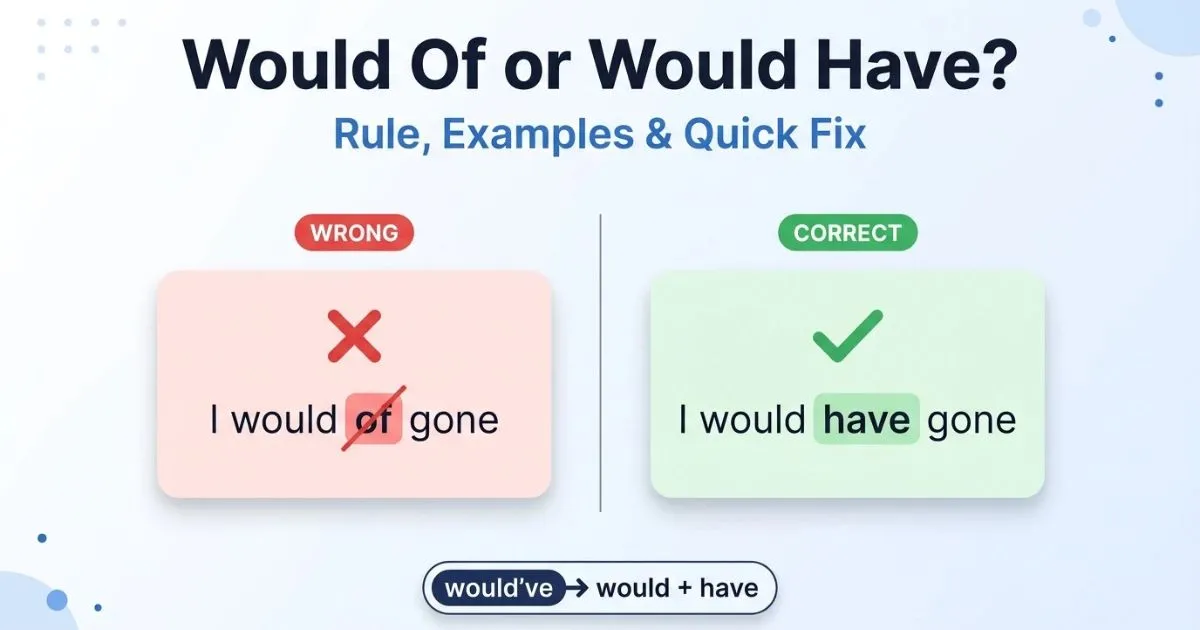
You type “I would of called you,” hit send, and move on. It looks fine. It sounds fine. But a sharp-eyed reader just spotted one of the most common slip-ups in English writing.
The good news is that this confusion has a simple cause and a one-line fix.
In this guide, you’ll see why would of or would have trips up so many people, what each phrase actually does, and how to build correct sentences every time.
You’ll also learn about a related trap, “if I would have known,” that most grammar guides skip. A quick self-check routine and a short practice set are included at the end.
Would Of or Would Have: The Quick Answer
The correct form is would have. Its short form, would’ve, is also correct. Would of is a mistake in standard English, whether you’re writing an exam answer, a work email, or a blog post.
| Phrase | Correct? | Why |
| would have | Yes | The full, standard form |
| would’ve | Yes | The contraction of “would have” |
| would of | No | “Of” wrongly replaces the verb “have” |
Here are the same sentence three ways:
- ✅ I would have helped if I had known.
- ✅ I would’ve helped if I had known.
- ❌ I would of helped if I had known.
The rule in one line: after “would,” write “have” (or ‘ve). Never “of.”
Read More: Peeking or Peaking? The Simple Rule to Pick the Right One
Why “Would Of” Looks Right but Isn’t
The sound trick
In everyday speech, we squash “would have” into “would’ve,” and the “have” part shrinks into a quick, weak sound. A weak “of” sounds almost exactly the same. Your ear can’t tell the two apart, so when you write what you hear, you may pick the wrong word.
That’s why the mistake is invisible in conversation and obvious on the page. Nobody can hear the spelling when you speak, but a reader sees it instantly.
Why “of” can’t fit in this sentence
Look at the grammar and the answer becomes clear.
“Would” is a modal verb, in the same family as can, could, should, may, might, must and ought to. A modal verb needs a verb form after it. In “would have gone,” the word “have” is an auxiliary verb that helps build the past meaning.
“Of,” on the other hand, is a preposition. A preposition links a word to an object, as in “a cup of tea” or “afraid of heights.” There is no object to link in “I would of gone,” so the sentence simply doesn’t work grammatically.
Is it different in British and American English?
No. Sources that cover this topic agree that both varieties treat “would of” as incorrect. There is no regional spelling where it becomes acceptable, so you don’t need to adjust it for your audience.
What “Would Have” Actually Means
Knowing the meaning helps you remember the form. “Would have” is used for the past, and it usually describes something that did not happen, or that depended on a different situation.
A result that was expected but didn’t happen
Marcus would have won the race, but he twisted his ankle at the last bend.
Marcus was on track to win. Something got in the way. “Would have” captures that gap between what was expected and what actually happened.
An imagined past
If we had left ten minutes earlier, we would have caught the train.
This sentence tells us two things: we didn’t leave early, and we didn’t catch the train. The speaker is imagining a different past and its result.
Without an “if” clause
You don’t always need an “if” part. Context can supply the condition.
- I would have joined you, but I had to work.
- She would have loved that gift.
In the first sentence, the reason is stated with “but.” In the second, the speaker is simply imagining her reaction. Either way, “would have” is the right choice.
Would vs. Would Have: Present vs. Past
Many learners mix up “would” and “would have” because both talk about imagined situations. The difference is time.
- Would + base verb talks about an imagined present or future: If I won the lottery, I would travel the world.
- Would have + past participle talks about an imagined past: If I had studied harder, I would have passed the exam.
A quick test: if the situation is already over, you almost always need “would have.” If it is still open or hypothetical right now, use plain “would.”
How to Build the Sentence Correctly
The formula
The pattern is simple:
Subject + would + have + past participle
Follow these steps:
- Choose your subject (I, she, they, the team).
- Add “would.”
- Add “have.”
- Finish with the past participle of your main verb.
Examples: I would have finished. She would have stayed. They would have won.
Watch the verb form: participle, not simple past
The verb after “have” must be a past participle. For regular verbs, this looks the same as the simple past (finished, helped, stayed), so there’s no problem. The trouble starts with irregular verbs, where the two forms differ.
| Verb | Simple past (don’t use here) | Past participle (use this) |
| go | went | gone |
| see | saw | seen |
| write | wrote | written |
| do | did | done |
| take | took | taken |
| eat | ate | eaten |
- ❌ I would have went home earlier.
- ✅ I would have gone home earlier.
Notice that this error can hide inside a correct contraction. “I would’ve went” has the right “would’ve” but the wrong verb. It should be “I would’ve gone.”
Negatives and questions
For negatives, use would not have or wouldn’t have. The same rule applies: never replace “have” with “of.”
- ✅ I wouldn’t have agreed to that.
- ❌ I wouldn’t of agreed to that.
For questions, flip the order of the subject and “would”:
- What would you have done in my place?
- Would she have noticed the mistake?
Would Have in Everyday Writing
Here is how the correct form looks in situations where people most often make the slip.
| Situation | ✅ Correct | ❌ Common mistake |
| Work email | We would have replied sooner if the file had opened. | We would of replied sooner. |
| School essay | The experiment would have worked with more time. | The experiment would of worked. |
| Text to a friend | I would’ve come, but my bus never showed up. | I would of come. |
| Customer message | We would have fixed it today if we’d had the part. | We would of fixed it today. |
| Social media | I would’ve paid double for those tickets! | I would of paid double. |
| Story or blog | She would have turned back if she’d seen the storm. | She would of turned back. |
Would Have vs. Would’ve: Which One Should You Choose?
There is no difference in meaning. One is the full form and the other is the contraction. The only question is tone.
Contractions feel relaxed, so they suit chats, personal emails and friendly blog posts. For formal writing, advice varies a little. Some sources recommend avoiding contractions in formal settings altogether, while others point out that contractions are not automatically wrong there. The safest approach is to follow your assignment brief or style guide. When you’re unsure, write the full form.
| Where you’re writing | Suggested form |
| Text messages, chats | would’ve |
| Friendly blog or newsletter | Either one |
| School essay, exam | would have |
| Business report, formal email | would have |
A small trap inside the contraction
The ‘d in “I’d” can stand for either “would” or “had.” That’s one reason the contraction causes so much confusion.
- If I’d seen you, I’d have said hello.
In “If I’d seen,” the ‘d means had (If I had seen). In “I’d have said,” it means would (I would have said). The word that follows gives you the clue: “had” is followed by a participle (seen), while “would” is followed by “have.”
Read More: Enquire or Inquire? Which One Should You Use?
Could Of, Should Of, Might Of and Must Of
The same sound problem affects every modal verb. Each one has the same fix.
| ❌ Wrong | ✅ Full form | ✅ Contraction |
| could of | could have | could’ve |
| should of | should have | should’ve |
| might of | might have | might’ve |
| must of | must have | must’ve |
| would of | would have | would’ve |
The meanings differ, even though the grammar pattern is identical. Could have points to a past possibility or ability: I could have finished the marathon in less time. Should have points to something expected or recommended in the past that didn’t happen: We should have gone to the meeting.
Would have vs. should have
These two are often confused, so here is a clear contrast:
- I would have called you if I’d had your number. (An imagined result.)
- I should have called you yesterday. (Regret, or a missed duty.)
Both are correct. They just do different jobs.
The Bigger Trap: “If I Would Have Known”
Even people who never write “would of” often slip here. It’s a different mistake, but it grows from the same root: speech habits creeping into writing.
The rule
When you imagine a different past, the “if” part uses the past perfect (had + past participle). “Would have” belongs in the result part, not the “if” part. English grammar references such as Raymond Murphy’s English Grammar in Use state clearly that “would” should not appear in the “if” part of these sentences.
| ❌ Incorrect | ✅ Correct |
| If you would have told me, I would have helped. | If you had told me, I would have helped. |
| If I would have known, I would have stayed. | If I had known, I would have stayed. |
| If they would have left earlier, they would have arrived on time. | If they had left earlier, they would have arrived on time. |
You can also flip the sentence for a more formal tone: Had you told me, I would have helped.
The contracted version
You’ll often hear “If I’d have known.” This is the contraction of “If I would have known,” and it carries the same problem. Usage commentators point out that the ‘d here stands for “would,” not “had,” which is why it breaks the pattern. The fix is simple: say or write “If I’d known” (which means “If I had known”).
Wishes follow the same logic
For a wish about the past, use the past perfect too.
- ❌ I wish it would have gone differently.
- ✅ I wish it had gone differently.
Common Mistakes Checklist
| Mistake | Fix |
| I would of called. | I would have (or would’ve) called. |
| I wouldn’t of done that. | I wouldn’t have done that. |
| She would’ve went. | She would’ve gone. |
| He would have took it. | He would have taken it. |
| We should of waited. | We should have waited. |
| If I would have known… | If I had known… |
| Believing “it sounds the same, so it’s the same.” | Sound doesn’t decide spelling. Check the grammar. |
How to Remember It (and Catch It in Your Own Writing)
Say the contraction as two words
Whenever you see ‘ve after a modal, read it as “have.” Would’ve = would + have. The apostrophe marks missing letters. It never turns “have” into “of.”
Do a quick search before you send or publish
This is the fastest fix for habitual writers. Use Ctrl+F (or Cmd+F) to search your text for each of these:
- would of
- could of
- should of
- might of
- must of
- ‘ve went, ‘ve did, ‘ve took
Replace each one with the correct form. It takes about thirty seconds, and it catches errors your eyes may skip while reading.
Proofread slowly, and say “have” clearly
When you read your work aloud, pronounce “have” in full instead of the squashed version. The mistake becomes obvious at once.
Use a checker as a backup
A grammar checker can flag these errors automatically. Treat it as a safety net, not a replacement for knowing the rule, because checkers don’t catch everything.
Where This Mistake Costs You the Most
For students, the stakes can be real. One English school warns learners preparing for exams such as IELTS or FCE that writing “would of” will cost them grammar marks.
For professionals, the issue is credibility. Writing the wrong phrase in a client email, proposal or CV can make otherwise good work look careless.
For bloggers and content writers, readers notice. A single “should of” in a headline or opening line can reduce trust before anyone reaches your main point.
Practice: Fix These Sentences
Correct each sentence, then check your answers below.
- I would of gone if I had known about it.
- She would have wrote the report herself.
- We wouldn’t of left so early.
- If you would have called, I would have answered.
- They should of waited for us.
- He would have ate lunch with us.
- I wish it would have been easier.
- You would’ve loved the show. (Is this one correct?)
Answers:
- I would have (or would’ve) gone if I had known about it.
- She would have written the report herself.
- We wouldn’t have left so early.
- If you had called, I would have answered.
- They should have waited for us.
- He would have eaten lunch with us.
- I wish it had been easier.
- Yes, it’s already correct. “Would’ve” is a valid contraction.
FAQs
1. Is it “would of” or “would have”?
“Would have” is correct. “Would’ve” is its accepted contraction. “Would of” is a common mistake that happens because the contraction sounds like “would of” when spoken quickly. Use “would have” or “would’ve” in your writing.
2. Is “would of” ever correct?
Not as a replacement for “would have.” The one exception is when “of” belongs to a different phrase, such as “of course”: “I would of course help you.” There, “of” is part of “of course,” not a substitute for “have.”
3. Is “would’ve” grammatically correct?
Yes. It’s the standard contraction of “would have” and is fine in everyday speech and informal writing. In formal writing, check your style guide or use the full form to be safe.
4. Should I use “would have” or “would’ve” in formal writing?
Both are grammatical, but the full form “would have” is usually the safer choice in essays, reports and professional documents. Contractions suit a relaxed tone, so match the form to your audience.
5. What verb form follows “would have”?
A past participle follows “would have”: would have gone, would have seen, would have written. Avoid the simple past, so write “would have gone,” not “would have went.”
6. Is “if I would have known” correct?
Standard usage guides treat it as an error. Use the past perfect in the “if” part and “would have” in the result: “If I had known, I would have helped.” You can also say “Had I known, I would have helped.”
7. Are “could of” and “should of” wrong too?
Yes. The correct forms are “could have” and “should have,” or the contractions “could’ve” and “should’ve.” The same sound confusion causes these mistakes, and the same fix applies. The same goes for “might of” and “must of.”
Conclusion:
So, would of or would have? Would have, every time, with “would’ve” as its friendly contraction. “Would of” survives only because the two sound alike in speech, and that’s exactly why it’s so easy to fix once you know the reason.
Remember three things: “have” follows modal verbs, a past participle follows “have,” and “would” stays out of the “if” part of a past conditional.
Your next step: before you send or publish your next piece of writing, run a quick Ctrl+F search for “would of,” “could of” and “should of.” Then try the practice sentences again in a week to lock the rule in.

As an American English writer, I specialize in creating clear and engaging content that makes grammar and language learning accessible to everyone. I enjoy breaking down complex English concepts into simple, practical lessons that readers can apply with confidence. My mission is to help learners strengthen their communication skills through easy and reliable content.








1 thought on “Would Of or Would Have? Rule, Examples & Quick Fix”