You read “dietary fiber” on a cereal box. Later, a British article tells you to eat more “dietary fibre.” Did someone make a typo?
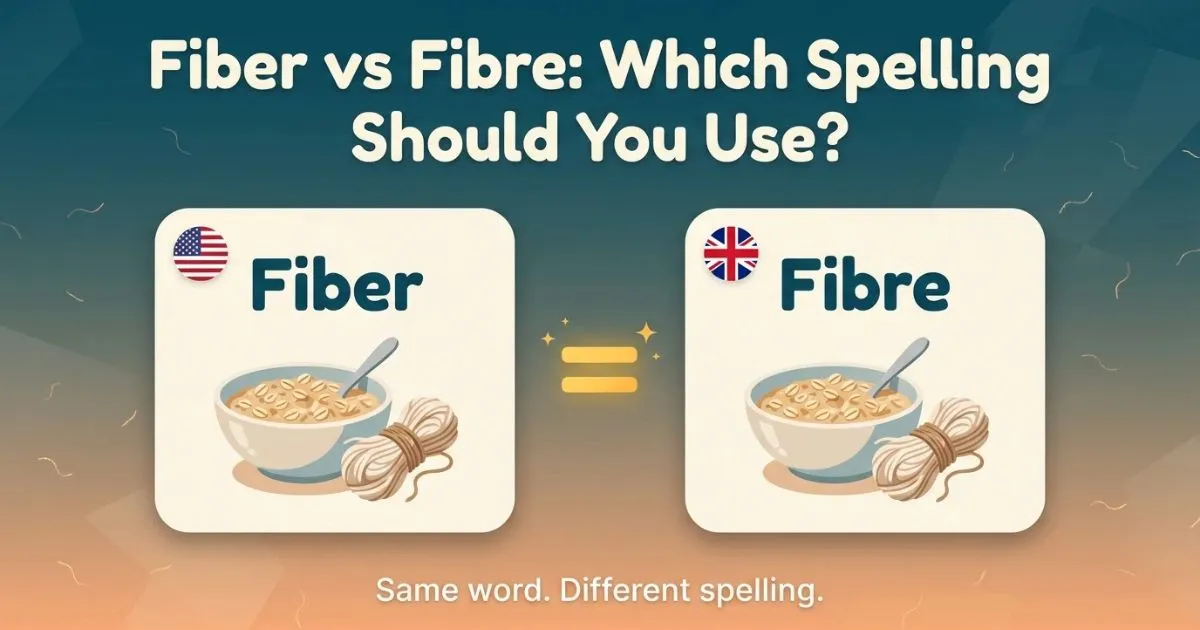
No. Both spellings are correct, and they mean exactly the same thing. The real question in the fiber vs fibre debate is which one fits your readers.
In this guide, you will learn where each spelling comes from, which countries prefer which, and how to pick the right one for your essay, blog, or business page.
You will also get a simple checklist you can use every time.
The Quick Answer
Use fiber for American readers and fibre for British, Australian, Irish, and New Zealand readers. The meaning never changes.
Here is the short version:
- Fiber: standard in US English
- Fibre: standard in UK English, and common in Australia, Ireland, and New Zealand
- Mixed or unsure audience: pick one and stay consistent
The rest of this article explains the “why,” because knowing the reasons makes the choice easy to remember.
Are Fiber and Fibre Really the Same Word?
Yes. They are two spellings of one word, not two different words. The dictionary meaning is identical in both. Only the letters at the end are swapped.
What the Word Means
Fiber/fibre is a noun with four everyday uses:
1. A thread or strand in a material. Think of cotton, wool, rope, or carpet.
- The basket is lined with natural coconut fibers.
- Synthetics don’t breathe as well as natural fibers.
2. A thread-like part of the body. Muscles and nerves are built from fibers.
- The scan showed damage to the muscle fibers.
3. Dietary material from plants. This is the part of plant foods your digestive enzymes cannot break down, such as cellulose and pectin.
- Whole grains and vegetables are rich in dietary fiber.
4. Strength of character. This one shows up in the phrase “moral fiber.”
- It takes real moral fiber to admit a mistake in public.
Whichever meaning you use, the spelling rule stays the same. A US writer writes muscle fiber and a British writer writes muscle fibre.
Do They Sound Different?
Not in any way that matters. Both are pronounced almost identically. Accents change the ending slightly, but nobody will mishear you because of the spelling. This is purely a writing question.
Read More: I Wish I Were or Was? Use This Easy Rule to Decide
Where Does the Difference Come From?
Most spelling debates feel random. This one has a real story.
A Word with French and Latin Roots
The word entered English around the late Middle Ages. It came through French from the Latin word fibra, which meant a filament or fibre. Early on, it was even used for the lobe of the liver, and in the plural for entrails. That is a long way from a breakfast cereal.
Fibre is the French-style spelling, which is why it kept the “-re” ending.
Why Britain and America Split
For centuries, both spellings floated around on both sides of the Atlantic. Neither one clearly “won” until the second half of the 18th century.
At that point, many British educators decided that words with French or Latin origins should keep their French or Latin shapes. So fibre was promoted as the proper form, even though it is less phonetic.
That idea never got much traction in the newly independent United States. Americans still used the French-style spelling through much of the 19th century. But the more phonetic fiber kept gaining ground, and it became the preferred American form around 1910.
In plain words: Britain formalized the older, French-looking spelling. America moved toward the way the word sounds.
Which Countries Use Which Spelling?
Rules are nice, but real usage tells you more. Sapling, a writing tool company, compared usage across 12 English-speaking countries. The numbers below are usage scores out of 100.
| Country | Fiber | Fibre | More common |
|---|---|---|---|
| United States | 97 | 3 | Fiber |
| Philippines | 96 | 4 | Fiber |
| Liberia | 74 | 26 | Fiber |
| India | 67 | 33 | Fiber |
| Trinidad & Tobago | 63 | 37 | Fiber |
| Canada | 58 | 42 | Fiber |
| Guyana | 58 | 42 | Fiber |
| Jamaica | 57 | 43 | Fiber |
| Ireland | 28 | 72 | Fibre |
| Australia | 25 | 75 | Fibre |
| United Kingdom | 21 | 79 | Fibre |
| New Zealand | 19 | 81 | Fibre |
Of those 12 countries, eight lean toward fiber and four toward fibre.
What These Numbers Tell You
- The US is nearly one-sided. At 97 to 3, writing fibre for an American audience will look unusual.
- The UK, Australia, Ireland, and New Zealand lean strongly to fibre. All four sit between 72 and 81 for that spelling.
- Canada and India are mixed. Canada is 58 to 42 and India is 67 to 33, so neither spelling would shock a reader. Here, your own site or publisher style matters more.
- Pakistan is not in this dataset. If you write mainly for readers there, look at what your own audience uses, or follow the English variety your school, employer, or publisher requires.
Is Fiber Taking Over Everywhere?
Maybe. One English usage dictionary notes that fiber has, in the past decade, passed fibre even in British English writing. It predicts that fiber will likely dominate English in the near future.
That does not match Sapling’s numbers, which still show the UK at 79 for fibre. The two sources measure different things and may use different text samples, so treat the “takeover” claim as a trend to watch rather than a settled fact.
The practical lesson is simple. For a UK publisher or exam today, fibre is the safe choice. For most other audiences, check what your readers actually use.
Fiber or Fibre in Common Phrases
The same rule applies in every phrase. Here is how the common ones look side by side:
| Phrase (US) | Phrase (UK) |
|---|---|
| dietary fiber | dietary fibre |
| muscle fiber | muscle fibre |
| carbon fiber | carbon fibre |
| fiber optic / optical fiber | fibre optic / optical fibre |
| fiberglass | fibreglass |
| moral fiber | moral fibre |
| fibers (plural) | fibres (plural) |
Technology and Product Names
Tech is where people slip most often. Sapling’s real-world examples include “fiber optics” and “Raman fiber laser” on the American side, and “undersea fibre optic cable” and “Fibre Channel switch” on the British side.
Notice that “Fibre Channel” is a capitalized technical term. When a spelling appears inside an official product, brand, or standard name, copy it exactly as the owner writes it. Do not “correct” it to match your article.
Food and Health Writing
On nutrition labels and health articles, the choice follows the audience, just like everywhere else. A US food blog writes dietary fiber. A UK health site writes dietary fibre.
If you quote a study or a label from another country, you can keep the original spelling inside the quotation marks and use your own spelling everywhere else.
How to Choose the Right Spelling
Here is a simple process you can follow every time.
Step-by-Step Decision Guide
- Identify your main readers. Where do most of them live? Which exam, publisher, or company are you writing for?
- Check for a style guide. If your school, journal, or employer has one, follow it. It overrules everything else here.
- Match the main audience. US readers get fiber. UK, Australian, Irish, and New Zealand readers get fibre.
- If the audience is mixed, pick one. Choose the variety that matches most of your readers, and use it throughout.
- Protect official names. Leave brand names, quotations, and titles exactly as written.
- Proofread for consistency. Search your document for both spellings before you publish.
Special Situations
Writing for students and exams. Follow the variety your teacher or exam board uses. Switching halfway can cost marks for inconsistency, even though neither spelling is wrong.
Running a business website. Look at where your customers are. If you sell mostly in the US, use fiber. If you sell in the UK or Australia, use fibre.
Targeting a global audience. Choose one and stay with it. Readers worldwide understand both. Consistency matters more than picking the “perfect” form.
Writing about the spelling itself. Here you can use both on purpose, as this article does.
Does the -er / -re Pattern Help?
Fiber and fibre belong to a larger family of words that end in “-er” in American English and “-re” in British English:
| American | British |
|---|---|
| fiber | fibre |
| center | centre |
| theater | theatre |
| liter | litre |
| meter | metre |
| caliber | calibre |
This pattern is a handy memory aid. But it is not a rule for every word ending in “-er.” Words like offer, proper, and number use “-er” in both American and British English.
So do not blindly swap endings. If you are unsure about a specific word, check it individually.
Common Mistakes (and Quick Fixes)
Mistake 1: Thinking One Spelling Is “Wrong”
Neither is. A British reader seeing fiber, or an American seeing fibre, will understand you. The issue is mismatch with the audience, not error.
Fix: Say “standard for this audience,” not “correct vs incorrect.”
Mistake 2: Mixing Both in One Article
This is the most common slip. A sentence like “Dietary fiber is important. Fibre also helps digestion” looks careless.
Fix: Pick one spelling. Use find-and-replace before publishing.
Mistake 3: “Correcting” Names and Quotes
Changing a brand name, a book title, or a quoted sentence can misrepresent the source.
Fix: Keep original spelling inside quotes and official names.
Mistake 4: Applying -er → -re Everywhere
Writing “numbre” or “offre” will make you look unsure of the pattern.
Fix: Remember the exceptions: offer, proper, number.
Mistake 5: Forgetting the Plural and Compounds
People write fiber but then type fibres, or write fibre optic next to fiberglass.
Fix: Apply the same spelling to every form: fibers/fibres, fiber optic/fibre optic, fiberglass/fibreglass.
Read More: Cancellation or Cancelation: Which Spelling Is Correct?
Practical Tips for Bloggers, Students, and Business Owners
- Set your spellcheck language first. English (US) will flag fibre, and English (UK) will flag fiber. Let your tool catch slips for you.
- Write a one-line style note. For example: “This site uses US spelling.” Share it with anyone who writes for you.
- Run a final search. Before publishing, search for the spelling you did not choose. It takes ten seconds.
- Compare trends if you are unsure. Sapling links to a Google Trends comparison of the two spellings, which can show interest in each over time.
- Do not chase keywords. Readers searching for either spelling will find a helpful page. Write naturally for your audience.
Easy Ways to Remember
- US = -er. American fiber ends the way it sounds.
- UK = -re. British fibre keeps the French-style ending.
- Link it to a familiar pair. If you write center or theater, you write fiber. If you write centre or theatre, you write fibre.
- Think “audience first.” Ask who is reading before you type.
Frequently Asked Questions
1. Is it fiber or fibre?
Both are correct. Fiber is the standard American spelling, and fibre is standard in British English. They mean the same thing, so choose the one that matches your audience and stay consistent in your writing.
2. Do fiber and fibre mean different things?
No. They are two spellings of one word. Both can mean a thread in a material, a part of the body, plant-based dietary material, or strength of character, as in “moral fiber.”
3. Which spelling do Canada and India use?
Both appear. Sapling’s data shows Canada at 58 for fiber and 42 for fibre, and India at 67 and 33. Follow your publisher’s preference, or choose one and use it consistently.
4. Is “fiber optic” or “fibre optic” correct?
Both are correct. American English uses fiber optic and optical fiber, while British English uses fibre optic and optical fibre. Keep any official product or standard name, like “Fibre Channel,” exactly as written.
5. Why does British English use “fibre”?
The word came from French and Latin. In the 18th century, British educators promoted the French-style spelling, fibre. Americans gradually shifted to the more phonetic fiber, which became the preferred US form around 1910.
6. Can I mix fiber and fibre in one article?
Avoid it. Mixing looks inconsistent. The exceptions are quotations, official names, and articles that discuss the spelling difference itself. Otherwise, pick one spelling and use it everywhere, including plurals and compound words.
Conclusion:
The fiber vs fibre question has a simple answer. They are the same word, and the spelling depends on your audience.
Use fiber for American readers and fibre for British, Australian, Irish, and New Zealand readers.
For mixed audiences like Canada or India, follow your publisher or pick one and stay consistent.
Your next step: decide which spelling your main audience uses, set your spellcheck to match, and run a quick search for the other spelling before you publish.

As an American English writer, I specialize in creating clear and engaging content that makes grammar and language learning accessible to everyone. I enjoy breaking down complex English concepts into simple, practical lessons that readers can apply with confidence. My mission is to help learners strengthen their communication skills through easy and reliable content.