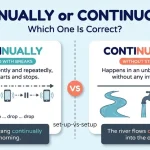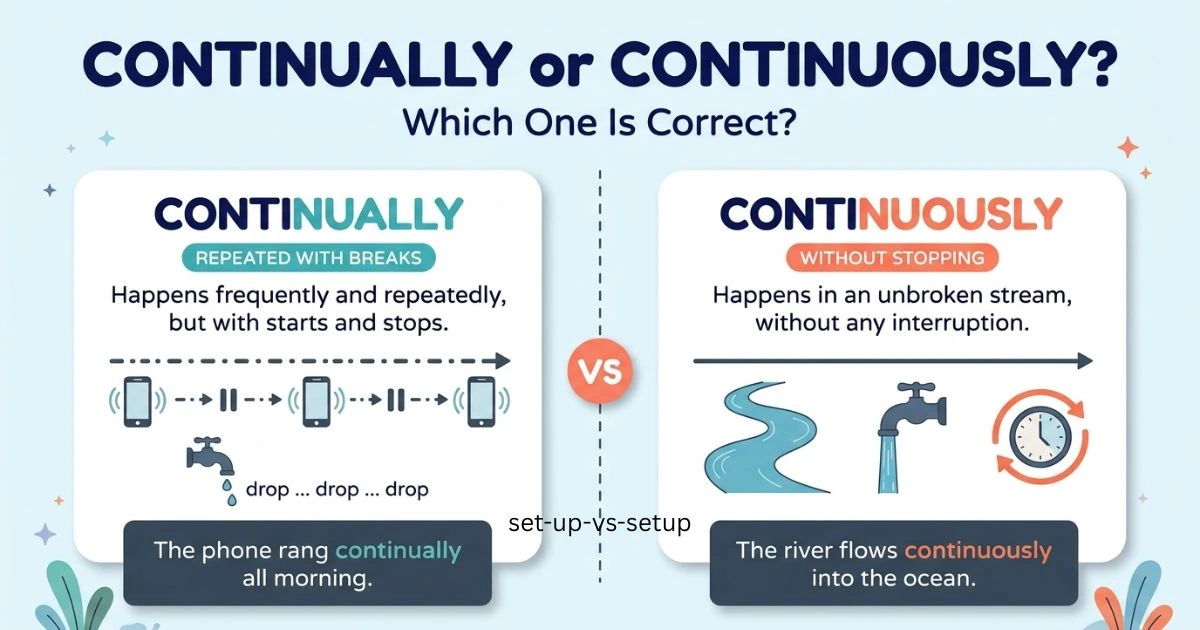
Continually means again and again, with breaks in between. Continuously means non-stop, with no break at all.
Picture a job application. You write, “I continuously check my email.” Your friend smiles and says, “So you never sleep?” That one word made you sound like a robot. You meant you check it often, not every single second.
This is why people mix up these two words. They look alike. They sound alike. Both talk about time. But one allows pauses, and the other does not.
This guide gives you a simple test, clear examples, and a few memory tricks. You will also see why even dictionaries treat this rule with some flexibility.
Table of Contents
- What Is the Difference Between Continually and Continuously?
- What Does Continually Mean?
- What Does Continuously Mean?
- Continually vs Continuously: Comparison Table
- The Pause Test: How to Choose the Right Word
- Is the Rule Strict? What Dictionaries Say
- Continual vs Continuous: The Adjective Forms
- Memory Tricks That Work
- 20 Example Sentences
- Common Mistakes
- When to Use Each Form
- FAQs
- Conclusion
- Key Takeaways
- Internal Linking Suggestions
- External Authoritative References
- Schema Note
Quick Answer Box
Use continually for things that repeat often, with pauses between them. Use continuously for things that go on without any stop. If you can picture a gap, choose continually. If you picture an unbroken line, choose continuously. Both spellings are the same in US and UK English.
⚡ Quick Rule in 1 Line
“Continually has pauses; continuously never stops — that’s the whole rule.”
What Is the Difference Between Continually and Continuously?
The difference is about breaks. Continually describes something that happens again and again, with stops in between. Continuously describes something that happens without any stop at all, from start to finish.
Both words come from the Latin word continuus, which means “hanging together.” That shared root explains the confusion. Both words are adverbs. Both tell us how an action runs through time.
Here is the key idea. Think of a bus that passes your house every ten minutes. It comes by continually. Now think of a river that flows past your house. It flows continuously.
The bus has gaps. The river does not.
Many usage guides have taught this split since the mid-1800s. Most style guides still teach it today. So if you want clear and careful writing, follow it.
What Does Continually Mean?
Continually means “repeatedly” or “very often.” It describes an action that happens again and again over a period, with short breaks between each time. The action stops, then starts again.
The word often carries a feeling of annoyance. People use it when something keeps happening, and they wish it would not.
Examples:
- My phone continually buzzes during meetings.
- She continually forgets her umbrella.
- The website is continually updated with new articles.
- Our neighbor continually plays loud music on weekends.
In each case, picture the pauses. The phone buzzes, goes quiet, then buzzes again. The updates come in waves, not in one endless stream.
Close synonyms: repeatedly, regularly, frequently, again and again, over and over.
What Does Continuously Mean?
Continuously means “without a break.” It describes an action that runs from start to end with no stop, no pause, and no gap. If the action never pauses, continuously is the right word.
This word fits machines, nature, and long stretches of time. It also fits any action where you want to stress that nothing interrupted it.
Examples:
- The generator ran continuously for three days.
- Your heart beats continuously.
- It rained continuously from dawn to dusk.
- He talked continuously for an hour.
Notice the feeling of one long line. Nothing breaks it.
Close synonyms: nonstop, constantly, without stopping, ceaselessly, unbroken.
Continually vs Continuously: Comparison Table
A side-by-side view makes the gap easy to see. Continually allows pauses, while continuously does not. The table below shows meaning, picture, feeling, and sample sentences for each word.
| Feature | Continually | Continuously |
|---|---|---|
| Core meaning | Again and again, with breaks | Non-stop, with no breaks |
| Mental picture | Dots on a line | One solid line |
| Pauses allowed? | Yes | No |
| Adjective form | Continual | Continuous |
| Common feeling | Often annoying or tiring | Neutral or technical |
| Close synonyms | Repeatedly, frequently | Nonstop, ceaselessly |
| Example | The printer continually jams. | The printer ran continuously for six hours. |
| US vs UK spelling | Same | Same |
The Pause Test: How to Choose the Right Word
Ask one question: could the action stop for a moment and then start again? If yes, use continually. If the action truly never stops, use continuously. This quick check works in almost every sentence.
Try the test on this sentence: “The baby cried ____ all night.”
Babies stop to breathe. They also pause, sleep for a few minutes, and wake up again. So “continually” fits well. If the baby truly cried for ten minutes straight with zero pause, “continuously” fits better.
Here is a simple three-step process:
- Picture the action. See it happening in your mind.
- Look for gaps. Does it stop, even for a second?
- Pick the word. Gaps mean continually. No gaps mean continuously.
The test also shows you when a sentence needs a rewrite. If you cannot decide, the action may be unclear. You can swap in a plainer word like “often” or “nonstop.”
Is the Rule Strict? What Dictionaries Say
The rule is a strong style guideline, but it is not a hard law. Major dictionaries note that “continual” can mean both “without interruption” and “happening again and again.” So the line between the two words is softer than many guides claim.
This is the part most articles skip.
Merriam-Webster lists two senses for continual. The first is “continuing without interruption.” The second is “occurring again and again within short intervals.” Other respected dictionaries and usage guides report the same overlap. They say continuous means uninterrupted, but continual can mean either one.
History explains why. In the early 1300s, continual itself meant “without stopping.” The word continuous came along later, in the 1600s. Writers then began to give each word its own job. The neat split we teach today grew mostly from usage guides in the 1800s.
So what should you do?
- In school, exams, and editing work: follow the pause rule. Teachers and editors expect it.
- In business and formal writing: follow the pause rule. It makes your meaning clear.
- In casual speech: most people will understand you either way.
Your safest choice is the careful one. When you follow the rule, no reader can say you made a mistake. When you ignore it, a sharp editor might.
One more point helps here. The adverb “continuously” has a very firm meaning: no breaks. The word “continually” is the flexible one. So if you are unsure, choose the one whose meaning you can defend.
Continual vs Continuous: The Adjective Forms
The same rule applies to the adjectives. Continual describes something that repeats with breaks. Continuous describes something that never breaks. Use continual for frequent events and continuous for unbroken flows, lines, or stretches of time.
Many searchers type “continual or continuous” because they need to describe a noun, not an action. Here is how the pairs match up.
| Adverb | Adjective | Example |
|---|---|---|
| Continually | Continual | The continual interruptions annoyed her. |
| Continuously | Continuous | A continuous line of cars stretched for miles. |
A few more examples with adjectives:
- Continual: continual complaints, continual rain showers, continual delays.
- Continuous: continuous noise, continuous improvement process, continuous coverage.
Notice that a continuous line has no gaps. It is a spatial idea as well as a time idea. A road can be continuous. A continual road makes no sense, because roads are not events that repeat.
That is a handy clue. If you describe a shape, a line, or a physical thing, pick continuous.
Memory Tricks That Work
The best memory tricks tie each word to a picture or a letter pattern. Continuously links to “one uninterrupted sequence,” while continually links to repeated events with gaps. Pick the trick that sticks for you.
Trick 1: The “ous” trick. Usage expert Bryan Garner suggests this idea. Think of the “ous” ending in continuously as standing for “one uninterrupted sequence.” One sequence means no stops.
Trick 2: The two bars. Look at the double L in continually. It looks like two short bars, with a gap between them. Two bars means two separate events, and a gap means a pause.
Trick 3: Bus versus river. A bus comes by continually. It stops, leaves, and returns. A river flows continuously. It never stops.
Trick 4: The “y” check. Both words end in -ly, so use the middle part. In continuously, the “uous” part runs together in an unbroken chain of vowels. In continually, a single “a” breaks up the chain.
Trick 5: Swap and test. Replace the word with “repeatedly.” If the sentence still works, use continually. Replace it with “without stopping.” If that works, use continuously.
20 Example Sentences
These examples show both words in everyday settings. Study the pattern in each group. Notice how the pauses, or the lack of them, change the right choice.
Continually (with breaks):
- The teacher continually reminds students to turn in their homework.
- Prices at the gas station continually change during the week.
- My brother continually borrows my charger and never returns it.
- The app is continually improved with small updates each month.
- She continually checks her phone during dinner.
- The company continually hires new staff as it grows.
- Tourists continually ask for directions to the museum.
- He continually loses his keys, then finds them in his coat.
- Fans continually chanted the team’s name throughout the game.
- The dog continually barks whenever the doorbell rings.
Continuously (no breaks):
- The air conditioner ran continuously all summer.
- Scientists monitored the volcano continuously for a week.
- The store stays open continuously from Monday morning to Saturday night.
- He worked continuously for eight hours without a break.
- The fountain flows continuously in the town square.
- It snowed continuously for two full days.
- The lighthouse has shone continuously since 1890.
- Oxygen moves continuously through your blood.
- The security camera records continuously.
- She has lived in the same house continuously for thirty years.
One sentence that uses both:
The lecturer spoke continuously for an hour and continually made the same mistake. He never paused, but the error kept coming back.
Common Mistakes
The most common mistake is using continuously when the action has breaks. Another is treating the words as exact twins. A third is using either word when a simpler word, like “often” or “nonstop,” would be clearer.
Mistake 1: Using “continuously” for repeated events.
- ❌ I continuously get emails from this company.
- ✅ I continually get emails from this company.
Emails arrive one at a time. There are gaps between them.
Mistake 2: Using “continually” for a truly unbroken action.
- ❌ The machine ran continually for 48 hours.
- ✅ The machine ran continuously for 48 hours.
The machine never stopped. Continuously is more precise.
Mistake 3: Overusing both words in a resume.
- ❌ I continuously learn new skills.
- ✅ I continually learn new skills.
No one learns without a pause. Continually is the honest word here.
Mistake 4: Mixing up the adjective and the adverb.
- ❌ The continuous interruptions made her angry.
- ✅ The continual interruptions made her angry.
Interruptions are events that repeat. They are not an unbroken line.
Mistake 5: Choosing a fancy word when a plain one is better.
- ❌ She continually and continuously complained.
- ✅ She complained nonstop.
If you must stack two similar words, your meaning is probably unclear. Pick one, or use a simple word.
When to Use Each Form
Use continually when you describe habits, repeated events, and updates with gaps. Use continuously when you describe machines, natural flows, or time periods with no stop. Match the word to what truly happens in the real world.
Use continually for:
- Habits and routines (“He continually checks the score.”)
- Repeated complaints or problems (“The server continually crashes.”)
- Regular updates or changes (“The list is continually updated.”)
- Events that come in waves (“Customers continually walk in.”)
Use continuously for:
- Machines and devices (“The pump runs continuously.”)
- Natural processes (“The river flows continuously.”)
- Long periods without a stop (“She studied continuously for six hours.”)
- Technical or legal writing (“The employee must work continuously for twelve months.”)
A note on business phrases. You will often see “continuous improvement” in business. This is a fixed phrase. It means a never-ending effort to get better. People also say “continually improving,” which suggests many small steps. Both are common. Keep the phrase your company or industry already uses.
Key Takeaways
- Continually = again and again, with breaks.
- Continuously = non-stop, with no break.
- The adjectives follow the same pattern: continual (repeating) and continuous (unbroken).
- Both words are spelled the same in US and UK English.
- Use the pause test: if you can picture a gap, choose continually.
- Dictionaries allow continual to mean “without a break” too, but the careful rule is still the safest choice.
- Quick trick: a bus comes continually; a river flows continuously.
- On a resume, continually is usually the more honest word.
- If neither word fits, use “often” or “nonstop.”
FAQs
1. Is it “continually” or “continuously”?
It depends on the action. Use continually if the action repeats with breaks. Use continuously if it goes on without any stop. When in doubt, ask whether you can picture a pause.
2. Can continually and continuously be used interchangeably?
In casual speech, many people do. In careful writing, you should not. Most style guides keep them apart. Some dictionaries admit that continual can mean “without a break,” but continuously never means “with breaks.”
3. Is “continually” a real word?
Yes. Continually is a standard English adverb found in all major dictionaries. It means “repeatedly” or, in some dictionaries, “without interruption.” Its adjective form is “continual.”
4. What is the difference between continual and continuous?
They are the adjective forms of the two adverbs. Continual means “happening again and again.” Continuous means “unbroken” or “without a stop.” The same pause rule applies.
5. Which is better on a resume: continually or continuously?
Use continually for most resume lines. For example, “continually improve processes” shows repeated effort. Continuously suggests no breaks at all, which sounds unrealistic. Keep resume lines honest and simple.
6. Is it “continuously improving” or “continually improving”?
Both appear in business writing. Continuously improving suggests a smooth, never-ending effort. Continually improving suggests repeated steps over time. Pick the one your team or style guide prefers.
7. Is there a US vs UK spelling difference?
No. Both words are spelled the same way in American and British English. You do not need to change them for any region.
8. What are good synonyms for each word?
For continually, try repeatedly, frequently, regularly, or again and again. For continuously, try nonstop, constantly, ceaselessly, or without stopping.
9. Does “constantly” mean continually or continuously?
Both, depending on the sentence. Constantly is flexible. It can mean “all the time without a stop” or “very often.” If you want to be exact, choose continually or continuously instead.
10. How can I remember the difference fast?
Think “bus versus river.” A bus comes again and again, with gaps, so it is continual. A river never stops flowing, so it is continuous.
Conclusion:
Use continually for actions that repeat with pauses. Use continuously for actions that never stop.
That single test settles most sentences. Picture a gap, and pick continually. Picture an unbroken line, and pick continuously.
Dictionaries are a little more relaxed than usage guides. But careful writers, teachers, and editors still expect the split.
Follow it, and your meaning stays sharp. When neither word feels right, swap in “often” or “nonstop.” Plain words never confuse anyone.

I am an English language writer passionate about grammar and clear communication. I create simple, easy-to-understand content that helps readers improve their English skills. My goal is to make learning English both practical and enjoyable.