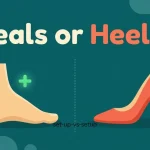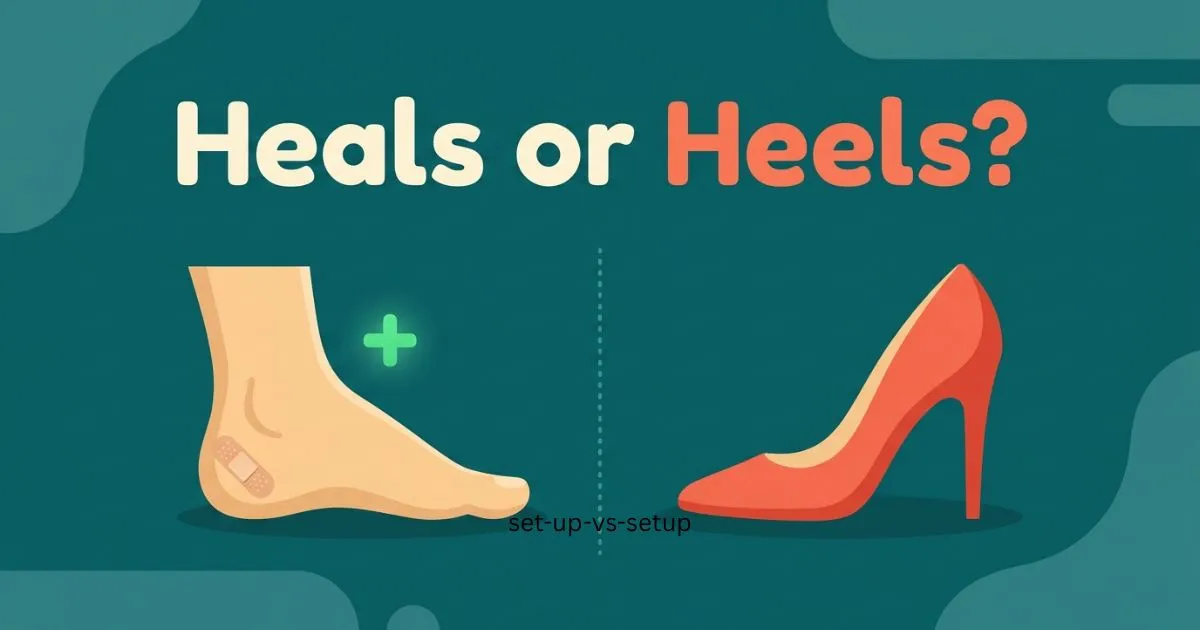
Heals means gets better. Heels are the back part of your foot, or the raised part of a shoe.
Maria texted her sister after a long hike. “My blisters need time to heels,” she wrote. Her sister replied with a laughing face.
Autocorrect did not catch it. Spell check often won’t, because both words are real.
These two words sound exactly the same. That is why so many people mix them up. This guide gives you a clear rule, simple tricks, and plenty of examples. You will know which word to pick in seconds.
Table of Contents
- Heals vs Heels: The Core Difference
- What Does “Heals” Mean?
- What Does “Heels” Mean?
- The Twist: Heels Can Also Be a Verb
- Easy Memory Tricks
- 18 Example Sentences
- Idioms With Heels and Heals
- Common Mistakes
- When to Use Each Word
- Heal, Heel, and He’ll
- FAQs
- Conclusion and Key Takeaways
Quick Answer
Use heals when something gets better, like a cut, a bone, or a heart. Use heels for the back part of your foot, for raised shoe parts, or when a dog or boat “heels.” Heals is always a verb. Heels can be a noun or a verb.
⚡ Quick Rule in 1 Line
If something gets better, it heals. If it’s part of a foot or shoe, it’s heels.
Heals vs Heels: The Core Difference
Heals is a verb that means “gets better” or “becomes healthy again.” Heels is mostly a noun for the back of the foot or part of a shoe. Both words sound the same, but their meanings never overlap.
Here is the whole difference at a glance.
| Word | Part of speech | Main meaning | Example |
|---|---|---|---|
| heals | Verb | Gets better; becomes well again | The cut heals fast. |
| heels | Plural noun | Back of the foot; raised part of a shoe | Her heels hurt. |
| heels | Verb | Follows close behind; tilts to one side | The dog heels well. |
Both words are pronounced the same way: heelz. So you can’t hear which one someone means. You have to check the meaning.
There is also no US vs UK spelling difference here. Americans and Britons spell both words the same way.
What Does “Heals” Mean?
“Heals” means that someone or something becomes healthy or whole again. It is the third-person singular form of the verb heal. Use it with he, she, it, or a single thing, such as “the wound heals.”
The verb heal has four forms:
- heal (base form): Rest helps you heal.
- heals (he/she/it form): A broken bone heals in weeks.
- healed (past): The scar healed last year.
- healing (-ing form): The cut is healing well.
The grammar rule
In the present tense, add -s when the subject is one person or thing. Say “she heals” but “they heal.”
- Correct: Time heals the pain.
- Correct: These bruises heal slowly.
- Incorrect: The bruises heals slowly.
Heals is not only about the body
People also use heal for feelings and relationships. A friendship can heal. A country can heal after a hard time. Dictionaries like Merriam-Webster list both the body and the spirit as correct uses.
Heals is never a noun. You cannot say “I bought new heals.” That sentence needs heels.
What Does “Heels” Mean?
“Heels” is the plural of heel. It usually means the back parts of your feet or the raised backs of your shoes. It can also mean the end pieces of bread, or a verb for staying close behind someone.
The word heel has many jobs. Here are the main ones.
- Body part: the back of the foot, below the ankle.
- Shoe part: the raised block under the back of a shoe.
- Shoes in general: many people say “heels” for high-heeled shoes.
- Bread: the crusty end of a loaf.
- Person: a mean or selfish person. People say “he felt like a heel.”
- Wrestling: a wrestler who plays the bad guy.
- Verb (dog): to walk close behind the owner.
- Verb (boat): to lean to one side in the wind.
That is a lot of meanings. But they all share one thing: none of them is about getting better. If the idea is recovery, you want heals.
The Twist: Heels Can Also Be a Verb
Most guides say heal is the verb and heel is the noun. That is not the full story. Heel is also a verb, so both “heals” and “heels” can follow he, she, or it. The sentence meaning decides which one is right.
Compare these two sentences:
- The dog heals after surgery. (It gets better.)
- The dog heels on a walk. (It stays close to its owner.)
Both sentences are grammatically fine. Only the meaning is different. So “it’s the verb, so it must be heals” is not a safe shortcut.
A boat can also heel. When strong wind pushes a sailboat over, the boat leans. We say the boat heels.
- Correct: The sailboat heels in strong wind.
- Correct: A good cut heals without a scar.
This is why a quick meaning check works better than a grammar check.
Easy Memory Tricks
The best trick is to link each spelling to a word you already know. Heal shares “ea” with health. Heel shares “ee” with feet. Link the spelling to the meaning and you will rarely get it wrong.
Trick 1: Health and feet
- heal and health both have ea. Healing brings health.
- heel and feet both have ee. Your heel is part of your foot.
Trick 2: Two Es, two feet
The word heels has two Es, like a pair of feet. The word heals has an E and an A. Think of the A as “all better.”
Trick 3: The swap test
Try replacing the word with “gets better.” If the sentence still makes sense, use heals. If it sounds silly, use heels.
- “The wound gets better.” Works, so write heals.
- “Her feet got better hurt.” Does not work, so write heels.
Trick 4: Proofread on purpose
Before you publish, search your draft for “heals” and “heels.” Check each one. Spell check will not flag them, because both are real words.
18 Example Sentences
The sentences below show each word in real use. Read them aloud and notice how the meaning guides your choice.
Heals (recovery)
- A paper cut usually heals in a few days.
- Her broken wrist heals a little more each week.
- Good sleep heals the body.
- Time heals most hurt feelings.
- The doctor says the burn heals best when kept clean.
- Laughter heals a tense room.
- After the argument, the friendship slowly heals.
- He heals fast because he stays active.
- The old scar heals into a thin line.
Heels (foot, shoe, and other uses)
- My heels hurt after the long walk.
- She wore black heels to the wedding.
- Cracked heels need a good moisturizer.
- He kicked off his shoes and rested his heels on the table.
- The kids fought over the heels of the bread.
- Our puppy heels beautifully on a short leash.
- The sailboat heels sharply when the wind picks up.
- The cobbler fixed the worn heels on my boots.
- The crowd booed the wrestler because he played the heel.
Idioms With Heels and Heals
Most idioms use heels, because they come from the foot or from walking. Only a few idioms use heals. This is also where the most common spelling mistake happens, in the phrase “head over heels.”
Idioms with heels
- Head over heels: deeply in love. “He fell head over heels for her.”
- Dig in your heels: refuse to change your mind. “The manager dug in her heels.”
- On the heels of: right after something. “The sale came on the heels of the big news.”
- Take to your heels: run away fast.
- Cool your heels: wait, often for a long time.
- Down at the heels: looking worn or poor.
- Well-heeled: wealthy.
- Kick up your heels: have fun and celebrate.
- Achilles’ heel: a weak spot in something strong.
Idioms with heals
- Time heals all wounds: pain fades as time passes.
- Heals over: a wound closes and covers itself. “The cut healed over nicely.”
Tip: if you are talking about love, stubbornness, speed, or waiting, the idiom almost always uses heels.
Common Mistakes
The most common mistake is writing heals in place of heels in a phrase, or the other way around. Most errors come from sound, not from grammar. Here are the slips that appear again and again.
1. “Head over heals”
- Wrong: She fell head over heals in love.
- Right: She fell head over heels in love.
2. “Dig in your heals”
- Wrong: He dug in his heals and said no.
- Right: He dug in his heels and said no.
3. Using heels for recovery
- Wrong: The wound heels slowly.
- Right: The wound heals slowly.
4. Using heals as a noun
- Wrong: I bought new red heals.
- Right: I bought new red heels.
5. Using heals for the plural foot part
- Wrong: My heals are sore.
- Right: My heels are sore.
6. Missing the -s on a verb
- Wrong: Her knee heal quickly.
- Right: Her knee heals quickly.
7. Trusting autocorrect
Autocorrect only flags words that do not exist. Both of these words exist, so it stays quiet. Always reread.
When to Use Each Word
Pick the word by asking one question: is this about getting better, or about a foot, shoe, or something that leans or follows? Use this short list as a final check before you hit publish.
Heals
- a cut, bone, burn, or wound gets better.
- a feeling, hurt, or relationship recovers.
- you need a verb after he, she, it, or one thing, and the idea is recovery.
Heels
- you mean the back of the foot or feet.
- you mean the raised part of a shoe, or high-heeled shoes.
- you mean the end pieces of a loaf.
- a dog stays close, or a boat leans over.
- you are writing “head over heels” or “dig in your heels.”
Heal, Heel, and He’ll
There is a third look-alike. He’ll is short for “he will,” and it sounds the same as heal and heel. Many writers mix up all three, so it helps to see them side by side.
| Word | Meaning | Example |
|---|---|---|
| heal | to get better | It will heal soon. |
| heel | back of the foot | She hurt her heel. |
| he’ll | he will | He’ll call you later. |
The apostrophe is your clue. If you can swap in “he will,” write he’ll. If not, check the meaning.
FAQs
1. Is it heals or heels?
It depends on the meaning. Write heals when something gets better, like a wound or a feeling. Write heels for the back of the foot, part of a shoe, or high-heeled shoes.
2. Is it “head over heels” or “head over heals”?
The correct phrase is “head over heels.” It means deeply in love. The idiom is about feet and heels, not about healing, so “heals” is a mistake.
3. Is it “dig in your heels” or “dig in your heals”?
The correct phrase is “dig in your heels.” It means to refuse to change your mind. Picture someone planting their heels in the ground.
4. Are heals and heels homophones?
Yes. They are pronounced the same way, but they have different spellings and meanings. Heal, heel, and he’ll also share this same sound.
5. Is “heals” a noun or a verb?
“Heals” is a verb. It is the he/she/it form of heal in the present tense. It is never a noun.
6. Is “heels” a noun or a verb?
Both. As a noun, it is the plural of heel, meaning feet parts or shoes. As a verb, it can mean a dog follows closely or a boat leans over.
7. Which is correct: “the wound heals” or “the wound heels”?
“The wound heals” is correct. A wound gets better, so you need the verb heal. “The wound heels” has no useful meaning in English.
8. Is there a US vs UK spelling difference for heals and heels?
No. Both countries spell the words the same way. The only difference is in meaning, not in region.
9. What does “time heals all wounds” mean?
It means that pain, grief, or hurt feelings get easier over time. The word is heals because the idea is recovery.
10. How can I remember the difference?
Link heal to health (both have ea) and heel to feet (both have ee). If you are still unsure, test the sentence with “gets better.”
Key Takeaways
- Heals = gets better (a verb, never a noun).
- Heels = back of the foot, shoe parts, or high-heeled shoes.
- Heels can also be a verb: a dog heels, and a boat heels.
- The correct idioms are “head over heels” and “dig in your heels.”
- Memory trick: heal + health (ea); heel + feet (ee).
- No US vs UK difference. Both countries spell them the same.
- Spell check will not catch this mistake, so proofread.
Conclusion:
Heals and heels sound the same, but they do different work. Use heals when something gets better.
Use heels for the back of the foot, raised shoe parts, or a dog or boat that follows or leans. Remember that heels can be a verb too, so check the meaning, not just the grammar.
Link heal to health and heel to feet, and the choice becomes easy. Reread your draft once, because spell check will not catch this one.

I’m Sophia Mitchell, an English grammar and writing enthusiast. I create simple, easy-to-understand content to help learners improve their English. My goal is to make grammar clear, practical, and enjoyable for everyone.