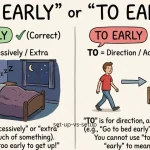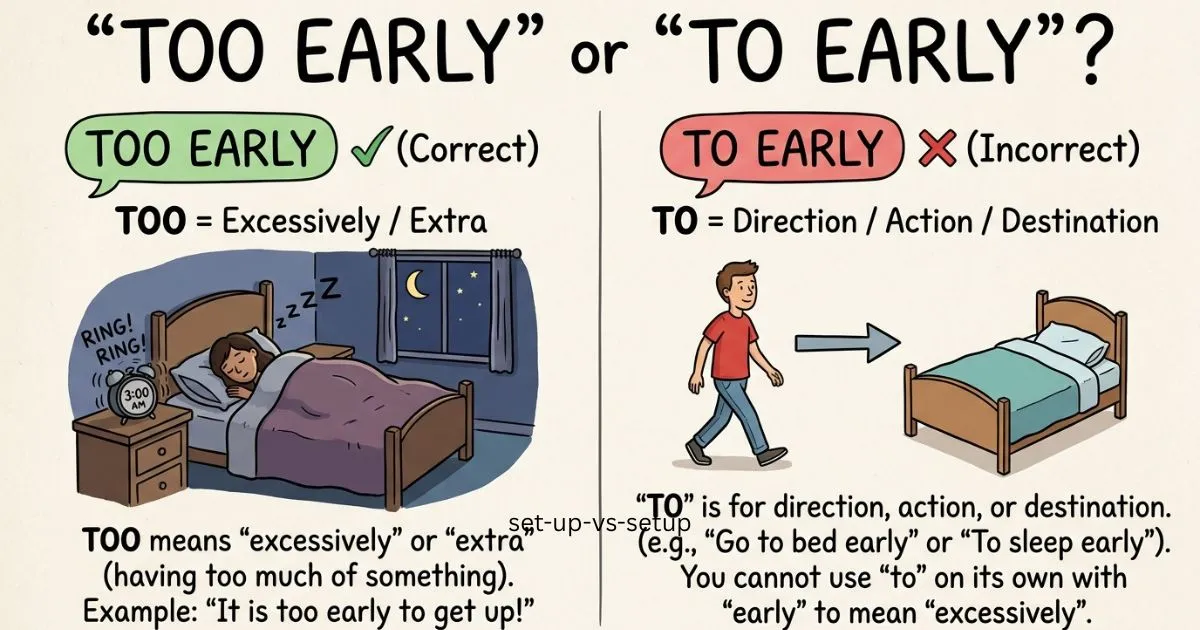
You send “It’s to early to call” to your boss, then spot the typo a second too late. The correct phrase is “too early,” with two Os, because “too” means “more than is wanted.”
“To early” is never correct in standard English. People write it because “to” and “too” sound exactly alike. Fast typing and autocorrect make the slip even easier.
This guide explains the rule in plain words. You will get a simple memory trick, 20 example sentences, and a short list of mistakes to avoid.
After a few minutes, you will pick the right word without stopping to think.
Table of Contents
- Introduction
- Quick Answer
- What Is the Difference Between To and Too?
- The Grammar Rule Behind Too Early
- To vs Too: Comparison Table
- Easy Memory Tricks
- 20 Example Sentences
- Common Mistakes With To and Too
- When to Use Each Form
- FAQs
- Conclusion
- Key Takeaways
Quick Answer
Use “too early” every time. “Too” is an adverb that means “more than needed” or “excessively,” so it fits before adjectives and adverbs like “early.” “To” is a preposition or part of an infinitive, which makes “to early” incorrect. Example: It is too early to call.
⚡ Quick Rule in 1 Line
“Two Os mean ‘too much,’ so write ‘too early’ when something comes sooner than it should.”
What Is the Difference Between To and Too?
“To” points toward a place, a person, or an action. “Too” is an adverb that means “also” or “more than needed.” Both words sound the same, but only “too” can describe how early, late, or soon something happens.
The two words are homophones. That means they sound alike but have different spellings and jobs. A third word, “two,” joins them. It is the number 2.
“To” has several jobs. It can show direction, as in “We drove to the lake.” It can also sit before a verb, as in “I want to sleep.” Merriam-Webster lists many senses for it.
“Too” has two main jobs. It can mean “also,” as in “I’m tired, too.” It can also mean “more than is wanted or needed,” as in “The soup is too hot.”
That second job is the one you need for “too early.” The word adds the idea of excess. Something is early, and it is more early than it should be.
The Grammar Rule Behind Too Early
The pattern is too + adjective or adverb. “Too” goes in front of a describing word and adds the idea of excess. So “too early” means earlier than wanted, allowed, or sensible. “To” cannot do that job on its own.
Here is the pattern in action:
- too + early: It is too early.
- too + late: It is too late.
- too + soon: It is too soon.
- too + hot: The tea is too hot.
Swap “to” into any of these and the sentence breaks. “It is to late” and “The tea is to hot” are both wrong.
Where the confusion comes from. Many correct sentences have “too” and “to” close together. Look at this one: It is too early to tell. The first word is “too” because it describes “early.” The second word is “to” because it comes before the verb “tell.” Oxford Learner’s Dictionaries uses this same pattern in its entry for “early.”
One real exception. The letters “to early” can appear side by side when “to” ends a range. For example: The shop is open from late May to early June. Here “to” means “until.” It is a different phrase, so this is not the mistake.
A quick check helps. If you can swap in “very” or “excessively” and the meaning holds, you need “too.”
To vs Too: Comparison Table
The table shows all three look-alike words in one place. Read across a row to see the part of speech, the meaning, and a sample sentence. The last column shows how each word works with “early.”
| Word | Part of speech | Meaning | Example | Works with “early”? |
|---|---|---|---|---|
| to | Preposition or infinitive marker | Toward, until, or a signal before a verb | We walked to school. | Only in a range, such as “to early June” |
| too | Adverb | Also, or more than needed | It is too early. | Yes: “too early” |
| two | Number | The number 2 | Two hours early | Only as a count, such as “two early birds” |
Easy Memory Tricks
The fastest trick is to count the Os. “Too” has an extra O, and it means an extra amount. Use “too early” whenever the early time is more than it should be. Three simple checks follow below.
- The extra O trick. “Too” has one O more than “to.” Think of it as “too many Os” for “too much.” Dictionary.com offers a similar idea: the extra O tags along, as if asking, “Can I come, too?”
- The swap test. Replace the word with “very” or “excessively.” If the sentence still works, write “too.” “It is excessively early” makes sense, so “too early” is right.
- The “also” test. If you can replace the word with “also,” you need “too.” “I am early, also” works, so “too” fits.
For “to,” use a different test. Ask whether a verb or a place follows. “To go” and “to the park” both need “to.”
20 Example Sentences
These 20 sentences cover “too early,” other uses of “too,” correct uses of “to,” and four wrong-versus-right pairs. American and British English use the same forms, so the examples work in both.
“Too early” (correct)
- It is too early to tell if the new plan will work.
- We arrived too early, so the shop was still closed.
- Is it too early to start planning the party?
- She felt it was too early to give up.
- The meeting starts at six, which is too early for me.
- He sent the email too early and forgot the attachment.
- It is still too early in the season to pick a winner.
- Your flight leaves too early for a hot breakfast.
“Too” in other uses (correct)
- The tea is too hot to drink.
- I want to join you, too.
- It is too late to ask for a refund.
- She works too hard and never takes a break.
“To” in correct uses
- I need to leave early tomorrow.
- We walked to the library after lunch.
- The shop is open from late May to early June.
- He wanted to arrive early to get a good seat.
Wrong vs. right
- Wrong: It’s to early to tell. Right: It’s too early to tell.
- Wrong: I got there to early. Right: I got there too early.
- Wrong: Is it to early for lunch? Right: Is it too early for lunch?
- Wrong: She woke up to early for school. Right: She woke up too early for school.
Common Mistakes With To and Too
The biggest mistake is writing “to early” when you mean “too early.” It happens because the words sound the same and both are real words. The same slip appears in “to late,” “to soon,” and “to much.”
1. Writing “to early” for “too early.” This is the mistake behind the keyword. Fix it by adding the extra O.
2. Writing “too” before a verb. “I want too go” is wrong. A verb needs “to,” so write “I want to go.”
3. Using “two” by accident. “Two early” is wrong, because “two” is only a number. Use “two” for counts, such as “two early birds.”
4. Trusting spell check. Each word is spelled correctly on its own, so spell check often stays quiet. Read your sentence once more before you send it.
5. Worrying about the comma before “too.” When “too” means “also” at the end of a sentence, the comma is usually optional. QuillBot notes that adding it can add emphasis.
6. Copying the error across the same pattern. Anyone who writes “to early” will likely write “to late.” Learn the pattern once: too + adjective or adverb.
When to Use Each Form
Use “too early” when something happens sooner than it should. Use “to” when you point toward a place, mark a verb, or end a range. If you are unsure, run the quick test below.
Quick test in three steps
- Does the sentence mean “more than it should be”? Write too.
- Can you swap in “also” or “very”? Write too.
- Does a verb or a place come next? Write to.
Use “too early” when:
- You judge a time as premature: It’s too early to call.
- You say someone came before the expected time: You’re here too early.
- You show doubt about a result: It’s too early to say.
Use “to” with early when:
- A verb follows the word “to,” and “early” comes later: I plan to leave early.
- “To” ends a range of time: from late May to early June.
Does region matter? No. American and British English both write “too early.” Oxford Learner’s Dictionaries lists “it’s early days yet” as a British way to say that it is too soon to be sure. That idiom is a separate phrase, not a spelling difference.
Key Takeaways
- “Too early” is the only correct phrase for something that comes sooner than it should.
- “Too” is an adverb meaning “also” or “more than needed.”
- “To” is a preposition or a verb marker, so it cannot replace “too.”
- The pattern is too + adjective or adverb: too early, too late, too soon.
- “To early” appears legitimately only when “to” ends a range, as in “to early June.”
- Use the extra-O trick, the “very” swap, or the “also” test to check yourself.
- American and British English follow the same rule, so there is no regional split.
FAQs
Is it “too early” or “to early”?
The correct phrase is “too early.” “Too” is an adverb that adds the idea of excess, so it belongs before “early.” “To early” is a spelling mistake in nearly every sentence.
What does “too early” mean?
“Too early” means sooner than is wanted, expected, or wise. You can use it for a clock time, as in “The bus is too early.” You can also use it for a stage, as in “It’s too early to judge.”
Is “to early” ever correct?
Only by accident of word order. In a range such as “from late May to early June,” “to” means “until.” It is a separate word from the “too” in “too early.”
What is the difference between to, too, and two?
“To” is a preposition that shows direction or comes before a verb. “Too” means “also” or “more than needed.” “Two” is the number 2. They are homophones, so they sound alike.
Why do people mix up “to” and “too”?
The two words sound the same, and both are common. When we type fast, our fingers pick the shorter spelling. Spell check also tends to miss the error, because both are real words.
Is “too early to tell” correct?
Yes. In that phrase, “too” describes “early,” and “to” comes before the verb “tell.” Both words are right, each in its own place.
Do I need a comma before “too”?
Usually not. When “too” means “also” at the end of a sentence, the comma is optional. Some writers add it for emphasis, as in “I want pizza, too.” Formal writing often keeps the comma.
What can I say instead of “too early”?
Try “prematurely,” “ahead of schedule,” “ahead of time,” or “unduly early.” Pick the one that fits your tone. In a professional email, “premature” is a good choice, as in “It is premature to decide.”
Is it “too late” or “to late”?
It is “too late.” The same rule applies as with “too early.” “Too” goes before adjectives and adverbs to show excess. “To late” is wrong in the same way.
Does US or UK English change the spelling?
No. Both American and British English write “too early.” There is no regional spelling split for this phrase. The mix-up with “to early” happens in both.
Conclusion:
The right phrase is “too early.” “Too” adds the idea of excess, and “early” is the word it describes. “To early” has no place in standard English, except by chance in a range like “to early June.”
When you doubt yourself, count the Os or swap in “very.” If it fits, add the extra O. The same rule fixes “too late,” “too soon,” and “too much.”

I am an English language writer passionate about grammar and clear communication. I create simple, easy-to-understand content that helps readers improve their English skills. My goal is to make learning English both practical and enjoyable.