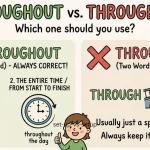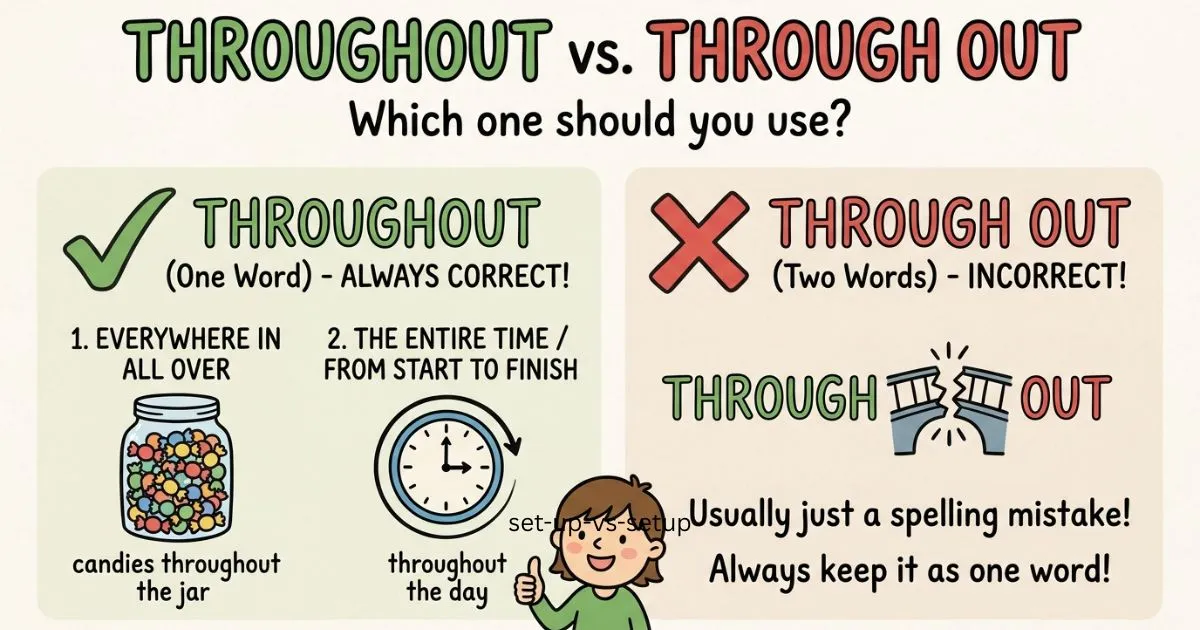
Throughout is always one word. Writing “through out” as two words is a mistake in almost every sentence.
Picture this. You write, “Thanks for your help through out the project.” You hit send. Then you notice the space.
It is a tiny slip, but it shows up in emails, resumes, and school essays. Spell checkers often miss it, because “through” and “out” are both real words.
Do not worry if you have made this mistake. Plenty of writers do.
This guide gives you the rule, the one rare exception, and a quick test. You will also see 20 example sentences you can copy. By the end, the choice will feel automatic.
Table of Contents
- Quick Answer
- What Does Throughout Mean?
- Why “Through Out” Is Usually Wrong
- Why People Split Throughout Into Two Words
- The Rare Time “Through Out” Is Correct
- Throughout as a Preposition and an Adverb (Grammar Rule)
- Throughout vs Through Out vs Through: Comparison Table
- Throughout vs Through: What Is the Difference?
- Easy Memory Trick
- 20 Example Sentences
- Common Mistakes With Throughout
- Throughout in Emails, Essays, and Resumes
- When to Use Each Form
- FAQs
- Conclusion
- Key Takeaways
Quick Answer
Write throughout as one word. It means “in every part of” a place or “during the whole time of” an event. Writing “through out” as two words is incorrect in these cases. Two words are correct only in rare sentences where “through” and “out” belong to different parts of the sentence.
⚡ Quick Rule in 1 Line
If it means “everywhere” or “the whole time,” write throughout as one word, every single time.
You may also like: Everything or Every Thing: Which Is Correct?
What Does Throughout Mean?
Throughout means “in every part of” a place or “during the whole time of” an event. It covers something from one end to the other. Dictionaries list it as both a preposition and an adverb, and it is always one word.
There are two main meanings.
1. Everywhere in a place or thing. This meaning is about space.
- The company has offices throughout Texas.
- Cracks ran throughout the old wall.
2. From start to finish. This meaning is about time.
- She stayed calm throughout the meeting.
- It rained throughout the night.
The word joins “through” and “out.” Over time, the two parts fused into one. Merriam-Webster records its first known use in the 13th century. So the one-word form has been standard for a very long time.
The idea is simple. Throughout tells the reader that nothing is left out. The whole area or the whole period is covered.
Why “Through Out” Is Usually Wrong
“Through out” as two words is a spelling error when you mean “everywhere” or “the whole time.” Dictionaries list only the one-word form for that meaning. The two words look like a real phrase, so the mistake is easy to make and easy to miss.
Here are a few wrong and right pairs.
| Wrong | Right |
|---|---|
| The rumor spread through out the school. | The rumor spread throughout the school. |
| He smiled through out the speech. | He smiled throughout the speech. |
| Flowers grew through out the garden. | Flowers grew throughout the garden. |
| We worked through out the weekend. | We worked throughout the weekend. |
Notice the pattern. In every wrong sentence, you can swap in “all over” or “the whole time.” That swap works, so one word is the right choice.
You can also test it with a dictionary. When you look up “through out” in Merriam-Webster, you land on the entry for throughout. That tells you which spelling is standard.
There is no US versus UK split here. American and British writers use the same one-word spelling. You do not need to change anything for a US audience.
Why People Split Throughout Into Two Words
People split throughout because both parts are real words. “Through” and “out” appear in many phrases, like “break through” or “work out.” It feels natural to add a space, even though the full word is one.
There are a few other reasons.
- It sounds like two beats. We say “through-OUT,” so the ear hears two parts.
- Other compounds split. Writers see pairs like “every day” and “everyday” and get unsure.
- Autocorrect may stay quiet. Both words are valid on their own, so many tools do not flag the gap.
- Typing speed. A quick space bar tap is easy to add by habit.
The fix is a one-second check. Before you hit send, scan for “through out.” If the sentence means “everywhere” or “the whole time,” close the gap.
The Rare Time “Through Out” Is Correct
Two words can be correct when “through” and “out” do different jobs in a sentence. Here, “out” joins another word, such as “of,” or starts a new phrase. This is rare, and a comma or rewrite often makes the sentence clearer.
Look at these cases.
- We drove through out of curiosity.
- He pushed through, out the side door.
- She read the contract through, out loud, twice.
None of these sentences mean “everywhere” or “the whole time.” That is the key difference.
Here is a simple rule for these cases.
- Try the swap test. Can you replace the words with “all over” or “the whole time”?
- If yes, use throughout.
- If no, check whether “out” belongs to another word, like “out of” or “out loud.”
- If it does, two words may be fine. Add a comma or reword for clarity.
Most writers will almost never need the two-word form. When in doubt, reword the sentence. “He ran out through the back door” reads smoothly and avoids the problem.
Throughout as a Preposition and an Adverb (Grammar Rule)
As a preposition, throughout comes before a noun: “throughout the house.” As an adverb, it stands alone, often at the end: “The house is painted white throughout.” Both uses are one word. The meaning stays the same in each.
As a preposition, throughout needs an object. The object is the place or time it covers.
- Throughout the semester, he studied every night.
- Fans cheered throughout the stadium.
As an adverb, throughout stands alone with no object after it.
- The kitchen is tiled throughout.
- The team played well throughout.
Here are a few more grammar notes.
- Placement is flexible. You can open a sentence with it or place it after the main clause.
- Use a comma after an opening phrase. Write, “Throughout the year, sales grew.”
- No “the whole” needed. Throughout already means “the whole time of.” Writing “throughout the whole year” repeats the idea.
- It pairs with places and periods. Think “throughout the country,” “throughout her life,” “throughout the day.”
The spelling never changes. Preposition or adverb, it stays throughout.
Throughout or Through Out vs Through: Comparison Table
Through, throughout, and “through out” look alike but work differently. “Through” shows movement or method. “Throughout” shows full coverage in space or time. “Through out” is rarely correct and only appears when the two words belong to separate parts of a sentence.
| Form | Meaning | Example | Use for “everywhere” or “whole time”? |
|---|---|---|---|
| throughout | In every part of; from start to finish | Snow fell throughout the valley. | ✅ Yes |
| through | In one side and out the other; by means of | We drove through the tunnel. | ❌ No |
| through out (two words) | Separate words, with “out” joined to another word or phrase | We drove through out of curiosity. | ❌ No |
| all throughout | Same as throughout, but repeats the idea | The song played all throughout the day. | ⚠️ Better to cut “all” |
| thruout | Informal shortened spelling | Avoid in formal writing. | ❌ Not in school or work writing |
The table shows one clear winner for coverage. Pick throughout.
Throughout vs Through: What Is the Difference?
Through usually means passing in one side and out the other, or by means of something. Throughout means everywhere or the whole time. If you can swap in “all over” or “the entire time,” choose throughout.
Some people mix these two words, so here is a closer look.
Through is about a path or a method.
- The train went through the mountain.
- She succeeded through hard work.
- We work Monday through Friday.
Throughout is about full coverage.
- Mold grew throughout the basement.
- He kept smiling throughout the interview.
Sometimes both can fit, and the meaning shifts a little. “She slept through the movie” means she slept while it played, and maybe missed it. “She slept throughout the movie” stresses that she slept the entire time.
So through often points to a path, a method, or an event passing by. Throughout points to the whole space or the whole stretch of time. Choose the one that matches your meaning.
Easy Memory Trick
Use the swap test. Replace the word with “all over” or “the whole time.” If the sentence still works, write throughout as one word. Think of it as one big word that covers one whole area or period.
Here are three quick tricks.
Trick 1: The swap test. Say the sentence with “all over” or “the whole time.”
- “The rumor spread all over the school.” ✅ Use throughout.
- “We drove through out of curiosity.” ❌ The swap fails, so two words may be right.
Trick 2: One area, one word. Throughout covers one whole area or one whole period. One whole thing gets one whole word.
Trick 3: Look for “the whole.” If you want to add “the whole,” you already have the meaning of throughout. Write the one-word form.
A quick three-step check before you publish:
- Find every “through out” in your draft.
- Run the swap test on each one.
- If the swap works, delete the space.
20 Example Sentences
These 20 examples show how the words work in real sentences. The first three groups use throughout as one word. Read them aloud and notice how each fits “everywhere” or “the whole time.” The last group shows the rare two-word cases.
Places and spaces (preposition)
- Food trucks line the streets throughout the city.
- The brand sells shoes throughout the United States.
- Wi-Fi works throughout the building.
- Birds nest throughout the forest.
- Rumors spread throughout the office by noon.
- She has friends throughout the world.
- The museum displays art throughout its three floors.
Time and duration (preposition)
- He took notes throughout the lecture.
- The baby slept throughout the flight.
- Prices stayed steady throughout the year.
- She volunteered throughout her college years.
- It snowed throughout the weekend.
- The band played hits throughout the night.
- Throughout history, people have told stories around fires.
Standing alone (adverb)
- The kitchen is tiled throughout.
- The paint is fresh throughout.
- Her team stayed loyal throughout.
Rare cases where two words are correct
- We drove through out of curiosity.
- He pushed through, out the side door.
- She read the contract through, out loud, twice.
Explore more: Goodluck or Good Luck? Correct Spelling
Common Mistakes With Throughout
The biggest mistake is splitting the word into “through out.” Other slips include “all throughout,” “throughout the whole,” and informal spellings like “thruout.” Each one is easy to fix once you know the pattern.
Mistake 1: Splitting the word.
- ❌ Sales grew through out the year.
- ✅ Sales grew throughout the year.
Mistake 2: Using “all throughout.” Many people say it, but it repeats the idea. Language experts note that “all through” or “throughout” usually works instead. In formal writing, cut “all.”
- ❌ The theme appears all throughout the book.
- ✅ The theme appears throughout the book.
Mistake 3: Adding “the whole.” Throughout already means “during the whole time of.”
- ❌ She smiled throughout the whole show.
- ✅ She smiled throughout the show.
Mistake 4: Mixing up through and throughout.
- ❌ The rumor spread through the school. (This sounds like it passed by.)
- ✅ The rumor spread throughout the school. (This shows it reached everywhere.)
Mistake 5: Using informal spellings in formal writing. Short spellings like “thruout” belong in casual texts at most. Use the full word in school, work, and published pieces.
Throughout in Emails, Essays, and Resumes
Throughout is common in emails, essays, and resumes. It shows that something lasted or spread across a full period or area. A clean one-word spelling signals care, so double-check it before you hit send.
Here is how it looks in each setting.
Emails
- Thank you for your support throughout the project.
- Please keep me updated throughout the week.
Essays and school writing
- The theme of loyalty appears throughout the novel.
- Throughout the 1800s, cities grew fast.
Resumes and cover letters
- Led a team of five throughout a two-year rollout.
- Kept quality high throughout peak season.
In each case, the one-word spelling looks polished. A split version like “through out” can make a sentence look rushed. Hiring managers and teachers often notice small slips like this.
A quick tip: use the Find tool in your document. Search for “through out” with a space. Fix every match in seconds.
When to Use Each Form
When unsure, choose throughout or reword the sentence.
Use throughout when:
- You mean “in every part of” a place.
- You mean “from start to finish” in time.
- The swap test with “all over” or “the whole time” works.
Through when:
- Something passes in one side and out the other.
- You mean “by means of” something.
- You mean “from one point up to and including another,” as in “Monday through Friday.”
Through out (two words) only when:
- “Out” belongs to another word, like “out of” or “out loud.”
- “Through” ends one idea and “out” starts another.
- A comma or rewrite would make it clearer.
For most writers, the first list covers nearly every case. Keep it simple and pick throughout.
FAQs
1. Is it throughout or through out?
It is throughout, written as one word. It means “in every part of” a place or “during the whole time of” an event. “Through out” as two words is a mistake in these cases.
2. Is “through out” ever correct?
Rarely. Two words can work when “out” belongs to another word, such as “out of,” or starts a new phrase. For example: “We drove through out of curiosity.” These cases are uncommon, so reword if the sentence feels unclear.
3. Is throughout one word or two words?
Throughout is one word. Dictionaries such as Merriam-Webster and Oxford list it as a single entry. You never need a space or a hyphen in it.
4. What does throughout mean?
Throughout has two main meanings. It can mean “in every part of” a place, like “throughout the city.” It can also mean “from start to finish,” like “throughout the movie.”
5. Is throughout a preposition or an adverb?
It is both. As a preposition, it comes before a noun: “throughout the house.” As an adverb, it stands alone: “The kitchen is tiled throughout.” The spelling stays the same.
6. Is “all throughout” correct?
People say it often, but it repeats the idea, because throughout already covers “all.” In formal writing, use “throughout” or “all through” instead. In casual speech, it is common and easy to understand.
7. What is the difference between through and throughout?
Through usually means passing in one side and out the other, or by means of something. Throughout means everywhere or the whole time. Use the swap test with “all over” or “the whole time” to decide.
8. Can I use throughout at the end of a sentence?
Yes. Used this way, it is an adverb. For example: “The kitchen is tiled throughout.” Here, it means “in every part” of the kitchen.
9. Is “thruout” a word?
Treat it as informal shorthand, like “thru” for “through.” It may appear in casual texts or signs. Use the full word throughout in school, work, and published writing.
10. Is there a US vs UK spelling difference for throughout?
No. Both American and British English use the one-word spelling throughout. You do not need to change it for a US audience.
Key Takeaways
- Throughout is always one word.
- It means “in every part of” a place or “from start to finish” in time.
- “Through out” as two words is a mistake when you mean “everywhere” or “the whole time.”
- Two words are correct only when “out” belongs to another word, like “out of.”
- Throughout works as both a preposition and an adverb.
- Skip “all” and “the whole” with throughout. They repeat its meaning.
- Through means movement or method. Throughout means full coverage.
- Use the swap test: if “all over” or “the whole time” fits, write throughout.
- US and UK English use the same spelling.
Conclusion:
The answer is simple: write throughout as one word. Use it when you mean “everywhere in” a place or “during the whole time of” an event. “
Through out” as two words is a mistake in those cases.
Two words are correct only in rare sentences, like “We drove through out of curiosity.”
If you are unsure, run the swap test with “all over” or “the whole time.” If it fits, close the gap and move on.
Still confused? Try these: Along Side or Alongside? Correct Spelling

As an American English writer, I specialize in creating clear and engaging content that makes grammar and language learning accessible to everyone. I enjoy breaking down complex English concepts into simple, practical lessons that readers can apply with confidence. My mission is to help learners strengthen their communication skills through easy and reliable content.