You typed “you was so funny last night,” hit send, and then froze.
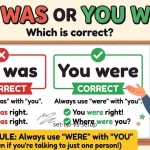
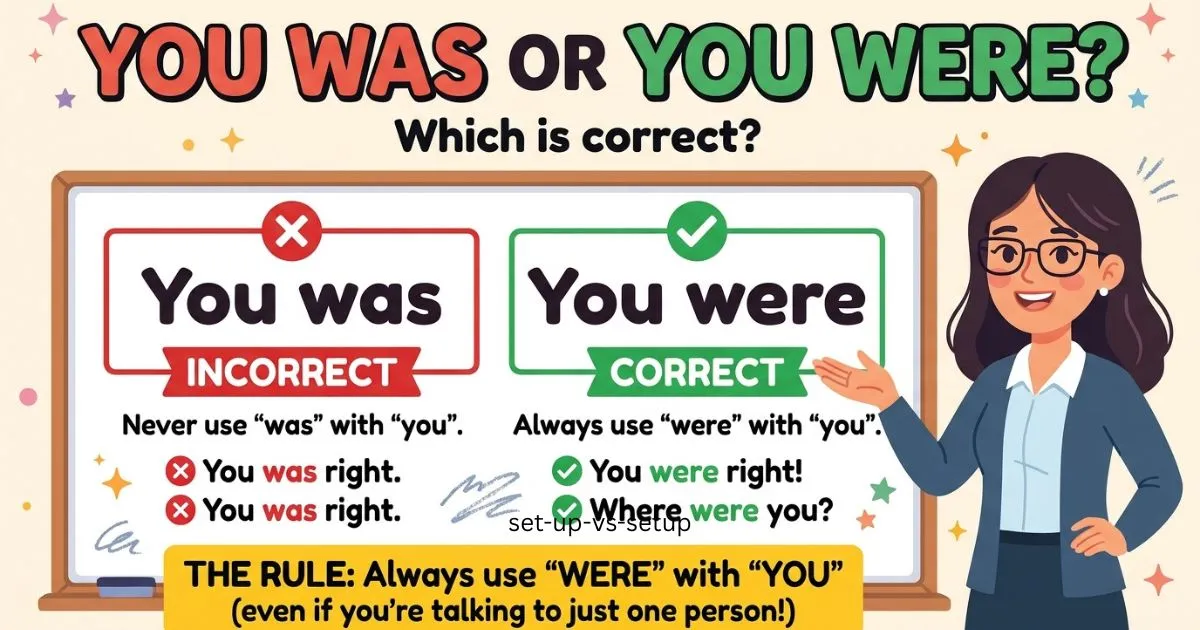
Fix it with “you were.” In standard English, “you” always takes “were” in the past tense, even when you mean just one person.
That pause is more common than you think. “You” feels singular, so “was” seems logical. Yet English treats “you” as a special case. It follows the same pattern as “we” and “they.” That small phrase causes big doubt.
Below, you will get the simple rule, the history behind “you was,” and memory tricks. You will also see 20 example sentences and a short quiz. No jargon. Just clear answers you can use today.
Table of Contents
- Introduction
- Quick Answer
- Quick Rule in 1 Line
- Why Is It “You Were” and Not “You Was”?
- Past Tense of “Be” at a Glance
- Why Do People Say “You Was”?
- “Was You” or “Were You”? Questions and Negatives
- “If You Were”: The Subjunctive Twist
- Easy Memory Tricks
- 20 Example Sentences
- Common “You Was” Mistakes and Fixes
- When to Use Each Form
- Quick Practice: Fill in the Blank
- FAQs
- Conclusion
- Key Takeaways
- Internal Linking Suggestions
- External Authoritative References
- Schema Note
Quick Answer
“You were” is the correct form. In standard English, “you” takes “were” in the simple past, whether you mean one person or many. “You was” is nonstandard. It appears in some dialects, songs, and dialogue, but not in school, business, or formal writing. Use “were” for the subjunctive too: “If you were ready.”
⚡ Quick Rule in 1 Line
Say “you were” every time: whether it is one person or ten, “you” always takes “were.”
Why Is It “You Were” and Not “You Was”?
Standard English pairs “was” with “I,” “he,” “she,” and “it.” It pairs “were” with “you,” “we,” and “they.” So “you” always gets “were” in the past tense. This stays true for one person or a whole crowd.
Start with the present tense. We say “you are,” never “you is.” The word “are” is the plural form, and “you” uses it every time. The past tense of “are” is “were.” So “you are” becomes “you were.”
This holds true even for one person. “You” may point to a single friend, but the verb still follows the plural pattern. That is the rule, and standard English has no exception to it.
The verb “be” is special. It is the only English verb that still has two past tense forms: “was” and “were.” Every other verb uses one past form for all subjects. That is why “be” causes so many mix-ups.
Past Tense of “Be” at a Glance
Here is the full past tense of “to be” in one table. Only two forms exist: “was” and “were.” Notice that “you” sits in the “were” column, whether it means one person or many.
| Pronoun | Present Tense | Past Tense | Example |
|---|---|---|---|
| I | am | was | I was late. |
| You (one person) | are | were | You were late. |
| You (many people) | are | were | You were late. |
| He / She / It | is | was | She was late. |
| We | are | were | We were late. |
| They | are | were | They were late. |
See the pattern? Only “I,” “he,” “she,” and “it” take “was.” Everyone else takes “were.”
This is the part many learners miss. They see “you” as one person and reach for “was.” The table shows why that choice breaks the pattern.
Why Do People Say “You Was”?
People say “you was” for two reasons. First, “you” once worked with “was” in older English. Second, many dialects use “was” with every subject. Today, standard English rejects it, but the form is not random or new.
A Short History of “You Was”
“You” began as a plural pronoun. Later it became a polite singular too. In the 1600s, singular “you” replaced “thou,” “thee,” and “thy” in most places.
Older English had “thou wast” for one person and “ye were” for many. When “thou” faded, speakers had to pick a verb for singular “you.” Some chose “was.” Others chose “were.”
In the 1700s, writers used both forms. Researchers have studied “you was” and “you were” in plays, letters, and grammar books from that time.
In 1762, grammarian Robert Lowth spoke out against “you was” in his grammar book. Schools then taught “you were,” and it became the standard.
Here is a twist. Researchers also found that “you was” already sounded low-status in stage comedies before Lowth’s book. So Lowth did not invent the stigma. He joined it.
The logic of “you was” is easy to see: one person, so a singular verb. But standard English follows custom, not logic.
“You Was” in Dialects Today
Many English dialects use “was” with every subject. Speakers say “I was,” “you was,” “we was,” and “they was.” The American Heritage Dictionary notes that most vernacular speakers in the United States level out the past of “be” this way.
This pattern is not random. It follows a clear rule inside those dialects. It is a different system, not a sign of low intelligence.
Still, school, business, and testing use standard English. There, “you were” is the only accepted form.
“You Was” in Songs, Movies, and Stories
Writers use “you was” in dialogue to show how a character speaks. Songs and movies do the same.
That is a creative choice. Handle it with care in fiction, because it can read as mockery when overused. Keep your narration in standard English.
“Was You” or “Were You”? Questions and Negatives
In questions, flip the order but keep the verb. Say “Were you at the game?” not “Was you at the game?” The word “you” still takes “were,” whether it comes before or after the verb.
The same rule applies to “where” questions. Say “Where were you?” not “Where was you?”
Negatives follow along. The negative of “you were” is “you weren’t.” Never write “you wasn’t.”
Tag questions work the same way. Say “You were there, weren’t you?” and not “You was there, wasn’t you?”
“If You Were”: The Subjunctive Twist
Use “were” after “if” when you talk about something unreal or unlikely. This rule applies to every subject. So say “If I were you” and “If she were here,” not “If I was you.” With “you,” it is already “were.”
The subjunctive covers wishes, dreams, and “what if” ideas. Think of it as the “imagination mode” of grammar.
You will see it after “if,” “as if,” and “I wish.” Here are quick examples:
- If I were you, I would apply today.
- She talks as if she were the boss.
- I wish he were here.
Real possibilities work differently. When the situation could be true, “was” is fine with “I,” “he,” “she,” and “it.” For example: “If he was late, nobody told me.”
This twist never changes the “you” rule. “You” takes “were” in both real and unreal sentences.
Easy Memory Tricks
Link “you were” to “you are.” If “you” takes “are” now, it takes “were” in the past. Nobody says “you is,” so nobody should say “you was.” This one link fixes the mistake fast.
Trick 1: The “are” link. “You are” becomes “you were.” Both go together.
Trick 2: The two-group chant. Say it out loud:
- “I, he, she, it” take was.
- “We, you, they” take were.
Trick 3: The swap test. Replace “you” with “they.” Does “they was” sound wrong? Then “you was” is wrong too.
Pick the trick that sticks. Use it for a week, and the habit will form.
20 Example Sentences
These 20 sentences show “you were” in daily life, school, and work. Each one follows the standard rule. Read them aloud. Hearing the pattern helps it stick.
Everyday Sentences (One Person)
- You were right about the test.
- You were the first person to arrive.
- You were great in the interview.
- You were not at home when I called.
- You were so kind to help me.
Sentences With Plural “You”
- You were all late to class, so I started without you.
- You were a strong team this season.
- Were you two at the park yesterday?
Questions and Negatives
- Were you at the meeting?
- Where were you last night?
- You weren’t ready, were you?
- Why weren’t you answering your phone?
Subjunctive Sentences
- If you were me, what would you do?
- I wish you were here.
- If you were the manager, you would change the schedule.
- It looked as if you were tired.
Work and School Sentences
- You were selected for the final round.
- Thank you for the email. You were very clear.
- Yesterday, you were assigned to the new project.
- You were correct to ask for a written copy.
Common “You Was” Mistakes and Fixes
Most “you was” errors come from one habit: treating “you” as singular. The fix is always the same. Replace “was” with “were,” or “wasn’t” with “weren’t.” Here are the six most common slips.
| Incorrect | Correct | Why |
|---|---|---|
| You was late. | You were late. | “You” always takes “were.” |
| Was you at home? | Were you at home? | The verb stays “were” in questions. |
| You wasn’t ready. | You weren’t ready. | “Weren’t” is the negative of “were.” |
| If you was me, I would stay. | If you were me, I would stay. | Unreal “if” sentences take “were.” |
| You and I was there. | You and I were there. | A compound subject takes “were.” |
| You where late. | You were late. | “Where” asks about place. “Were” is the verb. |
Three look-alikes cause trouble in writing. “Were” is the verb. “We’re” means “we are.” “Where” points to a place.
Proofread for these in texts and emails. Autocorrect will not always catch them.
When to Use Each Form
Use “you were” in all school, work, and public writing. Use “you was” only in dialogue that shows how a character speaks. Everywhere else, make “were” your default. Tests and job applications count too.
| Situation | Best Choice | Why |
|---|---|---|
| School essays and exams | you were | Teachers and tests expect standard English. |
| Resumes, cover letters, emails | you were | It looks careful and professional. |
| Texts and social posts | you were | It is clear to every reader. |
| Fiction dialogue | you was (for voice only) | It shows how a character speaks. |
| Quoting a person or a song | Keep the original | Do not change another person’s words. |
| English tests for ESL learners | you were | Only the standard form is accepted. |
Dialects deserve respect. They follow their own rules. But standard writing has one rule for “you,” and it is “were.”
Quick Practice: Fill in the Blank
Try this five-question check. Pick “was” or “were” for each blank. The answers are below, so cover them first.
- ___ you at the party?
- You ___ right about the answer.
- If you ___ taller, you could reach the shelf.
- She ___ happy, but you ___ sad.
- You and Sam ___ on time.
Answers: 1. Were. 2. were. 3. were. 4. was, were. 5. were.
Scored 5 out of 5? You have the rule. Missed one? Use the swap test again.
Key Takeaways
- “You were” is the only standard past tense form with “you.”
- “You” takes “were” for one person and for many.
- “You was” is nonstandard, though common in some dialects.
- Questions use “Were you…?” and negatives use “you weren’t.”
- Unreal “if” sentences use “were” with every subject.
- Use “you was” only in dialogue to show a character’s voice.
- Link it to “you are”: “you are” becomes “you were.”
- Try the swap test: if “they was” sounds wrong, so does “you was.”
FAQs
1. Is “you was” ever correct?
In standard English, no. “You was” is nonstandard, so it does not belong in school, business, or formal writing. It is common in some dialects and in fiction dialogue meant to show a speaker’s voice.
2. Is it “you was” or “you were” for one person?
It is “you were.” The word “you” takes “were” whether it means one person or many. Standard English has no singular exception.
3. Why does singular “you” take “were”?
“You” began as a plural pronoun and later became singular too. It kept its plural verb forms. That is why “you are” and “you were” stay the same for one person or many.
4. Is it “was you” or “were you” in a question?
It is “were you.” For example, “Were you at the game?” Flip the word order for a question, but keep “were.”
5. Is “you wasn’t” correct?
No. Say “you weren’t.” That is the negative form of “you were.”
6. Why do some people say “you was”?
Many dialects use “was” with every subject. Older English also had both forms for singular “you.” So the habit is old and still alive in speech.
7. Is “If you was” correct?
No. Use “If you were.” Unreal or unlikely “if” sentences take “were,” and “you” takes “were” anyway.
8. What is the past tense of “you are”?
The past tense is “you were.” Both singular and plural “you” use it.
9. Can I use “you was” in a story?
You can, in dialogue, to show how a character talks. Use it with care and keep your narration in standard English. Overuse can feel like mockery.
10. Is “you was” American or British English?
Neither. It is not tied to one country. It appears in dialects in both the US and the UK. Standard English in both places uses “you were.”
Conclusion:
“You were” is the correct form in standard English, every time. It works for one person or many. “You was” comes from old usage and living dialects, but school, work, and formal writing reject it.
Remember the link: “you are” becomes “you were.” When in doubt, run the swap test with “they.” If “they was” sounds wrong, “you was” is wrong too. Use “were” and move on with confidence.

I’m Sophia Mitchell, an English grammar and writing enthusiast. I create simple, easy-to-understand content to help learners improve their English. My goal is to make grammar clear, practical, and enjoyable for everyone.