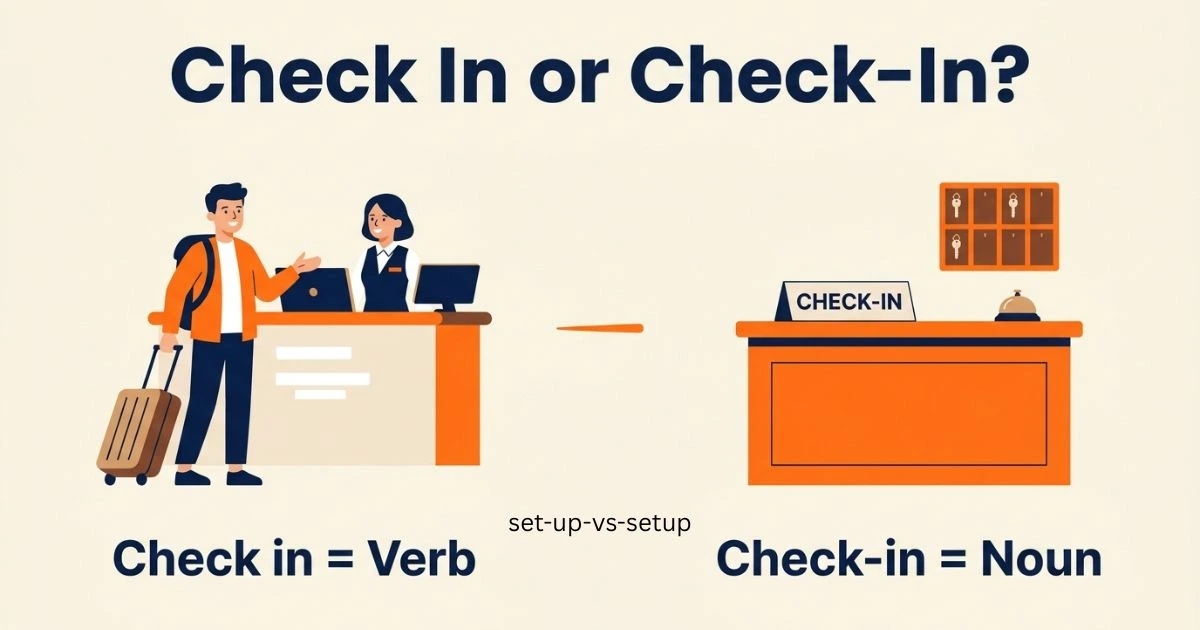
You write “Please check-in at the front desk,” and nothing turns red. Still, it’s wrong. The verb is two words: check in. The noun and adjective take a hyphen: check-in.
This mix-up shows up on hotel signs, work emails, and travel apps. The two forms sound exactly the same, so your ear can’t help you. Only the job the word does in the sentence tells you which one to write.
Don’t worry. English follows a clear pattern here, and it works for many other word pairs too. Below you’ll find a one-line rule, a quick test, more than 20 example sentences, and the mistakes to avoid.
Table of Contents
- Introduction
- Quick Answer
- Quick Rule in 1 Line
- What Is the Difference Between Check In and Check-In?
- The Grammar Rule: Phrasal Verb vs. Noun
- A 10-Second Test to Pick the Right Form
- Memory Trick
- Check In as a Verb (With Examples)
- Check-In as a Noun or Adjective (With Examples)
- Both Forms in One Sentence
- What About “Checkin”?
- Is There a US vs. UK Difference?
- Common Mistakes
- When to Use Each Form
- FAQs
- Conclusion
- Key Takeaways
- Internal Linking Suggestions
- External References
- Schema Note
Quick Answer
Write check in (two words) when it’s a verb, meaning an action: “We check in at 3 p.m.” Write check-in (hyphenated) when it’s a noun or adjective, meaning the act, place, or process: “The check-in desk is open.” Avoid “checkin” in formal writing.
⚡ Quick Rule in 1 Line
“If you can do it, write two words; if it names something, add the hyphen.”
Explore more: Full Time or Full-Time?
What Is the Difference Between Check In and Check-In?
Check in is a verb phrase that describes an action, like registering at a hotel. Check-in is a noun or adjective that names the act, the place, or the process. The words sound the same, so only the hyphen and the sentence job tell them apart.
Look at the job each form does:
- Check in tells you what someone does.
- Check-in names an event, a place, or a step. It can also describe another noun.
Merriam-Webster lists both forms. It defines the verb as registering at a hotel, and the noun as an act or instance of checking in. It dates the verb to 1918 and the noun to 1927.
Oxford Learner’s Dictionaries also keeps them apart. It has one entry for the phrasal verb and a separate entry for the noun.
| Form | Part of Speech | Meaning | Example |
|---|---|---|---|
| check in | Verb (phrasal verb) | Register, report your arrival, or make contact | We check in at 3 p.m. |
| check-in | Noun | The act, place, or process of checking in | The check-in was quick. |
| check-in | Adjective | Describes another noun | The check-in desk is open. |
| checkin | Not standard | Avoid in formal writing | (none) |
The Grammar Rule: Phrasal Verb vs. Noun
Check in is a phrasal verb: the verb check plus the small word in. When a phrasal verb becomes a noun or adjective, English usually joins the parts with a hyphen. That is why check in becomes check-in.
This pattern is not special to this word. Other pairs work the same way:
| Verb (two words) | Noun or adjective (hyphen) |
|---|---|
| check in | check-in |
| check up | check-up |
| sign up | sign-up |
Some pairs have closed up over time. Set up and setup is one example. Check-in has not. Dictionaries still list it with a hyphen, so that is the safe choice.
Speech gives a small clue too. In the verb, people stress the word in. In the noun, they stress the first word, check. The hyphen is the written version of that shift.
A 10-Second Test to Pick the Right Form
Use these quick checks. If one of them fits, you have your answer. Run through them in order, and stop at the first yes.
- Add “to” in front. “To check in” works? Write check in.
- Change the tense. Can it become checked in or checking in? Write check in.
- Add “the,” “a,” or “my.” “The check-in” works? Write check-in.
- Make it plural. Can it become check-ins? Write check-in.
- Does it describe another noun? Check-in desk, check-in time? Write check-in.
Here is the test on one sentence: “Please check in before check-in closes.” The first one takes “to,” so it’s a verb. The second takes “the,” so it’s a noun.
Memory Trick
Remember this: the word check is itself a verb, so check in is the action. Add the hyphen only when the phrase turns into a thing you can point to, such as a desk, a time, or a meeting.
Here are two easy tricks:
- The glue trick. The hyphen is glue. It sticks two words together so they act as one thing. A verb is an action, so it needs no glue.
- The “do or point” trick. If you do it, write two words. If you point at it, add the hyphen.
Check In as a Verb (With Examples)
Use check in, with no hyphen, any time it’s an action. That means registering at a hotel, reporting at an airport, or contacting someone. It also works in other forms: checks in, checked in, and checking in.
Common verb patterns
- check in at a place: “We check in at the hotel.”
- check in for a trip: “You can check in for your flight online.”
- check in with someone: talk to them to share or get an update.
- check in on someone or something: see how they are doing.
- check in an item: return it, or hand it over. Merriam-Webster gives “check in the equipment” as an example.
10 example sentences (verb)
- We check in at 3 p.m.
- Please check in at the front desk.
- You can check in online 24 hours before your flight.
- She checked in two hours early.
- I’ll check in with the team on Friday.
- Can you check in on Grandma tonight?
- He is checking in his bags now.
- Guests must check in before midnight.
- Please check in the borrowed laptop after class.
- Did you check in yet?
See the full guide: Up-to-Date or Up to Date?
Check-In as a Noun or Adjective (With Examples)
Use check-in, with a hyphen, when the phrase names the act, place, or process. Use it too when it describes another noun. Think check-in desk, check-in time, and weekly check-in. The plural noun is check-ins.
As a noun
- The check-in was fast and smooth.
- We waited ten minutes at check-in.
- Online check-in opens the day before departure.
- I have a check-in with my manager at noon.
- Daily check-ins keep the team on track.
As an adjective
- The check-in desk is on the left.
- Check-in time is 3 p.m.
- Show your passport at the check-in counter.
- Please read the check-in instructions.
- Our weekly check-in meeting starts at 9 a.m.
Both Forms in One Sentence
You will often need both forms side by side. The verb gets two words. The noun or adjective gets the hyphen. Seeing them together makes the pattern easy to spot.
- You must check in before the check-in deadline.
- If you check in online, the check-in line moves faster.
- I will check in with you after the check-in meeting.
- Guests who check in early should use the express check-in desk.
What About “Checkin”?
Skip “checkin” in formal writing. Merriam-Webster and Oxford list the hyphenated form, and the one-word spelling is not standard. You may see checkin in app labels, code, or casual messages, but it is not correct for essays, emails, or articles.
Why does it appear at all? Tech products often drop hyphens and spaces to save room on a button or in a file name. That is a design choice, not a grammar rule.
For your own writing, the choice is simple:
- Action? Write check in.
- Thing or description? Write check-in.
- One word, no hyphen? Don’t.
Is There a US vs. UK Difference?
No. Unlike color and colour, check in and check-in do not split by country. The sources checked for this article show no regional difference. The split is about grammar, not geography, so the same rule works for a US audience.
This is why “check in or check-in” is a different kind of confusion from most spelling pairs. You don’t need to ask where your reader lives. You only need to ask what job the word does.
Common Mistakes
Most errors come from one habit: using the same form everywhere. Writers either hyphenate the verb or drop the hyphen from the noun. The table below shows the most common slips and the fix.
| Wrong | Right | Why |
|---|---|---|
| Please check-in at the desk. | Please check in at the desk. | It’s a verb. |
| The check in desk is open. | The check-in desk is open. | It describes “desk.” |
| What time is check in? | What time is check-in? | It’s a noun. |
| I will checkin online. | I will check in online. | Never write it as one word. |
| We checked-in at noon. | We checked in at noon. | It’s a verb in the past tense. |
| I’ll check-in with you later. | I’ll check in with you later. | It’s a verb. |
| We hold two check in’s a week. | We hold two check-ins a week. | The plural takes no apostrophe. |
One more tip. In headlines, keep the same structure. Write “How to Check In Online” for the verb. Write “Your Check-In Guide” for the noun.
When to Use Each Form
The right form depends on the job, not on the place. Hotels, airports, offices, and apps all use both. This table shows how the same setting needs each form at different times.
| Setting | Verb: check in | Noun or adjective: check-in |
|---|---|---|
| Hotel | We check in at 3 p.m. | Check-in is at 3 p.m. |
| Airport | Check in your bag at the counter. | The check-in line is long. |
| Work | I’ll check in with you on Monday. | Our Monday check-in is short. |
| Health care | Please check in with the nurse. | Your check-in form is on the clipboard. |
| Apps and social media | Check in at the café. | Her check-in showed Paris. |
Key Takeaways
- Check in (two words) is a verb: “We check in at noon.”
- Check-in (hyphenated) is a noun or adjective: “The check-in desk is open.”
- Checkin (one word) is not standard English.
- Test it: add “to” for the verb, or add “the” for the noun.
- The plural is check-ins, with no apostrophe.
- The past tense is checked in, with no hyphen.
- Check in with means to update. Check in on means to see how someone is.
- There is no US vs. UK difference. The rule depends on grammar, not region.
- The same pattern works for check up and check-up, and sign up and sign-up.
FAQs
1. Is it check in or check-in?
Both are correct, but they do different jobs. Use check in (two words) as a verb. Use check-in (hyphenated) as a noun or adjective. “We check in at noon” uses the verb. “The check-in desk is open” uses the adjective.
2. Is check-in hyphenated?
Yes, when it is a noun or an adjective. Dictionaries such as Merriam-Webster list the noun as check-in. When it is a verb, it has no hyphen: check in.
3. Is “check in” a verb or a noun?
Check in, with no hyphen, is a verb. It is a phrasal verb made of check plus in. The noun form is check-in, with a hyphen. If you can put “to” before it, it’s the verb.
4. Is “checkin” a word?
Not in standard English. You may see it in apps and code, but dictionaries list check-in with a hyphen. In formal writing, use check in for the verb and check-in for the noun or adjective.
5. What is the past tense of check in?
The past tense is checked in, with no hyphen: “She checked in at noon.” The -ing form is checking in. The third-person form is checks in. All are verb forms, so none take a hyphen.
6. What is the plural of check-in?
The plural is check-ins: “We hold daily check-ins.” Don’t add an apostrophe. Write check-ins, not check-in’s. The hyphen stays, because the word is still a noun.
7. What is the difference between “check in with” and “check in on”?
Check in with someone means to talk to them for an update: “I’ll check in with my boss.” Check in on someone means to see how they are doing: “Please check in on your neighbor.”
8. Do I hyphenate check-in in an email subject line?
Use the same rules. Write “Weekly check-in” for the noun. Write “Please check in by noon” for the verb. A subject line is still a sentence, so the part of speech decides the form.
9. Is it check in or check-in at a hotel?
It can be either, depending on the sentence. “Guests check in at 3 p.m.” uses the verb. “Check-in starts at 3 p.m.” uses the noun. “Check-in time is 3 p.m.” uses the adjective.
10. Is there a US vs. UK spelling difference?
No. The sources checked show no regional split. The hyphen follows the part of speech in both varieties, so one rule covers all readers.
Conclusion:
The answer is simple. Use check in for the action and check-in for the thing. If you can add “to” before it, write two words.
If you can add “the” before it, or it describes another noun, add the hyphen. Skip “checkin” in formal writing.
There is no US and UK split to worry about, so one rule works everywhere.
Still confused? Try these: Lifelong or Life-Long? The Correct Spelling Explained

As an American English writer, I specialize in creating clear and engaging content that makes grammar and language learning accessible to everyone. I enjoy breaking down complex English concepts into simple, practical lessons that readers can apply with confidence. My mission is to help learners strengthen their communication skills through easy and reliable content.