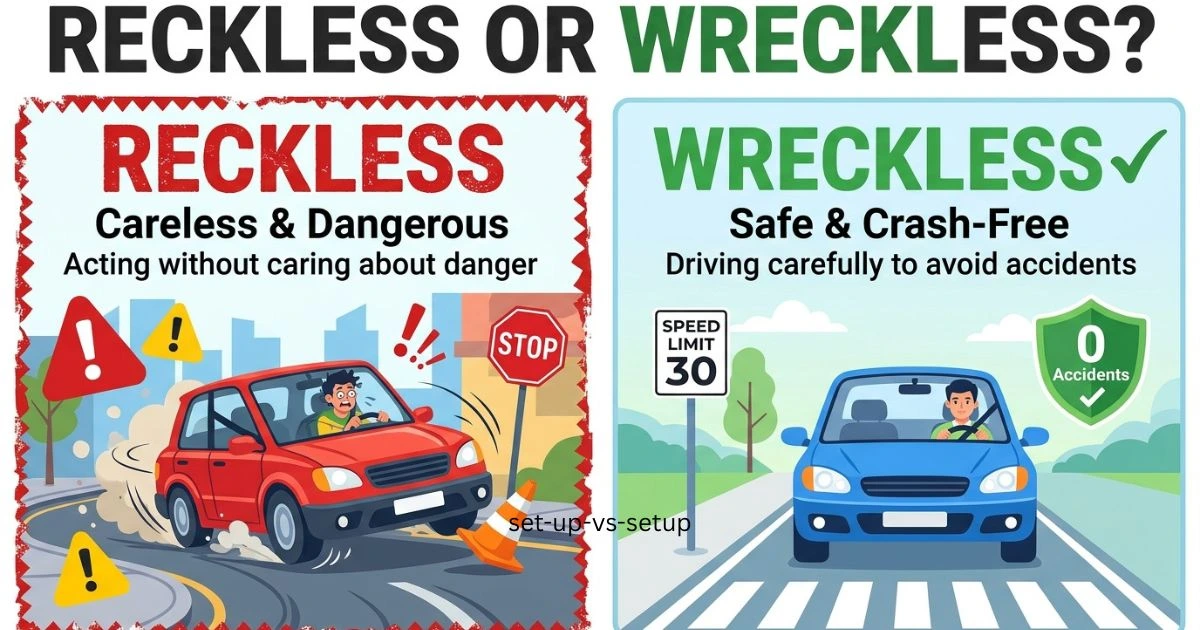
Reckless is the correct spelling. Wreckless is a misspelling. Reckless means careless about danger or what happens next.
Picture this. You text a friend, “Stop being so wreckless on that bike!” He replies, “So you want me to have no wrecks?”
That one extra w flips your meaning. Wreckless would mean “without wrecks.” Reckless means you are asking for one.
The mix-up is common because reckless and wreck sound almost alike. Reckless drivers also cause wrecks, so the w feels natural.
In this guide, you will learn the rule, the true origin of the word, and a trick to remember it for good.
Table of Contents
- Reckless or Wreckless? Start Here
- Quick Answer
- Quick Rule in 1 Line
- What Does Reckless Mean?
- Why Is “Wreckless” Wrong?
- Is “Wreckless” Ever Correct?
- Where Does the Word Reckless Come From?
- Reckless vs Wreckless at a Glance
- Is Reckless Spelled Differently in US and UK English?
- Easy Memory Tricks for Reckless
- The Reckless Word Family
- 20 Example Sentences
- Reckless in the News and Legal Terms
- Common Mistakes to Avoid
- When to Use Reckless and When to Use Wreck
- Reckless Synonyms and Antonyms
- FAQs
- Conclusion
- Key Takeaways
- Internal Linking Suggestions
- External References
- Schema Note
Quick Answer
Quick Answer: Reckless is the only correct spelling. It is an adjective that means careless about danger or consequences, as in “reckless driving.” Wreckless is a misspelling, and most dictionaries do not list it. The spelling is the same in American and British English, so you never need the w.
⚡ Quick Rule in 1 Line
Reckless means without care. Wreckless would mean without wrecks. Only reckless is the standard spelling.
Related spelling guides: Cozy or Cosy: Which Is Correct?
What Does Reckless Mean?
Reckless is an adjective. It describes a person or action that shows no care about danger or results. Merriam-Webster describes it as showing a lack of caution and not caring about consequences. A reckless driver, for example, ignores risks to themselves and others.
The word works for people, choices, and behavior. You can be a reckless driver, make a reckless decision, or spend money in a reckless way.
Reckless often appears in a few set phrases:
- reckless driving
- reckless abandon
- reckless disregard
- reckless endangerment
- reckless with money
Oxford Learner’s Dictionary lists driver, driving, and disregard as common partners of reckless. Its examples also include “reckless abandon” and “reckless with money.”
Say it as REK-less. The first part sounds just like the word wreck. That sound match is the root of the whole mix-up.
Why Is “Wreckless” Wrong?
Wreckless is wrong because it joins two unrelated words. Reckless comes from an old verb, reck, which means “to care.” Wreck is a different word that means ruin or destruction. The letter w does not belong in reckless.
Merriam-Webster says there is no language link between reckless and wreck. A reckless driver might cause a wreck. That is only a coincidence.
Dictionary.com agrees. It notes that most dictionaries do not list wreckless as another spelling of reckless.
Writing Explained calls wreckless a common misspelling and says it is wrong in both American and British English. It also reports a usage-guide ratio of about 1,072 uses of reckless for every one use of wreckless.
Why Do So Many People Make This Mistake?
There are three simple reasons:
- The sounds match. Reckless begins with the same sound as wreck, because the w in wreck is silent.
- The story fits. Reckless people cause wrecks, so adding a w feels logical.
- The pattern fits. Many English words end in -less, so wreck + less looks like a real word.
The Funny Part
If wreckless were a real word, it would mean the opposite of reckless. Merriam-Webster points out that a “wreckless” driver would have no accidents and be very safe.
So the error does more than look wrong. It can reverse your message.
Is “Wreckless” Ever Correct?
Almost never. Most dictionaries do not list wreckless at all, so standard writing treats it as an error. A writer could coin it to mean “without wrecks,” but that use is rare and confusing. Do not use it as another way to spell reckless.
Sources differ a little on the rare joke use. Dictionary.com says the “without wrecks” sense is possible but very uncommon. Writing Explained says no context makes wreckless correct.
The safe rule is simple. For school, work, blogs, and business writing, always use reckless.
If you want a joke about a driver with no crashes, explain it. Otherwise, readers may think you made a typo.
Where Does the Word Reckless Come From?
Reckless comes from the Old English word receleas, which meant careless or heedless. It was built from reck, meaning “care,” plus -less, meaning “without.” So reckless literally means “without care.” The word wreck has a different history.
Here is the short path of the word, based on the Online Etymology Dictionary:
- Old English reccan meant “to care.”
- Old English receleas meant “careless, thoughtless, heedless.”
- Middle English recheles came next.
- Modern English settled on reckless.
The root verb reck is now rare. That is one reason the word looks mysterious today.
German and Dutch have similar forms: ruchlos and roekeloos. In those languages, the words mean “wicked.”
Wreck follows another path. Merriam-Webster traces it to Old Norse and Medieval Latin roots. It has been in English since before the 12th century.
Two words, two families. They only meet in the way they sound.
Reckless vs Wreckless at a Glance
The table below shows the difference in one quick look. Use it as a cheat sheet when you edit your own writing.
| Feature | Reckless | Wreckless |
|---|---|---|
| Is it correct? | Yes | No, it is a misspelling |
| Part of speech | Adjective | Not listed in most dictionaries |
| Meaning | Careless about danger or results | If used at all, “without wrecks” |
| Root | reck (to care) + -less | wreck (ruin) + -less |
| Example | He is a reckless driver. | ✗ He is a wreckless driver. |
| US English | Correct | Wrong |
| UK English | Correct | Wrong |
Is Reckless Spelled Differently in US and UK English?
No. Reckless is spelled the same in American and British English. This word does not follow the usual US versus UK pattern, like color and colour. The only error to avoid is the extra w, and that error is wrong in both countries.
Many spelling guides split words by region. This one does not.
The whole word family also matches everywhere.
| Word | American English | British English |
|---|---|---|
| Adjective | reckless | reckless |
| Adverb | recklessly | recklessly |
| Noun | recklessness | recklessness |
| Common error | ✗ wreckless | ✗ wreckless |
So you do not need to switch spellings for a US or UK audience. Just keep the w out.
Easy Memory Tricks for Reckless
The best trick is this: reckless has no w because it has no wreck in it. Another way is to remember that reck means “care.” If you are reckless, you have less care. Pick one trick below and use it every time.
Trick 1: Reck + Less
Break the word into two parts. Reck means care, and less means without. Reckless means without care.
Trick 2: The “No Wrecks” Test
Read wreckless as “no wrecks.” Now check your sentence. If you mean danger or carelessness, “no wrecks” does not fit.
Trick 3: Count the Letters
Reckless has eight letters. Wreckless has nine. The shorter word is the real one.
The Reckless Word Family
Reckless is an adjective. Add -ly to make the adverb recklessly. Add -ness to make the noun recklessness. All three keep the same spelling pattern, with no w in any of them.
| Word | Part of Speech | What It Does | Example |
|---|---|---|---|
| reckless | Adjective | Describes a person or thing | She made a reckless choice. |
| recklessly | Adverb | Describes how someone acts | He drove recklessly. |
| recklessness | Noun | Names the quality itself | His recklessness shocked us. |
Use the adjective before a noun, as in “a reckless plan.” You can also use it after a linking verb, as in “The plan was reckless.”
You can add with to show what someone is careless about. For example, “He is reckless with money.”
Watch the double s in every form. Reckless has two s letters at the end, not one.
20 Example Sentences
Reckless (adjective)
- The reckless driver ran a red light and almost hit a bus.
- It was reckless to swim in the lake during the storm.
- She is reckless with money and spends it all on weekends.
- The company made a reckless bet on a product nobody wanted.
- His reckless comment started an argument at dinner.
- The coach warned the team not to make reckless passes.
- Hikers who ignore weather alerts are being reckless.
- The mayor called the plan reckless and asked for a safer one.
Recklessly (adverb)
- He drove recklessly down the icy road.
- The kids ran recklessly across the busy street.
- She spent recklessly during the sale and regretted it later.
- Investors who trade recklessly can lose their savings fast.
Recklessness (noun)
- The judge criticized his recklessness behind the wheel.
- Recklessness on the trail put the whole group at risk.
- Her recklessness cost the team the game.
Common Phrases
- She jumped into the new project with reckless abandon.
- The lawyer accused the company of reckless disregard for safety.
Wrong vs Right
- ✗ He is a wreckless driver. → ✓ He is a reckless driver.
- ✗ They danced with wreckless abandon. → ✓ They danced with reckless abandon.
- ✗ Wreckless spending ruined the budget. → ✓ Reckless spending ruined the budget.
Explore more: Lose vs. Loose: 3 Quick Tests
Reckless in the News and Legal Terms
In US news and law, reckless often describes serious carelessness. You will see reckless driving and reckless endangerment in headlines and court stories. Legal meanings and penalties vary by state, so check local law for exact rules.
US Legal explains that reckless is used in both negligence and criminal cases. It points to a gross lack of care and a complete disregard for harmful results.
This section is language help, not legal advice.
Spelling matters most in this setting. A news post or business report that says “wreckless driving” looks careless. It also changes the meaning.
Common Mistakes to Avoid
The top mistake is adding a w to make wreckless. Other errors include writing reckles with one s, or using wreckless in set phrases like “wreckless abandon.” Check this word once in your final read.
- Adding a w. Write reckless, not wreckless.
- Using one s. Write reckless, not reckles. The ending -less always has two s letters.
- Writing “wreckless driving.” The correct phrase is reckless driving.
- Writing “wreckless abandon.” The correct phrase is reckless abandon.
- Mixing wreck and reckless in one sentence. Use each in its place: “He drove recklessly and wrecked the car.”
Sound-alike errors like this one happen with many other word pairs. If you also mix up lose and loose, or there and their, the same careful final read will help.
When to Use Reckless and When to Use Wreck
Use reckless to describe careless behavior. Use wreck for a crash, a ruined thing, or the act of ruining. These are different jobs. One describes a person’s attitude, and the other names damage.
- Reckless: describes careless behavior. “She is a reckless rider.”
- Recklessly: describes how something is done. “He jumped recklessly.”
- Recklessness: names the careless quality. “Recklessness often ends in trouble.”
- Wreck (noun): a crash or a ruined thing. “The car was a wreck.”
- Wreck (verb): to ruin or destroy. “Don’t wreck the surprise.”
- Wrecked: ruined or badly damaged. “The storm wrecked the fence.”
Here is a sentence that uses both correctly: “His reckless driving wrecked the truck.”
Reckless Synonyms and Antonyms
Common synonyms for reckless include careless, rash, heedless, and foolhardy. Common antonyms include careful, cautious, and prudent. The words are close, but each has a small difference in tone.
Merriam-Webster notes some useful shades of meaning:
- Reckless suggests you ignore the likely results of what you do.
- Rash suggests a hasty choice made without enough thought.
- Foolhardy suggests a risk that goes against good sense.
Antonyms: careful, cautious, prudent, responsible, vigilant.
Example: “A cautious hiker checks the weather. A reckless hiker does not.”
Key Takeaways
- Reckless is correct. Wreckless is a misspelling.
- Reckless means careless about danger or consequences.
- It comes from reck (to care) + -less, not from wreck.
- Wreckless, if it were a word, would mean “without wrecks.”
- The spelling is the same in US and UK English.
- Correct forms: reckless, recklessly, recklessness.
- Correct phrases: reckless driving, reckless abandon, reckless disregard.
- Memory trick: reckless has eight letters, wreckless has nine. Pick the shorter one.
FAQs
Is it reckless or wreckless?
Reckless is the correct spelling. Wreckless is a common misspelling that most dictionaries do not list. Reckless means careless about danger or consequences, as in “reckless driving.” The spelling is the same in American and British English.
Is wreckless a real word?
No, not in standard English. Dictionaries list reckless, not wreckless. In rare cases, writers use wreckless as a joke about “no wrecks,” but readers will likely see it as a typo. Avoid it in school, work, and professional writing.
What does reckless mean?
Reckless means careless about danger or the results of your actions. It describes people, choices, and behavior, such as a reckless driver or a reckless decision. It sounds stronger and more serious than simply being forgetful or sloppy.
Is it reckless abandon or wreckless abandon?
It is reckless abandon. Abandon here means a lack of restraint, and reckless stresses that you do not care about the outcome. Wreckless abandon is a misspelling. Example: “She jumped into the pool with reckless abandon.”
Is it reckless driving or wreckless driving?
Reckless driving is correct. It means driving without care for safety. Wreckless driving would mean driving with no wrecks, which is the opposite idea. Writers sometimes add the w because reckless driving often causes wrecks.
How do you spell reckless in British English?
The same way: r-e-c-k-l-e-s-s. British and American English do not differ on this word. Recklessly and recklessness also match in both. The extra w in wreckless is wrong in both countries.
Why is reckless spelled without a w?
Reckless comes from the old verb reck, meaning “to care,” plus the ending -less. Wreck is a separate word with a different history. Because the two words are not related, the w never entered reckless.
What is the difference between reckless and careless?
Careless usually means not paying enough attention. Reckless usually suggests ignoring a danger you can see or should expect. Because of that, reckless sounds stronger. A careless typo is a small slip. A reckless dive into shallow water is a real risk.
What is the opposite of reckless?
Common opposites are careful, cautious, prudent, and responsible. For example, a careful driver slows down in the rain. A reckless driver does not.
How do you pronounce reckless?
Say REK-less. The first syllable rhymes with “check.” It sounds like the start of wreck, because the w in wreck is silent. That matching sound is why people add a w by mistake.
Conclusion:
Reckless is the only correct spelling. It means careless about danger or consequences, and it comes from the old word reck, meaning “to care.”
Wreckless is a misspelling in American and British English. If it were a word, it would mean “without wrecks,” the opposite of what you want to say.
Remember the simple test: reckless means without care, and it has no w. Use recklessly for the adverb and recklessness for the noun.
Then check your draft once, and your spelling will be safe.
Still confused? Try these: Surprise or Suprise? Which Spelling Is Correct?

I am an English language writer passionate about grammar and clear communication. I create simple, easy-to-understand content that helps readers improve their English skills. My goal is to make learning English both practical and enjoyable.