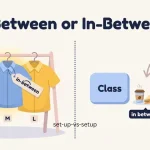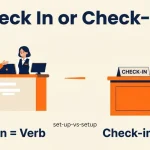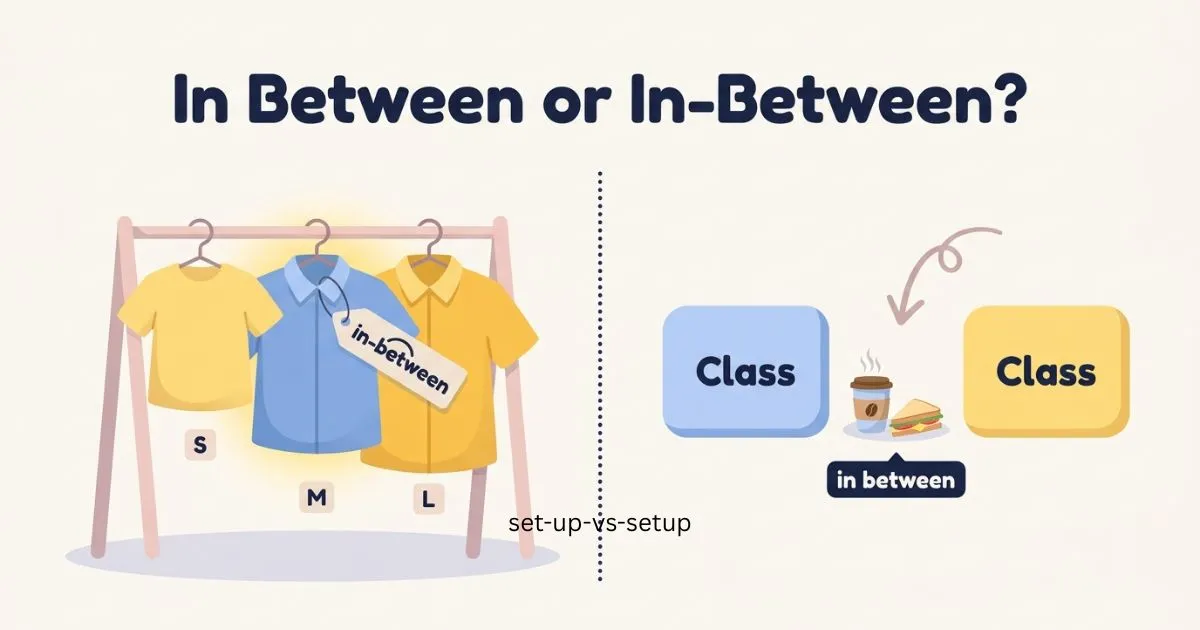
You write “an in between size” in an email, and something looks off. Use in-between with a hyphen before a noun (an in-between size).
Use in between without one when it works as an adverb or preposition (somewhere in between).
That is the whole rule. Most people mix it up because the two forms sound the same. Say them out loud and you cannot hear the hyphen. You can only see it.
This guide shows the exact difference, simple examples, and a memory trick. It also covers the one-word form “inbetween,” which you should skip.
This is not a US vs UK spelling issue. American and British writers follow the same rule. It all depends on the job the words do in the sentence.
Table of Contents
- Quick Answer
- The Difference Between In Between and In-Between
- When to Use In-Between (With a Hyphen)
- When to Use In Between (Two Words)
- Why “Inbetween” Is Not Standard
- The Grammar Rule Behind the Hyphen
- In Between vs Between
- Memory Trick: The Swap Test
- 21 Example Sentences
- Common Mistakes
- When to Use Each Form
- FAQs
- Conclusion
- Key Takeaways
Quick Answer Box
Write in-between with a hyphen when it works as an adjective before a noun (in-between days) or as a noun (there is no in-between). Write in between as two words when it works as an adverb or preposition (stops in between). Do not write “inbetween” as one word.
⚡ Quick Rule in 1 Line
Hyphen when it names or describes a thing; no hyphen when it shows where or when.
The Difference Between In Between and In-Between
The difference is the job the words do. In-between with a hyphen is an adjective or a noun. In between without a hyphen is an adverb or a preposition. Merriam-Webster covers both forms in one entry and splits them by part of speech.
So this is not a spelling fight. It is a grammar choice. The same two words change form when their role changes.
Here is a quick look at both forms side by side.
| Form | Part of speech | What it means | Example |
|---|---|---|---|
| in-between | Adjective | Intermediate; in the middle | an in-between size |
| in-between | Noun | A middle point or thing | There is no in-between. |
| in between | Adverb | In the space or time separating things | Lunch is at noon, with a snack in between. |
| in between | Preposition | Between | She is in between jobs. |
Notice the pattern. When the phrase sits in front of a noun, it gets a hyphen. When it stands on its own after a verb or at the end of a clause, it stays open.
The form with the hyphen is also the newer of the two in some respects. Merriam-Webster dates the adjective and noun use to 1815. It dates the adverb and preposition use to 1523.
When to Use In-Between (With a Hyphen)
Use the hyphenated form when you need an adjective or a noun. As an adjective, it describes a noun and means “intermediate” or “in the middle.” As a noun, it names a middle point, state, or thing. Both uses take a hyphen.
In-between as an adjective
An adjective describes a noun. Here, the two words team up to act as one modifier. The hyphen shows that they belong together.
- Spring is an in-between season.
- She picked an in-between shade of green.
- Baseball players talk about an in-between hop, which is a bounce that is hard to read.
Without the hyphen, the reader might see “in” and “between” as two separate ideas. The hyphen joins them into one idea.
In-between as a noun
A noun names a thing. In-between can name a middle position or a middle option.
- The switch is either on or off. There is no in-between.
- Parents often think they must pick one extreme, but there is an in-between.
- Look for the in-betweens in your day, like bus rides and coffee breaks.
The plural is in-betweens. Keep the hyphen there too.
When to Use In Between (Two Words)
Use the open, two-word form when the phrase works as an adverb or a preposition. As an adverb, it tells where or when something happens. As a preposition, it links two things and means “between.” In both cases, the two words stay separate.
In between as an adverb
An adverb adds detail to a verb or a whole clause. It often sits at the end of the sentence.
- Prices run from cheap to costly, with many choices in between.
- We have class at nine and at two, with lunch in between.
- The bus stops at Main Street and Pine Street, and nowhere in between.
Here “in between” answers a simple question: where, or when? Nothing follows it. That is a good sign you need two words.
In between as a preposition
A preposition comes before a noun or a pronoun. Merriam-Webster lists “in between” as a preposition meaning “between.”
- A narrow path runs in between the school and the park.
- Call me in between your meetings.
- She is in between jobs right now.
These sentences are fine, and people say them every day. Still, the next section shows why many writers cut the word “in” here.
Why “Inbetween” Is Not Standard
The one-word spelling “inbetween” is not standard English. Dictionaries list the word as in-between (hyphenated) or in between (two words). Usage guides such as Grammarly advise against the one-word form. Spell it with a hyphen or a space, based on the sentence.
You will see “inbetween” in texts, brand names, and social posts. That does not make it correct for school, work, or publishing. Autocorrect may leave it alone, so proofread by eye.
If you are ever unsure, pick the two-word form for adverb use and the hyphenated form for adjective use. Either choice beats the one-word spelling.
The Grammar Rule Behind the Hyphen
The hyphen follows a common rule for compound adjectives. When two or more words team up to describe a noun that follows them, join them with a hyphen. This stops the reader from misreading the phrase. The rule is the same in American and British English.
Here are other examples of the same rule:
- chocolate-covered pretzels
- a fat-free snack
- a well-known author
In-between works the same way. “An in-between size” is one idea. “An in between size” looks like a typo.
Now compare what happens after a verb or at the end of a clause. There, the words usually act as an adverb, so they stay open:
- The scores were high, low, and everything in between.
One extra note. Many news writers hyphenate “in-between” even in the adverb spot, such as “points in-between.” You will see this in print. Standard dictionaries, though, give the two-word form for that use. If you want to be safe, follow the dictionary.
In Between vs Between
For the preposition use, “between” alone is shorter and cleaner. “In between” works well as an adverb at the end of a clause. Both are common in speech. In formal writing, most style guides prefer the plain word “between” when a noun follows.
Think of it like this. There is only one kind of “between” in most sentences: the one that means “in the space separating things.” Adding “in” does not add meaning. It adds length.
| Wordy | Cleaner |
|---|---|
| Park in between the two trees. | Park between the two trees. |
| The meeting is in between lunch and dinner. | The meeting is between lunch and dinner. |
| Choose in between the two plans. | Choose between the two plans. |
When “between” has no noun after it, you often need “in between.” Compare these two:
- The shop opens at nine and closes at five, with a long break in between.
- The shop is between the bank and the bakery.
In the first sentence, nothing follows “in between,” so “between” alone would sound incomplete. In the second, a noun phrase follows, so “between” is enough.
Memory Trick: The Swap Test
Try a quick swap. Replace the phrase with one of two words and see which one fits. This works almost every time and takes about five seconds.
Swap 1: Try “middle” or “intermediate.” If the sentence still makes sense, use the hyphen.
- “We wore in-between coats.” becomes “We wore intermediate coats.” That works, so use the hyphen.
- “There is no in-between.” becomes “There is no middle.” That works, so use the hyphen.
Swap 2: Try “between” or “between them.” If the sentence still makes sense, use two words.
- “Lunch is in between.” becomes “Lunch is between them.” That works, so use two words.
- “She is in between jobs.” becomes “She is between jobs.” That works, so use two words.
You can also remember it this way: a hyphen is a tiny bridge. It holds two words together so they can stand in front of a noun as one word. No noun after it? You do not need the bridge.
21 Example Sentences
In-between as an adjective (with a hyphen)
- Spring is an in-between season, too warm for coats and too cool for shorts.
- She wore an in-between shade of blue, not quite navy and not quite sky.
- We booked the in-between flight, the one that leaves after lunch.
- This recipe works for those in-between days when you have no plans.
- He felt stuck in an in-between stage of life after college.
In-between as a noun (with a hyphen)
- The light is either on or off, and there is no in-between.
- Many teens feel like an in-between, too old for toys and too young to drive.
- Use the in-betweens of your day to read a few pages.
- Some writers live in the in-between of fiction and fact.
In between as an adverb (two words)
- We have class at nine and at two, with lunch in between.
- Some people love summer, some love winter, and some like everything in between.
- The train stops in Dallas and in Austin, and nowhere in between.
- Prices range from cheap to costly, with plenty of choices in between.
In between as a preposition (two words)
- The cat sat in between the two chairs.
- Call me in between your meetings.
- She is in between jobs right now.
- A narrow path runs in between the school and the park.
Wrong vs better
- Wrong: There are many inbetween steps. Right: There are many in-between steps.
- Wrong: Choose inbetween the two plans. Right: Choose between the two plans.
- Wordy: Park in between the two trees. Cleaner: Park between the two trees.
- Wrong: It is a very in between color. Right: It is a very in-between color.
Common Mistakes
The most common error is the one-word spelling “inbetween.” The next most common are skipping the hyphen before a noun and adding “in” where “between” is enough. Each one is easy to fix once you know the pattern.
Mistake 1: Writing “inbetween” as one word
- Wrong: The inbetween years were hard.
- Right: The in-between years were hard.
Mistake 2: Skipping the hyphen before a noun
- Wrong: It was an in between week for us.
- Right: It was an in-between week for us.
If the phrase sits right before a noun, add the hyphen.
Mistake 3: Adding a hyphen where two words work better
- Less clear: We stopped for lunch in-between classes.
- Better: We stopped for lunch in between classes.
News writers sometimes hyphenate this use. Dictionaries do not. Follow the dictionary for school and work writing.
Mistake 4: Using “in between” when “between” is cleaner
- Wordy: The store is in between the bank and the park.
- Cleaner: The store is between the bank and the park.
This is not a hard error, since dictionaries list “in between” as a preposition. It is just extra weight.
Mistake 5: Using “in-between” as a verb phrase
- Wrong: Please in-between the two files.
- Right: Please choose between the two files.
In-between is not a verb. It never takes the place of an action word.
When to Use Each Form
Use the form that matches the job the words do. Before a noun, write in-between. As a stand-alone noun, write in-between. At the end of a clause, write in between. Before a noun phrase, “between” alone is usually best.
| Situation | Form to use | Example |
|---|---|---|
| Describes a noun that follows | in-between | an in-between size |
| Names a middle point or thing | in-between | no in-between |
| Plural noun | in-betweens | the in-betweens of the day |
| Ends a clause (adverb) | in between | with lunch in between |
| Before a noun phrase (casual) | in between | in between meetings |
| Before a noun phrase (formal) | between | between meetings |
| One-word spelling | Avoid | inbetween |
For formal essays and reports, lean toward “between” when you can. For emails and blog posts, either form is fine. In every case, skip “inbetween.”
FAQs
1. Is it “in between” or “in-between”?
Both are correct, but they do different jobs. Use “in-between” with a hyphen as an adjective or noun (an in-between size). Use “in between” as two words as an adverb or preposition (lunch in between).
2. Is “inbetween” a word?
No. “Inbetween” is not standard spelling. Dictionaries list in-between (hyphenated) and in between (two words). Always choose one of those two.
3. Do I use a hyphen after the noun?
Usually not. A hyphen helps most when the phrase comes before a noun. After a verb, writers typically use two words, as in “the answer lies in between.”
4. Is “in between” a preposition?
Yes. Merriam-Webster lists “in between” as a preposition meaning “between.” Many style guides still suggest using “between” alone when a noun follows, since it is shorter.
5. What is the difference between “between” and “in between”?
“Between” is a preposition and needs an object after it. “In between” can stand alone as an adverb. Compare “between the two houses” with “a garden and a path in between.”
6. What part of speech is “in-between”?
It can be an adjective (an in-between day) or a noun (no in-between). The two-word form “in between” is an adverb or a preposition.
7. What is the plural of “in-between”?
The plural is “in-betweens.” Keep the hyphen. For example: “The in-betweens of my schedule are my favorite parts.”
8. Is there a US vs UK difference?
No. American and British writers follow the same rule. The choice depends on the part of speech, not on the country.
9. Can I end a sentence with “in between”?
Yes. Ending a clause with “in between” is natural and correct. Example: “We have two meetings, and a break in between.”
Conclusion:
The answer depends on the job the words do. Use in-between with a hyphen when it describes a noun or names a middle point.
Use in between as two words when it tells where or when. Skip “inbetween” as one word.
When in doubt, run the swap test. Try “middle” for the hyphen and “between” for the open form. Whichever fits, you have your answer.

I am an English language writer passionate about grammar and clear communication. I create simple, easy-to-understand content that helps readers improve their English skills. My goal is to make learning English both practical and enjoyable.