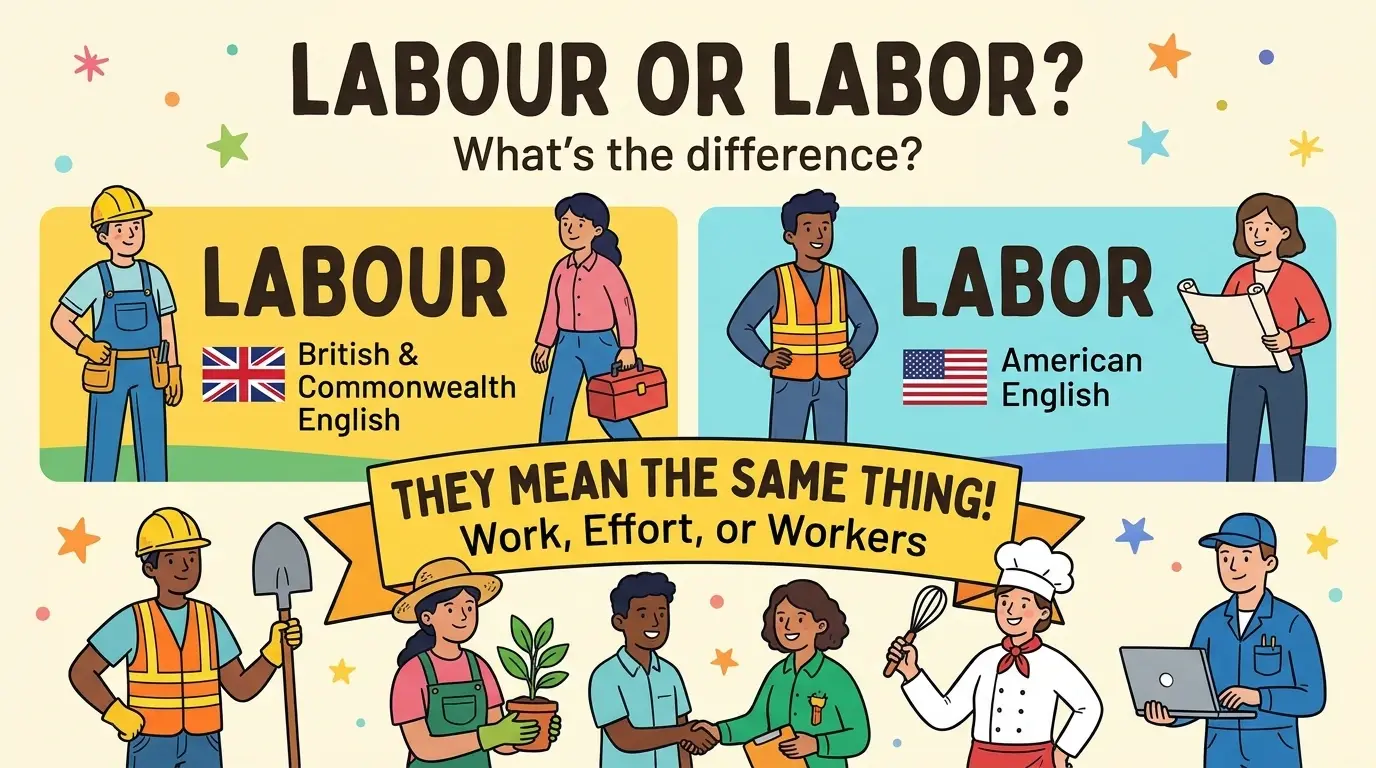
You typed “labour” in a US job application, and the hiring manager’s spellcheck lit up red. Americans write labor. The British, Canadians and most of the Commonwealth write labour.
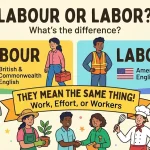
Both are correct. They are the same word with the same meaning. Only the audience changes the spelling.
If you write for a US reader, use labor. If you write for a UK or Canadian reader, use labour. Pick one spelling and keep it the same through your whole piece.
This guide covers the exceptions that trip people up, such as the Labor Party, Labor Day and laborious.
Table of Contents
- Quick Answer
- Labor vs Labour: The Difference
- Why the Spellings Split
- Which Spelling for Which Country
- The Three Exceptions
- Related Words: Labored, Laborer, Laboring
- Memory Trick
- 20 Example Sentences
- Common Mistakes
- When to Use Each Form
- FAQs
- Conclusion and Key Takeaways
Quick Answer Box
Both spellings are correct. Labor is the American English spelling. Labour is the British spelling, also used in Canada. They mean the same thing. For a US audience, always write labor. The exceptions are names: the UK’s Labour Party and Australia’s Labor Party, plus the word laborious, which has no u anywhere.
⚡ Quick Rule in 1 Line
Labor in the US, labour in the UK — but Australia’s Labor Party drops the u anyway.
What Is the Difference Between Labor and Labour?
Labor and labour mean the same thing: work, effort, or workers as a group. The only difference is spelling. Americans drop the “u” (labor), while British English keeps it (labour). Nothing else changes, including grammar, pronunciation and meaning.
Here is what the word covers:
- Hard work or effort: “The job took years of labor.”
- Workers as a group: “Labor and management reached a deal.”
- Childbirth: “She went into labor at midnight.”
- A verb: “He labored over the report all night.”
The pronunciation is the same on both sides of the Atlantic. Say “LAY-ber” either way.
| American English | British English | |
|---|---|---|
| Noun | labor | labour |
| Verb | to labor | to labour |
| Past tense | labored | laboured |
| -ing form | laboring | labouring |
| Worker | laborer | labourer |
| Plural | labors | labours |
| Holiday | Labor Day | Labour Day (Canada) |
Why Did the Spellings Split?
The split began centuries ago. Both spellings existed in English for a long time. American writers gradually settled on “-or” in the 1800s, while British writers kept “-our.” It is part of a larger pattern, not a one-time quirk.
Merriam-Webster traces the word to Middle English, from Anglo-French labur, from Latin labor. The “u” came into English through the French form.
Noah Webster gets much of the credit for the American spelling. But many of his reforms had earlier roots on both sides of the Atlantic, and he popularized certain spellings rather than inventing them. By the mid-nineteenth century, American spelling had firmly switched to the -or style.
The same split shows up in many words:
- color / colour
- honor / honour
- humor / humour
- neighbor / neighbour
- favor / favour
If you know the pattern, you can predict the spelling of dozens of words.
Which Spelling Should You Use?
Choose the spelling that matches your reader. Use “labor” for readers in the United States. Use “labour” for readers in the UK, Canada, and most Commonwealth countries. Your site and your audience decide, not personal taste.
| Country or Region | Spelling |
|---|---|
| United States | labor |
| United Kingdom | labour |
| Canada | labour |
| Australia | labour (but Labor Party) |
| New Zealand | labour |
| Ireland | labour |
| India | labour |
Canada is a common point of confusion. Canadian writing mixes both styles. Canada’s government language portal lists labour for Canadian Oxford and British spelling, and labor for Merriam-Webster (American).
Tip for US-targeted writing: If you run a US site, use “labor” everywhere. Your readers, Google’s US results, and style guides like AP and Chicago all expect it.
The Three Exceptions
Labor and labour follow the normal US/UK rule except in three cases: political party names, the word “laborious,” and a few proper nouns. These are the places where writers most often make mistakes.
Exception 1: Political Party Names
Party names are proper nouns. Their spelling is fixed, no matter where you write.
- Labour Party (UK): always with a “u.”
- Labor Party (Australia): always without a “u.”
A US writer covering UK politics must still write “Labour Party.” Do not “fix” it to American spelling.
Grammarist explains that the Australian spelling comes from the influence of the American labor movement on the party’s founders. So Australia, a “labour” country, has a “Labor” party.
Exception 2: Laborious
“Laborious” has no “u” in any country. The adjective laborious (not “labourious”) is the only correct form in both American and British English. The Canadian government’s comparison table lists “laborious” for all three standards.
- Correct: “It was a laborious process.”
- Wrong:
“It was a labourious process.”
The same goes for related words like laboratory. They come from the Latin root without the French “u.”
Exception 3: Names and Titles
Organization names keep their official spelling:
- U.S. Department of Labor
- Bureau of Labor Statistics
- International Labour Organization (ILO)
Copy the name exactly as the organization writes it.
Related Words: Labored, Laborer and More
The same rule carries over to every form of the word. Drop the “u” for American English and keep it for British English. The pattern stays consistent across the verb, adjective, and noun forms.
| American | British |
|---|---|
| labored | laboured |
| laboring | labouring |
| laborer | labourer |
| belabor | belabour |
| labor-saving | labour-saving |
| laborers | labourers |
Note: Unlike cancelled/canceled, labor has no doubled-letter issue. Only the “u” changes.
Memory Trick
Think “U in UK.” The word “labour” has a “u,” and so does “United Kingdom.” There is no “u” in “labor,” and none in “America.” Link the “u” to the UK, and you will never mix them up again.
20 Real Example Sentences
American English (labor)
- The company cut labor costs by 8 percent last year.
- Labor Day falls on the first Monday of September.
- Child labor laws protect young workers.
- She went into labor at 2 a.m.
- The laborer carried bricks all morning.
- He labored over his college essay for a week.
- The union represents skilled labor in three states.
- Manual labor can be hard on the back.
- The Department of Labor released new job numbers.
- Her breathing was labored after the run.
British and Canadian English (labour)
- The firm cut labour costs by 8 per cent last year.
- Labour Day is a holiday in Canada.
- Child labour is illegal in the UK.
- She was in labour for twelve hours.
- The labourer carried bricks all morning.
- He laboured over his essay for a week.
- The Labour Party won the seat in a close vote.
- Manual labour can be hard on the back.
- Cheap labour pushed prices down.
- The report praised the labouring families of the north.
The exceptions in use
- “The Australian Labor Party held its conference in Sydney.”
- “Writing the report was a laborious task.” (correct in both)
Common Mistakes
The most common errors involve mixing styles in one document, changing party names, and inventing “labourious.” Each one is easy to avoid with a quick check before you publish.
- Mixing spellings. Writing “labor” in one paragraph and “labour” in the next looks careless.
- Fixing the Labour Party. If you write about UK politics in American English, the party is still “Labour.”
- Writing “labourious.” This word does not exist. Use laborious.
- Changing official names. “U.S. Department of Labour” is wrong. It is “Labor.”
- Trusting spellcheck blindly. Your tool may be set to US English, and it will flag correct UK spelling. Set the language to match your audience.
- Assuming Canada uses “labor.” Canadian writers use “labour.”
When to Use Each Form
Use “labor” for US readers and “labour” for UK, Canadian, and most Commonwealth readers. Keep one style per document. Always keep proper nouns as their owners spell them.
- US blog, school essay, or business site: labor
- UK or Canadian audience: labour
- Global audience: pick one and add a style note
- Quoting a name or title: copy it exactly
- The word “laborious”: no “u,” ever
Key Takeaways
- Labor (US) and labour (UK, Canada) are the same word.
- The meaning, grammar and pronunciation do not change.
- “Laborious” is spelled without a “u” everywhere.
- The UK has the Labour Party. Australia has the Labor Party.
- US: Labor Day. Canada: Labour Day.
- The same rule applies to labored, laboring and laborer.
- Never mix both spellings in one document.
- Keep official names exactly as written.
FAQs
1. Is it labor or labour?
Both are correct. “Labor” is American English. “Labour” is British English. Choose the one that matches your reader.
2. Which spelling is used in the United States?
Use “labor.” Standard US dictionaries like Merriam-Webster list it as the main spelling, and the U.S. Department of Labor uses it in its name.
3. Do Canadians write labor or labour?
Canadians write “labour.” Canadian spelling mostly follows British forms, though it uses many American word choices.
4. Is it Labor Day or Labour Day?
In the US, it is Labor Day. In Canada, it is Labour Day.
5. Is it the Labor Party or the Labour Party?
It depends on the country. The UK party is the Labour Party. The Australian party is the Labor Party. Always use the official name.
6. Is “laborious” spelled with a “u” in British English?
No. “Laborious” has no “u” in any country. “Labourious” is not a word.
7. Is it laborer or labourer?
“Laborer” is American. “Labourer” is British. The same rule applies to labored/laboured and laboring/labouring.
8. Do labor and labour mean different things?
No. They share the same meanings: work, effort, workers as a group, and childbirth. Only the spelling differs.
9. Is it “in labor” or “in labour” for childbirth?
Americans write “in labor.” The British write “in labour.” Merriam-Webster itself lists “labour” as the British variant.
10. Which spelling is better for SEO?
Match your target audience. For a US-focused site, use “labor.” Using the wrong regional spelling can make your page look off to local readers and spellcheck tools.
Conclusion
Labor and labour are one word with two regional spellings.
Use labor for US readers and labour for UK and Canadian readers. Keep your choice consistent in each piece.
Remember the three exceptions: party names, official titles, and laborious, which never takes a “u.”
A quick check of your audience and the proper noun solves nearly every case.

As an American English writer, I specialize in creating clear and engaging content that makes grammar and language learning accessible to everyone. I enjoy breaking down complex English concepts into simple, practical lessons that readers can apply with confidence. My mission is to help learners strengthen their communication skills through easy and reliable content.