You get a job offer and reply, “I am happy to except your offer.” You hit send, and then you notice it. One wrong letter, and your sentence now says something you never meant.
Except vs accept is one of the most common mix-ups in English, and it trips up native speakers and learners alike. The two words sound almost the same, so your ear can’t help you. Your brain has to.
This guide explains what each word means, how each one behaves in a sentence, and which memory tricks actually stick.
You’ll also get a simple test, a list of common mistakes, a ten-question quiz with answers, and an FAQ. By the end, you’ll choose the right word without stopping to think.
Except vs Accept: The Quick Answer
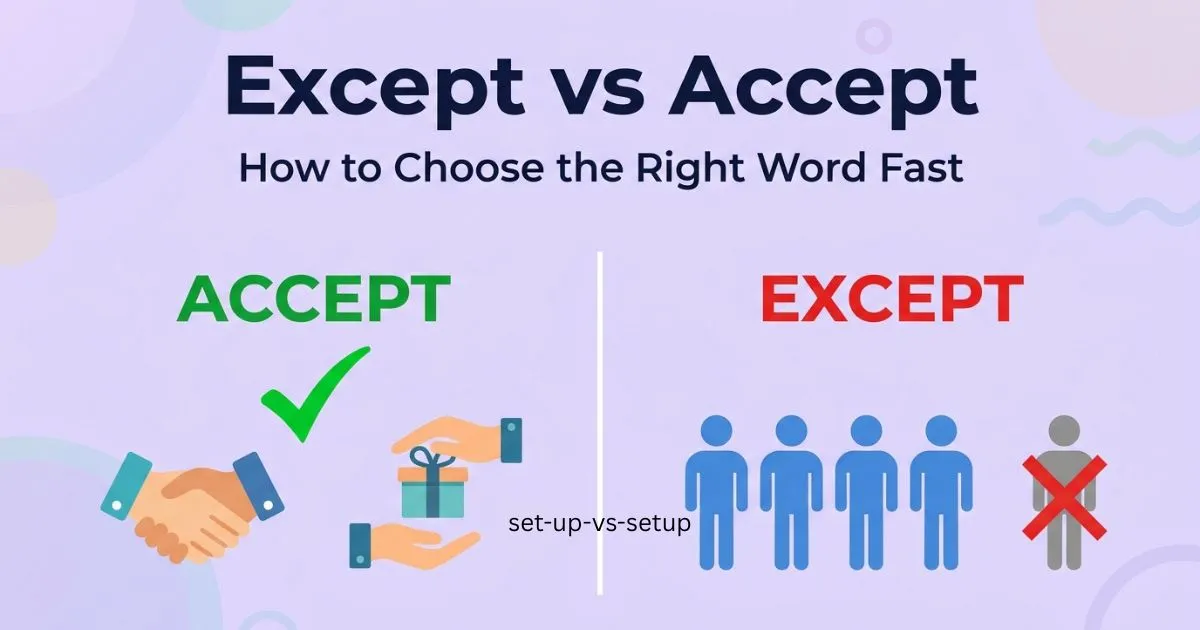
Accept is a verb. It means to receive something willingly, to agree to something, or to believe that something is true or fair.
Except usually means “not including.” It points at the person or thing that is left out.
Compare these two sentences:
- I accept your invitation. (I’m saying yes.)
- Everyone came except Hina. (Hina is the one who didn’t come.)
Rule of thumb: if someone is saying yes, receiving, or agreeing, use accept. If someone or something is being left out, use except.
Read More: A Comparison Using Like or As? Simile Rules & Examples
What Does “Accept” Mean?
Accept is an action word. Someone offers, asks, claims, or explains, and someone else takes it in. That “taking in” can be physical, emotional, or purely logical. Here are the main shades of meaning.
Accept = Receive Something Willingly
This is the most basic use. Something is offered, and you take it.
- She accepted the parcel from the courier.
- He accepted a cup of tea and sat down.
- The team accepted the trophy with big smiles.
Being admitted somewhere also counts: “Zara was accepted into her first-choice university.”
Accept = Agree to Something
Use accept when you say yes to an invitation, a proposal, or a job.
- I accepted the interview invitation this morning.
- They accepted our proposal without changes.
- Please accept my apologies for the delay.
Accept = Believe or Approve
Here, accept means you consider something true, fair, or good enough.
- The teacher accepted my explanation for being late.
- Scientists won’t accept a claim without evidence.
- The editor accepted the revised draft.
Accept = Learn to Live With Something
Sometimes accepting is less about agreeing and more about facing reality.
- It took him a while to accept the move to a new city.
- Sometimes you have to accept that a plan has failed.
Accept = Take Responsibility
- The manager accepted responsibility for the missed deadline.
- She accepted the consequences of her choice.
Accept on Signs and Notices
You’ll see this verb everywhere in daily life:
- Cards accepted here.
- The shop accepts cash only.
- The journal is no longer accepting submissions.
Forms of Accept
| Form | Example |
| accept | I accept the terms. |
| accepts | She accepts every challenge. |
| accepted | He accepted the offer. |
| accepting | They are accepting applications. |
| acceptance (noun) | Her acceptance surprised everyone. |
| acceptable (adjective) | The quality is acceptable. |
Accepted and accepting can also work as adjectives: “a widely accepted rule,” “an accepting attitude.”
Synonyms and Opposites of Accept
- Close in meaning: receive, agree to, approve, welcome, tolerate.
- Opposites: refuse, decline, reject, deny.
These aren’t perfect swaps. “Receive a gift” and “accept a gift” are close, but “accept the truth” can’t become “receive the truth.”
What Does “Except” Mean?
Except points to an exclusion. In most sentences it’s a preposition. It can also be a conjunction, and in rare cases a verb.
Except as a Preposition
This is the everyday use. Except introduces the person or thing that doesn’t fit the general statement.
- The library is open daily except Friday.
- I eat every vegetable except okra.
- All the lights were off except the one in the kitchen.
- Nobody replied except Bilal.
One small grammar point: after except, use the object form of a pronoun. Say “everyone except me,” not “everyone except I.”
Except as a Conjunction
As a conjunction, except often appears as except that. It introduces a clause that qualifies what you just said.
- The hotel was perfect, except that the Wi-Fi kept dropping.
- I’d join you, except I have to finish a report.
In academic writing, “except that” can often be replaced with however, which is a handy check.
Except For
- The room was spotless except for a few coffee rings on the table.
- Except for the price, it was an ideal flat.
Except as a Verb
As a verb, except means to leave someone or something out, or to exempt them.
- Students with a medical certificate are excepted from the fee.
You won’t need this in casual writing. Most people say exclude or exempt instead. But it’s real, and it explains why you sometimes see excepted in formal documents.
A Related Phrase: Take Exception
To “take exception” to something means to object to it. “She took exception to the tone of the email.” The noun exception belongs to the except family, not the accept family.
Synonyms of Except
- apart from
- aside from
- other than
- barring
- excluding
- but
Except vs Accept: Side-by-Side Comparison
| Accept | Except | |
| Core meaning | Receive, agree, believe | Leave out, not including |
| Usual part of speech | Verb | Preposition (also conjunction, rarely verb) |
| Typical pattern | Subject + accept + thing | Group/statement + except + thing left out |
| Opposite | Refuse, decline, reject | Include |
| Related word | Acceptance, acceptable | Exception |
| Example | I accept your offer. | Everyone agreed except Sam. |
Except or Accept? A 3-Step Test to Pick the Right Word
When you’re stuck mid-sentence, run this quick test. It takes about five seconds.
Step 1: Look for the Action
Is someone receiving, agreeing, or believing something? If a person is doing something with an offer, a gift, an apology, or an idea, you want accept.
Step 2: Try “Excluding” or “Apart From”
Replace the word with excluding or apart from. If the sentence still makes sense, the answer is except.
Step 3: Try “Agree To” or “Receive”
Replace the word with agree to or receive. If that works, the answer is accept.
Worked Examples
- “She (accepted/excepted) the offer.”
- “She excluding the offer” breaks. “She agreed to the offer” works. → accepted.
- “Everyone (accept/except) Omar left early.”
- “Everyone excluding Omar left early” works. → except.
- “We can’t (accept/except) late applications.”
- “We can’t agree to late applications” works. → accept.
Shortcut for the verb slot: if the word comes right after a subject like I, she, they, or we and describes what they do, it is almost always accept. The verb except exists, but it’s rare.
Why Do People Mix Up Accept and Except?
A few things make this pair especially slippery.
- They sound alike. In normal speech, the two words are often hard to tell apart, so you can’t rely on pronunciation.
- Both are real words. A spellchecker sees a correctly spelled word and stays quiet, even when it’s the wrong one.
- They share a Latin ancestor. Both trace back to a word meaning “to take.” The prefix ex- means “out of.” So accept is, loosely, to take something in, and except is to take something out.
- We type fast. When you’re replying to a quick message, your fingers pick the familiar shape, not the right meaning.
That last point is why a memory trick helps more than memorizing rules.
Memory Tricks That Actually Work
Trick 1: Take In vs Take Out
Picture the shared root. Accept = take in. Except = take out. If something is being taken out of the group, it’s except.
Trick 2: EX Means Out
Except starts with EX, just like exclude, exit, and expel. All of them are about something going out or being left out.
Trick 3: A for Agree
Accept starts with A. Think of A for agree or an A grade, which is something you’re happy to receive. Except starts with an X-sounding start, and an X is what you put through something you cross out.
Trick 4: Tick and Cross
Draw a tick (✓) next to accept and a cross (✗) next to except. A tick says yes. A cross says no to this one.
Trick 5: The Opposite Test
Say the opposite word in your head. If decline or reject fits the sentence, you need accept. If include fits, you need except.
Pick one trick and use it for a week. One good hook beats five half-remembered ones.
Common Mistakes (and How to Fix Them)
Mistake 1: Writing “Except” for an Offer or Invitation
- ❌ I will except your invitation.
- ✅ I will accept your invitation.
You’re agreeing, so you need the verb accept.
Mistake 2: Writing “Accept” When Someone Is Left Out
- ❌ Everyone was there accept Rafay.
- ✅ Everyone was there except Rafay.
Rafay is excluded from the group.
Mistake 3: Mixing Them Up in Apologies
- ❌ Please except my apology.
- ✅ Please accept my apology.
An apology is something you receive, not something you leave out.
Mistake 4: Writing “Accept For”
- ❌ I like every season accept for winter.
- ✅ I like every season except for winter.
Accept can’t introduce an exception. Only except can.
Mistake 5: Using “Excepted” on Notices
- ❌ Credit cards are excepted here.
- ✅ Credit cards are accepted here.
Unless you mean cards are exempt, which is rarely the point of the sign.
Mistake 6: Writing “Except” When You Mean “Expect”
- ❌ I except to hear from you soon.
- ✅ I expect to hear from you soon.
Which brings us to the third word in this family.
Accept, Except and Expect: Don’t Forget the Third Twin
Expect looks and sounds close to the other two, which makes the confusion worse. It means to believe or think that something will happen. In everyday English it also describes someone who is waiting for a baby: “They’re expecting their second child.”
Here are all three in one sentence:
I accept your deadline, except for the last section, and I expect to finish it by Friday.
A quick split: accept is about saying yes, except is about leaving out, and expect is about looking ahead.
Accept vs Except in Real-Life Writing
In Emails and the Workplace
Professional emails are where this mistake costs the most, because a wrong letter looks careless.
- “Thank you for the offer. I am pleased to accept.”
- “I can attend every session except Thursday.”
- “Please accept my apologies for the late reply.”
- “We accept payments by bank transfer.”
In School and Academic Writing
In academic texts, except mostly appears as a preposition meaning “excluding”: “All participants completed the survey except two.” Accept tends to show up when authors talk about agreeing with a theory, a finding, or a method: “Researchers widely accept this model.”
If you write essays, search your draft for both words before submitting. It takes seconds.
In Texts and Social Media
Autocorrect won’t save you here, since both words are valid. If you’re replying to a friend, a quick “Everyone’s coming except Ali” is fine. If you’re replying to a client, read it once more.
Practice Quiz: Accept or Except?
Fill in each blank with accept or except. Answers are below.
- She was happy to ______ the job offer.
- The bakery is open every day ______ Sunday.
- Please ______ my apologies for the delay.
- Everyone finished the test ______ Daniel.
- The school does not ______ late applications.
- I like all desserts ______ for coconut ones.
- He couldn’t ______ that he had lost.
- The movie was great, ______ that it was too long.
- We ______ credit cards at the counter.
- All the windows were open ______ one.
Answers: 1. accept · 2. except · 3. accept · 4. except · 5. accept · 6. except · 7. accept · 8. except · 9. accept · 10. except
Score check: 9-10 means you’ve got it. 6-8 means reread the 3-step test. Below 6 means pick one memory trick and try the quiz again tomorrow.
FAQs
1. What is the difference between except and accept?
Accept is a verb meaning to receive, agree to, or believe something. Except usually means “not including” and introduces whatever is left out. “I accept your offer” shows agreement. “Everyone came except Sana” shows exclusion. They sound alike, but they can’t replace each other.
2. Is it “accept the invitation” or “except the invitation”?
It is always “accept the invitation.” You’re agreeing to attend, which is an action, so you need the verb accept. “Except the invitation” would mean leaving it out, which is almost never what anyone intends to say.
3. Can except be a verb?
Yes, but rarely. As a verb, except means to leave out or exempt, as in “Students with permission are excepted from the rule.” In everyday writing, most people use exclude or exempt instead. If you need a verb meaning “say yes,” it’s accept.
4. Do accept and except sound the same?
Often they sound nearly identical in everyday speech, which is why the mix-up is so common. Accents vary, so you can’t depend on pronunciation to choose the spelling. Check the meaning instead: agreeing or receiving means accept, leaving out means except.
5. What is the easiest way to remember the difference?
Think “take in vs take out.” Accept takes something in, such as an offer or an idea. Except takes something out of a group. The ex- at the start of except also matches exclude, which is a quick visual reminder.
6. What is the difference between except and except for?
Before a noun, they’re often interchangeable: “everyone except Ali” and “everyone except for Ali.” At the start of a sentence, use except for: “Except for the price, it was perfect.” Use except that when a full clause follows, as in “The plan is good, except that it’s costly.”
Conclusion:
Except vs accept comes down to one question: are you taking something in, or leaving something out?
Accept is a verb for receiving, agreeing, and believing. Except marks what is not included. Run the 3-step test when you’re unsure, and use the “take in vs take out” picture if you need a quick hook.
Your next step: open the last email or document you wrote, press Ctrl+F (or Cmd+F), and search for “accept” and “except.”
Check each one against the test. It’s the fastest way to turn this lesson into a habit.

I’m Sophia Mitchell, an English grammar and writing enthusiast. I create simple, easy-to-understand content to help learners improve their English. My goal is to make grammar clear, practical, and enjoyable for everyone.



2 thoughts on “Accept vs Except: How to Choose the Right Word Fast”