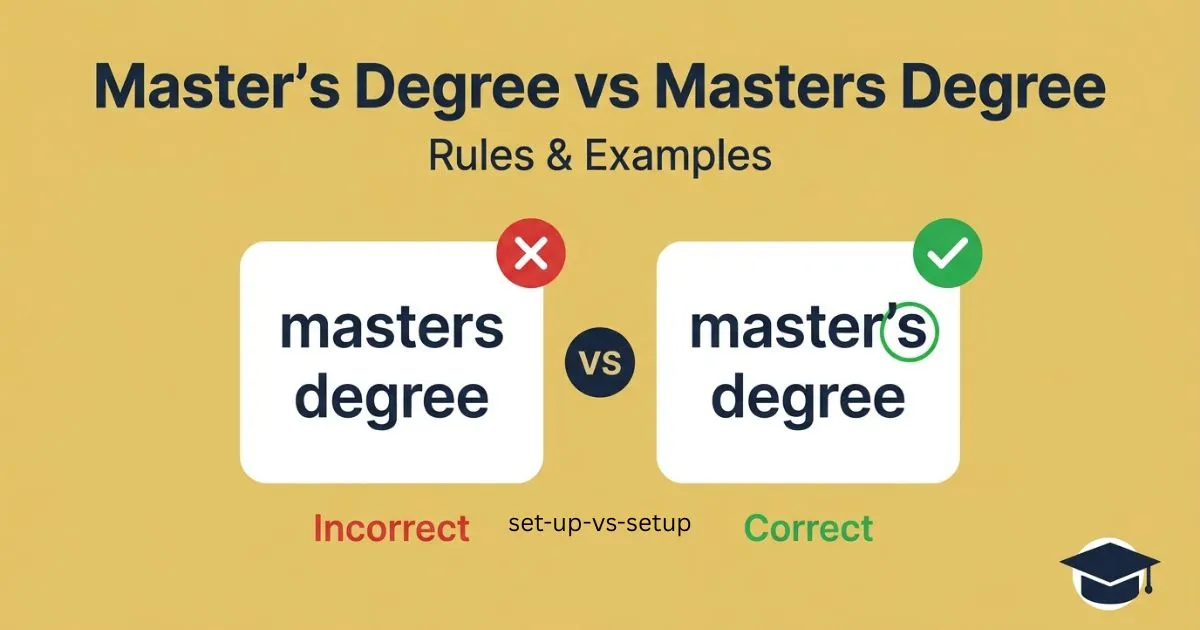
You are filling in a job application, polishing your CV, or finishing a university essay, and you stop mid-sentence. Is it master’s degree or masters degree?
Both look fine on screen, and spellcheck stays quiet, so it is tempting to guess and move on.
But one tiny apostrophe can tell a hiring manager or professor how careful you are.
In this guide you will get the correct spelling in one line, the logic behind it, and clear rules for plurals, capital letters and abbreviations like MA and MSc.
You will also find copy-ready examples for your CV and LinkedIn, a list of common mistakes, and a short practice quiz.
The Quick Answer
Write “master’s degree,” with an apostrophe.
That is the standard form in formal writing, in both US and UK English. “Masters degree” without the apostrophe is treated as an error by most grammar guides and style references.
Here is the short version of everything else you will read below:
- Lowercase in general use: She has a master’s degree.
- Capital letters for the full official title, with no apostrophe: Master of Science.
- Plural: two master’s degrees.
- Abbreviations (MA, MSc, MBA) never take an apostrophe.
What Is a Master’s Degree?
A master’s degree is a postgraduate qualification. You usually earn it after finishing a bachelor’s degree.
Depending on the program, and on whether you study full-time or part-time, it typically takes one to three years. Programs often mix coursework, research projects and sometimes a thesis or capstone project.
People pursue one to build expertise in a field, improve career options, or meet the requirements of certain professions and doctoral programs.
Some common types:
- Master of Arts (MA)
- Master of Science (MS or MSc)
- Master of Business Administration (MBA)
- Master of Laws (LLM)
- Master of Education (MEd)
- Master of Fine Arts (MFA)
- Master of Engineering (MEng)
Knowing the formal names helps, because the spelling rules change slightly when you write the full title instead of the general term. We will get to that shortly.
Read More: Is the S or C Silent in Scent? Why It Sounds Like Sent
Why “Master’s Degree” Has an Apostrophe
The apostrophe is not decoration. It changes the meaning of the phrase.
It Is Possessive, Not Plural
“Master’s” is a possessive. A master’s degree is the degree of a master, meaning a person who has reached a high level of knowledge in a subject.
Think of other possessive phrases:
- a driver’s license (the license of a driver)
- a baker’s dozen (the dozen of a baker)
- a master’s degree (the degree of a master)
Without the apostrophe, “masters” reads as a plural, as if several masters were sharing one degree. That is not what you mean.
A simple memory trick: ask yourself, “Whose degree is it?” The answer is “the master’s.” If you can answer with “of a master,” you need the apostrophe.
Why “Masters Degree” Slips Through
Here is the tricky part. “Masters” is a perfectly real English word. It is the plural of “master,” as in They are masters of their craft.
Because it is a valid word, spellcheck does not underline it. You may type “masters degree” on a job portal and see no warning at all. The tool cannot tell that you needed the possessive form.
So do not trust the red squiggle on this one. Check it yourself.
What About “Masters’ Degree”?
An apostrophe after the s would suggest one degree owned by several masters. But the degree belongs to one person, the graduate who earned it. Even when a person holds several degrees, there is still only one master in the sentence: the student.
So the form stays “master’s,” even when the number of degrees changes.
A Quick Look at History
The apostrophe form is not a modern fad. Dictionary citations quoted in a Wayword Radio forum thread show “Master’s degree” in a diary entry dated 1774. People have been writing it this way for a very long time.
How to Write the Plural: Master’s Degrees
Suppose someone holds two of them. What do you write?
Master’s degrees.
Only the word degree becomes plural. “Master’s” stays exactly as it is, because it simply describes the type of degree.
- ✅ Her résumé lists two master’s degrees.
- ❌ Her résumé lists two masters degrees.
- ❌ Her résumé lists two masters’ degrees.
The same applies when you talk about many people. The job fair attracted candidates with advanced master’s degrees. The degree is what gets counted, not the master.
Capitalization: When Do You Use Capital Letters?
Capitalization is where many confident writers slip, so take it step by step.
General Reference: Use Lowercase
When you talk about the degree in general, write it in lowercase.
- I’m working toward my master’s degree in economics.
- Many employers prefer candidates with a master’s degree.
The field of study is lowercase too, unless it is a language or another word that is always capitalized (like English or Spanish).
Formal Title: Capitalize and Drop the Apostrophe
When you name the exact degree, you are writing a formal title. Capitalize it, remove the apostrophe-s, and put “of” between the degree and the field.
- He holds a Master of Science in Computer Science.
- She completed a Master of Business Administration.
- The final step before her Master of Arts in Linguistics was the thesis.
Compare these two sentences. They describe the same achievement:
- He completed a master’s degree in chemistry. (general)
- He completed a Master of Science in Chemistry. (official title)
Both are correct. They just work at different levels of formality.
At the Start of a Sentence
If “master’s” opens a sentence, capitalize it like any other first word: Master’s programs usually require a bachelor’s degree for admission.
A Note on Conflicting Advice
You may find a guide online that capitalizes “Master’s Degree in Engineering” even in general use. Most references go the other way. They keep “master’s degree” lowercase unless it is part of the formal title or starts a sentence.
If you are unsure, follow the majority rule above. If a university, publisher or employer gives you a style guide, follow that instead.
Abbreviations: MA, M.A., MS, MSc and More
Abbreviations are a matter of style, not meaning. Still, a few habits will keep you consistent.
Do Not Add an Apostrophe
Abbreviations like MA, MSc and MBA are already in their formal form. They never need an apostrophe.
- ✅ He finished his MA in Psychology last year.
- ✅ The MSc in Environmental Science is competitive.
- ❌ He finished his MA’s in Psychology.
Periods or No Periods?
Both MA and M.A. are acceptable. Which one you pick depends on the style guide you follow.
Universities do not agree on this. Ohio University, for example, asks writers to use periods in degree abbreviations. Northeastern University prefers no periods. Modern usage leans toward dropping them, but the rule that matters is the one your institution or publication sets.
Whatever you choose, stay consistent. Do not write “BA” in one line and “M.A.” in the next.
US vs UK and Europe
Different regions use different short forms for the same degree.
- In the United States, Master of Science is normally MS or M.S.
- In UK and Commonwealth countries and much of Europe, it is usually MSc or M.Sc.
Match the form to the audience. If you are applying to a UK university, MSc will look natural. For a US employer, MS is the safer choice.
Latin-Based Abbreviations
Some universities use abbreviations from Latin. Harvard and the University of Chicago, for instance, use A.M. and S.M. for their master’s degrees. MIT uses S.M. for its Master of Science degrees.
You do not need these for everyday writing. But if you see them on a certificate or a university website, now you know why they look unfamiliar.
Writing the Abbreviation With a Field
Put “in” between the abbreviation and the subject:
- MA in History
- M.S. in Mathematics
- MBA in Finance
How to Write It on a CV, LinkedIn and Applications
Real-life writing is where this rule matters most. Here is what to use and where.
On Your CV or Résumé
Use the general form or the full formal title. Both look professional.
- Master’s degree in Finance, University of Leeds
- Master of Science in Data Analytics
If you hold both a bachelor’s and a master’s, list them with the correct possessives:
- ✅ Bachelor’s degree in Psychology; master’s degree in Education
- ❌ Bachelors in Psychology; masters Education
On LinkedIn
LinkedIn profiles often use the abbreviation, which saves space and is easy to scan.
- MSc in Marketing
- Master’s degree, University of Manchester
Pick one format and use it for every education entry, so your profile looks consistent.
In Essays and Academic Papers
Be formal. Write “master’s degree” in full. Avoid the shortcut “master’s” on its own, which is better kept for conversation.
In Speech and Casual Messages
Saying “I’m doing my master’s” is perfectly fine in conversation. People understand it, and the apostrophe stays. Just do not carry that shortcut into formal documents.
A Five-Step Check Before You Submit
- Search your document for “masters” and “master degree.”
- Replace general references with “master’s degree” (lowercase).
- Check that formal titles read “Master of ___” with capital letters and no apostrophe.
- Make sure abbreviations are consistent (all MA, or all M.A.).
- Confirm the style matches the school’s or employer’s guidelines if they gave you any.
Related Phrases: Master’s Student, Master’s Program and More
Once you know the rule, the related phrases follow the same logic. The “master’s” part stays possessive whenever it describes the degree.
- She is a master’s student in the engineering department.
- The university offers a master’s program in public policy.
- He is still writing his master’s thesis.
- The seminar is open to master’s degree students.
Notice that even when several students are involved, the word stays “master’s.” The students are plural; the degree type is not.
Some people shorten the phrase to “master’s” alone, as in “She has a master’s.” That is fine in casual speech, but in formal writing, add the word degree.
Read More: Acknowledgement or Acknowledgment? Pick the Right One
Does the Same Rule Apply to Bachelor’s Degrees?
Yes. “Bachelor’s degree” works exactly like “master’s degree.”
- ✅ She earned her bachelor’s degree in psychology.
- ❌ She earned her bachelors degree in psychology.
The formal title follows the same pattern: Bachelor of Science in Computer Science. The usual abbreviations are BA, BS or BSc.
Doctoral degrees are different. Names like PhD or Doctor of Philosophy do not involve this apostrophe question, so you can write them without worrying about it.
When You Might See “Masters Degree” Without the Apostrophe
You will occasionally notice some organizations drop the apostrophe. For example, a UK careers website, Prospects, uses “Masters degree” throughout.
That does not make it the standard form. It means that publication chose its own house style. The rules of thumb:
- Writing for a specific publication, school or employer? Follow their style guide, even if it drops the apostrophe.
- Writing for your own blog or site? You can choose. But “master’s degree” is the most common and conventional form, so it is the safer choice.
- Not sure? Use the apostrophe.
Above all, be consistent. Pick one form and use it the same way across the whole document.
Common Mistakes (and How to Fix Them)
| Mistake | Fix | Why |
| masters degree | master’s degree | The apostrophe shows the degree belongs to a master. |
| master degree | master’s degree | Without the possessive, the phrase is incomplete. |
| Masters of Science | Master of Science | In the formal title, the word is “Master,” not plural. |
| Masters in Business Administration | Master of Business Administration | The formal degree name uses “of.” |
| two masters degrees | two master’s degrees | Only “degree” becomes plural. |
| Master’s Degree (capitalized in a general sentence) | master’s degree | Capitalize only formal titles or sentence openers. |
| BA in one line and M.A. in the next | BA and MA (or B.A. and M.A.) | Keep the abbreviation style consistent. |
Two small habits catch most of these. First, read your education line out loud: if you hear “of a master,” add the apostrophe. Second, scan for the word “masters” on your final read-through.
Cheat Sheet: Keep This Handy
| Situation | Correct form |
| General reference | master’s degree |
| More than one | master’s degrees |
| Formal title | Master of Science in Chemistry |
| Abbreviation | MA, M.A., MS, MSc (pick one style) |
| With a field | MA in History |
| Student type | master’s student |
| Start of a sentence | Master’s programs require… |
| Bachelor’s level | bachelor’s degree |
Test Yourself: Quick Practice
Fill in each blank, then check your answers below.
- My cousin just started her ______ degree. (masters / master’s)
- He holds a ______ of Science from a well-known university. (Master / master)
- She has two ______ degrees. (master’s / masters / masters’)
- I am applying for a ______ program next year. (masters / master’s)
- Which is correct: “Masters in Business Administration” or “Master of Business Administration”?
Answers:
- master’s
- Master (it is part of a formal title)
- master’s
- master’s
- Master of Business Administration
FAQs
Is it master’s degree or masters degree?
The correct form is master’s degree with an apostrophe. The apostrophe shows possession: it is the degree of a master. “Masters degree” without it is considered an error in formal writing, although some publications choose that style for themselves.
Should I capitalize master’s degree?
Not in general writing. Use lowercase, as in “She earned her master’s degree.” Capitalize only when it opens a sentence or when you write the full official title, such as Master of Science, which drops the apostrophe.
How do I write more than one master’s degree?
Write master’s degrees. Only the word “degree” becomes plural, while “master’s” stays the same. For example: “He holds two master’s degrees, one in physics and one in biology.” Avoid “masters degrees” and “masters’ degrees.”
Is it Master of Science or Masters of Science?
It is Master of Science. In a formal degree title, “Master” is a title word, not a plural and not a possessive. The same applies to Master of Arts and Master of Business Administration.
Can I write just “master’s” without the word degree?
In casual speech or informal writing, yes: “I’m doing my master’s.” Keep the apostrophe. In essays, applications and other formal documents, write the full phrase “master’s degree” for clarity and professionalism.
Is it written the same way in UK English?
Yes. UK English also uses “master’s degree” with an apostrophe. Differences show up mainly in abbreviations: MSc and M.Sc. are common in the UK and Europe, while MS or M.S. is typical in the United States.
Conclusion:
The rule for master’s degree is simpler than it first looks. Use the apostrophe, because the degree belongs to a master.
Keep it lowercase in general writing, capitalize the formal title (Master of Science), pluralize only the word degree, and never add an apostrophe to abbreviations like MA or MSc.
Most of all, do not rely on spellcheck, since “masters” is a real word and will pass unnoticed.
Your next step: open your CV and LinkedIn profile right now, search for “masters,” and fix every instance. It takes two minutes, and it makes your education section look careful and professional.

I’m Sophia Mitchell, an English grammar and writing enthusiast. I create simple, easy-to-understand content to help learners improve their English. My goal is to make grammar clear, practical, and enjoyable for everyone.





1 thought on “Master’s Degree vs Masters Degree: Rules & Examples”