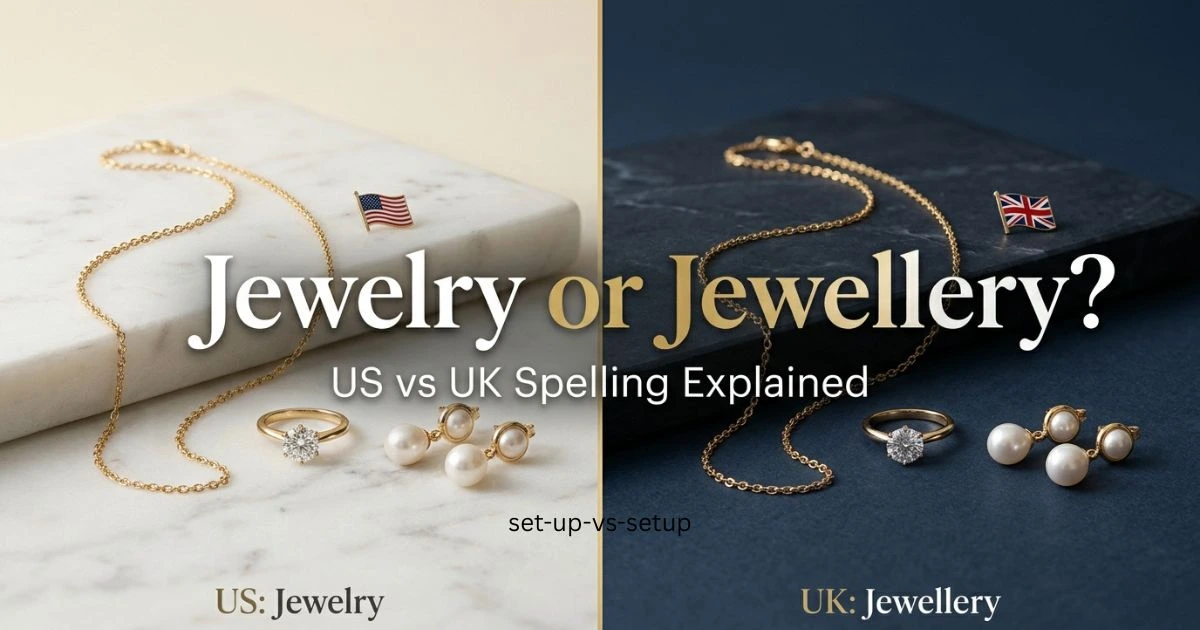
Your spellchecker just underlined “jewellery” in red. Is it wrong? In American English, write jewelry. In British English, write jewellery.
Both spellings mean the same thing. They name rings, necklaces, bracelets, and earrings. The only difference is geography.
Imagine you run a small online shop. A shopper in Texas sees “jewellery” on your page. A shopper in London sees “jewelry.” Neither is confused, but both notice. Spelling tells readers who your writing is for.
This guide gives you the simple rule, the reason behind it, and a memory trick. It also covers a sneaky third spelling, “jewelery,” which is wrong in both countries.
Table of Contents
- Introduction
- Quick Answer
- Quick Rule in 1 Line
- Jewelry vs. Jewellery: The Core Difference
- Which Countries Use Which Spelling?
- Related Words: Jeweler, Jeweled, and Jeweling
- Why Do the Spellings Differ?
- The “Jewelery” Trap
- Is the Pronunciation Different?
- Is Jewelry Countable?
- Memory Tricks
- 20 Example Sentences
- Common Mistakes
- When to Use Each Form
- FAQs
- Conclusion
- Key Takeaways
- Internal Linking Suggestions
- External References
- Schema Note
Quick Answer
Jewelry is the correct spelling in American English. Jewellery is the correct spelling in British English. It is also standard in Australia, New Zealand, India, and South Africa. Canada uses both. The meaning is identical. Never write “jewelery.” It is a common misspelling of both forms.
⚡ Quick Rule in 1 Line
Americans write jewelry; Britons write jewellery — the British version simply adds an extra L and an extra E.
Jewelry vs. Jewellery: The Core Difference
Jewelry and jewellery are two spellings of one word. American English uses jewelry. British English uses jewellery, which has an extra L and an extra E. The meaning, the sound, and the grammar stay the same. Only the spelling changes.
Merriam-Webster lists “jewelry” as the main entry. It labels “jewellery” as the chiefly British variant. Oxford’s learner dictionary does the reverse. It lists “jewellery” first and marks “jewelry” as the US form.
Here is the split at a glance.
| Feature | American English | British English |
|---|---|---|
| The word | jewelry | jewellery |
| Letter count | 7 letters | 9 letters |
| Person who makes it | jeweler | jeweller |
| Adorned with gems | jeweled | jewelled |
| Verb form (-ing) | jeweling | jewelling |
| The stone itself | jewel | jewel |
| Store | jewelry store | jewellery shop |
Notice the last row of word forms. “Jewel” is the same everywhere. Nobody writes “jewell.”
Which Countries Use Which Spelling?
The United States uses jewelry. The United Kingdom, Australia, New Zealand, India, and South Africa use jewellery. Canada accepts both. Choose the spelling that matches the country of your readers, not the country where you live.
| Country or region | Preferred spelling | Notes |
|---|---|---|
| United States | jewelry | Standard in news, shops, and schools. |
| United Kingdom | jewellery | Standard in British publications. |
| Australia | jewellery | Follows British usage. |
| New Zealand | jewellery | Follows British usage. |
| India | jewellery | Follows British usage. |
| South Africa | jewellery | Follows British usage. |
| Canada | Both | Both appear. Sources disagree on which is more common. |
Canada is the tricky case. Many Canadians follow British spelling for words like “colour.” Yet “jewelry” also appears in Canadian writing. If you write for Canadians, check your editor’s style guide. Then stay consistent.
Related Words: Jeweler, Jeweled, and Jeweling
The spelling split reaches every word built from “jewel.” American English uses one L. British English uses two. The base word “jewel” never changes. Use the same regional style for the whole family of words.
| Base idea | American English | British English |
|---|---|---|
| Collective noun | jewelry | jewellery |
| A person who makes it | jeweler | jeweller |
| Decorated with gems | jeweled | jewelled |
| Decorating with gems | jeweling | jewelling |
| A single gem | jewel | jewel |
This matches a bigger pattern. British English often doubles a final L before an ending that starts with a vowel. That is why the British write “travelled,” “cancelled,” and “jewelled.” American English usually keeps one L: “traveled,” “canceled,” “jeweled.”
Want to see the same pattern in another word? Read our guide on Cancelled vs Canceled. The logic is the same.
Why Do the Spellings Differ?
Both spellings grew from the same word, “jewel.” English borrowed it from French in the Middle Ages. American English later simplified the spelling. British English kept the longer form. Noah Webster helped make the shorter version standard in the US.
Here is the short history.
- The root traces back to the Latin word jocus, meaning a joke or a game.
- Old French turned it into a word for a small treasure or plaything.
- Middle English borrowed it as “juel,” or jewel.
- The suffix -ery (or -ry) turned “jewel” into a word for a whole collection of jewels.
So “jewelry” literally means “things made of jewels.”
Noah Webster was an early American dictionary maker. He is famous for reforming spelling to make it simpler. According to Grammarist, he did not invent the “jewelry” spelling. He did help make it part of American English. That is the same story behind “color” and “center.”
British writers never adopted the change. So the two forms have lived side by side ever since.
The “Jewelery” Trap
The spelling “jewelery” is not correct in American or British English. It mixes the two standard forms. It uses the British “-ery” ending but drops the second L. Pick either jewelry or jewellery instead.
Why do so many people write it? There are a few likely reasons:
- Some people say “JOO-luh-ree,” with an extra sound before the R. Merriam-Webster marks that pronunciation as nonstandard.
- The word looks like “jeweller,” so writers add an E out of habit.
- Autocorrect sometimes lets it slide.
Treat “jewelery” as a typo. It may pass a quick glance, but it can hurt trust. This matters most on product pages, résumés, and school papers.
Quick test: If you see three Es, you need two Ls (jewellery). If you see two Es, you need one L (jewelry). Any other mix is wrong.
Is the Pronunciation Different?
No. The pronunciation is almost the same in both countries. Most speakers say “JOO-ul-ree.” The spelling changes, but the sound does not. Many people who write “jewellery” still say it exactly like “jewelry.”
Merriam-Webster gives the standard American sound as “JOO-ul-ree.” It also notes a shorter form, “JOOL-ree.” Oxford’s learner dictionary gives the British sound as “JOO-ul-ree” too.
That is why spelling is the real problem. You cannot rely on your ear. You must remember which spelling fits your audience.
Is Jewelry Countable?
Jewelry is usually an uncountable noun. You cannot say “a jewelry” or “three jewelries.” Say “a piece of jewelry” or “some jewelry” instead. The same rule applies to jewellery in British English.
This is a grammar trap for many ESL learners. Look at these pairs.
| Incorrect | Correct |
|---|---|
| She bought a jewelry. | She bought a piece of jewelry. |
| He owns many jewelries. | He owns a lot of jewelry. |
| The jewellery were stolen. | The jewellery was stolen. |
| Three jewelleries are on sale. | Three pieces of jewellery are on sale. |
Use a singular verb with the word. Say “The jewelry is beautiful.” Do not say “The jewelry are beautiful.”
If you want to count single items, use “jewel,” “ring,” “necklace,” or “bracelet.” Those words are countable.
Memory Tricks
The easiest trick is length. The American word is shorter. The British word is longer. Remember that Americans cut the extra L and E, while Britons keep them. Use one of the tricks below.
Trick 1: Count the letters. Jewelry has 7 letters. Jewellery has 9. The shorter spelling is American.
Trick 2: Think “lean” for the US. American spelling is often lean: color, center, jewelry. British spelling often keeps more letters: colour, centre, jewellery.
Trick 3: Match the L count to the E count. Two Es go with one L (jewelry). Three Es go with two Ls (jewellery). If the pattern breaks, you have “jewelery.”
Trick 4: Link it to a word you know. You write “cancelled” in the UK and “canceled” in the US. You write “jewellery” in the UK and “jewelry” in the US. Same idea, same split.
20 Example Sentences
American English (jewelry)
- She keeps her jewelry in a small wooden box.
- The jewelry store opens at ten o’clock.
- He gave his mother a piece of silver jewelry.
- Costume jewelry is cheaper than fine jewelry.
- The thief took cash and jewelry from the house.
- My sister designs handmade jewelry for her online shop.
- Please remove all jewelry before the scan.
- The jeweler cleaned the ring for free.
British English (jewellery)
- She keeps her jewellery in a small wooden box.
- The jewellery shop opens at nine o’clock.
- He gave his mother a piece of silver jewellery.
- Costume jewellery is cheaper than fine jewellery.
- The burglar took cash and jewellery from the flat.
- My sister designs handmade jewellery for her market stall.
- Please take off all jewellery before the scan.
- The jeweller cleaned the ring for free.
Related forms
- (US) The queen wore a jeweled crown.
- (UK) The queen wore a jewelled crown.
- (US) He is jeweling the box with tiny crystals.
- (UK) He is jewelling the box with tiny crystals.
Common Mistakes
Most errors fall into five groups. Check your draft against this list before you publish.
| Mistake | Why it is wrong | Fix |
|---|---|---|
| jewelery | Mixes both spellings; not standard. | jewelry or jewellery |
| jewelrey | Extra E in the wrong place. | jewelry |
| jewellry | Doubles the L but skips the E. | jewellery |
| a jewelry / many jewelries | Treats an uncountable noun as countable. | a piece of jewelry |
| Mixing jewelry and jewellery in one text | Looks careless. | Pick one spelling and keep it. |
Another common slip is mixing a US word with a UK word nearby. For example, “jewelry” and “colour” in the same paragraph. Choose one style for the whole page.
When to Use Each Form
Use jewelry when your readers are mostly American. Use jewellery for British, Australian, New Zealand, Indian, or South African readers. For mixed audiences, choose one spelling and stay consistent. Always follow any style guide you have been given.
Here is a quick guide.
- Writing for US readers: Use jewelry, jeweler, jeweled, jeweling.
- Writing for UK or Commonwealth readers: Use jewellery, jeweller, jewelled, jewelling.
- Writing for Canadians: Both are accepted. Check your style guide and stay consistent.
- Writing for a global audience: Pick one spelling and use it everywhere on the page.
- Using a brand name: Copy the brand’s official spelling exactly, even if it differs from your style.
- Running an online store: Use the spelling your main buyers type and see in local shops.
- Writing for school or work: Follow the style your teacher or editor requires.
No spelling is “better.” The right one is the one your reader expects.
Key Takeaways
- Jewelry is American English. Jewellery is British English.
- Australia, New Zealand, India, and South Africa use jewellery.
- Canada accepts both spellings.
- The word “jewel” is spelled the same everywhere.
- “Jewelery” is a misspelling in both countries.
- Jewelry is usually uncountable. Say “a piece of jewelry.”
- The pronunciation is the same: “JOO-ul-ree.”
- Choose one spelling and keep it consistent across a page.
FAQs
1. Is it jewelry or jewellery?
Both are correct. Jewelry is the American spelling. Jewellery is the British spelling. Pick the one that matches your audience.
2. Is jewellery wrong in American English?
It is not a mistake, but it looks British. Merriam-Webster calls it a chiefly British variant. For US readers, use jewelry.
3. Is “jewelery” a real word?
No. It is a common misspelling. It blends the two correct forms. Use jewelry or jewellery instead.
4. How do Canadians spell jewelry?
Canadian English accepts both. Many Canadians follow British habits, yet “jewelry” also appears in Canadian writing. Follow your style guide and stay consistent.
5. Which spelling do Australia, New Zealand, India, and South Africa use?
They use jewellery. These countries follow British spelling in most cases.
6. Is it jeweler or jeweller?
Jeweler is American. Jeweller is British. Match it to the spelling of jewelry or jewellery in your text.
7. Is jewelry singular or plural?
It is usually uncountable. It takes a singular verb: “The jewelry is on the table.” For single items, say “a piece of jewelry.”
8. Do jewelry and jewellery sound different?
No. Most people say “JOO-ul-ree” for both. Only the spelling changes.
9. Why do Americans drop the extra L?
American English simplified many spellings. Noah Webster helped spread the shorter form. British English kept the longer one.
10. Which spelling should I use on my website?
Use the spelling your main audience expects. A US store should use jewelry. A UK store should use jewellery. Stay consistent across every page.
Conclusion:
The answer is simple. Use jewelry for American readers and jewellery for British and most Commonwealth readers.
Canada accepts both. The meaning and the sound stay the same.
Watch the related words too: jeweler or jeweller, jeweled or jewelled.
And never write “jewelery.” Pick one style, then stick with it from the first word to the last.

As an American English writer, I specialize in creating clear and engaging content that makes grammar and language learning accessible to everyone. I enjoy breaking down complex English concepts into simple, practical lessons that readers can apply with confidence. My mission is to help learners strengthen their communication skills through easy and reliable content.