“I’m just going to lay in bed all day.” You have probably typed that exact sentence. It sounds natural, and millions of people say it.
But grammar guides call it nonstandard, and in an email, essay, or exam it can make your writing look careless.
The problem is that lay and lie look and sound alike, and lay is also the past tense of lie. So sometimes the word you thought was wrong is exactly right.
This guide settles lay in bed or lie in bed for good. You will get the one rule that decides it, every verb form in a single table, the most common mistakes, and a short self-test.
Quick Answer: Lay in Bed or Lie in Bed?
Here is the short version:
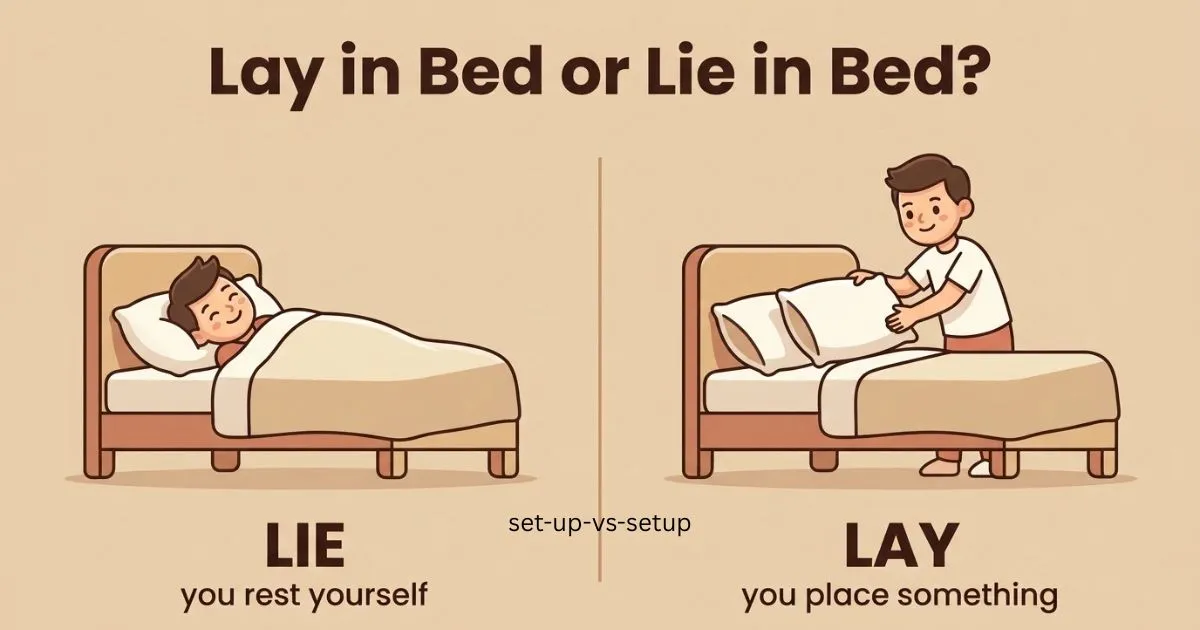
- Lie in bed means you rest or recline yourself: “I want to lie in bed for ten more minutes.”
- Lay in bed is the past tense of that same verb: “Yesterday I lay in bed until noon.”
- Lay + an object means to place something: “Lay the pillow on the bed.”
Memory shortcut: today I lie, yesterday I lay, and I have lain.
In standard written English, avoid “I’m going to lay in bed.” Write “I’m going to lie in bed” instead.
Why Lay and Lie Are So Confusing
Three things make this pair a trap.
First, the meanings overlap. Both words involve a person or thing in a horizontal position. The difference is who or what is being laid down: yourself, or something else.
Second, the past tense of “lie” is “lay.” So lay appears as the present tense of one verb and the past tense of another. Your brain sees the same word and cannot tell which job it is doing.
Third, “lie” has a second meaning. It can also mean telling an untruth, and that version has a regular past tense: lied. So you are juggling three different sets of forms.
Even native speakers struggle. One American commenter in a language-learning forum admitted she still mixes them up because nobody clearly taught her the difference at school. If this pair has confused you, you are in good company.
Read More: Set Up vs Setup: The Simple Rule to Get It Right
The One Rule That Settles It: Look for an Object
Here is the whole system in two lines.
Lie never takes an object. You do it yourself, and nothing receives the action: “I lie in bed.”
Lay always needs an object. Something is being placed: “I lay my phone on the bed.” The phone receives the action.
Grammar books call lay a transitive verb and lie an intransitive verb. If those terms make your eyes glaze over, skip them and ask one question: What am I putting down? If the answer is “something or someone else,” use lay. If you are the one reclining, use lie.
The “Put or Recline” Test
Swap the word for put or recline.
- “Please lay the bags on the table.” Does “put the bags on the table” work? Yes, so lay is right.
- “I want to lie in bed for a while.” Does “recline in bed” work? Yes, so lie is right.
If put fits, choose lay. If recline fits, choose lie.
Two Memory Tricks
For the present tense: think pLAce and recLIne. Lay begins with “la” like place. Lie begins with “li” like recline.
For the past tense of lay: use a “d” when there is a direct object. Because only lay takes an object, its past tense is laid, with a d. “I laid the book on the bed.”
Lie, Lay, Laid, Lain: Every Form in One Table
Most of the confusion disappears once you see all the forms together.
| Meaning | Present | -ing form | Past | Past participle |
| To recline | lie | lying | lay | lain |
| To place something | lay | laying | laid | laid |
| To tell an untruth | lie | lying | lied | lied |
Notice that the “recline” verb and the “untruth” verb share the same present and -ing forms but have different past forms. Only the “recline” verb uses lay as its past tense.
Lain sounds formal to many people and is not heard much in casual speech. It is still the correct form after have, has, or had.
How to Use “Lie in Bed” (Present and Future)
Use lie in bed whenever you are resting, or plan to rest, in a horizontal position. No object follows it.
- I like to lie in bed on Sunday mornings.
- She wants to lie in bed for another hour.
- You should lie in bed if you feel unwell.
- They often lie in bed and listen to the radio.
- He is going to lie in bed until the doctor arrives.
After to or going to, the verb stays in its base form, so it is always “going to lie,” never “going to lay.”
The -ing Form: Lying in Bed
For an action happening right now, use lying: “I am lying in bed right now.” Watch the spelling. It is lying, not “lieing.”
Does this sound like you are telling a fib? It does not. The -ing form of both “recline” and “tell an untruth” is lying, and the sentence context makes the meaning obvious.
When “Lay in Bed” Is Correct (Past Tense)
Lay is correct when you describe resting in bed in the past. It is the simple past of lie, and it takes no object.
- I lay in bed all morning yesterday.
- She lay in bed because she had a fever.
- He lay in bed and listened to the rain.
- We lay in bed until the alarm rang.
- The child lay in bed until his mother came home.
Look for the Time Clue
Past-tense lay usually travels with a time clue: yesterday, last night, all afternoon, until the alarm rang. If you can see a clue like that, you are almost certainly in the past tense and lay is correct.
Why “I Lay in Bed” Can Still Look Wrong
Here is the awkward part. Many people use lay where standard grammar wants the present tense lie, so a bare “I lay in bed every morning” can confuse a reader. Is it a past habit, or the nonstandard present?
The fix is simple: add a time word or choose a clearer sentence.
- Past: “Last winter, I lay in bed every morning until eight.”
- Present: “I lie in bed every morning until eight.”
After Have, Has, or Had
With a helper verb, the “recline” verb becomes lain. “I have lain in bed since morning.” “She had lain awake for hours.” The form laid here is the past participle of the other verb, so “I have laid in bed” is a mistake when you mean resting.
Lying in Bed vs. Laying in Bed
The same object rule applies to the -ing forms.
- Lying in bed is correct when you are resting: “The baby is lying under the blanket.”
- Laying needs an object: “I am laying clean sheets on the bed.”
So “I am laying in bed” is nonstandard, because nothing is being placed. Say “I am lying in bed.” If you want to check any sentence, remove the word and see whether an object follows it. If nothing follows, lying is your word.
“In Bed” or “On the Bed”?
A forum tutor on Preply confirmed that both “lying in bed” and “lying on the bed” are correct. The verb is the same, so only the preposition changes.
- In bed is the standard phrase for resting or sleeping there: “I was lying in bed when you called.”
- On the bed points to the piece of furniture itself, often on top of the covers: “The cat is lying on the bed.”
Whichever you choose, the verb rule does not change. It is still lie, lay, lain.
Common Mistakes and Quick Fixes
Check your writing for these six patterns.
- ❌ I’m going to lay in bed. → ✅ I’m going to lie in bed.
- ❌ I was laying in bed. → ✅ I was lying in bed.
- ❌ I have laid in bed all day. → ✅ I have lain in bed all day.
- ❌ I layed in bed yesterday. → ✅ I lay in bed yesterday. (“Layed” is not the standard form.)
- ❌ I lied in bed yesterday. → ✅ I lay in bed yesterday. (Lied means you told an untruth.)
- ❌ She is laying beside me. → ✅ She is lying beside me.
In every case the cure is the same: find out whether there is an object, then check the tense.
Is It Okay to Say “Lay in Bed” in Casual Speech?
Honestly, people say it all the time. Dictionary-based guides describe this use of lay as nonstandard but very common, and they note that lay and lie are often swapped in casual communication. In a text to a friend, nobody will blink.
The advice from those same guides is to use the standard forms in formal contexts. A practical way to apply that:
- Use standard lie in essays, exams, job applications, business emails, and anything you publish.
- Relax a little in casual chat, but know the correct form so you can choose it deliberately.
Knowing the rule is what gives you the choice.
Lie Down vs. Lay Down
This phrase causes the same confusion and follows the same rule.
- Lie down means to put yourself in a resting position: “I need to lie down for a bit.”
- Lay down means to put something down: “Lay down your bags by the door.”
The past tense trap applies here too. Because lay is the past of lie, “Yesterday I lay down for an hour after practice” is correct. “Lay down” for yourself in the present, as in “I’m going to lay down,” is the common nonstandard version.
A related phrase uses the -ing form: “Don’t leave dirty clothes lying around.” Nothing is being placed, so it is lying.
Quick Self-Test
Choose the correct word for each blank. Answers are below.
- I’m so tired. I’m going to ____ down for a while. (lie / lay)
- Please ____ the blanket on the bed. (lie / lay)
- Last night I ____ awake for hours. (lay / laid)
- She has ____ in bed since morning. (lain / laid)
- He ____ the keys on the table and left. (lay / laid)
Answers: 1. lie (you are reclining). 2. lay (the blanket is the object). 3. lay (past of lie, no object). 4. lain (past participle of lie). 5. laid (past of lay, the keys are the object).
If you got four or five right, you already understand the system.
FAQs
Is it “lay in bed” or “lie in bed”?
Both can be correct, depending on tense. “Lie in bed” is the present form: “I lie in bed every morning.” “Lay in bed” is the past form: “I lay in bed yesterday.” If you mean resting right now or in the future, choose lie.
Is “I’m going to lay in bed” correct?
In standard English, no. After “going to,” use the base form lie: “I’m going to lie in bed.” You are describing your own resting, and no object follows. Many people say “lay” in casual speech, but standard writing prefers lie.
Is it “lying in bed” or “laying in bed”?
“Lying in bed” is correct for resting. “Laying” needs an object, as in “I am laying a blanket on the bed.” Also remember the spelling: it is lying, never “lieing.”
What is the past tense of “lie in bed”?
The past tense is lay: “Yesterday I lay in bed all afternoon.” The past participle is lain, used after have, has, or had: “I have lain in bed since noon.” Laid belongs to the other verb, lay, meaning to place.
Should I say “I have lain” or “I have laid” in bed?
Say “I have lain in bed” when you mean resting. Laid is the past participle of lay, which needs an object, such as “I have laid my clothes on the bed.” Without an object, lain is the form you want.
Why do so many native speakers say “lay” instead of “lie”?
Because the two verbs overlap and lay is also the past tense of lie. Guides call this use nonstandard but common. Some native speakers also say they were never taught the difference clearly at school. In formal writing, stick with lie.
Conclusion:
So, lay in bed or lie in bed? Use lie when you are resting now or plan to rest. Use lay when you describe that resting in the past.
Use lay with an object when you place something. Remember the forms: lie, lay, lain, and lying.
Your next step is easy. Open the last thing you wrote, search for “lay” and “laying,” and ask each time: Is there an object, and what is the tense?
A few minutes of checking will make the rule automatic.

I’m Sophia Mitchell, an English grammar and writing enthusiast. I create simple, easy-to-understand content to help learners improve their English. My goal is to make grammar clear, practical, and enjoyable for everyone.