Someone tells you the whole thing was a setup. Someone else says he was set up. The letters are the same and the sounds are identical, yet one version has a space and the other doesn’t.
So which one is right? Both are, depending on the job the word does in the sentence. That’s the heart of the set up vs setup question, and it trips up writers in emails, reports, and school work all the time.
In this guide you’ll learn what each form means, four quick tests for choosing correctly, how the hyphenated set-up fits in, and which mistakes to watch for. A short quiz at the end lets you check yourself.
The Short Answer: Verb or Noun?
Here is the whole idea in three lines:
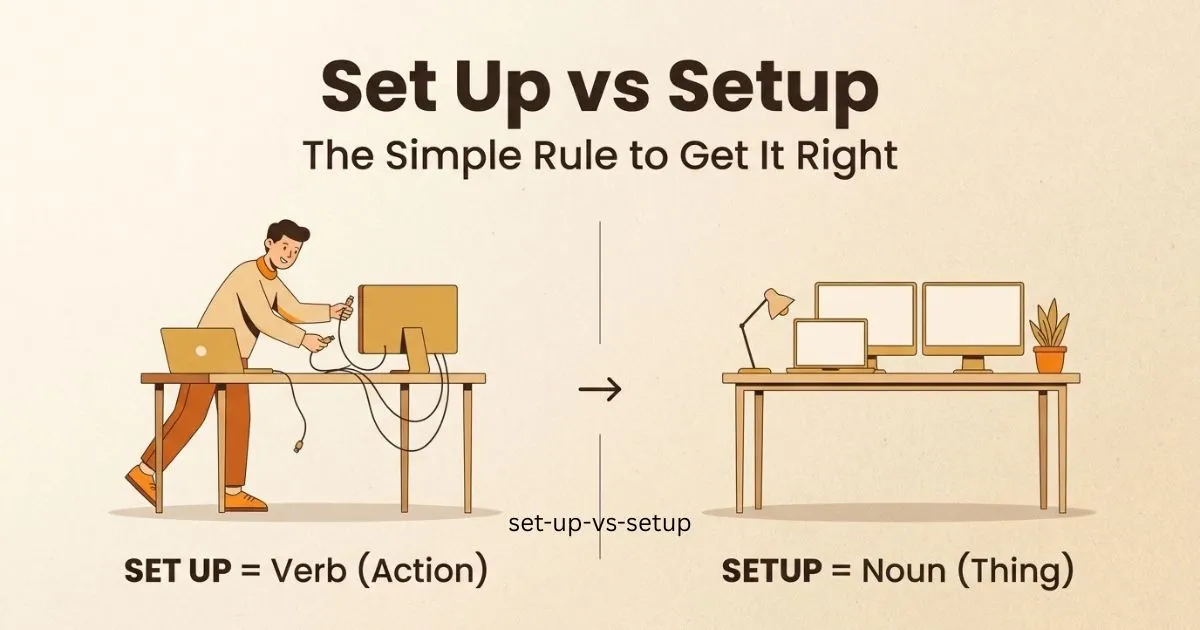
- Set up (two words) is a verb. It is the action: to arrange, prepare, install, or establish something.
- Setup (one word) is a noun or an adjective. It is the thing: an arrangement, a configuration, a preparation process, or a trick.
- Set-up (with a hyphen) is a variant of the noun and adjective, more common in British writing. It is never the verb.
If someone is doing something, write set up. If you are naming or describing something, write setup.
Compare:
- Please set up the projector. (action)
- The projector setup is ready. (thing)
What Does “Set Up” Mean?
Set up is a phrasal verb: the verb set joined with the particle up. Together they describe arranging or preparing something. Whenever it works as a verb, it stays two words.
Common meanings
- Arrange or organize: set up a meeting, set up a classroom
- Prepare equipment: set up a printer, set up a new phone
- Establish something new: set up a business, set up a scholarship fund
- Arrange a situation for someone: friends set her up on a blind date
- Frame or trap someone: the suspect claimed the police had set him up
Handy synonyms include arrange, assemble, build, construct, create, establish, and open.
Set up can be split
Set up is a transitive phrasal verb, which means it takes an object. That object can sit after the phrase or in the middle of it:
- Can you set up the decorations?
- Can you set the decorations up?
When the object is a pronoun, it goes in the middle: set it up, set them up. Standard English doesn’t use “set up it.”
This splitting is a useful clue. Anything you can pull apart like this is a verb, so it needs the space. The one-word setup can never be split.
Forms and tenses
The verb set is irregular. It stays the same in the present, the past, and the past participle. The only form that changes is the -ing form.
| Form | Spelling | Example |
|---|---|---|
| Base form | set up | I always set up the room early. |
| Third person | sets up | She sets up the meetings. |
| Past | set up | He set up the office yesterday. |
| Past participle | set up | We have set up the system. |
| -ing form | setting up | They are setting up the stage. |
A common slip is writing “setup” for the past tense. It stays two words: “She set up the meeting,” not “She setup the meeting.”
Read More: Himself or Hisself? The Answer, Plus Why It Exists
What Does “Setup” Mean?
Setup is one word, and it works as a noun or an adjective. It never acts as the verb.
Setup as a noun
As a noun, setup names the way something is arranged or prepared. It can mean:
- An arrangement: “I like the setup of your new kitchen.”
- A configuration: “My desk setup includes two monitors.”
- A preparation process: “The console setup is complicated.”
- A trick or trap: “He realized the meeting was a setup.”
Notice that each sentence names something. Nobody is performing an action on it.
Setup as an adjective
Setup can also sit in front of another noun and describe it. Grammar books call this a noun used as an adjective. It tells you what kind of thing the second noun is.
Common examples: setup guide, setup screen, setup instructions, setup crew, setup fee, setup time.
Try it in a sentence: “Read the setup guide before you plug anything in.” The word guide is the real subject. Setup just tells you which guide.
Set Up vs Setup: Four Quick Tests
When you’re unsure, run your sentence through these tests. Most sentences get a clear answer from the first or second.
1. The action test
Is someone doing something? Then you need the verb: set up. “I’ll set up the account tonight.”
2. The article test
Can you put a, an, or the in front of the word? Then it’s a noun: setup. “The setup was easy.” “We need a better setup.”
3. The swap test
Try replacing the word. If arrange fits, write set up. If arrangement fits, write setup.
- “I’ll arrange the room” works, so: I’ll set up the room.
- “My office arrangement looks tidy” works, so: My office setup looks tidy.
4. The split test
Can you slide the object between set and up? Then it’s the verb. “Set the laptop up” sounds natural, so the verb is set up. There is no way to split setup like that, which is why “setup the laptop” is wrong.
Still stuck? Look at the word that follows. If it’s a noun like guide, screen, or fee, you almost certainly want the adjective setup.
Side-by-Side Comparison
| Set up | Setup | |
|---|---|---|
| Spelling | Two words | One word |
| Part of speech | Verb (phrasal) | Noun or adjective |
| Core meaning | To arrange, prepare, install, establish | An arrangement, configuration, or preparation process |
| Can be split? | Yes: set it up | No |
| Past tense | set up (unchanged) | Not applicable |
| -ing form | setting up | Not applicable |
| Example | I set up my laptop. | My laptop setup is simple. |
| Swap test | arrange fits | arrangement fits |
The two forms can’t trade places. “Let’s speed up the setup” is correct, while “Let’s speed up the set up” is not.
Set Up vs Setup in Everyday Situations
Meetings and appointments
When you arrange one, use the verb: “I’ll set up a call with the client.” You can also split it: “I’ll set a call up.” When you talk about how the room or equipment is arranged, use the noun: “The meeting setup is ready, with one screen and six chairs.”
Computers, phones, and gadgets
“I need to set up my new phone” is an action. “The phone setup is complete” refers to the finished process.
Watch the -ing form too. “Setting up the router” is an action, while “the router setup” is a thing.
Businesses and events
“They want to set up a café” describes starting something. “Their business setup is unusual” describes how it is organized. Events follow the same split: “The crew will set up the stage” versus “The stage setup looks impressive.”
Being framed
This is where both forms meet in one story. Verb: “The police set him up,” or in the passive, “He was set up.” Noun: “It was a setup.” The verb tells us what someone did. The noun names the trap itself.
When “Set Up” Describes a State
There’s one case that surprises people. Look at this sentence:
“The conference room is set up for the meeting.”
Here set up sits after is and describes the room’s condition. It’s a past participle doing the work of an adjective, so it keeps the space. Nobody is performing an action in the sentence, but the verb is still behind the word.
Compare it with a noun in the same area:
- “Everything is set up.” (state, two words)
- “Everything about the setup is fine.” (noun, one word)
A quick check: if you can swap in arranged or ready, use set up. If you can add the before it, use setup.
What About “Set-Up” With a Hyphen?
You may run into set-up with a hyphen and wonder whether it’s a typo. It isn’t. Here’s how it works:
- As a noun or adjective, set-up is an accepted variant of setup. It shows up more often in British writing, while American writing leans toward the one-word form.
- As a verb, it doesn’t exist. The verb is always two words: “set up.” Writing “to set-up” is wrong.
- Consistency matters. Pick one spelling for the noun and adjective and use it throughout. Writing “a lovely setup” in one paragraph and “a set-up fee” in the next looks careless.
- Style guides win. GrammarBook suggests skipping the hyphen unless you’ve been told to use it, so follow your publisher’s or employer’s guide if you have one.
Here’s a useful way to remember it: the hyphen is a matter of regional style, but the space is a matter of grammar. Whether you write setup or set-up, the verb stays set up in both American and British English.
Common Mistakes and Quick Fixes
1. Using setup as a verb
- Wrong: I need to setup my laptop.
- Right: I need to set up my laptop.
2. Using set up as a noun
- Wrong: My desk set up is tidy.
- Right: My desk setup is tidy.
3. Splitting the adjective
- Wrong: Read the set up guide.
- Right: Read the setup guide.
4. Using setup for the past tense
- Wrong: She setup the meeting yesterday.
- Right: She set up the meeting yesterday.
5. Putting the pronoun in the wrong place
- Wrong: I’ll set up it tonight.
- Right: I’ll set it up tonight.
6. Mixing styles in one document
- Wrong: The set-up was simple, but the setup fee was high.
- Right: Choose one spelling for the noun and adjective and keep it throughout.
Practice: Pick the Right Form
Choose set up, setup, or setting up for each blank.
- Can you help me ___ the new printer?
- The ___ instructions are printed on the box.
- She ___ her own bakery last year.
- I like the ___ of your home office.
- The tables are already ___ for the party.
- Don’t trust him. The whole offer was a ___.
- We are ___ the stage right now.
- Please ___ the sound system before the guests arrive.
Answers
- set up (verb after “help me”)
- setup (adjective before “instructions”)
- set up (past tense)
- setup (noun after “the”)
- set up (describes the tables’ condition)
- setup (noun after “a”)
- setting up (-ing form of the verb)
- set up (verb after “please”)
FAQs
1. Is it setup or set up?
Both are correct, but they do different jobs. Set up is the verb: “I’ll set up my account.” Setup is the noun or adjective: “The setup is easy” or “setup guide.” If someone is performing an action, write two words. If you are naming an arrangement or describing one, write one word.
2. Do I write “set up a meeting” or “setup a meeting”?
Write set up a meeting. You are performing an action on the meeting, so you need the two-word verb. Setup only works when it names something, as in “the meeting setup,” which refers to how the meeting is arranged. You can also split the verb: “set a meeting up.”
3. Is “set-up” with a hyphen correct?
Yes, as a noun or adjective. The hyphenated form is more common in British writing, while American writing usually prefers setup. It is never the verb, which stays set up. Whichever spelling you choose, use it consistently throughout your text, unless a style guide tells you otherwise.
4. What is the past tense of set up?
It stays set up. The verb set does not change in the past tense or the past participle, so you write “She set up the office yesterday” and “We have set up the system.” Only the -ing form changes: setting up.
5. Can setup be an adjective?
Yes. When setup comes before another noun and describes it, it works as an adjective. Common examples are setup guide, setup screen, setup fee, and setup instructions. In these phrases, setup tells you what kind of thing the noun is. No action is being performed, so the one-word form is correct.
6. Is it “computer setup” or “computer set up”?
It depends on the sentence. “My computer setup is simple” names an arrangement, so use one word. “I need to set up my computer” describes an action, so use two. If you can put a, an, or the before the word, choose setup. If you can split it around the object, choose set up.
7. Is it “he was set up” or “he was setup”?
Use both, in different roles. “The police set him up” and “he was set up” use the verb, so write two words. “It was a setup” uses the noun, so write one word. The verb means someone arranged a trap for him. The noun names the trap itself.
Conclusion:
The set up vs setup question comes down to one idea: is the word an action or a thing?
Write set up when someone is arranging, preparing, installing, or establishing something. Write setup when you’re naming an arrangement or describing it with a noun like guide, fee, or screen.
The hyphenated set-up is only a regional variant of the noun and adjective.
Your next step is simple. Open your latest draft, search for both spellings, and run each hit through the action test and the article test. Fix any that fail, and you’ll rarely get this pair wrong again.

As an American English writer, I specialize in creating clear and engaging content that makes grammar and language learning accessible to everyone. I enjoy breaking down complex English concepts into simple, practical lessons that readers can apply with confidence. My mission is to help learners strengthen their communication skills through easy and reliable content.