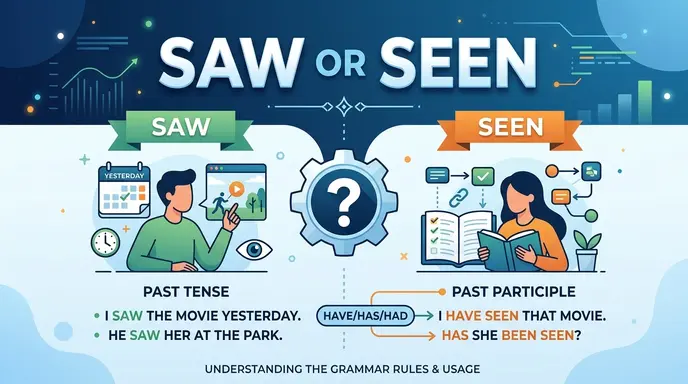
Saw is the simple past form of see, while seen is the past participle. You use them differently.
You might write a text about a movie and pause: “I saw it” or “I seen it”? Both words come from the same verb, but only one works in that sentence.
The confusion happens because see is an irregular verb. Its three main forms are see, saw, seen. Cambridge lists saw as the past tense and seen as the past participle.
The basic rule is simple. Use saw for the simple past, such as “I saw him yesterday.” Use seen with a helping verb, such as “I have seen him before.”
Quick Answer
Saw is the simple past form of see. Seen is the past participle. Use saw by itself for a completed past action. Use seen with a helping verb such as have, has, or had. For example, “I saw the movie” and “I have seen the movie” are both correct.
Quick Rule
Use saw alone for simple past actions, but use seen after have, has, or had.
What Is the Difference Between Saw or Seen?
Saw and seen are two different forms of the irregular verb see. Saw is the simple past form and can stand as the main verb. Seen is the past participle and normally needs a helping verb, such as have, has, or had.
Compare these sentences:
I saw the movie yesterday.
I have seen the movie before.
Both sentences describe seeing a movie.
However, their grammar is different.
In the first sentence, saw is the simple past verb.
In the second sentence, seen is a past participle used with have.
The basic pattern
see → present
saw → simple past
seen → past participle
This pattern is worth memorizing because see does not follow the regular -ed pattern.
You do not say:
I seed the movie.
You say:
I saw the movie.
You also do not normally say:
I seen the movie.
You say:
I have seen the movie.
Cambridge’s irregular verb table lists the three forms as see, saw, seen.
Read More: In or On: What’s the Difference? Simple Rules and ExamplesWhat Does “Saw” Mean?
Saw is the simple past form of see. Use it when you are talking about something that happened and finished in the past. It can usually stand alone without have, has, or had.
For example:
I saw John yesterday.
The action happened in the past.
You can also use saw with a specific past-time expression:
- yesterday
- last night
- last week
- two days ago
- in 2025
- this morning, when the period is finished
Examples:
I saw her yesterday.
We saw that movie last weekend.
She saw her teacher at the store.
They saw a strange light last night.
The important point is that saw is the simple past form.
Saw does not need “have”
You can say:
I saw him.
You do not need a helping verb.
But if you want to use the present perfect, you need seen:
I have seen him.
Not:
I have saw him.
What Does “Seen” Mean?
Seen is the past participle form of see. It usually appears with a helping verb, such as have, has, or had. It can also appear in passive constructions with forms of be.
For example:
I have seen that movie.
She has seen the message.
They had seen the warning.
Here, seen cannot normally stand alone as the main past-tense verb.
This is why the following sentence is incorrect in standard English:
❌ I seen the movie yesterday.
The correct sentence is:
✅ I saw the movie yesterday.
However:
✅ I have seen the movie before.
The helping verb have makes seen correct.
See, Saw, and Seen Verb Forms
The verb see has three important forms that you should learn together. Cambridge lists see as the base form, saw as the past tense, and seen as the past participle.
| Verb Form | Word | Example |
| Base form | see | I see the problem. |
| Simple past | saw | I saw the problem. |
| Past participle | seen | I have seen the problem. |
| Present participle | seeing | I am seeing the problem. |
See
Use see for the base or present form.
I see the mountain.
Saw
Use saw for the simple past.
I saw the mountain yesterday.
Seen
Use seen as the past participle.
I have seen the mountain before.
Seeing
Use seeing as the present participle or gerund.
I am seeing the doctor tomorrow.
Cambridge notes that seeing can also be used for arrangements to meet someone.
1st, 2nd, and 3rd Form of See (V1, V2, V3)
The three forms of see are see (V1), saw (V2), and seen (V3). Saw is the second form. Seen is the third form.
| Form | Word | Example |
|---|---|---|
| V1 (base) | see | I see the sign. |
| V2 (simple past) | saw | I saw the sign. |
| V3 (past participle) | seen | I have seen the sign. |
With he, she, or it, V1 becomes sees: “She sees the sign.”
Sees is still present tense. It is not the past.
Is “Seen” a Verb? Is It Past Tense?
Yes, seen is a verb. It is the past participle of see. It is not the simple past tense, and it is not present tense either.
Seen does not show the tense by itself. The helping verb does that:
- has seen = present perfect
- had seen = past perfect
- was seen = passive past
If you want a simple past verb, use saw.
See, Seen, or Seeing?
See is the base form. Seen is the past participle and needs a helper. Seeing is the -ing form.
| Form | Usually comes after | Example |
|---|---|---|
| see | will, can, to, did | I can see it. |
| seen | have, has, had, was, were | I have seen it. |
| seeing | am, is, are, was, were | She is seeing the doctor today. |
Common errors:
❌ I will seen him.
✅ I will see him.
For ordinary sight, people usually say “I can see it,” not “I am seeing it.” Seeing is more natural when it means meeting someone.
Seeing has no past form of its own. Use saw, or was seeing for an action that was in progress.
When to Use “Saw”
Use saw when you are describing a completed action in the simple past. It is especially common with finished past-time expressions such as yesterday, last week, or two hours ago.
Example 1
I saw Sarah yesterday.
The action happened yesterday.
Example 2
We saw a great movie last night.
The movie was watched in a finished past period.
Example 3
He saw an accident on Monday.
The action happened on Monday.
Example 4
They saw the new building last week.
Again, saw describes a completed past action.
Common pattern
Subject + saw + object
Examples:
I saw him.
She saw the dog.
We saw the show.
They saw the problem.
You do not need have or had with saw in the simple past.
Was Seen or Were Seen?
Use was seen with one person or thing. Use were seen with more than one. This is the passive voice: be + seen.
The thief was last seen near the station.
Two boys were seen outside the gate.
The same pattern works with other forms of be:
- The star is seen at night.
- The signs are seen from far away.
- The problem has been seen before.
- That mountain can be seen from here.
Always match was/were to the subject. Seen does not change.
When to Use “Seen”
Use seen when the sentence requires a past participle. The most common pattern is have/has/had + seen. It can also occur in passive structures with forms of be.
Have seen
I have seen that movie.
Has seen
She has seen the report.
Had seen
They had seen the warning before.
Was seen
The bird was seen near the lake.
Have you seen…?
This is also a very common question:
Have you seen my keys?
Here, seen is correct because it follows have.
You would not write:
❌ Have you saw my keys?
The correct form is:
✅ Have you seen my keys?
Saw vs Seen Examples
The easiest way to understand the difference is to compare the forms in complete sentences.
| Incorrect | Correct | Why? |
| I seen him yesterday. | I saw him yesterday. | Simple past needs saw. |
| I have saw that movie. | I have seen that movie. | Have needs the past participle. |
| She seen the message. | She saw the message. | Simple past needs saw. |
| We had saw it before. | We had seen it before. | Had needs seen. |
| Did you saw him? | Did you see him? | Did takes the base form. |
| He has saw the result. | He has seen the result. | Has needs the past participle. |
Notice something important in the fifth example.
After did, you use see, not saw.
That rule is explained below.
Saw or Seen After “Did”?
After did, use the base form see, not saw or seen. This happens because did already carries the past tense. The main verb returns to its base form.
Correct:
Did you see the movie?
Incorrect:
❌ Did you saw the movie?
Incorrect:
❌ Did you seen the movie?
The same rule applies to negative sentences.
Correct:
I did not see him yesterday.
Incorrect:
I did not saw him yesterday.
Why?
Think of did as carrying the past tense.
Did + see
Not:
Did + saw
This pattern applies to many English verbs.
Compare:
Did you go?
Not:
Did you went?
And:
Did you eat?
Not:
Did you ate?
So:
Did you see?
is the correct structure.
Saw or Seen With “Have,” “Has,” and “Had”?
After have, has, or had, use seen, not saw, when you are forming a perfect tense. These helping verbs combine with the past participle. Therefore, the correct patterns are have seen, has seen, and had seen.
Have seen
I have seen this movie before.
Has seen
She has seen the doctor.
Had seen
He had seen the message earlier.
Compare:
❌ I have saw it.
✅ I have seen it.
❌ She has saw him.
✅ She has seen him.
❌ They had saw the accident.
✅ They had seen the accident.
Easy formula
Have + seen
Has + seen
Had + seen
If you see have, has, or had before this verb, seen is usually the form you need.
Has Seen or Have Seen?
Use has seen with he, she, it, or one person or thing. Use have seen with I, you, we, they, or more than one.
| Subject | Correct form |
|---|---|
| I / You | I have seen it. |
| He / She / It | She has seen it. |
| We / They | They have seen it. |
| One person or thing | The manager has seen it. |
| More than one | The students have seen it. |
Only has/have changes. Seen stays the same.
❌ He have seen it.
❌ They has seen it.
Singular “they” also takes have.
20 Real Examples of “Saw”
- I saw him at the store yesterday.
- She saw the message this morning.
- We saw a beautiful sunset.
- They saw the movie last night.
- He saw his friend at school.
- I saw your car outside.
- She saw an interesting article yesterday.
- We saw the doctor on Monday.
- They saw a bird in the garden.
- He saw the accident happen.
- I saw your brother downtown.
- She saw the problem immediately.
- We saw several animals at the zoo.
- They saw the new restaurant last week.
- He saw the results yesterday.
- I saw her at the airport.
- She saw a strange light outside.
- We saw the team play last weekend.
- They saw the changes earlier.
- He saw the answer on the board.
These examples use saw as the simple past form.
20 Real Examples of “Seen”
- I have seen that movie before.
- She has seen the report.
- We have seen this problem before.
- They have seen the new design.
- He has seen your message.
- I had seen the building before.
- She had seen him earlier.
- We had seen the warning.
- They had seen the results.
- Have you seen my keys?
- Has she seen the email?
- Have they seen the new website?
- I have never seen snow.
- She has already seen that film.
- We have seen enough evidence.
- He has seen many changes.
- The mistake was seen by the teacher.
- The bird was seen near the house.
- The problem has been seen before.
- The movie had been seen by millions.
These examples show seen working as a past participle.
Common Mistakes With Saw and Seen
The most common mistakes happen when writers use saw and seen in the wrong grammatical structure. The easiest fix is to check the word before the verb.
Mistake 1: “I seen”
❌ I seen him yesterday.
✅ I saw him yesterday.
Why?
There is no helping verb before seen.
The simple past needs saw.
Mistake 2: “I have saw”
❌ I have saw that movie.
✅ I have seen that movie.
Why?
Have requires the past participle.
The correct form is have seen.
Mistake 3: “Did you saw?”
❌ Did you saw the movie?
✅ Did you see the movie?
Why?
After did, use the base form see.
Mistake 4: “She has saw”
❌ She has saw the email.
✅ She has seen the email.
Why?
Has is the helping verb, so you need seen.
Mistake 5: “We had saw”
❌ We had saw the accident.
✅ We had seen the accident.
Why?
Had + past participle creates the past perfect.
The correct form is had seen.
Saw vs Seen in Questions
Questions can make this distinction confusing.
The correct form depends on the helping verb.
Simple past question
Did you see him?
Use see after did.
Present perfect question
Have you seen him?
Use seen after have.
Past perfect question
Had you seen him before?
Use seen after had.
Compare all three:
| Question | Correct form | Tense |
| Did you see him? | See | Simple past |
| Have you seen him? | Seen | Present perfect |
| Had you seen him? | Seen | Past perfect |
This is a useful pattern to memorize.
Saw or Seen With “I”
The phrase I saw is correct when you are using the simple past.
I saw him yesterday.
The phrase I have seen is correct when you are using the present perfect.
I have seen him before.
But:
❌ I seen him yesterday.
is not the standard form.
The key is not the subject I.
The key is the verb structure.
Compare
I saw
I have seen
I had seen
I did see
These are all correct.
But they use different verb structures.
Saw or Seen With He, She, We, and They?
The subject does not change the rule. Saw works alone for the simple past. Seen needs a helping verb. This is true for every subject.
| Subject | Simple past | With a helper |
|---|---|---|
| He | He saw it. | He has seen it. |
| She | She saw it. | She has seen it. |
| We | We saw it. | We have seen it. |
| They | They saw it. | They had seen it. |
Saw never changes with the subject.
You may hear “she seen it” or “they seen it” in casual speech. It is nonstandard. In school, exams, and work writing, use saw.
Saw vs Have Seen: What’s the Difference in Meaning?
Both are correct. Use saw for something that happened at a finished time in the past. Use have seen for an experience or result that still matters now.
| Sentence | What it suggests |
|---|---|
| I saw that film in 2019. | A finished time is given. |
| I have seen that film. | I know it now, and no time is given. |
| I had seen the film before the sequel came out. | It happened before another past event. |
A simple tip: if you add a finished time like last year, use saw.
❌ I have seen him last year.
✅ I saw him last year.
Never Saw or Never Seen?
Use I have never seen for something you have not experienced up to now. Use I never saw for a specific past period.
✅ I have never seen snow.
✅ I never saw him again after that day.
❌ I never seen it.
❌ I haven’t saw it.
✅ I haven’t seen it.
With ever, “the best film I have ever seen” is the safer choice in formal writing. “The best film I ever saw” is also used in casual speech.
Just Saw or Just Seen?
Both “I just saw him” and “I have just seen him” are correct. “I just seen him” is not.
“Just saw” sounds natural in everyday American English. Some writers, especially in British English, prefer “have just seen.”
Memory Trick
Use this simple three-word pattern:
See → Saw → Seen
Then remember:
Saw = simple past
Seen = needs a helper
For example:
I saw it yesterday.
I have seen it before.
You can also use this quick test:
Can you put “have” before it?
If yes, use seen.
I have seen it. ✅
I have saw it. ❌
Is it a simple past action?
Use saw.
I saw it yesterday. ✅
One more important reminder:
Did you see it?
After did, return to see.
So the three most useful patterns are:
I saw it.
I have seen it.
Did you see it?
Words Often Confused With Saw and Seen
Some people search for saw and seen because other words look or sound similar. Here are the common ones.
Seen vs Scene
Seen is a verb form of see. Scene is a noun for a place, a view, or a part of a movie. They sound the same.
She has seen that scene twice.
The police arrived at the scene.
Quick test: if you can put have, has, or had before it, use seen. If it names a thing, use scene.
Saw vs Watched
Saw means you noticed or viewed something. Watched means you looked with attention, often for some time.
We saw a bird on the roof.
We watched the bird for ten minutes.
For movies, both work: “We saw a movie” or “We watched a movie.” Watched often fits TV or streaming at home.
Saw vs Show
These are different words. Saw is the past of see. Show is a different verb (show, showed, shown) and also a noun.
✅ I saw the show last night.
✅ She showed us the photo.
Saw as a Noun (and “Sawed”)
Saw is also a noun for a cutting tool. As a verb meaning “to cut,” its forms are saw, sawed, sawed/sawn. “Sawed” has nothing to do with seeing.
He used a saw to cut the board.
He sawed the branch.
❌ I sawed a movie.
✅ I saw a movie.
Once Seen or One Seen?
Once seen is correct in phrases like “once seen, never forgotten.” Here once means “after it has been.” One seen is not a standard phrase.
Once seen, the mistake is hard to ignore.
One works only as a number or pronoun: “Only one was seen.”
Quick Quiz: Saw or Seen?
Choose saw, seen, or see.
- Maria ___ her teacher at the mall yesterday.
- Have you ___ the new schedule?
- Did he ___ the message?
- They had ___ the warning before the storm.
- The thief was ___ near the shop.
Answers:
- saw
- seen
- see
- seen
- seen
FAQs
1.Is “saw” or “seen” correct?
Both are correct, but they have different grammatical jobs. Saw is the simple past form of see. Seen is the past participle and normally follows a helping verb.
2.Is “I saw” or “I seen” correct?
I saw is correct for the simple past. For example, “I saw him yesterday.” I seen is not standard English because seen normally needs a helping verb.
3.Is it “I have saw” or “I have seen”?
The correct form is I have seen. The verb have is followed by the past participle seen, not the simple past saw.
4.Is it “Did you saw” or “Did you see”?
The correct form is Did you see? After did, use the base form see.
5.What is the past tense of “see”?
The simple past tense of see is saw. Cambridge lists saw as the past tense and seen as the past participle.
6.What is the past participle of “see”?
The past participle of see is seen. It is used in structures such as have seen, has seen, and had seen.
7.Is “I have seen” correct?
Yes. I have seen is the present perfect form of see. For example, “I have seen that movie before.”
8.Is “I had seen” correct?
Yes. I had seen is the past perfect form. For example, “I had seen the movie before you recommended it.”
9.Is “I seen it” correct?
In standard English, I seen it is not correct. Use I saw it for simple past or I have seen it for present perfect.
10.Is “saw” a past participle?
No. Saw is the simple past form. Seen is the past participle. Cambridge’s irregular verb table gives the forms as see, saw, seen.
Conclusion:
Saw and seen are both forms of the verb see, but they have different uses. Use saw as the simple past form, such as “I saw him yesterday.” Use seen as the past participle with a helping verb, such as “I have seen him before.”
Also remember that did takes the base form:
Did you see?
The easiest pattern to remember is:
see → saw → seen
Saw works alone in the simple past. Seen normally needs a helping verb.

I’m Sophia Mitchell, an English grammar and writing enthusiast. I create simple, easy-to-understand content to help learners improve their English. My goal is to make grammar clear, practical, and enjoyable for everyone.











3 thoughts on “Saw or Seen? The Correct Form Explained”