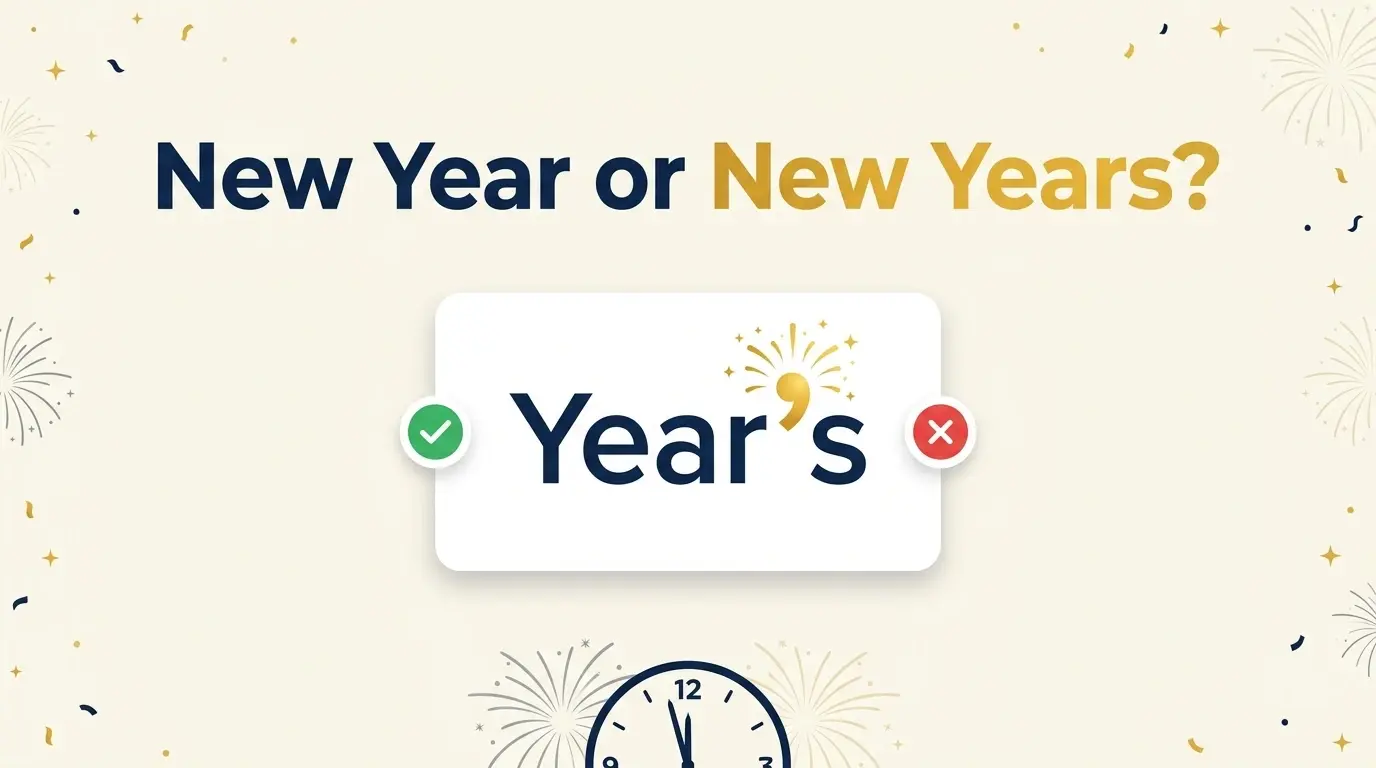
Every December, the same small question shows up in cards, captions, and group chats: do you write Happy New Year or Happy New Years?
And what about New Year’s Eve?
The words sound identical when spoken, so the only clue is the apostrophe, and that is exactly where people slip.
The short answer is simple.
Use New Year in the greeting, New Year’s in holiday names, and new year (lowercase) when you mean the coming year in general. The rest of this guide explains why, with examples you can copy.
Quick Answer
| What you mean | Correct form | Example |
| The greeting | New Year | Happy New Year! |
| A holiday name | New Year’s | New Year’s Eve, New Year’s Day |
| Something tied to the holiday | New Year’s | New Year’s resolution, New Year’s party |
| The coming year in general | new year | I have big plans for the new year. |
| More than one year | new years | Different cultures celebrate their own new years. |
One-line rule: greeting = New Year, holiday = New Year’s, general time = new year.
What Does “New Year” Mean?
New Year refers to the start of a calendar year, or to the holiday that marks it. It is always written as two words. Newyear is not a word.
The meaning changes slightly depending on context, and that is why the capitalization changes too. The next sections show how.
New Year Meaning in Hindi and Urdu (Naya Saal)
New Year in Hindi and Urdu is naya saal (नया साल). The more formal Hindi word is nav varsh (नव वर्ष).
Just like in English, it can mean the coming year or the holiday that starts it.
– Happy New Year: Naya saal mubarak (नया साल मुबारक)
– Spelling: If you search for new year ki spelling, it is two separate words: N-E-W, a space, then Y-E-A-R. There is no s and no apostrophe in the basic phrase.
When to Use “New Year” (Capitalized)
Capitalize both words when you mean the holiday itself, especially in the greeting.
- Happy New Year, Mom!
- Have fun at the New Year celebration.
- She sent me a card to wish me a happy New Year from abroad.
The greeting refers to one moment, the arrival of one new year, so it stays singular. There is no extra s and no apostrophe.
Read More: You’re Welcome or Your Welcome? Which Is Correct?
When to Use “new year” (Lowercase)
Use lowercase when you mean the year ahead rather than the holiday.
- I have several goals for the new year.
- The new year is a good time to start fresh.
- He decided to quit smoking since it’s a new year.
A Simple Test: Look for “a” or “the”
If new year comes right after an article (a or the), it is almost always lowercase. Phrases like “the new year” and “a new year” describe a period of time, not a named holiday.
When to Use “New Year’s”
Use the apostrophe form when you are naming the holiday or something that belongs to it. The apostrophe-s shows that relationship.
New Year’s Eve and New Year’s Day
- New Year’s Eve is December 31.
- New Year’s Day is January 1.
Both words after the apostrophe (Eve and Day) are capitalized because they are part of the holiday’s name. You can read them literally: the eve of the new year and the day of the new year. Style guides such as The Chicago Manual of Style treat the possessive as standard here.
New Year’s Resolution and New Year’s Party
The same logic covers anything connected to the holiday.
- My New Year’s resolution is to read more.
- We’re hosting a New Year’s party.
- She sent New Year’s greetings to her coworkers.
Notice that resolution and party stay lowercase. Only New Year’s is capitalized.
Why People Drop the “Day”
Sometimes the word Day is left out: “We’re celebrating New Year’s at Grandma’s.” This works the same way people say “Christmas” for “Christmas Day.” The apostrophe stays, because the shortened phrase still means New Year’s Day.
New Year Day or New Year’s Day?
New Year’s Day is the standard form. New Year Day (without the s) and New Years Day (without the apostrophe) are both incorrect in everyday English writing.
| Form | Correct? |
|—|—|
| New Year’s Day | ✅ Yes |
| New Year Day | ❌ Missing the s |
| New Years Day | ❌ Missing the apostrophe |
| New Years’ Day | ❌ Apostrophe in the wrong place |
New Year’s Eve follows the same pattern.
In, On, or At: Which Preposition Goes With New Year?
Use in for the year ahead, on for a specific date, and at or over for the celebration period.
– In the new year: In the new year, I want to walk more.
– On New Year’s Day / Eve: We leave on New Year’s Eve.
– At / over New Year’s: They always visit us over New Year’s.
– After the new year: We will review the plan after the new year.
Quick tip: “In new year” sounds incomplete. Add the or a: in the new year.
New Year’s on its own can mean the Eve or the Day, so name the date when you make plans.
Is “New Years” Ever Correct?
In holiday names, no. New Years Eve, New Years Day, and New Years resolution are all missing the apostrophe. Because New Year’s and New Years sound the same, this is one of the most common spelling errors in English.
There is one narrow exception: plural meaning. If you are genuinely talking about more than one new year, the plural works.
- Lunar New Year, Nowruz, and the Islamic New Year are three different new years, each with its own traditions.
- The two new years that followed were very different for the company.
In these sentences, years is a plain plural noun and has nothing to do with the holiday greeting. If you are not sure which one you need, ask yourself: am I talking about several years, or one holiday? If it is one holiday, use New Year or New Year’s.
When Is New Year Celebrated?
Most of the world celebrates New Year on January 1, with New Year’s Eve on December 31. Other cultures follow different calendars and celebrate on other dates.
| Celebration | Usual timing |
|—|—|
| Lunar New Year | Late January to mid-February |
| Nowruz | Around March 20 or 21 |
| Islamic New Year | First day of Muharram (moves earlier each year) |
| Rosh Hashanah | Usually September or early October |
Exact dates change every year, so verify the current date before planning.
Is Lunar New Year Capitalized?
Yes. Lunar New Year is the name of a holiday, so capitalize all three words. The same goes for Islamic New Year.
– We visit family every Lunar New Year.
– Lunar New Year celebrations last several days in many places.
This Year’s or This Years?
This year’s is correct when something belongs to this year, like this year’s event or this year’s budget. This years is wrong in that meaning.
It is the same apostrophe rule as New Year’s: the ’s shows that something belongs to the year.
– Correct✅: This year’s event is online.
– Incorrect❌: This years event is online.
Quick test: Can you say “the event of this year”? Then use year’s. If you are only counting years, use plain years: “It took five years.”
When the plural itself owns something, the apostrophe goes after the s: “She has two years’ experience.”
Happy New Year or Happy New Years?
Happy New Year is the standard greeting. Happy New Years is incorrect, because you are wishing someone well for one new year, not several.
What About “Happy New Year’s”?
As a stand-alone greeting, Happy New Year’s! is not the standard form. It does appear as a shortened version of Happy New Year’s Eve or Happy New Year’s Day, and it is heard in some regions, but it is less common in North America. If you want the safest option in writing, use Happy New Year!
Is It “Happy New Year” Today?
There is no grammar rule about when you can say it. People traditionally use the greeting on December 31 and January 1 and for the first days or weeks of January. After that it starts to sound out of place. The spelling does not change: it is Happy New Year every time.
Why the Apostrophe Matters: A Comparison With Other Holidays
Holiday names that end in s confuse people for the same reason. The difference comes down to who the day belongs to.
- New Year’s Day: the day of one specific event, so the apostrophe goes before the s.
- Mother’s Day and Father’s Day: days that belong to each person’s own mother or father, so the apostrophe goes before the s.
- Presidents’ Day: a day that belongs to many presidents, so the apostrophe goes after the s.
- Veterans Day: a day for veterans, not one that belongs to them, so there is no apostrophe.
If a day belongs to something, you need the possessive. If it is simply for a group, you may not.
New Year or New Years in a Speech
When you speak, New Year and New Year’s sound the same. The spelling only matters in your written script.
– Opening line: Write “Happy New Year, everyone!” with capital letters, just like “Happy Birthday!”
– Holiday mention: Write “On New Year’s Eve, we looked back…” with the apostrophe.
– General time: Write “In the new year, we will…” in lowercase.
– Final check: Read your printed script once for missing apostrophes.
Capitalization Rules
| Situation | Capitalize? | Example |
| Holiday greeting | Yes | Happy New Year! |
| Holiday names | Yes | New Year’s Eve, New Year’s Day |
| After “a” or “the” | No | We will launch in the new year. |
| Something tied to the holiday | Capitalize New Year’s only | My New Year’s resolution |
Avoid capitalizing every word in a normal sentence. “I Will Set New Goals In The New Year” is incorrect. Write “I will set new goals in the new year.”
New Year or New Years in Quotes and Messages
If you are writing wishes, captions, or card messages, the same rules apply inside quotation marks. Capitalize Happy New Year, and keep the apostrophe in New Year’s Eve.
Here are a few original messages that use each form correctly:
- “Wishing you a Happy New Year full of good health and good news.”
- “On New Year’s Eve, I’m grateful for everyone who made this year better.”
- “May the new year bring you more calm than chaos.”
- “Happy New Year! Here’s to fresh starts and finished to-do lists.”
If you quote a famous person, check their exact wording and spelling in the original source rather than copying it from a social media post, since misquoted lines spread easily.
New Year or New Years in an Essay
Whether you are writing a school essay or a blog post, a few habits keep the spelling clean.
- Titles: In title case, write My New Year’s Resolutions or Celebrating the New Year. Keep the apostrophe in the title.
- Opening lines: Write “New Year’s Eve is a night for reflection,” not “New Years Eve is…”
- General time: Use lowercase in sentences like “In the new year, I plan to study more.”
- Multiple cultures: If your essay compares celebrations, new years in the plural is fine: “Many cultures mark their own new years at different times.”
- Be consistent: Pick one style for the holiday name and use it throughout.
A sample paragraph:
New Year’s Eve is a time for reflection. Many people set a New Year’s resolution, hoping the new year will bring a fresh start. Across the world, different cultures celebrate their own new years on different dates.
Read More: Fish or Fishes? Understanding the Correct Plural Form
Common Mistakes
1. Writing “Happy New Years”
- Incorrect❌: Happy New Years!
- Correct✅: Happy New Year!
2. Leaving out the apostrophe
- Incorrect❌: We celebrated New Years Eve.
- Correct✅: We celebrated New Year’s Eve.
3. Putting the apostrophe in the wrong place
- Incorrect❌: New Years’ Eve
- Correct✅: New Year’s Eve
4. Dropping the “s” completely
- Incorrect❌: My New Year resolution is to exercise.
- Correct✅: My New Year’s resolution is to exercise.
5. Adding an apostrophe to the greeting
- Incorrect❌: Happy New Year’s!
- Better✅: Happy New Year!
6. Capitalizing the general phrase
- Incorrect❌: I’m excited for the New Year ahead.
- Correct✅: I’m excited for the new year ahead.
Easy Memory Trick
- Is it a greeting? Write Happy New Year.
- Does Eve, Day, party, or resolution come next? Write New Year’s.
- Is there an a or the before it? Write new year in lowercase.
- Do you mean several different years? Only then use new years.
Key Takeaways
- Happy New Year! is the correct greeting, with no s and no apostrophe.
- New Year’s Eve (December 31) and New Year’s Day (January 1) always take an apostrophe before the s.
- New Year’s resolution and New Year’s party follow the same rule.
- Use lowercase new year after a or the.
- New years is correct only when you mean several years.
- New Years Eve and Happy New Years are common errors to avoid.
FAQs
Is it New Year or New Years?
New Year is correct for the holiday and the greeting. New Years is only correct when you mean more than one year, not as the holiday name.
Is it Happy New Year or Happy New Years?
Happy New Year is correct. The greeting refers to one new year.
Is “Happy New Year’s” correct?
It is not the standard greeting. It can appear as a short form of Happy New Year’s Eve or Happy New Year’s Day, but Happy New Year is the safest choice.
Should New Year’s have an apostrophe?
Yes, in New Year’s Eve, New Year’s Day, New Year’s resolution, and similar phrases.
Is it New Year’s resolution or New Years resolution?
New Year’s resolution. The plural is New Year’s resolutions.
Is it New Year’s Eve or New Years Eve?
New Year’s Eve. The apostrophe goes before the s, not after it.
Is it “Happy New Year” today?
There is no grammar rule about the date. It is most commonly used around December 31 and January 1 and in early January.
When do you capitalize “new year”?
Capitalize New Year in the greeting and in holiday names. Use lowercase new year when you mean the coming year, especially after a or the.
Conclusion:
The confusion comes down to one small mark.
Say Happy New Year when you greet someone, write New Year’s when the phrase names the holiday or something that belongs to it, and use lowercase new year when you mean the year ahead.
Save new years for the rare time you really mean more than one year.
Keep those four patterns in mind, and you will get it right in cards, emails, essays, and captions.

As an American English writer, I specialize in creating clear and engaging content that makes grammar and language learning accessible to everyone. I enjoy breaking down complex English concepts into simple, practical lessons that readers can apply with confidence. My mission is to help learners strengthen their communication skills through easy and reliable content.








2 thoughts on “New Year or New Years? The Correct Spelling and Grammar Explained”