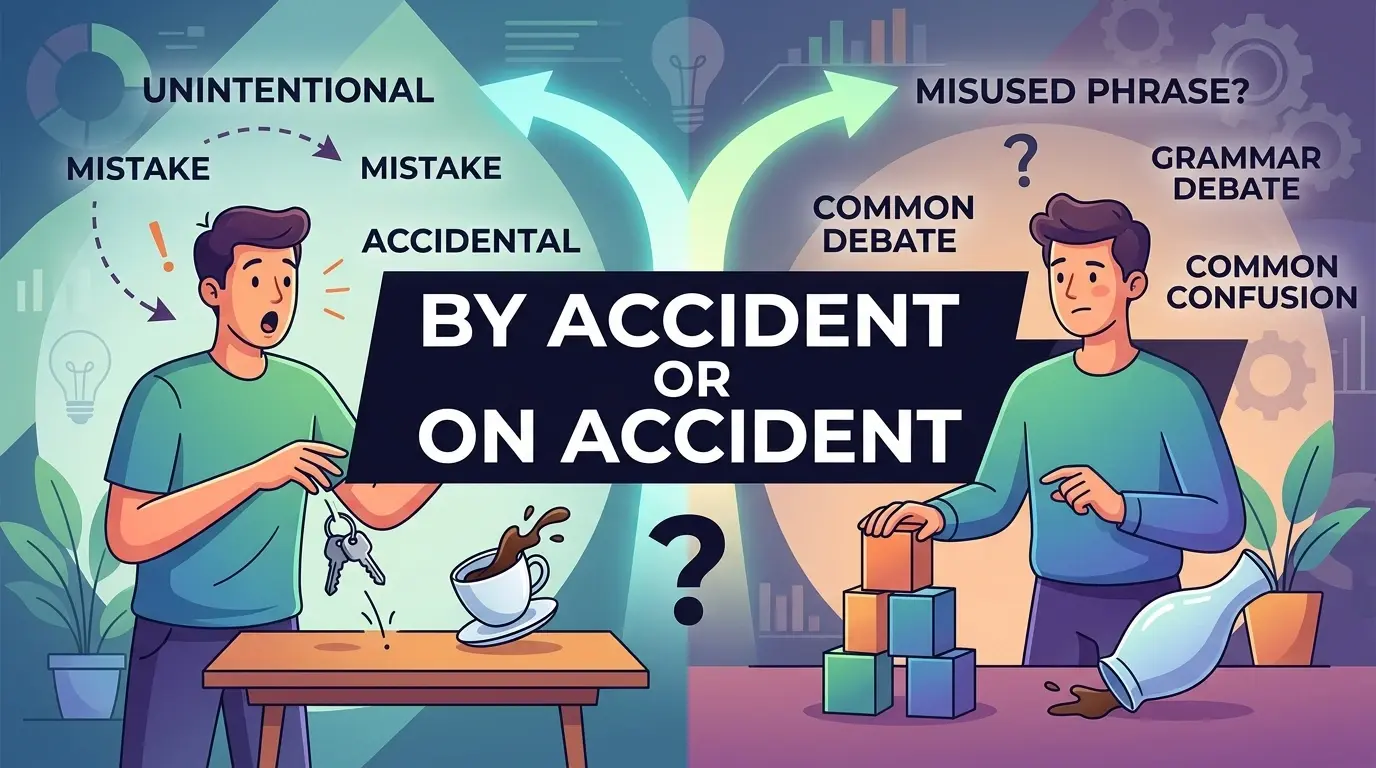
By accident is the traditional and widely accepted phrase, while on accident is also used, especially in American English. Both describe something that happened unintentionally.
You may have typed, “I deleted the file on accident,” and wondered if it should be by accident.
This confusion is common because both phrases are heard in everyday American speech.
By accident is the safer choice for formal or professional English, while on accident is common in informal American conversation. The right choice depends on your audience, context, and preferred style.
Quick Answer
By accident is the established standard phrase for something that happens unintentionally. On accident is also used in American English, especially informally. If you are writing for a formal, professional, or broad international audience, by accident is usually the clearest choice.
Quick Rule
Use “by accident” for standard English; “on accident” is common mainly in informal American usage.
What Does “By Accident” Mean?
By accident means something happened unintentionally or without being planned. It is the established English expression and works in both American and British English. You can use it in everyday speech, professional writing, school assignments, and other formal contexts.
For example:
I deleted the email by accident.
This means the person did not intend to delete the email.
Another example:
She broke the glass by accident.
She did not plan to break it.
The phrase can describe many unplanned actions.
You might:
- send a message by accident
- click a button by accident
- lose something by accident
- break something by accident
- meet someone by accident
- reveal information by accident
More examples
I opened the wrong file by accident.
He called me by accident.
We found the old photo by accident.
She took my notebook by accident.
In each example, the action was not intentional.
Read More: Neighbor or Neighbour? Correct Spelling, Meaning & ExamplesWhat Does “On Accident” Mean?
On accident is an expression used to mean essentially the same thing as by accident: something happened unintentionally. It is particularly associated with American English and is more common in informal speech than formal writing.
For example:
I deleted the photo on accident.
The speaker means that the deletion was unintentional.
Another example:
I clicked the wrong button on accident.
Again, the action was not planned.
The important point is that on accident is not simply a meaningless mistake.
It is an expression that is genuinely used by English speakers.
However, its acceptance and style status differ from by accident.
If your goal is formal, traditional, or widely accepted English, by accident remains the safer option.
Is “On Accident” Correct?
On accident is used and understood in modern American English, particularly in informal conversation. However, by accident is the more established and broadly accepted expression. For formal writing, by accident is generally the better choice.
This distinction matters because language changes over time.
A phrase can become common in everyday speech before it becomes widely accepted in formal writing.
On accident is an example of this kind of usage difference.
You may hear:
I did it on accident.
You may also hear:
I did it by accident.
Both are understandable.
But they do not have exactly the same status across all varieties and styles of English.
For a school paper, business email, article, application, or other formal text, choosing by accident avoids unnecessary questions about style.
By Accident vs On Accident
By accident is the traditional and standard expression. On accident is a newer informal American usage that has become common in speech. Both express an unintentional action, but by accident is more suitable when you need formal or broadly accepted English.
| Phrase | Meaning | Common use | Best for formal writing? |
| by accident | Unintentionally | General English | Yes |
| on accident | Unintentionally | Informal American English | Usually avoid |
| accidentally | In an unintentional way | General English | Yes |
Example
Formal:
I sent the document by accident.
Informal American speech:
I sent the document on accident.
Alternative:
I accidentally sent the document.
The third version is also clear and natural.
Why Do People Say “On Accident”?
People may say on accident because English commonly uses on in phrases such as “on purpose.” The similar meanings of these expressions may have helped support the newer pattern.
Compare:
I did it on purpose.
I did it by accident.
The two expressions have opposite meanings.
On purpose means intentionally.
By accident means unintentionally.
Some speakers have extended the on + noun pattern from “on purpose” to “on accident.”
This produces:
I did it on accident.
The phrase is especially common in American speech.
That does not mean everyone accepts it equally.
Some speakers consider on accident informal or nonstandard, while others use it naturally without considering it incorrect.
For formal writing, the distinction is easy to handle:
Choose “by accident.”
American English or British English
By accident is standard in both American and British English. On accident is much more closely associated with American English and is generally more informal. If you write for an international audience, by accident is the safest choice.
This is not a simple US-versus-UK spelling difference.
It is primarily a difference in usage and register.
American English
You may hear both:
I broke it by accident.
I broke it on accident.
The second version is more informal.
British English
By accident is the established choice:
I broke it by accident.
For readers across different English-speaking countries, by accident avoids confusion and sounds natural.
By Accident vs On Accident in Sentences
Here are examples showing how both expressions are used.
By accident
- I deleted the file by accident.
- She called her boss by accident.
- He broke the window by accident.
- We met by accident at the airport.
- I opened your message by accident.
- She took my pen by accident.
- He revealed the surprise by accident.
- I clicked the wrong link by accident.
- They found the restaurant by accident.
- I sent the email by accident.
On accident
- I deleted the file on accident.
- She called him on accident.
- He broke the glass on accident.
- I clicked the button on accident.
- She took my phone on accident.
- I opened the message on accident.
- He deleted the photo on accident.
- I sent the text on accident.
- She shared the wrong file on accident.
- I pressed the button on accident.
The meaning remains essentially the same.
The main difference is usage and formality.
Common Mistakes
1. Assuming “on accident” is always wrong
It is too simple to say that on accident never occurs in English.
The phrase is widely used in American English, especially informally.
However, if you want the most established form, choose:
by accident
2. Assuming “by accident” means something different
In most ordinary contexts, by accident means unintentionally.
I broke the cup by accident.
The person did not intend to break it.
3. Confusing “by accident” with “on purpose”
These phrases have opposite meanings.
By accident = unintentionally
On purpose = intentionally
Compare:
I deleted the file by accident.
I deleted the file on purpose.
4. Using “on accident” in formal writing
Even though many American speakers use it naturally, on accident can sound informal to some readers.
For a professional email, essay, report, or application, choose:
I sent the file by accident.
This is the safer and more widely accepted form.
By Accident or Accidentally
By accident and accidentally usually have the same basic meaning. Both describe something that happens unintentionally. The main difference is grammatical: by accident is a prepositional phrase, while accidentally is an adverb.
Compare:
I deleted the file by accident.
I accidentally deleted the file.
Both sentences tell us that the deletion was not intentional.
You can often replace one with the other.
More examples
She broke the glass by accident.
She accidentally broke the glass.
He called me by accident.
He accidentally called me.
Both forms are natural.
When Should You Use “By Accident”?
Use “by accident” when you want a standard expression that works in formal, informal, American, and British English. It is especially useful when writing for an audience with different English backgrounds.
Choose by accident in:
- School assignments
- Professional emails
- Business documents
- Resumes and applications
- Formal articles
- Academic writing
- International communication
Examples:
I attached the wrong document by accident.
The payment was submitted twice by accident.
The information was shared by accident.
These sentences sound clear and professional.
When Can You Use “On Accident”?
Use “on accident” mainly when you are comfortable with informal American English. It is common in casual speech and informal writing, but some readers may still consider it nonstandard or less polished.
You may encounter it in:
- Casual conversations
- Text messages
- Social media
- Informal chats
- Everyday American speech
For example:
I did that on accident.
The meaning is clear.
But if you are unsure about your audience, use:
I did that by accident.
It works in more situations.
A Simple Way to Remember the Difference
Think about the two expressions together:
On purpose = intentionally
By accident = unintentionally
They form a useful pair.
Did you do it on purpose?
No, I did it by accident.
This is the traditional pattern.
If you are writing carefully, remember:
Purpose → on
Accident → by
This trick is simple and works well for formal English.
FAQs
Is “by accident” or “on accident” correct?
By accident is the established standard expression. On accident is also widely used in informal American English. For formal writing, by accident is the safer choice.
Is “on accident” grammatically correct?
On accident is a real and common usage in American English, especially informal speech. However, some speakers and style guides still prefer by accident.
Do Americans say “on accident”?
Yes. On accident is commonly heard in American English, particularly in informal conversation. It means essentially the same thing as by accident.
Do British people say “on accident”?
By accident is the established expression in British English. On accident is much more strongly associated with American usage.
What does “by accident” mean?
By accident means unintentionally or without planning to do something.
What does “on accident” mean?
On accident means essentially the same as by accident: something happened unintentionally.
Is “by accident” formal?
Yes. By accident is suitable for both everyday and formal English. It is the safer choice for professional and academic writing.
Can I say “I did it on accident”?
Yes, particularly in informal American English. However, I did it by accident is more widely accepted and suitable for formal contexts.
Is “accidentally” better than “by accident”?
Neither is always better. Both are standard and natural. For example, I accidentally deleted it and I deleted it by accident are both correct.
What is the opposite of “by accident”?
The common opposite is on purpose, which means intentionally.
Conclusion:
By accident is the established and widely accepted expression for something that happens unintentionally.
On accident is also common, especially in informal American English, but some readers may still view it as informal or nonstandard.
For school, work, professional writing, and international communication, by accident is the safest choice.
If you want an alternative, accidentally works naturally in many sentences.
The easiest pair to remember is:
By accident = unintentionally
On purpose = intentionally

As an American English writer, I specialize in creating clear and engaging content that makes grammar and language learning accessible to everyone. I enjoy breaking down complex English concepts into simple, practical lessons that readers can apply with confidence. My mission is to help learners strengthen their communication skills through easy and reliable content.