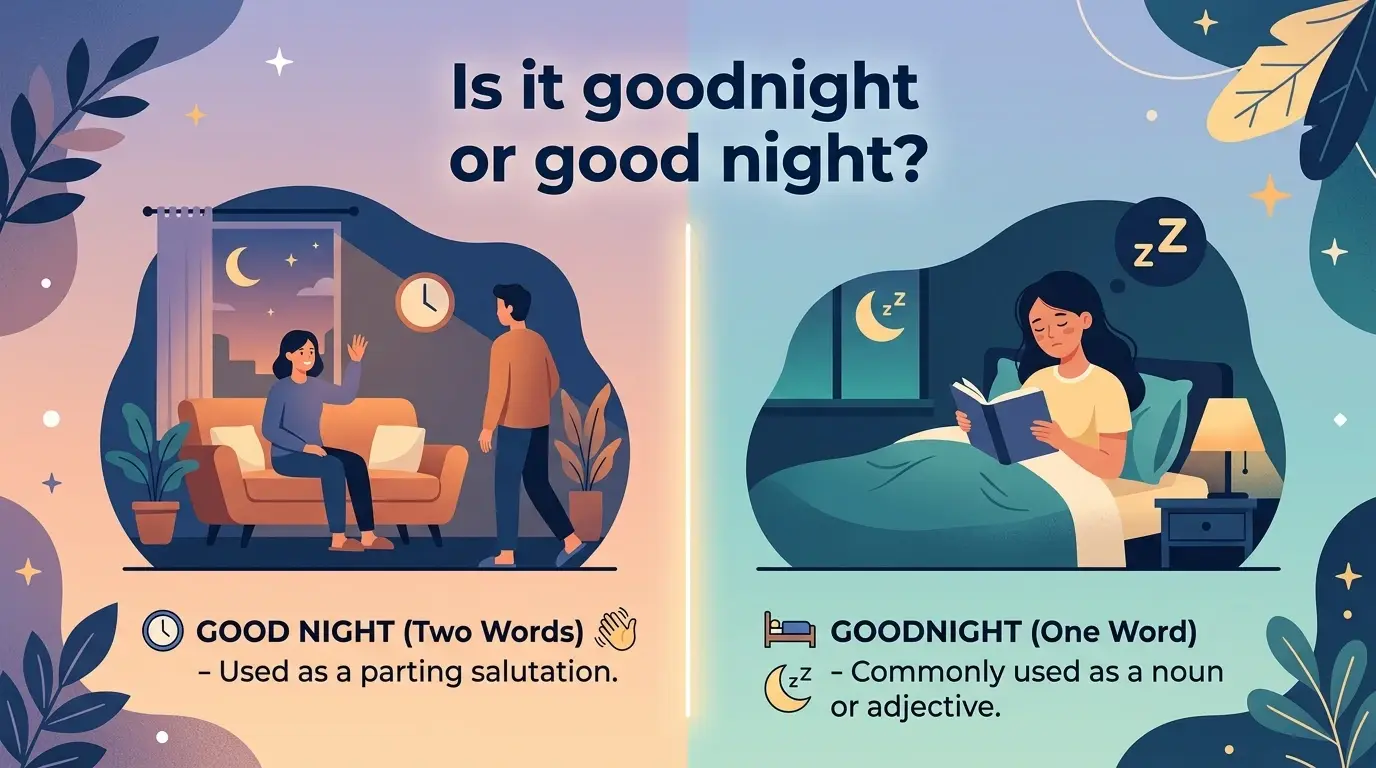
You are about to send a bedtime text, and you suddenly stop. Should you write “goodnight” or “good night”?
Here is the short answer: both are correct. “Good night” is the safer, standard choice for most writing, including school work and professional emails.
“Goodnight” is also accepted, and it is very common in casual messages and in expressions like “goodnight kiss.”
The confusion is understandable. Even dictionaries do not list the two forms in exactly the same way. Oxford shows “goodnight” as an exclamation, while Cambridge uses “good night” as its main entry.
Once you see the small difference, the choice becomes easy. In this guide, you will learn when to use each form, how their meanings differ, and which mistakes to avoid.
Quick Answer: Is It Goodnight or Good Night?
Both “goodnight” and “good night” are correct. Use good night as the safer standard form when saying goodbye at night or before sleep. Goodnight is also accepted, especially in informal use and compound expressions such as “goodnight kiss.” Oxford lists both forms for the farewell expression.
Quick Rule in 1 Line:
Use “good night” for the safest standard farewell, while “goodnight” is also accepted in common usage.
What Is the Difference Between Goodnight and Good Night?
“Good night” is the traditional two-word form, while “goodnight” is an accepted one-word form. Both can express a nighttime farewell, but the two-word form is safer in formal writing.
The main confusion comes from spacing.
English has many expressions that can appear as open compounds or closed compounds. Over time, some phrases become more commonly written as one word.
That is what has happened with goodnight.
Good night
Good night is written as two words.
It is commonly used when you are leaving someone at night.
Examples:
- Good night! See you tomorrow.
- Good night, Mom.
- I said good night before leaving.
- Good night, everyone.
- Have a good night.
It can also describe a night that was enjoyable or pleasant.
For example:
We had a good night at the concert.
Here, good describes the noun night.
You are not saying goodbye.
You are describing the night itself.
Goodnight
Goodnight is written as one word.
It is also accepted as a nighttime farewell. Oxford lists goodnight as an exclamation and gives good night as an alternative.
Examples include:
- Goodnight!
- Goodnight, sweetheart.
- I said goodnight before going to bed.
- She kissed her son goodnight.
- He sent me a goodnight text.
The one-word form is especially common in casual communication.
Pro Writing Aid notes that good night is generally the safer choice for formal writing, while goodnight works well in informal settings.
Read More: Grateful To or Grateful For? The Correct Difference Explained
When Should You Use “Good Night”?
Use “good night” when you want the safest standard spelling for a nighttime farewell or when “good” directly describes “night.” This form is widely recognized and is especially suitable for formal writing.
Use good night when saying goodbye in the evening.
Examples
- Good night! Sleep well.
- Good night, Sarah.
- Good night, everyone.
- I should go now. Good night.
- She said good night before leaving.
- We wished our guests good night.
You can also use good night when describing a pleasant evening.
Examples
- We had a good night at the restaurant.
- I had a good night with my friends.
- It was a good night for a walk.
- She said she had a good night at the party.
- They enjoyed a good night together.
Notice the difference.
In:
Good night, John.
You are saying goodbye.
In:
I had a good night.
You are describing your evening.
The meaning is different, but the spelling stays good night in both examples.
When Should You Use “Goodnight”?
Use “goodnight” when it functions as an accepted one-word farewell or appears naturally in informal and compound expressions. Oxford recognizes it as a farewell exclamation, while ProWritingAid notes its common informal use.
You may see goodnight in texts, messages, stories, and casual conversations.
Examples:
- Goodnight!
- Goodnight, Dad.
- Goodnight, my love.
- She kissed the children goodnight.
- I forgot to say goodnight.
- He sent a sweet goodnight message.
The one-word spelling is not automatically a spelling mistake.
That is important.
Many learners assume that goodnight must be wrong because good night has traditionally been more common.
But modern dictionaries recognize goodnight too. Oxford lists it directly as an exclamation.
So writing:
Goodnight!
is acceptable.
However, if you want the safest choice for formal writing, Good night! is still a strong option. Pro Writing Aid specifically recommends the two-word form for formal contexts.
Have a Good Night or Have a Goodnight?
“Have a good night” is the correct form. “Have a goodnight” is not standard English, because “good” describes the noun “night” here.
In this phrase, you are wishing someone a pleasant night. So the two words stay separate.
Examples:
- Have a good night, everyone.
- I hope you have a good night.
- Have a good night and see you tomorrow.
Here is a quick test. Replace “good” with “great.”
“Have a great night” works. “Have a greatnight” does not. The same logic applies to “good night.”
“Good night” vs. “have a good night”: “Good night” is a short farewell, usually at the end of the evening or before sleep. “Have a good night” is a wish, and you can say it earlier too, such as when you leave work or a shop.
Good Night’s Sleep or Good Night Sleep?
“Good night’s sleep” is the safer standard form. The apostrophe + s shows that the sleep belongs to a good night.
Examples:
- A good night’s sleep helps you focus.
- I need a good night’s sleep before the exam.
You may see “good night sleep” in casual writing. For clear and correct English, choose “good night’s sleep.”
Is “Goodnight” One Word or Two?
“Goodnight” is one word, while “good night” contains two words. Both forms can be correct when used as a nighttime farewell, although “good night” is the safer standard choice.
This is one of those English spelling questions where there is no simple “one is correct and one is wrong” answer.
Both forms appear in reputable English sources.
Oxford gives:
goodnight
and identifies good night as another form.
Cambridge uses good night as its main dictionary entry and gives examples involving goodnight in related expressions.
This tells us something useful.
English usage allows both forms.
The safest choice
If you are unsure, choose:
Good night.
This is especially useful in:
- School assignments
- Professional emails
- Formal writing
- Business communication
- General educational writing
For casual texts, Goodnight! is also perfectly understandable and accepted.
Is Goodnight a Compound Word?
Yes. “Goodnight” is a closed compound word, which means two words joined into one. “Good night” is written as an open compound, with a space between the words.
Compound words come in three styles:
- Open: good morning, good night
- Hyphenated: good-night (seen in some dictionaries)
- Closed: goodnight
There is no single rule for why “goodnight” became one word. People use the phrase as one unit, especially in texts and before nouns, so the joined form became common.
One more thing to remember: in speech, both forms sound exactly the same. The choice only matters in writing.
Is Late Night One Word?
No. “Late night” is two words. When it comes before a noun, it usually takes a hyphen: “late-night.”
Examples:
- It was a late night at the office.
- She made a late-night snack.
“Latenight” is not standard. If you follow a specific style guide, check its rule for hyphenation.
Goodnight vs. Good Night: Comparison Table
The easiest way to remember the difference is to treat “good night” as the safer standard form and “goodnight” as an accepted one-word alternative. The exact choice depends on the sentence, tone, and grammatical role.
| Form | Words | Common Use | Example |
| good night | 2 | Standard farewell | Good night, James. |
| goodnight | 1 | Informal farewell | Goodnight, James. |
| good night | 2 | Describing a pleasant night | We had a good night. |
| goodnight | 1 | Compound expression | She gave him a goodnight kiss. |
| good night | 2 | Formal writing | Good night, everyone. |
| goodnight | 1 | Casual messages | Goodnight! Sleep well. |
The table shows why context matters.
You should not assume that one form is always correct.
Goodnight and Good Night as Farewells
Both forms can be used as a farewell at night, so the choice often depends on style rather than meaning. “Good night” is the safer standard form, while “goodnight” is common in casual communication.
Imagine leaving a friend’s house at 10 p.m.
You could say:
Good night!
You could also say:
Goodnight!
Both communicate the same basic message.
You are ending the conversation and wishing the person a pleasant night.
Cambridge defines good night as something said when people leave each other in the evening or before going to bed.
Oxford also recognizes goodnight for the same purpose.
Therefore, it would be misleading to say that goodnight is always incorrect.
It is not.
Goodnight or Good Night in Formal Writing
For formal writing, “good night” is usually the safer choice because it is the traditional and widely accepted spelling. “Goodnight” is better suited to casual messages and informal communication.
Suppose you are writing a professional message.
You might write:
Thank you for your time. Good night.
That spelling is clear and conventional.
Now imagine sending a text to a close friend:
Goodnight! Talk to you tomorrow ❤️
The one-word form feels natural in casual communication.
Both can work.
The difference is mainly about style and context.
Formal examples
- Good night, everyone.
- I wish you a good night.
- Thank you for joining us. Good night.
- We had a good night at the event.
Informal examples
- Goodnight!
- Goodnight, love.
- Goodnight 😊
- I forgot to say goodnight.
If you are writing for school or work, good night is usually the safer option.
Goodnight Kiss or Good Night Kiss?
“Goodnight kiss” is a common one-word compound expression, although dictionaries and style guides may also show hyphenated forms. When writing a compound before a noun, follow the style used by your chosen dictionary or publication.
This is where the one-word form becomes especially useful.
For example:
She gave her daughter a goodnight kiss.
Here, goodnight describes the type of kiss.
It is not simply a farewell.
That is why you will often see the compound written as:
goodnight kiss
However, there is some variation in dictionary style.
Cambridge gives the example:
good-night kiss
while ProWritingAid discusses both goodnight and good-night as adjective forms.
This means you should not treat the hyphen as a universal rule.
For normal modern writing, goodnight kiss is widely used.
Goodnight as an Adjective: Story, Message and Hug
When “goodnight” comes before a noun and describes it, the one-word form is the clearest choice.
Examples:
- She read him a goodnight story.
- He sent a goodnight message.
- The kids got a goodnight hug.
The one-word form avoids confusion. “Good night story” can be read as a good story, or a story about a good night. “Goodnight story” clearly means a story told at bedtime.
Say Goodnight or Say Good Night?
Both “say goodnight” and “say good night” can be found in English. The two-word form is the safer general choice, while the one-word form is common in casual usage.
Consider these sentences:
I said good night to my parents.
I said goodnight to my parents.
Both are understandable.
Cambridge’s learner dictionary itself uses say goodnight in an example, showing that the one-word form occurs naturally in standard English.
So you do not need to panic when you see say goodnight.
It is not automatically an error.
Still, if you want one simple rule for your own writing, use:
I said good night to my parents.
This is the safer and more traditional form.
20 Examples of Goodnight and Good Night
The examples below show how both forms work in real sentences, including farewells, descriptions, casual messages, and compound expressions.
Examples with “Good Night”
- Good night! Sleep well.
- Good night, Mom.
- Good night, everyone.
- I said good night before leaving.
- She wished me good night.
- We should say good night and go home.
- Good night, and see you tomorrow.
- He called to say good night.
- I hope you have a good night.
- We had a good night at the concert.
- She had a good night with her friends.
- It was a good night for a walk.
Examples with “Goodnight”
- Goodnight! See you in the morning.
- Goodnight, sweetheart.
- Goodnight, Dad.
- She kissed her son goodnight.
- I forgot to say goodnight.
- He sent me a goodnight message.
- She gave the baby a goodnight kiss.
- I said goodnight and turned off the light.
These examples show an important point.
The two forms often have the same basic meaning when used as a farewell.
The difference is mainly spelling, grammatical context, and level of formality.
Common Mistakes With Goodnight and Good Night
The biggest mistake is assuming that “goodnight” is always wrong. Another common error is confusing a nighttime farewell with a sentence describing a good or pleasant night.
Mistake 1: Thinking “goodnight” is always wrong
Incorrect assumption:
Goodnight is never correct.
That is not true.
Oxford lists goodnight as an accepted exclamation.
Mistake 2: Thinking “good night” is always one word
Some writers assume that every use should be:
Goodnight
That is also too simple.
For example:
We had a good night.
Here, good describes night.
You need two words.
Mistake 3: Writing “goodnight” in formal work without checking style
While accepted, goodnight can sound more casual.
If you are writing a school assignment, professional email, or formal document, good night is usually the safer choice.
Mistake 4: Confusing “good night” with “good evening”
Good night is normally used when saying goodbye at night or before sleep.
Good evening is generally used as a greeting when meeting someone in the evening.
For example:
Good evening, Mr. Smith.
You are greeting him.
Later, when you leave:
Good night, Mr. Smith.
You are saying goodbye.
Good Night vs. Good Evening
“Good evening” usually works as an evening greeting, while “good night” normally works as a farewell or bedtime expression. They are not simple spelling alternatives.
This distinction is useful for English learners.
Imagine you enter a restaurant at 7 p.m.
You might say:
Good evening.
When you leave several hours later, you might say:
Good night.
The expressions have different jobs.
Greeting
Good evening, everyone.
Farewell
Good night, everyone.
Before sleep
Good night. Sleep well.
So if someone says good evening when leaving, the meaning may sound unusual depending on the situation.
Is “Goodnight” More Informal?
“Goodnight” is common in informal communication, while “good night” is the safer traditional form for formal writing. However, “goodnight” is still a recognized English form, not simply a spelling error.
You may see goodnight frequently in:
- Text messages
- Social media posts
- Personal notes
- Romantic messages
- Children’s writing
- Casual conversations
For example:
Goodnight ❤️
That sounds natural in a personal message.
In a formal document, you might prefer:
Good night.
The meaning does not change much.
The tone changes slightly.
Does “Goodnight” Mean the Same as “Good Night”?
When both forms are used as a farewell, they usually communicate the same basic meaning: goodbye for the night or a wish for pleasant sleep. The main difference is spelling and context.
Compare:
Good night, Sarah.
and:
Goodnight, Sarah.
Both can be used when saying goodbye before bedtime.
The listener will understand the same basic message.
The difference becomes clearer when good night describes the quality of a night.
For example:
We had a good night.
You cannot replace it with:
We had a goodnight.
That sentence does not work in standard usage.
Here, good is an adjective and night is a noun.
They remain separate words.
Goodnight Meaning and Definition
“Goodnight” (or “good night”) is a farewell wish used when you leave someone at night or before sleep. It is a short way of saying “I hope you have a good night.”
You will see it in a few roles:
- Farewell: Goodnight, Sam.
- Noun (the act of saying it): He said his goodnights and left.
- Modifier: She gave him a goodnight kiss.
What does “good night then” mean? It is a polite way to end a conversation. For example: “Well, good night then.” The tone depends on the situation. It can sound warm, or just final.
What is the full form of good night? There isn’t one. It is not an abbreviation. The longer version is simply “I wish you a good night.”
Easy Memory Trick
When you need a safe default, remember “good night” follows the same two-word pattern as “good morning” and “good evening.”
This is a simple trick for English learners.
Think about these expressions:
- Good morning
- Good afternoon
- Good evening
- Good night
All four are normally written as two words.
So when you are unsure, choose:
Good night.
Then remember that goodnight is also accepted in modern English.
You may especially see it in casual writing or compound expressions.
Simple memory rule
Formal or unsure → good night
Casual or compound use → goodnight can work
This is not an absolute grammar law.
It is simply a useful writing guide.
How to Spell Good Night and Goodnight
Spell it as two words (g-o-o-d n-i-g-h-t) or one word (g-o-o-d-n-i-g-h-t). The letters are the same. Only the space changes.
The most common spelling trouble is the silent “gh” in “night.” Many typos come from missing or swapping those letters.
Quick checklist:
- Good night (two words): safe for formal and general writing
- Goodnight (one word): casual messages and compounds like “goodnight kiss”
- Not standard: gud, gd, nite, nyt
Goodnite, Gud Nyt and Other Informal Spellings
“Goodnite,” “gud nyt” and “gdnyt” are informal text spellings, not standard English. They are fine in quick chats with friends. Avoid them in school work, emails and formal writing.
“Goodnite” follows the same pattern as “nite” and “lite,” where “ite” replaces “ight.”
Typing errors are also common. These are all misspellings:
- goodnigh
- goodnigt
- gudnight
- godnigth
- good nught
- goodnigjt
The correct forms are always good night or goodnight.
When to Use Each Form
Choose “good night” when you want the safest standard form. Choose “goodnight” when the one-word form fits an informal farewell or compound expression.
Use “good night” when:
- Saying goodbye at night
- Writing formally
- Writing for school
- Writing a professional message
- Describing a pleasant night
- You are unsure which form to choose
Examples:
Good night, everyone.
We had a good night.
Use “goodnight” when:
- Writing an informal farewell
- Sending a casual bedtime text
- Using a common compound expression
- Writing a personal message
Examples:
Goodnight!
She gave him a goodnight kiss.
The most important point is this:
Goodnight is not simply a misspelling of good night.
It is an accepted form.
Other Ways to Say Good Night
You can say “sleep well,” “sweet dreams” or “have a pleasant night” instead of “good night.” A short “Night!” also works in casual chats.
More polite options:
- Have a pleasant night
- Rest well
- Sleep well
More casual options:
- Sweet dreams
- Sleep tight
- Night!
- Nighty-night
“Night!” is a clipped, friendly form. It works with friends and family, but “good night” is better for formal situations.
FAQs
Is “goodnight” correct?
Yes. Goodnight is correct and recognized by Oxford as a farewell exclamation. Good night is also correct and remains the safer standard form.
Is “good night” one word or two?
Good night is two words. It is the traditional spelling and is widely used as a nighttime farewell.
Should I write “goodnight” or “good night”?
If you are unsure, write good night. It is the safer choice for formal and general writing. Goodnight is also accepted, especially in informal contexts.
Is “goodnight” more informal?
Usually, yes. Goodnight is common in casual texts and personal messages. However, it is still a recognized English form, not an incorrect spelling.
Is “goodnight kiss” correct?
Yes. Goodnight kiss is a common compound expression. Some dictionaries and style guides may use a hyphenated form, so follow your preferred style guide when needed.
Is “say goodnight” correct?
Yes. Say goodnight is used in standard English. Cambridge’s learner dictionary gives it as an example.
Is “say good night” also correct?
Yes. Say good night is also correct and is a safe choice in formal writing.
Is “good night” used only before sleeping?
No. You can say good night when leaving someone late in the evening. You can also say it before going to bed.
Is “good night” formal?
It can be used in both formal and informal situations. It is the safer choice when you want a traditional and neutral spelling.
Is “goodnight” wrong in formal writing?
Not necessarily. It is a recognized form. However, good night is generally the safer choice for formal writing because it is the more traditional spelling.
Is “have a goodnight” correct?
No. Use “have a good night.” Here, “good” describes “night,” so the words stay separate.
Is “good night’s sleep” correct?
Yes. “Good night’s sleep” is the standard form. “Good night sleep” is less careful writing.
Is “goodnite” correct?
No. “Goodnite” is an informal text spelling. Use “good night” or “goodnight” in normal writing.
Is it goodnight or good night in UK English?
Both forms are used in British and American English. Dictionaries differ in which one they list first, so pick one and stay consistent. “Good night” is still the safer choice for formal writing.
What is the full form of good night?
“Good night” has no full form because it is not an abbreviation. It is a short wish, like “I hope you have a good night.”
Conclusion:
Both goodnight and good night are correct forms.
For a safe and standard choice, especially in formal writing, use good night. It works naturally as a nighttime farewell and when describing a pleasant night.
Goodnight is also accepted and appears often in informal communication. It is especially common in personal messages and compounds such as goodnight kiss.
So, if you are ever unsure, remember the simple rule:
Choose “good night” as your default, but do not treat “goodnight” as a spelling mistake.

As an American English writer, I specialize in creating clear and engaging content that makes grammar and language learning accessible to everyone. I enjoy breaking down complex English concepts into simple, practical lessons that readers can apply with confidence. My mission is to help learners strengthen their communication skills through easy and reliable content.









2 thoughts on “Is It Goodnight or Good Night? Which One Is Correct?”