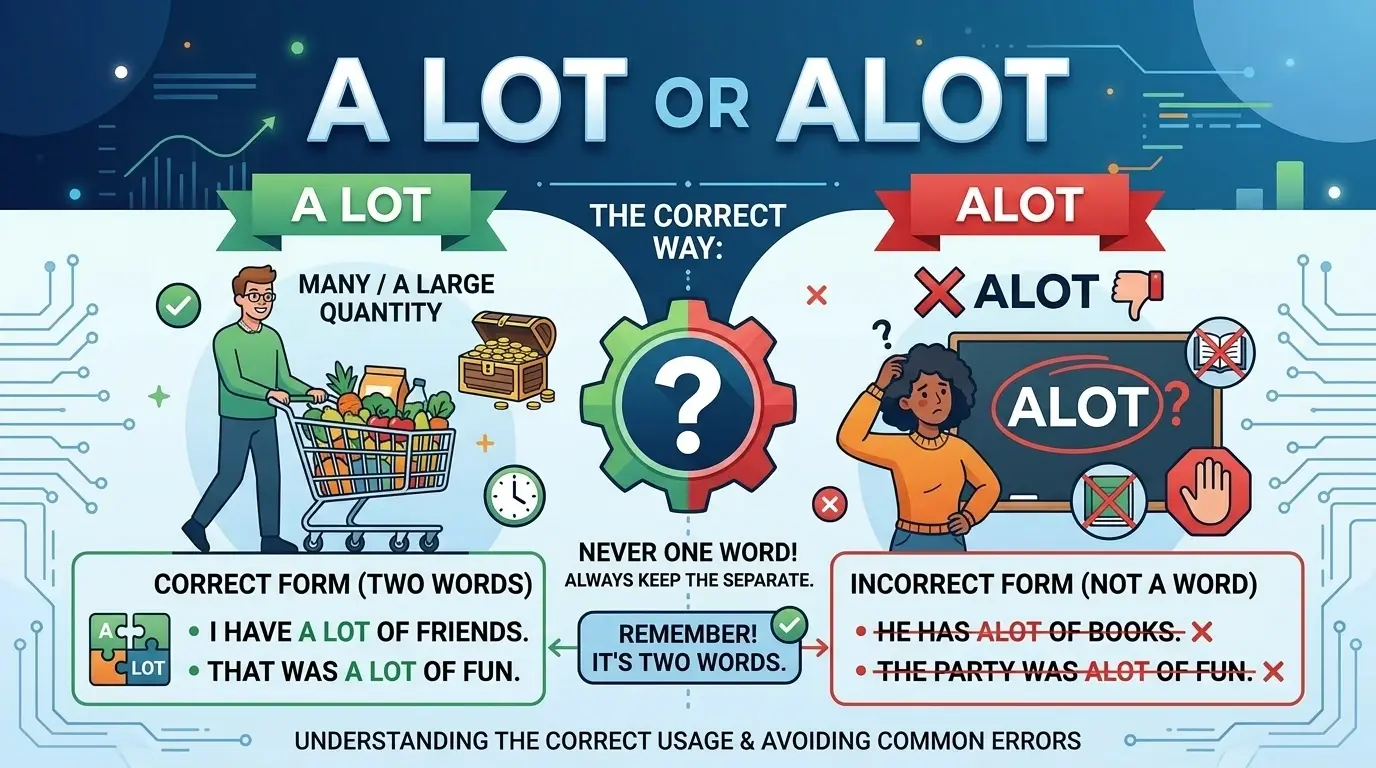
A lot is the correct spelling when you mean “many,” “much,” or “very often.” Alot is not the standard spelling of this phrase.
You may have typed alot and wondered if it should be one word. This confusion is common because English has words like already, another, and anyone that are written as single words.
However, a lot remains two separate words in standard English. Another confusing word is allot, which means to give, divide, or assign something.
So, should you write a lot or alot? The answer is simple: write a lot.
A Lot or Alot: Quick Answer
A lot is the correct spelling when you mean “a large amount,” “a large number,” “very much,” or “often.” Alot is a common misspelling and should not be used in standard English. Do not confuse a lot with allot, which is a verb meaning to assign or distribute something.
⚡ Quick Rule
Always write “a lot” as two words; “alot” is a common spelling mistake.
What Does “A Lot” Mean?
A lot means a large amount, a large number, very much, or often. It can describe quantity, degree, or frequency depending on the sentence.
For example:
- I have a lot of homework.
- She knows a lot about science.
- We visit our grandparents a lot.
- He spends a lot of money on books.
The meaning changes slightly based on how the phrase works in the sentence.
When a lot of comes before a noun, it usually refers to a large quantity or number.
There are a lot of students in the class.
Here, a lot of students means many students.
When a lot comes after a verb, it can mean “very much” or “often.”
I read a lot.
This means I read frequently or read a great deal.
Why Is “Alot” Incorrect?
Alot is incorrect when it is used as the one-word spelling of a lot. Standard English uses the two-word form a lot, not alot.
The mistake is understandable because a lot often works together as one expression.
People also see many English words that began as separate words and later became one word. This can make alot look reasonable.
However, standard spelling has not changed a lot into alot.
Compare these examples:
❌ I have alot of work today.
✅ I have a lot of work today.
❌ She talks alot.
✅ She talks a lot.
❌ We learned alot from the lesson.
✅ We learned a lot from the lesson.
The simple solution is to keep the space between a and lot.
A Lot vs Alot: What Is the Difference?
A lot refers to a large amount, number, degree, or frequency. Allot is a verb that means to give, assign, divide, or distribute something for a particular purpose.
These words can sound similar when spoken, but their meanings are different.
| Word | Meaning | Example |
| a lot | A large amount or number | We have a lot of work. |
| alot | Incorrect spelling | ❌ We have alot of work. |
| allot | To assign or distribute | We will allot ten minutes to each speaker. |
A Lot
Use a lot when talking about quantity, degree, or frequency.
She has a lot of books.
I exercise a lot.
Alot
Do not use alot as the spelling of a lot.
❌ I like this song alot.
Write:
✅ I like this song a lot.
Allot
Use allot when something is assigned or distributed.
The teacher will allot ten minutes to each student.
We need to allot enough money for the project.
A useful way to remember this difference is:
A lot = much or many.
Allot = assign or distribute.
Read More: Afterward or Afterwards? Which One Is Correct?How to Use “A Lot” in a Sentence
A lot can be used in several common sentence patterns. It often appears before a noun with of, or after a verb to express degree or frequency.
1. A Lot of + Noun
Use a lot of before a noun to describe a large amount or number.
Examples:
- I have a lot of work today.
- She bought a lot of books.
- We need a lot of water.
- There are a lot of people here.
- He has a lot of experience.
The phrase can work with both countable and uncountable nouns.
For example:
A lot of students joined the club.
“Students” is countable.
A lot of information was shared.
“Information” is uncountable.
2. A Lot After a Verb
A lot can also follow a verb.
In this use, it often means “very much” or “often.”
Examples:
- I travel a lot.
- She studies a lot.
- They laugh a lot.
- We talk a lot.
- He worries a lot.
The phrase usually appears toward the end of the sentence.
For example:
I enjoy reading a lot.
This sounds natural.
3. A Lot With Comparisons
You can use a lot to strengthen a comparison.
Examples:
- This book is a lot better.
- The new phone is a lot faster.
- She feels a lot happier now.
- This road is a lot longer.
- The second test was a lot easier.
Here, a lot adds emphasis to the comparison.
Is “A Lot” One Word or Two?
A lot is written as two words when it means a large amount, many, much, very much, or often.
The first word is a.
The second word is lot.
Together, they form the phrase:
a + lot = a lot
Do not combine them into alot.
Compare:
- a lot ✅
- alot ❌
The same idea can help you remember similar expressions:
- a little
- a few
- a lot
- a great deal
You would not normally write alittle when you mean “a little.”
Likewise, write a lot with a space.
A Lot in American and British English
A lot is used in both American English and British English. There is no standard US spelling of alot and UK spelling of a lot.
The correct spelling is a lot in both varieties.
For example:
American English
I have a lot of homework tonight.
British English
I have a lot of homework tonight.
The spelling does not change.
There can be differences in how formal a lot feels. In formal writing, alternatives such as many, much, a large number, or a great deal may sometimes sound more suitable.
For everyday communication, however, a lot is extremely common.
A Lot or Lots
A lot and lots can have similar meanings, especially when talking about quantity or frequency. Lots is generally more informal.
Compare:
We have a lot of homework.
We have lots of homework.
Both sentences mean that the amount of homework is large.
You can also say:
I travel a lot.
I travel lots.
The first version is more widely used.
For school, work, and general writing, a lot is a safe and familiar choice.
Is “A Lot” Formal or Informal?
A lot is common and natural, but it can sound informal in some formal writing situations.
For example, in casual writing:
I learned a lot from this course.
This sounds natural.
In a formal report, you might choose:
I learned a great deal from this course.
Or:
The study produced a large amount of useful information.
The best choice depends on the context.
You do not need to avoid a lot completely. Just consider whether a more precise or formal expression fits your writing better.
Common Mistakes With A Lot
Mistake 1: Writing “alot”
This is the most common spelling mistake.
❌ I have alot of homework.
✅ I have a lot of homework.
Mistake 2: Confusing “a lot” and “allot”
These words look similar but have different meanings.
❌ We will a lot ten minutes for each person.
✅ We will allot ten minutes for each person.
Here, allot means “assign.”
Mistake 3: Writing “a-lot”
Do not add a hyphen.
❌ I have a-lot of work.
✅ I have a lot of work.
The standard phrase does not need a hyphen.
Mistake 4: Using “a lot” when a precise word is better
Sometimes a lot is too general.
For example:
The company received a lot of applications.
This is understandable.
A more precise version could be:
The company received 2,000 applications.
When exact information is available, a specific number can make your writing clearer.
A Simple Memory Trick for “A Lot”
Think of a lot as two separate pieces:
A + LOT
You can also compare it with a little.
You write:
a little
So write:
a lot
Not:
alot
Another useful trick is to remember that allot has two Ls because it is a completely different word.
A lot = a large amount.
Allot = assign a share.
For example:
I have a lot of work.
I will allot two hours to the work.
The first describes quantity.
The second describes assigning time.
20 Example Sentences With “A Lot”
Here are natural examples showing how a lot works in different sentences.
- I have a lot of homework tonight.
- She reads a lot before going to bed.
- We spent a lot of time preparing for the meeting.
- There were a lot of people at the event.
- He knows a lot about computers.
- I learned a lot from that book.
- They have a lot of experience in this field.
- My brother plays football a lot.
- We need a lot of information before making a decision.
- She has changed a lot since last year.
- There is a lot of traffic on this road.
- I miss my family a lot.
- The new version is a lot faster.
- This exercise is a lot easier than the last one.
- He spends a lot of money on books.
- We have a lot to discuss today.
- She asks a lot of interesting questions.
- I visit that restaurant a lot.
- The project requires a lot of patience.
- You can learn a lot by practicing every day.
When Should You Use “A Lot”?
Use a lot when you want to express a large quantity, large number, strong degree, or frequent action.
Use a lot of before a noun:
We have a lot of work.
Use a lot after a verb when expressing degree or frequency:
I study a lot.
Use a lot with comparisons:
This one is a lot better.
If you mean “assign,” “give a share,” or “distribute,” use allot instead:
The manager will allot enough time for each task.
ALot vs A lot: Quick Comparison
| Form | Correct? | Meaning | Example |
| a lot | Yes | Much, many, very much, often | I like it a lot. |
| alot | No | Misspelling of “a lot” | ❌ I like it alot. |
| allot | Yes | Assign or distribute | We will allot enough time. |
This table gives you the entire rule at a glance.
If you mean many, much, very much, or often, choose a lot.
If you mean assign or distribute, choose allot.
Do not use alot as a standard English spelling.
FAQs
1.Is “alot” a word?
No. Alot is not the standard spelling when you mean “a lot.” Use a lot as two words.
2.Is “a lot” one word?
No. When it means a large amount, many, much, or very often, write a lot as two words.
3.Which is correct, a lot or alot?
A lot is correct. Alot is a common spelling mistake.
4.Is “a lot” grammatically correct?
Yes. A lot is grammatically correct and can describe quantity, degree, or frequency.
5.What does “a lot” mean?
A lot can mean a large amount, a large number, very much, or often, depending on the sentence.
6.What is the difference between a lot and allot?
A lot refers to a large amount, number, degree, or frequency. Allot is a verb meaning to assign or distribute something.
7.Can I use “a lot” in formal writing?
Yes, but it can sound informal in some formal contexts. Depending on the sentence, many, much, a large number, or a great deal may be more formal.
8.Is “a lot” the same in American and British English?
Yes. A lot is the standard spelling in both American and British English.
9.Is “lots” the same as “a lot”?
They can have similar meanings. Lots is generally more informal than a lot, especially when discussing quantity.
10.How can I remember the spelling of a lot?
Remember A + LOT. Keep the two words separate. If you mean “many,” “much,” or “very much,” write a lot, not alot.
Conclusion:
The correct spelling is a lot, not alot. Use a lot to mean a large amount, a large number, very much, or often.
Remember that a lot is written as two words in both American and British English.
Do not confuse it with allot, which is a separate verb meaning to assign or distribute something.
The easiest rule is simple: if you mean “many,” “much,” or “very much,” write a lot. Keep the space between a and lot.

I am an English language writer passionate about grammar and clear communication. I create simple, easy-to-understand content that helps readers improve their English skills. My goal is to make learning English both practical and enjoyable.