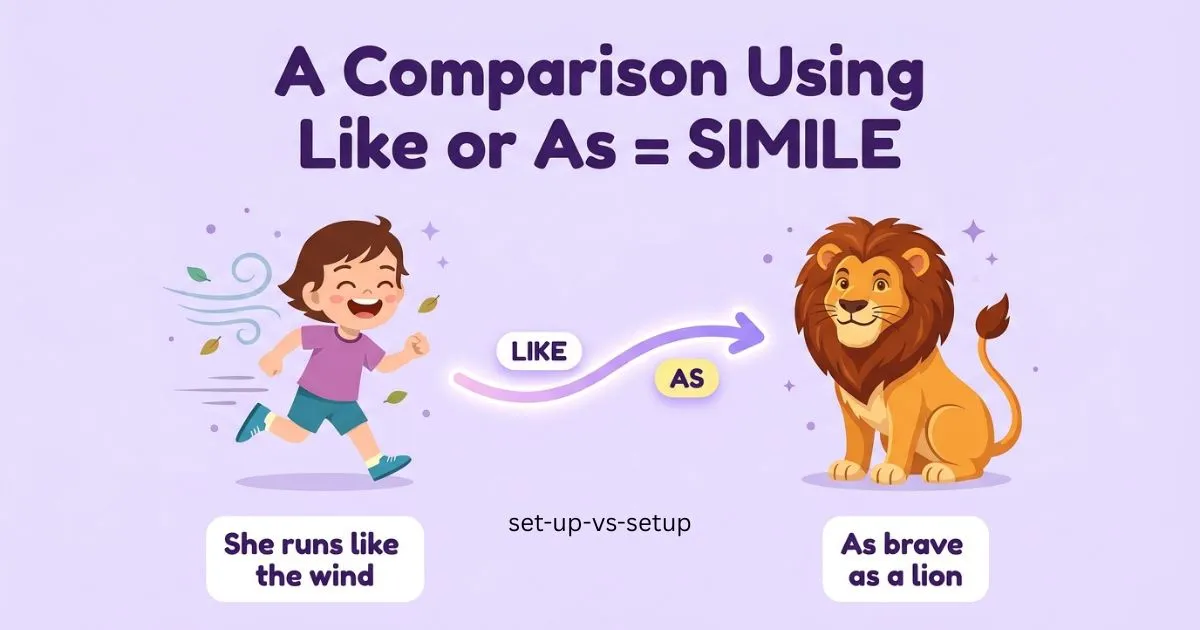
Someone says you are “as busy as a bee,” and you instantly know what they mean. Nobody checked a dictionary. The picture did all the work.
That is the power of a comparison using like or as. It has a name, a few simple grammar rules, and a couple of traps that confuse even confident writers.
In this guide, you will learn what the device is called, how like and as differ, and how to build fresh comparisons of your own.
You will also find examples, common mistakes, and a short practice set with answers.
What Is a Comparison Using Like or As Called?
It is called a simile (pronounced SIM-uh-lee). A simile compares two different things by using like or as to point out what they share.
Take this sentence: The lecture hall was as silent as a tomb. A lecture hall and a tomb are completely different places. The simile borrows one quality, silence, and moves it from one to the other.
A simile never says the two things are identical. It only says they are alike in one specific way. That is why it feels gentler and more flexible than other comparisons.
The Quick Rule
If a sentence compares two unlike things and uses like or as to do it, you are looking at a simile.
How a Simile Works
Every simile has three parts:
- The subject: what you are describing (the lecture hall).
- The comparison word: like or as.
- The image: something familiar that carries the quality (a tomb).
The reader does a small bit of mental work. They ask, “What do these two share?” The answer, silence here, is what you wanted them to feel.
Why Writers Use Similes
Similes turn abstract descriptions into pictures. “The wind was strong” tells you something. “The wind howled like an angry crowd” lets you hear it.
They also help explain unfamiliar ideas through familiar ones. Describing a new gadget as “light as a pencil” works better than quoting its weight to someone who has no feel for grams.
Finally, similes add personality. Two writers can describe the same rainy day, and the one with a sharp comparison is the one you remember.
Do Similes Have to Be Literally True?
No, and they usually are not. A person who “eats like a horse” does not eat hay. The phrase just means a big appetite. Exaggeration is part of the fun, and readers understand it instantly.
Read More: Company’s or Companies? Which One Should You Use?
Like vs. As: How to Choose the Right Word
This is where most learners get stuck. Both words can make comparisons, but they do not behave the same way. Once you see the pattern, the confusion mostly disappears.
Use Like Before a Noun or Pronoun
When the comparison word is followed by a noun or pronoun, use like.
- She looks like her aunt.
- It feels like velvet.
- There are plenty of people like us.
Like also pairs naturally with the senses: something looks, sounds, smells, tastes, or feels like something else.
- The kitchen smells like cinnamon.
- That noise sounds like a dripping tap.
Use As + Adjective + As to Match a Quality
This is the classic simile frame. The adjective sits between the two as words and names the shared quality.
- The tea was as cold as a winter morning.
- He is as stubborn as a mule.
The same pattern works for ordinary, non-figurative comparisons too. “My laptop is as expensive as hers” is a plain comparison, not a simile, because nothing figurative is happening. It is a fair reminder that the grammar and the literary device overlap but are not the same thing.
The Shortened Version
Many famous similes drop the first as: “clear as mud,” “good as gold.” People say them this way all the time. Both forms are fine, though the shorter one sounds more casual.
Use As If or As Though With a Full Clause
When you compare a real situation to an imagined one, use as if or as though, followed by a subject and verb.
- You look as if you ran all the way here.
- He spoke as though he owned the building.
Here the comparison is with a situation, not a single noun, which is why a clause is needed.
The Role Test: As vs. Like
There is another difference that has nothing to do with similes. As can describe a real job or function. Like describes resemblance.
- She worked as a nurse. (She really was a nurse.)
- She worked like a nurse. (She was not one, but she behaved similarly.)
One small word changes the meaning completely. If someone acts “as a boss,” they are the boss. If they act “like a boss,” they are imitating one.
The “The Way” Swap Test
Here is a quick trick for sentences where a verb follows the comparison word. Try replacing the word with “the way.”
- Nobody bakes bread ___ my grandfather does.
“Nobody bakes bread the way my grandfather does” sounds right, so the formal choice is as. In formal writing, as introduces a clause (a subject plus a verb), while like goes before a plain noun or pronoun.
In everyday speech, many people use like here anyway (“Like I said, I’m busy”). It is common and widely understood. For essays, exams, and professional writing, stick with as when a clause follows.
A Simple Decision Process
When you are unsure, ask three questions in order:
- Is a verb coming after the word? If yes, use as (or as if).
- Am I naming a job or function? If yes, use as.
- Is it just a noun or pronoun? Use like.
Quick Reference Table
| Situation | Word | Example |
| Noun or pronoun follows | like | He sings like a bird. |
| Matching a quality | as…as | She is as calm as a lake. |
| Imagined situation, clause follows | as if / as though | He acted as though nothing had happened. |
| Real job or role | as | He used the box as a table. |
| Verb follows (formal) | as | Do it as I showed you. |
Not Every Like or As Is a Simile
Look at these sentences:
- I like cold coffee. (a preference, not a comparison)
- She works as an editor. (a job)
- He plays like a professional. (a comparison, so a simile)
The words alone do not make a simile. You need a comparison between two different things.
Simile Examples Using Like
Here are fresh examples with their meanings:
| Simile | What It Means |
| The rumor spread like spilled paint. | It moved fast and was hard to undo. |
| She moved through the crowd like a needle through cloth. | She slipped through smoothly. |
| My phone dies like a candle in the wind. | The battery drains quickly. |
| He stared at the exam like it was written in code. | He understood nothing. |
| The kids scattered like marbles on a floor. | They ran in every direction. |
| Her laughter rang like a small bell. | Her laugh was bright and clear. |
Some “like” similes have become everyday expressions: sleep like a log, work like a dog, fit like a glove, fight like cats and dogs. They are useful to recognize, but because everyone uses them, they rarely make writing feel original.
Simile Examples Using As
| Simile | What It Means |
| as steady as a clock | very reliable |
| as slippery as soap | hard to hold or catch |
| as bright as a new coin | shiny and fresh |
| as tangled as headphone wires | very confusing |
| as calm as a sleeping cat | totally relaxed |
| as thin as a sheet of paper | very slim |
Classic “as” expressions you will hear often: as light as a feather, as busy as a bee, as cool as a cucumber, as free as a bird, as sharp as a razor. Many of them include an animal or everyday object because those images are instantly clear.
Similes in Sentences
- During the storm, the old bridge shook like a leaf on a branch.
- Her handwriting is as neat as a printed page.
- The new employee looked as if she had walked into the wrong building.
- After the final exam, the corridor felt as quiet as an empty church.
Types of Similes
You do not need to memorize categories, but knowing them helps you spot similes in books and poems.
Direct Similes
These use like or as openly. Most of what you have seen so far belongs here: “She sings like a radio.”
Extended Similes
An extended simile keeps the comparison going across several lines. For example: Her mind was like a crowded train station: people rushing in, announcements echoing, and nobody sure which platform to choose. Writers use these to build atmosphere.
Personification Similes
These give human behavior to things. The old fridge groaned like a tired traveler. The fridge cannot groan, but the comparison makes the sound feel alive.
Expressive Similes
Some similes are about feelings rather than objects. I felt as light as a balloon after the good news. They put emotion into a picture.
Simile vs. Metaphor vs. Analogy
These three are close relatives, so they are easy to mix up.
Simile vs. Metaphor
A simile says one thing is like another. A metaphor says one thing is another.
| Simile | Metaphor |
| Her mood was like a storm. | Her mood was a storm. |
| The city is like a beehive. | The city is a beehive. |
| His words were like arrows. | His words were arrows. |
The simile keeps a little distance. The metaphor commits fully. Neither is “better.” Pick the one that suits the tone you want.
Simile vs. Analogy
An analogy goes further. Instead of a quick image, it explains how two things are similar in order to clarify an idea.
- Simile: Learning to drive is like riding a wave.
- Analogy: Learning to drive is like riding a wave. At first you wobble, but once you find the balance, you stop thinking about each movement.
A simile hits fast and creates a feeling. An analogy teaches.
How to Write a Strong Simile
Writing a simile is easy. Writing a good one takes a little thought. Try these steps.
Step 1: Pick One Quality
Decide what you actually want to say. Is it speed? Silence? Clumsiness? A simile works best when it carries one clear quality.
Step 2: Find a Familiar Image
Think of something your reader already knows that has that quality strongly. If your quality is “messy,” a teenager’s bedroom beats a “disorganized warehouse.”
Step 3: Connect and Test
Join the two with like or as. Then ask: would a stranger understand this immediately?
Step 4: Add a Sensory Detail
The strongest similes appeal to sight, sound, touch, smell, or taste. Compare these:
- Her laugh was like sunshine. (fine, but familiar)
- Her laugh was like warm bread breaking open. (more specific and sensory)
Step 5: Avoid Clichés When You Can
Phrases like “cold as ice” are easy to understand but have lost their spark from overuse. Use them in casual speech if you like. In creative writing, try to invent your own.
A Worked Example
- Subject: a slow internet connection
- Quality: painfully slow
- Image: something known for slowness
- Simile: The page loaded like a tortoise climbing a hill.
You can refine it further. How about The page loaded like honey off a cold spoon? That adds touch and visual detail.
Common Mistakes With Similes
Mistake 1: Mixing the Patterns
Wrong: She is as clever like her sister.
Right: She is as clever as her sister.
Pick one frame and stay with it.
Mistake 2: Choosing Like Before a Clause in Formal Writing
Wrong (formal): The project went like we planned.
Right: The project went as we planned.
Mistake 3: Comparing Things With No Clear Link
Wrong: He ran like a whisper. What do running and a whisper share? Readers have to guess.
Better: He ran like a deer.
Mistake 4: Overusing Clichés
If every comparison is something readers have seen a thousand times, they stop paying attention. Keep a few for rhythm, and invent the rest.
Mistake 5: Stacking Too Many
One strong simile in a paragraph is memorable. Four in a row blur together and confuse the picture.
Mistake 6: Calling Every Like or As a Simile
Remember the earlier test: “I like tea” and “She works as a pilot” contain the words but not the device.
Mistake 7: Reading Similes Too Literally
If you hear “He’s as quiet as a mouse,” you are not being told he is small, grey, or squeaky. Only the shared quality matters.
Practice Exercises (With Answers)
Fill in the blank with like, as, or as if:
- She looks ___ her grandmother.
- He worked ___ a driver for two years.
- The soup was ___ hot ___ lava.
- Nobody cooks rice ___ my mother does.
- You look ___ you have seen a ghost.
- Her voice is ___ honey.
Spot the simile: Which sentence contains one?
A) I like mangoes.
B) He is as stubborn as a mule.
C) She works as a teacher.
Answers:
- like
- as
- as…as
- as (the verb “does” follows)
- as if
- like
- B is the simile. A is a preference and C is a job.
FAQs
1. What is a comparison using like or as called?
It is called a simile. A simile is a figure of speech that compares two different things by using like or as to highlight one shared quality. “He is as quick as lightning” and “she dances like a flame” are both similes.
2. What is the difference between a simile and a metaphor?
A simile uses like or as to say one thing resembles another. A metaphor states that one thing is another. “Her smile is like sunshine” is a simile. “Her smile is sunshine” is a metaphor.
3. Can I use like and as in the same simile?
Not in the same comparison frame. Choose one pattern. Use like before a noun (“runs like a deer”) or as…as with an adjective (“as fast as a deer”). Mixing them, as in “as fast like a deer,” is incorrect.
4. When should I use “as” instead of “like”?
Use as when you name a role (“worked as a guide”), in the as…as pattern, with as if/as though, and before a clause in formal writing. Use like before a plain noun or pronoun.
5. Is “as brave as a lion” a simile?
Yes. It compares a person’s courage with a lion’s using the as…as pattern. Because phrases like this are used so often, they are also called idioms or clichés, but they are still similes.
6. Is every sentence with “like” or “as” a simile?
No. “I like swimming” shows a preference and “she works as a chef” names a job. A simile only exists when two different things are being compared. Look for the comparison, not just the word.
7. How do I write my own simile?
Choose one quality, find a familiar image that has it strongly, and connect them with like or as. Then test whether a stranger would understand it. Adding a sensory detail makes the comparison feel fresh.
Conclusion:
A comparison using like or as is a simile, and it is one of the simplest ways to make writing and speech more vivid.
Use like before a noun or pronoun, use as…as to match a quality, use as if for imagined situations, and use as to name a role.
Your next step is easy: pick one ordinary object near you and write three similes for it, one with like, one with as…as, and one with as if.
Then check whether a stranger would understand each one instantly. Do this a few times a week and strong comparisons will start showing up in your writing without effort.

As an American English writer, I specialize in creating clear and engaging content that makes grammar and language learning accessible to everyone. I enjoy breaking down complex English concepts into simple, practical lessons that readers can apply with confidence. My mission is to help learners strengthen their communication skills through easy and reliable content.


1 thought on “A Comparison Using Like or As? Simile Rules & Examples”