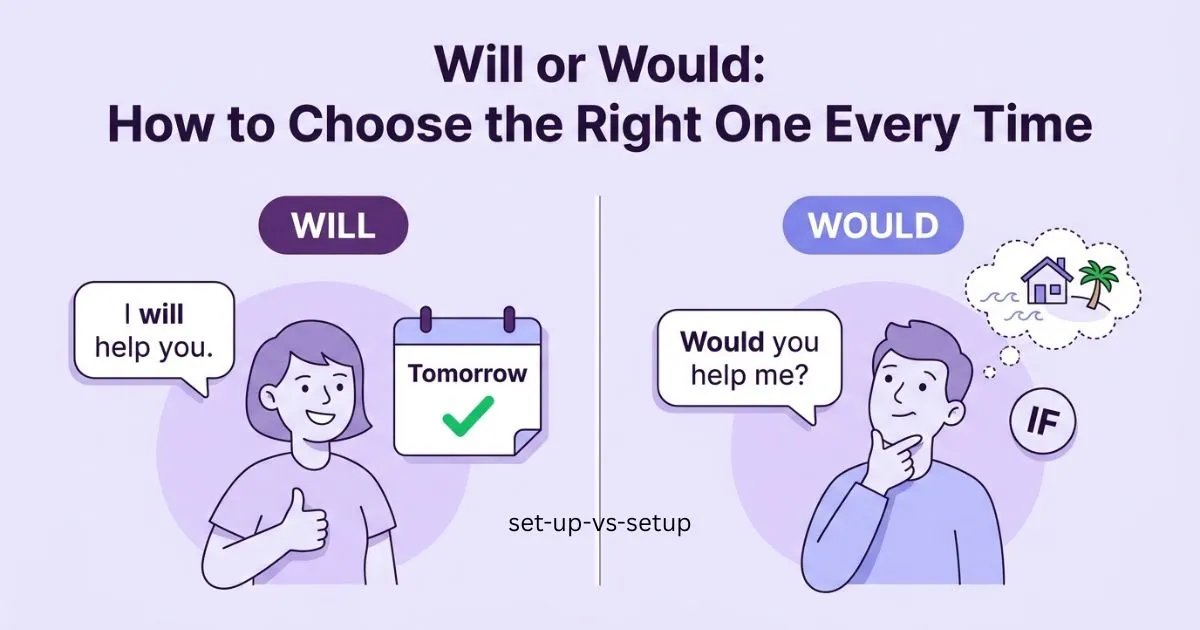
You tell a friend, “I will help you tomorrow,” and it sounds like a promise. Then you say, “I would help you if I had time,” and the meaning changes completely. Same word family, very different message.
That is why will or would trips up so many learners, and plenty of native speakers too. The two words overlap, but they signal different things: certainty or imagination, directness or politeness, the present or the past.
In this guide you will get clear rules, side-by-side examples, a polite-request cheat sheet, conditional and reported-speech patterns, common mistakes, and a short quiz.
By the end, you will know which word to pick and why.
The Quick Answer
Use will when you are talking about something you believe, decide, promise or offer, and you treat it as real.
Use would when you are imagining something, being polite, describing the past, or looking at the future from a past moment.
- I will call you tonight. (a real plan)
- I would call you if I had your number. (an imagined situation)
Both are modal verbs, so they never change form. They take the same ending with every subject (I would, she would, they would), and the main verb that follows stays in its base form.
What “Will” Does
Think of will as the “this is real” word. It covers more than just the future.
Beliefs About the Present or Future
Will shows what you believe or expect. That belief can be about right now, not only tomorrow.
- John will be in his office. (a belief about the present)
- We will be late. (a belief about the future)
- It will rain this evening. (a prediction)
A prediction is a belief, not a guarantee. You are saying “I expect this.”
Quick Decisions
When you decide something at the moment of speaking, use will.
- The doorbell is ringing. I’ll get it.
- I’m starving. I’ll make some toast.
- What would you like? I’ll have the pasta.
Promises and Offers
Will sounds direct and committed, which is exactly what a promise needs.
- I will never share your secret.
- We’ll come and see you next week.
- I’ll carry that for you.
Willingness and Typical Behaviour
Will can also describe what people are willing to do, or what they habitually do.
- Maybe Dad will lend me the car.
- Every summer we stay at the same hotel. We’ll get up early, grab breakfast and head straight to the beach.
That last use is for habits you describe in the present. Keep it in mind, because would has a past twin for it.
Read More: Accept vs Except: How to Choose the Right Word Fast
What “Would” Does
Would is the past form of will, but it has grown many extra jobs. Learn them as separate uses and it becomes much easier.
Imagined Situations
Use would for things that are not real right now.
- I would travel more if I had the money.
- It would be expensive to stay in a hotel.
Using would creates distance between what is real and what you are imagining. The speaker is exploring a possibility without claiming it will happen.
Politeness
Would softens a sentence. That is why it dominates requests, offers and invitations.
- Would you mind closing the window?
- Would you like another cup of tea?
- I’d like the fish, please.
Compare “I will have the fish” with “I would like the fish, please.” The second one sounds like a customer who knows the social rules.
Soft Opinions and Advice
When you are not fully sure, or you want to sound gentle, would works well.
- I would think that’s the right answer.
- I’d guess it’s about an hour away.
- The best way to get there would be to take the train.
- Eight o’clock would be a good time to meet.
Past Habits
Would can describe things you did repeatedly in the past, much like used to.
- When we were kids, we would play outside until dark.
- My grandfather would tell us a story every night.
This use belongs to memories and storytelling. For a one-time action, use the simple past: Yesterday I visited my friend, not Yesterday I would visit my friend.
The Future Seen From the Past
When you report what someone expected or said earlier, would is the natural choice.
- I knew she would come.
- He thought it would rain.
The event was in the future at that earlier moment, so would takes over from will.
Refusals and Annoying Behaviour
This is a use many lessons skip. In the past, wouldn’t often means “refused” or “wasn’t willing.”
- I asked him twice, but he wouldn’t listen.
- The baby wouldn’t go to sleep.
We even give this “refusal” to machines that misbehave: My car wouldn’t start this morning. And would can describe typical, irritating behaviour: Typical! It would rain just when I have to leave.
Set Phrases You Should Know
These come up constantly in daily English:
- would you…? and would you mind + -ing for requests
- would you like…? for offers and invitations
- I’d like… for what you want
- I’d rather… for what you prefer
Will vs Would: Side-by-Side Comparison
Here is the whole topic in one place. Notice how the same situation changes meaning when you swap the word.
| Situation | Will | Would |
| Plan | I will call you tonight. | I would call you if I could. |
| Decision | I’ll take the blue one. | I’d take the blue one, but it’s too pricey. |
| Prediction | It will be a great trip. | I thought it would be a great trip. |
| Request | Will you open the door? | Would you open the door? |
| Offer | I’ll carry your bag. | Would you like me to carry your bag? |
| Condition | If you ask, she will help. | If you asked, she would help. |
| Habit | We’ll head to the beach each morning. (present) | We would head to the beach each morning. (past) |
| Reported speech | He says he will come. | He said he would come. |
| Preference | not used this way | I’d rather stay home. |
Two patterns stand out. Will stays anchored in reality and the present moment. Would moves away from reality, away from bluntness, or backward in time.
A Simple Test When You Are Stuck
Ask yourself three quick questions:
- Is this real and decided? Choose will.
- Is this imagined, conditional or “if”? Choose would.
- Am I describing the past or being extra polite? Choose would.
Will or Would in If-Sentences
Conditionals are where most mix-ups happen. The rule is simple: the “if” part sets the mood, and the result part follows it.
First Conditional: Real Possibilities
Use will for results that are realistic.
If + present simple, will + base verb
- If I study tonight, I will pass the test.
- If it rains, we will stay inside.
Second Conditional: Unreal or Unlikely
Use would for imagined situations in the present or future.
If + past simple, would + base verb
- If I were rich, I would buy a big house.
- If we lived near the sea, we would swim every day.
The past tense here does not mean past time. It signals “this is imaginary.”
Third Conditional: Unreal Past
Use would have for results that never happened.
If + past perfect, would have + past participle
- If I had left earlier, I would have caught the train.
- Charlie would have become a doctor if he could have afforded medical school.
Don’t Put “Will” in the Time or If Clause
This is one of the most common errors. After words like when, after, until and if, English uses the present tense even for future meaning.
- Wrong: I will come home after I will finish my exam.
- Right: I will come home after I finish my exam.
- Wrong: We won’t ride our bikes if it will rain.
- Right: We won’t ride our bikes if it rains.
Only the main result gets will. The clause that sets the condition stays in the present.
Giving Advice With Conditionals
Both forms work for advice, but they feel different.
- Dan will help you if you ask him.
- Dan would help you if you asked him.
The second one is gentler. It sounds like a suggestion rather than a guarantee, and it takes the pressure off Dan.
Which Is More Polite: Will You or Would You?
Both are grammatically correct when asking someone to do something. Tone is the difference.
| More direct | More polite |
| Will you send me the report? | Would you send me the report? |
| Will you wait here? | Would you wait here? |
Will you…? can sound like you expect a yes. In the wrong tone, it can come across as impatient. Would you…? leaves room for the other person to say no, which is why it feels respectful.
Making It Even Softer
Add please, or use would you mind. After would you mind, the next verb ends in -ing.
- Right: Would you mind opening the window?
- Wrong: Would you mind to open the window?
In offers, stick with would you like: Would you like to join us?
Will or Would in Reported Speech
When you report what someone said earlier, will usually shifts to would. This shift is often called backshift.
| What they said | How you report it |
| “I will come.” | He said he would come. |
| “We will arrive early.” | They said they would arrive early. |
| “I will call you.” | Tom said he would call me. |
The logic is simple. The original speaker was looking forward from their moment. You are looking back at that moment, so the verb steps back too.
The shift is not always required. If the statement is still true or still upcoming, will can stay: She says she will join us tomorrow.
Choosing Based on How Likely You Think It Is
Here is a practical angle that most grammar pages never spell out. In many “real life” sentences, both words are possible, and your choice shows how likely you think something is.
- A draw will be a better result for City than for Liverpool. (You think a draw is likely.)
- A draw would be a better result for City than for Liverpool. (You think it is unlikely, or you are just speculating.)
Another example:
- Applicants will have to be fit. (The hiring is happening.)
- Applicants would have to be fit. (The hiring is uncertain or hypothetical.)
The same logic explains will be vs would be. Use will be for something you treat as certain. Use would be when you are speculating.
So when both feel correct, ask: “Do I believe this is likely?” If yes, lean to will. If you are guessing or imagining, lean to would.
Sound More Natural: Contractions and Negatives
In everyday speech, will shrinks to ‘ll and would to ‘d.
- I will wait. becomes I’ll wait.
- She would help. becomes She’d help.
The full word will is usually stressed only for emphasis: I WILL win this game!
For negatives, use these short forms:
- will not becomes won’t
- would not becomes wouldn’t
Use the full forms in formal writing, and the short forms in conversation and informal messages.
Common Mistakes (and Quick Fixes)
1. Using will for an imagined result.
- Wrong: If I were rich, I will buy a mansion.
- Right: If I were rich, I would buy a mansion.
2. Using would when you mean a firm promise.
- Weak: I would help you tomorrow.
- Better: I will help you tomorrow.
3. Adding to or an -s after would.
- Wrong: She would goes to school.
- Right: She would go to school.
4. Stacking two modals.
- Wrong: I would will help you.
- Right: I would help you.
5. Using will inside a time or if clause.
- Wrong: Call me when you will arrive.
- Right: Call me when you arrive.
6. Using would for a single finished past action.
- Wrong: Last night I would visit my friend.
- Right: Last night I visited my friend.
7. Forgetting have in unreal past situations.
- Wrong: If I had known, I would help you.
- Right: If I had known, I would have helped you.
Quick Practice: Test Yourself
Choose will or would. Answers are below.
- The phone is ringing. I ___ answer it.
- If I had more time, I ___ learn the guitar.
- ___ you mind waiting outside?
- She said she ___ call me back.
- When I was a child, we ___ visit my aunt every Sunday.
- If it rains tomorrow, we ___ stay home.
Answers: 1. will (quick decision). 2. would (imagined). 3. Would (polite request). 4. would (reported speech). 5. would (past habit). 6. will (real possibility).
If you got five or six right, you have the core. If you missed some, re-read the section for that use and try again in a day.
FAQs
1. What is the difference between will and would?
Will expresses beliefs, decisions, promises and offers about real situations. Would expresses imagined situations, polite requests, past habits and the future seen from the past. Context and tone decide which one fits.
2. Is would the past tense of will?
Yes, would is the past form of will, and it appears in reported speech and past habits. But it also works in the present and future for imagined situations and polite language, so it is more than just a past tense.
3. Is would more polite than will?
Generally, yes. Would you help me? sounds softer and less direct than Will you help me? Both are grammatically correct, but would gives the other person more room to say no.
4. Can I use would for the future?
Yes. Would can refer to the future from a past viewpoint (She said she would visit tomorrow) or to an imagined future situation (I would go if I had time).
5. What is the difference between “would” and “used to” for past habits?
Both describe repeated past actions, and would is common in storytelling. A simple way to remember it: would paints repeated actions in memories, while used to is the safer choice when you simply want to say that something was true in the past.
6. Should I use “will be” or “would be”?
Use will be when you treat something as certain, and would be when you are speculating or imagining. The train will be late states an expectation. The train would be late in winter describes a typical or hypothetical pattern.
7. Can will and would appear in the same sentence?
Yes, when they do different jobs. For example: I will help you if you would like me to. Here will makes the offer, and would softens the condition into something polite.
Conclusion:
Choosing between will or would gets easy once you stop treating them as two versions of one word.
Will handles real beliefs, quick decisions, promises and offers. Would handles imagined situations, politeness, past habits, reported speech and soft opinions.
When you are unsure, run the three-question test: Is it real and decided? Is it imagined or conditional? Is it past or extra polite? Your answer will point to the right word almost every time.
Your next step: write three sentences about your own week using will for real plans, then rewrite each one with would and an “if” to imagine a different situation.
That small exercise locks the difference in far better than memorising rules.

I am an English language writer passionate about grammar and clear communication. I create simple, easy-to-understand content that helps readers improve their English skills. My goal is to make learning English both practical and enjoyable.

2 thoughts on “Will or Would: How to Choose the Right One Every Time”